Animals rarely fear human beings because we look dangerous. On the contrary, our bodies are objectively fragile by wildlife standards. We have easily torn skin, no claws, unimpressive teeth, and we cannot outrun, out-climb, or overpower most wild animals. A horse is faster, a buffalo is stronger, and even a medium-sized chimpanzee has more powerful pulling muscles.
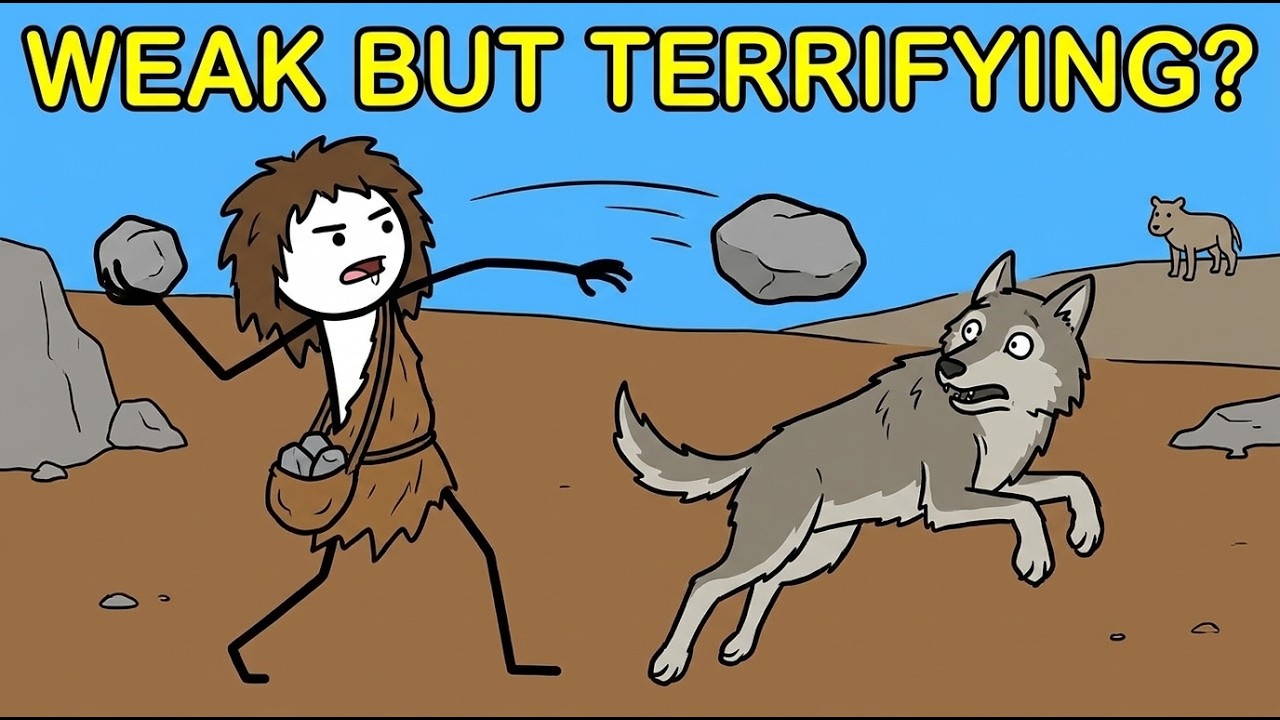
Placed naked and unarmed beside a large wild animal, a human would appear to be a catastrophic error rather than an apex predator. Yet across much of the world, wild animals flee from human presence as if it were the greatest threat they know. In some modern African experiments, researchers played recorded sounds near water holes. Mammals were substantially more likely to retreat from ordinary human conversation than from lion vocalizations.
Elephants, giraffes, leopards, hyenas and antelope responded to calm human speech as though an evacuation order had been issued. The voice did not need to roar. It only needed to be human. This fear is neither universal nor instinctive.
Urban pigeons tolerate humans with the indifference of rent collectors. Animals in protected areas can habituate to people. Island species that evolved without terrestrial predators have sometimes approached human newcomers with disastrous curiosity. Animals were not born knowing that soft-bodied humans carried dangerous intentions.
They learned, and what they learned was more unsettling than mere strength. To understand this fear, consider the first encounter from the animal’s point of view. A herd spots several upright apes at the edge of open ground. The apes are thin, noisy, and graceless.
They lack fangs and claws. Their young remain helpless for so long that the species appears to be developmentally delayed. The herd runs, and the problem is solved. Almost every prey animal is built around this calculation.
A predator must spend energy to chase and risks injury in a fight. A gazelle does not need to kill the lion; it only needs to make pursuit unprofitable. Once enough distance opens, the lion stops because it cannot buy meat with optimism. But the upright ape does not stop.
It is slower, yet it does not disappear. The herd runs again. The ape follows the tracks. This introduces the first human advantage: not speed, but refusal.
Humans are unusually capable endurance movers. Upright walking is efficient over distance. Long legs cover ground, spring-like tendons store energy, and a large gluteus maximus stabilizes the trunk while running. Most mammals cool themselves by panting, which competes with the mechanics of hard movement.
Humans sweat across a mostly hairless skin surface, allowing heat to be shed through evaporation while still moving. Under hot, open conditions, a trained hunter can persistently track and pursue an animal forced to alternate between sprinting and cooling. Eventually, the faster body overheats and the slower body arrives. This persistence hunting is well documented in ethnographic and historical records, though it was not the only hunting strategy.
In dense vegetation, cool climates, or varied terrain, humans also ambushed, surrounded, trapped, scavenged, drove animals into hazards, and used weapons. But the principle exposed a fundamental problem for prey: human weakness did not behave normally. A lion reveals its limits during pursuit. A human changes the type of contest entirely.
Endurance alone was not enough, however. A tired large animal remained large. Humans therefore moved danger outside the body. A sharpened stick is a detachable tooth.
Human hands could grip, shape, and combine materials. Stone cut wood, wood carried a stone point, fiber bound the pieces, resin glued them, and fire hardened the tip. Each component was ordinary, but together they created an anatomical feature that no gene had to grow. Wood preserves poorly, making the first hunting weapons difficult to date.
But ancient wooden spears and throwing sticks show that earlier human relatives manufactured carefully designed equipment hundreds of thousands of years ago. Stone points and impact damage reveal even more complex systems, although archaeologists continue to debate when specific projectile technologies appeared and how they were used. The transformation was more important than the dates. A predator’s body normally tells prey how close danger must be.
Claws and teeth require contact. A thrown spear changes the safe distance. The animal can remain stronger than the human and still bleed from a wound delivered before strength becomes relevant. Later spear throwers and bows extended that distance even further.
This helps explain why the human upper body was deceptively weak. Our shoulder orientation, mobile waist, arm structure, and ability to coordinate rapid rotation allow unusually effective throwing. A chimpanzee can overpower a person at close range, but it cannot throw a fast, accurate projectile with the same control. Humans took a fight they were poorly equipped to win and moved it several meters away.
Then they moved it into the future. An animal sees only the hunter present at the encounter. It does not see the person who shaped the point yesterday, the elder who taught the route, the tracker reading prints, or the group waiting beyond the ridge. Human predation extended through other humans.
Many carnivores hunt socially, including wolves and lions. But human cooperation was unusually flexible. People assigned different roles before the animal appeared. Some drove prey while others waited in ambush.
Some blocked escape routes while others guarded dangerous approaches. Groups used gestures, calls, shared expectations, and detailed knowledge of terrain to coordinate individuals who could not always see one another. The animal was not escaping bodies. It was escaping positions.
This made the landscape itself suspicious. A narrow pass could contain waiting spears. A cliff could become a tool if a herd was driven toward it. Mud, deep snow, water, fences, pits, nets, and fire removed an animal’s advantages.
Humans practiced disadvantage hunting. Instead of confronting prey where it was strongest, they arranged situations where speed, mass, or aggression stopped helping. A mammoth in open ground was an enormous problem. A mammoth trapped in soft earth was an enormous resource.
Most predators approach with visible intention. A cat crouches. A wolf pack advances. Humans might walk away, circle downwind, return at night, burn vegetation, or spend days constructing an object that did nothing until an animal stepped on the wrong place.
A snare is human intention left alone in the forest. A pit is a hunter that does not breathe. A sharpened stake remains dangerous after its maker has gone home. For prey, this broke a basic rule: monitor the predator and monitor the risk.
With humans, the predator could leave while the risk remained. Fire expanded the problem again. Humans did not create fire, but controlling it turned an environmental force into portable behavior. Flames offered warmth, cooking, protection, light, and a way to alter vegetation.
Smoke could flush animals, and carefully used fire could shape habitats, encourage new growth, and influence where game moved. At night, a human camp became deeply unnatural. Most primates are limited by darkness. Humans carried a piece of daylight into it.
A solitary human remained vulnerable, and people were certainly killed and eaten by predators. Large cats, hyenas, crocodiles, snakes, and other predators took human lives. Early hominins may sometimes have been prey, scavengers, competitors, and hunters within the same landscape. We evolved while looking over our shoulders, and that may have helped make us more dangerous.
Living among powerful carnivores rewarded vigilance, group defense, weapon use, and the ability to read tracks and intentions. Fear does not require believing the human is unbeatable. It requires deciding that the cost of checking is too high. Animals constantly make these decisions.
Fleeing wastes energy and feeding time. Staying risks death. Natural selection favors a response sensitive enough to avoid real threats, but not so nervous that an animal spends its life escaping weather and leaves. Humans pushed that calculation toward early flight because our danger was difficult to estimate.
A lion is usually hunting when it hunts. A human may appear to be walking. The same person can be harmless, dangerous, or interested in an entirely different species. Clothing changes the outline.
Tools change the range. Group size changes the risk. Wind can conceal scent. Uncertainty itself becomes frightening.
If an animal waits to identify the weapon, it may be using its final seconds for equipment appraisal. The safest rule becomes simple: leave when humans are still far away. This response develops in several ways. An individual animal may survive an encounter and learn.
Young animals watch mothers and herd members react. Social species transmit information through alarm calls, movement, or simple copying. Over generations, human-sensitive behavior may be favored genetically if cautious animals survive more often than bold ones. This is why animals in different places react so differently.
Where humans walk frequently without harming wildlife, animals may habituate. Urban birds learn that most pedestrians are scenery with snacks. In protected areas, mammals may tolerate vehicles at predictable distances. Where humans hunt, tolerance becomes expensive.
Studies comparing wildlife populations often find that hunting encourages earlier escape, while non-lethal exposure produces habituation. Sometimes the model fails. Animals on remote islands evolved without humans or similar land predators. Many showed little fear when people first arrived.
Flightless birds nested on the ground. Giant tortoises could be collected. Their lack of fear was not stupidity. Fear is costly, and if a threat has never existed, selection cannot reward an accurate response to it.
This prey naivete proves that animals did not always fear us automatically. Humans had to earn the reputation, and in many newly colonized environments, that reputation arrived too late for some species. Human hunting contributed to extinctions and population collapses, often interacting with climate change, habitat alteration, introduced predators, and other pressures. The exact causes differ by region and remain debated for many prehistoric extinctions, but the broad pattern is difficult to ignore.
Where humans expanded, large animals often encountered a predator with no established ecological contract. Ordinary predators are constrained by prey abundance and tend to capture vulnerable young, old, injured, or slow individuals. Humans can break both patterns. We often target large, healthy adults because they provide more meat, hides, bone, or status.
Technology reduces the cost of selecting difficult prey. Food storage allows temporary surplus. Sharing spreads the reward. Agriculture later supported human populations that continued removing wild animals even after they became scarce.
Modern research describes humans as a super predator partly because we exploit many species, kill at unusually high rates, and often target reproductively valuable adults. This matters because a prey population may replace young losses more easily than repeated losses of breeding adults. Ancient humans were not modern industrial hunters, however. They had small populations, variable technology, and frequent failure.
Hunting dangerous game produced injuries visible in the skeletal record. People starved, and predators stole kills. Knowledge accumulated culturally. A genetic adaptation spreads through reproduction across many generations.
A useful hunting method can spread after one demonstration. A new point design, trapping technique, animal call, or seasonal observation can be copied, modified, and taught. This allowed the human predator to improve during a single animal’s lifetime. A deer population might adapt genetically to wolves over many generations, but the humans encountered next year could carry a weapon their grandparents never possessed.
Biological evolution faced cultural evolution, and culture moved faster. Language magnified this advantage. Humans could communicate about things not currently visible: a herd beyond the hill, a wounded animal moving north, a water hole used last season. Other animals communicate sophisticated information, but human language allowed unusually detailed planning and teaching.
A person could benefit from an encounter they never witnessed. When a lion fails, the lion becomes hungry. When a human fails, the human may return with notes. Memory extended across generations.
Elders knew migration routes, breeding seasons, watering places, and animal behavior. Children practiced tracking before they were strong enough to hunt. Stories preserved warnings. Skills became traditions, and traditions became toolkits adapted to local prey.
Arctic hunters, tropical forest foragers, desert trackers, coastal peoples, and grassland hunters solved entirely different problems. Humans did not dominate because one body fit every ecosystem. We dominated because culture allowed the same basic body to acquire new behavior without waiting for new anatomy. Animals did not fear humans despite our weak bodies.
They feared us partly because the weakness was misleading. Hands sacrificed the stability of hooves and the lethality of claws for a precision grip. Upright posture freed those hands and raised the visual field. Shoulders and waist supported throwing.
Sweating supported endurance. Large brains consumed enormous energy but enabled planning, learning, and social coordination. A tiger is born carrying most of its equipment. A human child is born carrying almost none of it and spends years learning the local ways.
Human technology is part of the extended human phenotype, effects produced by bodies that reach beyond skin. Judging a human without tools is therefore like judging a spider after removing the web. Animals do not fear philosophical definitions. They fear patterns.
Footsteps near a trail, smoke on the wind, voices after dark, the sudden silence of other animals, an upright outline on a ridge. Each signal may have been followed often enough by pursuit, injury, habitat change, or death. The individuals that reacted early survived. The herds that copied them moved.
The populations unable to adjust declined. Eventually, the human voice itself became a weapon without being used as one. Even this result needs caution. The playback experiments do not prove that a mammoth feared human conversation 40,000 years ago.
Responses vary with hunting pressure, habitat, previous exposure, protection, hunger, season, and context. A starving predator may approach. A habituated animal may ignore us. A mother defending young may attack.
Fear is a calculation, not worship, and humans still lose that calculation. Crocodiles take people near water. Big cats ambush. Elephants charge.
Bears learn to associate us with food. Our reputation never made our skin thicker. It made encounters happen less often. Killing is dangerous, and a predator benefits when prey begins fleeing before combat.
Once wildlife treats humans as high risk, people gain access to space, carcasses, water, and roots without fighting every competitor directly. Fear changes behavior even when nobody dies. Animals feed less, move at different times, abandon productive areas, or avoid paths associated with people. Ecologists call this a landscape of fear.
Return to the herd watching the first upright apes. The herd is faster. It runs. The apes track it.
Other apes are waiting. A spear crosses the distance that once meant safety. If the hunt fails, the hunters remember the terrain. If one hunter learns something, the others can learn it without being there.
The animal is not facing one weak human. It is facing preserved knowledge, several cooperating minds, altered wood, broken stone, controlled flame, and tomorrow’s revised plan. That is why claws were unnecessary. Claws cannot be sharpened into a new shape after breakfast.
Teeth cannot be thrown. Muscle cannot remain hidden in a pit for three days. A lion cannot explain its failed ambush to lions living beyond the mountain. Humans moved predation out of anatomy and into culture.
Once that happened, animals did not need to believe we were strongest. They only needed to understand that strength was no longer enough. Our bodies remained soft, but the plan around them became lethal.
When wild animals flee from an ordinary human voice, they are recognizing something lions never became: a predator that can arrive looking weak, fail without forgetting, kill without touching, and return as a different problem.