In the summer of 1833, a ship left Boston Harbor carrying 100 tons of frozen pond water packed in sawdust, bound for Kolkata on the other side of the world. After four months at sea, crossing the equator twice, most of the ice was still ice when the hold was opened on the docks of India. The man behind the shipment, Frederick Tudor, was a failed Boston merchant who had already gone bankrupt once trying to sell frozen water. His own brother thought the idea was a joke, and a local newspaper had mocked his first shipment as a slippery speculation.
Yet Tudor built an entire trade route around a product that begins melting the moment it is exposed to warmth. The ice eventually went far beyond drinks. It cooled meat lockers, fish holds, and storerooms, giving people who had never had a reliable way to stop food from rotting their first real chance at preservation. For nearly all of human history, keeping food edible for more than a few days was one of the hardest technical problems our species faced.
Our ancestors solved it centuries before anyone understood why the solutions worked. The core problem was simple. A large animal killed for food might weigh several hundred pounds, far more than one family could eat in a week. Left uneaten, that surplus began changing almost immediately.
The animal’s own enzymes started breaking down its cells from the inside, while bacteria already on the skin and in the gut gained unrestricted access to a warm, nutrient-rich food source. In a warm climate, within hours, that surplus became dangerous. Our ancestors had no microscopes and had never heard the word bacteria. But they were careful observers.
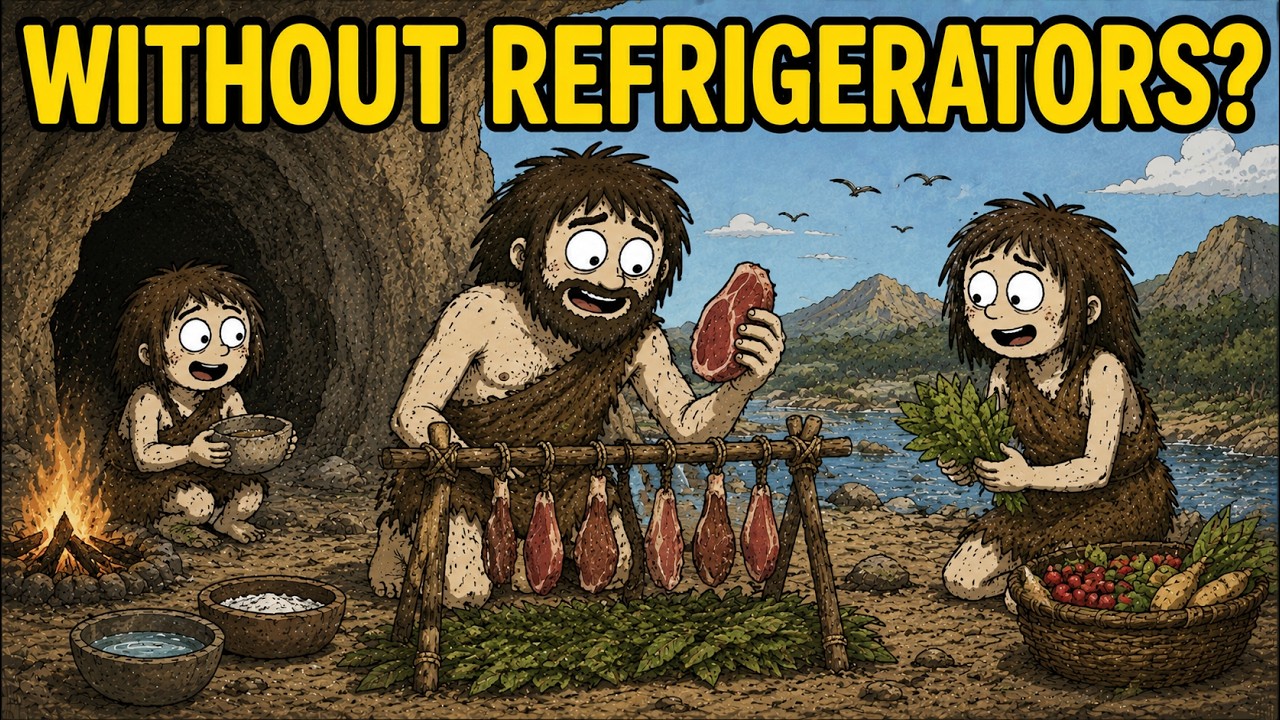
They noticed that meat left in humid air spoiled quickly, meat exposed to dry wind lasted longer, meat packed in salt barely spoiled at all, and meat hung over smoky fire seemed to keep for months. Across completely separate continents, with no contact between them, human societies arrived at strikingly similar solutions. When the same physical laws are tested by different groups of people over thousands of years, with hunger as the only teacher and death as the penalty for failure, the same answers tend to emerge. Nearly every ancient preservation method comes down to one of a handful of tricks: pulling the water out of food, adding enough salt to force water out through osmosis, adding smoke that deposits protective chemical compounds on the surface, lowering the temperature so decay slows down, or deliberately letting a harmless microorganism take over the food first so dangerous ones cannot move in.
Salt is probably the oldest and most widespread preservation chemical humans ever used. When meat or fish is packed in salt, water inside both the food’s cells and any bacteria on its surface rushes outward through cell membranes, trying to balance the concentration on both sides. Bacteria are extremely sensitive to this. Take enough water out of a bacterial cell and it cannot reproduce, cannot move nutrients, and often dies outright.
Scientists today measure this using something called water activity, a number between zero and one that describes how much water in food is actually available for microorganisms to use. Fresh meat sits close to one, essentially wide open for bacterial growth. Push salt concentration to around 13 percent of total weight and water activity drops to about 0. 91.
At that level, most common food-poisoning bacteria cannot grow at all. None of the people salting fish on ancient coastlines knew the term water activity. But through painful trial and error, they learned roughly how much salt was enough. Salt itself was not easy to obtain.
People near oceans, natural salt springs, or underground deposits had access to a powerful preservative. Everyone else had to trade for it, sometimes across very long distances at real cost. Salt became one of the first goods valuable enough to build trade networks, tax systems, and entire economies around. The word salary comes from the Latin word for salt, because Roman soldiers were, according to enduring tradition, partly paid in it.
There was a cost. Diets built heavily around salted meat and fish meant chronically high sodium intake, which modern medicine links to high blood pressure and kidney strain over a lifetime. Ancient societies knew nothing of blood pressure. They only knew salt kept them alive through winter, and that tradeoff was worth making because the alternative was starvation.
Smoke worked in a different way. When wood burns, it releases hundreds of chemical compounds through a process called pyrolysis. Many of these compounds are phenols, which happen to be natural antioxidants and mild antimicrobials. When meat or fish hangs over a smoky fire, these compounds settle on the surface and slowly work into the outer tissue layers.
They slow down the process by which fat goes rancid and make life difficult for bacteria trying to establish a foothold. There were two approaches. Hot smoking, at roughly 140 to 170 degrees Fahrenheit, cooks the meat while smoking it and seals the surface. Cold smoking, below about 90 degrees, takes days and soaks protective chemistry deeper into the meat without cooking it.
Smoking was rarely used alone. Most ancient preservers stacked techniques, salting lightly first, then smoking, then hanging the meat in dry air. Each step alone was not enough to guarantee safety for months. Stacked together, they were remarkably effective, and unrelated cultures converged on very similar layered strategies.
Drying might be the single oldest preservation technique, older than agriculture itself. The idea is simple. Bacteria, yeasts, and molds all need liquid water to survive. Remove enough water from food and you remove the environment those organisms need to live in.
Most ordinary spoilage bacteria need a water activity above roughly 0. 91 to grow. Many molds survive down to about 0. 7, which is why dried fruit can still mold in humid storage.
Below a water activity of around 0. 6, essentially nothing biological can grow at all. Getting food that dry with only sun and wind required real skill. Laying meat flat in direct sunlight often backfired, because the outer surface hardened and sealed moisture inside, a failure mode called case hardening.
So ancient drying specialists built raised slatted racks that let air flow above and below the food at the same time. They sliced meat into thin strips because thinner pieces dry faster. They paid close attention to shade, wind direction, and humidity, running drying operations with no dials or thermometers, just accumulated community knowledge. In colder regions, an entirely different method sat right outside the door.
Cold slows down almost every biological process, including decay. Ancient farming communities scheduled their major animal slaughters for late autumn or early winter because the falling outdoor temperature would chill the meat naturally and slow bacterial growth without requiring fuel, salt, or smoke. Winter itself became nature’s refrigerator. In places without winter, some ancient engineers went even further.
The most extraordinary example comes from ancient Persia, in what is now Iran, where structures called yakhchals were built as far back as roughly the fourth century BCE. These were ice houses that made ice from scratch in a desert in summer using nothing but architecture and physics. Persian builders constructed tall conical domes, sometimes reaching 60 feet, out of a mortar called sarooj, a mixture of sand, clay, lime, ash, goat hair, and egg whites. Once cured, it was dense, nearly waterproof, and slow to conduct heat.
The outside of the dome could be scorching while the inside stayed dramatically cooler. Beside the dome lay a deep pit that took advantage of stable underground temperatures. Nearby, shallow channels of water were fed in from underground aqueducts called qanats, which carried water for miles through tunnels to avoid desert evaporation. These shallow pools sat next to tall shade walls that blocked the low winter sun during the day.
At night, with clear skies and no sun, the exposed water radiated its heat out into the night sky, a process called radiative cooling. The thin layer of water could actually drop below freezing even though the air above remained above it. Workers would break up the ice before sunrise and rush it into the insulated underground pit. The dome’s shape encouraged warm air to rise and escape through a vent at the top, pulling cooler air up from the pit in a continuous natural airflow loop.
Some of these structures could maintain a temperature difference of well over 60 degrees Fahrenheit between the outside surface and the inside chamber. They kept large stockpiles of ice intact through desert summers where daytime temperatures regularly climbed above 100 degrees. No electricity, no fuel, no chemical refrigerant. Just a precise understanding of how heat moves, encoded directly into a building’s shape and material.
One of the strangest and most sophisticated methods worked by doing the opposite of pushing microbes out. It let decay happen on purpose, but steered it toward a harmless outcome. That method was fermentation. Fermentation works on a principle biologists call competitive exclusion.
If you flood food with a huge population of a specific harmless microorganism early on, that organism uses up available nutrients and space so thoroughly that harmful organisms never establish a foothold. Fermentation does not stop decay. It wins the race against dangerous decay by getting there first. The most common ancient version used lactic acid bacteria, found naturally on the surface of most vegetables and in raw milk.
Given the right conditions, usually low oxygen and a bit of salt, these bacteria feed on natural sugars and produce lactic acid. That acid drops the pH of the food, making the environment too acidic for dangerous bacteria. Some strains also produce natural antibiotics aimed at competing bacteria. This is how cheese, yogurt, sauerkraut, and countless other fermented foods were made long before anyone saw a bacterium under a microscope.
Milk deserves special attention, because in its raw state it is one of the most perishable foods that exist. It is mostly water, close to neutral in acidity, and loaded with nutrients. Left untreated in a warm climate, it spoils within hours. Turning milk into cheese solved this through steps ancient dairy farmers refined over generations: introduce lactic acid bacteria, add an enzyme taken from the stomach lining of young animals to clump milk proteins into a solid curd, press the curd to squeeze out the liquid whey, and salt the surface.
A liquid that would spoil in a day became a solid block stable for months or years. The Romans took fermentation one step further with a fish sauce called garum. Producers layered whole small fish with their internal organs into large containers alongside heavy salt, sometimes a fifth of the total weight, and left the mixture in the sun for weeks. Digestive enzymes naturally present in the fish’s organs broke down the fish’s own tissue.
The salt kept dangerous bacteria away while the sun sped up the process. The result was a strong, savory liquid rich in free amino acids, including the one responsible for what we now call umami. It was shelf-stable for years and traded across the entire Roman world as both a seasoning and a source of dietary protein. These techniques only became truly powerful when combined with careful storage.
A perfectly preserved piece of dried meat can still be ruined in a week by rats, insects, or damp air. Ancient storage engineers targeted specific threats. Grain stores were often built on raised stone platforms with overhanging discs designed to stop rats and mice from climbing. Sealed ceramic jars were lined with pitch or beeswax and capped with wet clay to keep moisture out.
Some regions stored grain in sealed underground pits where the grain’s own respiration used up the oxygen, creating a low-oxygen environment that killed insect larvae and slowed fungal growth. Large state-run granaries functioned as buffer stocks against drought, as a form of currency for taxation, and as core infrastructure that allowed cities to grow far larger than surrounding farmland could otherwise support. Without reliable surplus storage, the entire model of large dense ancient cities could not have existed. The same logic scaled up to armies and trade.
Salted cod from Northern Europe could be shipped through tropical heat without spoiling. Ship’s biscuit, made from flour and water baked repeatedly until almost all moisture was gone, fed long ocean voyages for centuries. The Mongol Empire relied on a dried meat called borts, shredded by cold dry winds until it lost almost all its water weight. A single rider could carry about two pounds and rehydrate it for the nutritional equivalent of several times that weight in fresh meat.
Eliminating supply wagon weight was a real factor in how fast Mongol forces could move. Ships faced the hardest version of the storage problem. Constant humidity, salt spray, and warm damp holds made naval food preservation a constant fight against moisture, insects, and time. Hardtack pulled moisture from the air and went moldy within weeks if mismanaged.
Barrels of salted meat slowly oxidized and turned rancid on long voyages. Every preservation method came with trade-offs that ancient people paid for with their health. Heavy drying and long-term storage destroy certain fragile vitamins, particularly vitamin C and vitamin B1. Sailors on long voyages living on salted meat and dried biscuit routinely developed scurvy, a brutal disease causing bleeding gums, reopening old wounds, extreme fatigue, and often death.
For centuries, nobody connected the disease to the diet, because preserved food that caused the deficiency looked and tasted fine. One of the clearest documented failures came from maize. Indigenous cultures in what is now Mexico and Central America discovered, likely over 2,000 years ago, that soaking and cooking dried maize in an alkaline solution made from wood ash or limestone released a form of vitamin B3 that otherwise passes through the body unused. When maize was later adopted as a staple in parts of Europe without this process, populations developed outbreaks of pellagra, a disease marked by severe skin rashes, digestive problems, mental confusion, and death in advanced untreated cases.
It took centuries to identify the connection. The most acute danger came from a bacterium called Clostridium botulinum, which produces one of the most potent toxins known to science, but only when food is low in acid, sealed from oxygen, and left at tolerant temperatures. A batch of preserved food sealed improperly could grow the toxin without any obvious smell, discoloration, or taste. Ancient populations operated without a safety net every time they opened a sealed container.
The fact that these techniques generally worked across thousands of years is a genuine testament to how much careful empirical knowledge was built up and passed down. Why did it take until the 1800s to build a machine that could make cold on demand? Mechanical refrigeration was not held back by a lack of ideas. It required several completely separate fields to mature at the same time.
Scientists including Sadi Carnot, Rudolf Clausius, and James Prescott Joule formalized thermodynamics only in the 1800s. Precision metalworking good enough to build sealed compressors that could cycle gas under pressure for years without leaking did not exist earlier. Chemical substances that could absorb and release large amounts of heat in phase changes had to be identified. And a source of continuous mechanical or electrical power required the broader industrial infrastructure of the 19th century.
Before those pieces came together, the 19th century leaned on natural ice. Tudor’s frozen pond water shipments were a real functioning industry, moving tens of thousands of tons of natural ice a year by the 1840s, insulated with sawdust that lumber mills had previously thrown away. It ran the same basic physics the Persians used 2,000 years earlier, just through 19th century logistics. In the second half of the 1800s, engineers including John Gorrie, James Harrison, and Carl von Linde built working mechanical refrigeration systems.
Harrison had a practical ice-making machine running by the 1850s. From that point, cold storage stopped being something harvested seasonally and became something that could simply be switched on. Once that switch flipped, everything changed. Farms no longer needed to be near the people eating their food, because refrigerated rail cars and ships moved perishable goods across continents while keeping them fresh.
Cities no longer needed daily trips to buy food that would spoil by evening. The home refrigerator turned preservation from a demanding daily household task into something almost invisible. Every method in this story was an act of applied science discovered without formal science, purely through observation, memory, and the high stakes of getting it wrong. None of the people who developed these techniques understood exactly why they worked.
What they had instead was an enormous, carefully maintained body of practical knowledge about how to buy a little more time before food turned against them. Salt bought time. Smoke bought time. Dry air bought time.
A clever piece of desert architecture bought time. A jar of deliberately soured milk bought time. None of these methods stopped decay permanently. They all slowed it down enough, stacked cleverly enough on top of each other, that human communities could survive between one harvest and the next.
Mechanical refrigeration did not invent food preservation. It folded thousands of years of scattered hard-earned knowledge, salting, smoking, drying, fermenting, cooling, into one continuous process most of us never think about. Every time a refrigerator door opens without a second thought, we stand on top of an unbroken chain of trial, error, and survival stretching back through Persian ice engineers, Roman fish sauce makers, Mongol cavalry rations, salted cod fleets, and hand-dug root cellars from people who never heard the word bacteria and never needed to.