The roar that had defined Formula 1 for decades was silenced in 2014, replaced by a futuristic whine that signaled the dawn of a new, uncertain era. The sport, once a gladiatorial contest of raw horsepower and screaming V8 engines, was undergoing a seismic shift toward hybrid technology, fuel efficiency, and a controversial new aesthetic. But beneath the surface of this technological revolution, a perfect storm of regulatory chaos, extreme weather, and fateful decisions was brewing, setting the stage for a tragedy that would irrevocably alter the sport’s relationship with safety and leave a permanent scar on its history.
This is the story of the 120 seconds that changed F1 forever, a period of time that exposed the sport’s vulnerabilities and led to the loss of a brilliant young life.
 The 2014 season was a watershed moment, marking the most significant regulatory overhaul in the sport’s history. The naturally aspirated 2. 4-liter V8 engines that produced a spine-tingling, high-pitched scream were unceremoniously retired.
In their place came the complex and quieter 1. 6-liter turbocharged V6 hybrid power units, a move designed to align F1 with the automotive industry’s new focus on sustainability and road-relevant technology. The cars were now required to complete a Grand Prix distance on just 100 kilograms of fuel, a drastic reduction that forced teams to become masters of energy management, often at the expense of flat-out racing.
The number of permitted engines per season was slashed from eight to five, adding a new layer of strategic complexity and penalty risk. The once-ubiquitous blown diffusers, which used exhaust gases to generate downforce, were banned, and the front wings were lowered in the name of safety, resulting in some of the most aesthetically challenged, memeworthy nose cones the sport has ever seen.
This transition was not a smooth one for the sport’s soul. The new cars were quieter, and for the first time, the spectacle of F1 was no longer solely about speed and aggression. It was about efficiency, energy recovery, and showcasing cutting-edge tech.
The fans and many drivers were initially hostile. The visceral, emotional connection to the sound of the cars was severed, and the new regulations felt like a betrayal of the sport’s core principles. While the world outside was caught up in the Ice Bucket Challenge and the infectious pop of Pharrell Williams, F1 was grappling with an identity crisis.
The paddock was a cauldron of frustration, with teams struggling to adapt to the complex new power units, which were prone to reliability issues and sounded, to many, like angry vacuum cleaners rather than racing machines.
Amidst the chaos, one team had managed to decode the new formula perfectly. Mercedes AMG Petronas emerged from the winter testing with a dominant car, leaving the rest of the field in their wake. After years of Red Bull Racing’s supremacy, the Silver Arrows had built a machine that was not only the fastest but also the most reliable.
This set the stage for an epic, internal battle for the World Championship between their two star drivers, Lewis Hamilton and Nico Rosberg. The tension was palpable, and their rivalry produced some of the most thrilling and contentious racing of the season. Red Bull, hampered by a problematic Renault power unit, were relegated to a distant second, while Williams, powered by the same Mercedes engine, capitalized on their opportunity to secure third place in the Constructors’ Championship.
Despite the initial backlash, 2014 delivered a season of unexpected drama and thrilling races. The Bahrain Grand Prix was a standout, a wheel-to-wheel duel between Hamilton and Rosberg that had fans on the edge of their seats. The two Mercedes drivers pushed each other to the absolute limit, their cars running side-by-side through high-speed corners, a spectacle of aggression and skill that momentarily silenced the critics.
There were also heartwarming stories of triumph against the odds. Jules Bianchi, driving for the backmarker Marussia team, scored a historic ninth-place finish at the Monaco Grand Prix, securing the team’s first-ever World Championship points in a drive that showcased his immense talent and rainy-weather prowess. Daniel Ricciardo, in his first year with Red Bull, announced himself as a future star by snatching his maiden victory in Canada, a race of attrition and strategy that saw him capitalize on the Mercedes’ troubles.
 As the season progressed, the championship battle tightened, and the paddock was rocked by a bombshell that would reshape the driver market for years to come. Sebastian Vettel, the four-time consecutive World Champion with Red Bull, was struggling. His car was unreliable, and he was being outperformed by his younger teammate, Ricciardo.
The frustration was visible, culminating in a moment of despair during the Singapore Grand Prix when he was ordered to let his teammate pass. It was a defining moment for the German, a realization that his time at the team he had built his legacy with was coming to an end. The news broke that he would be leaving to join Ferrari, a move that sent shockwaves through the sport and triggered a “silly season” of driver moves, with Fernando Alonso leaving the Scuderia after five frustrating, title-less years.
But while the driver market was the talk of the paddock, a far more ominous threat was brewing in the Pacific Ocean. Typhoon Phanfone, a powerful category four storm, was barreling towards Japan. The Japanese Grand Prix at Suzuka, a legendary and demanding circuit, was scheduled for the weekend, and the storm was expected to bring torrential rain and high winds.
The decision was made to keep the race’s original start time, despite a suggestion from F1 supremo Bernie Ecclestone and FIA race director Charlie Whiting to start earlier to avoid the worst of the weather. The track, nestled in a region prone to heavy rainfall, was soon deluged. The conditions were so severe that the medical helicopter, a crucial component of the sport’s emergency response, was unable to fly, a fact that would have devastating consequences.
The race began behind the safety car, with visibility almost zero and rivers of water streaming across the track. Drivers struggled for grip, and Marcus Ericsson spun off on the second lap. After two laps of this procession, the race was red-flagged, and the cars were brought back into the pit lane.
The weather briefly relented, and after a 20-minute delay, the race was restarted, again behind the safety car. The conditions were still treacherous, but the FIA deemed it safe enough to proceed. On lap 9, the safety car pulled in, and the race was finally underway.
Hamilton, starting from second, was immediately on the tail of Rosberg, and the two Mercedes drivers began to pull away from the field, their duel resuming as if the rain was nothing more than a minor inconvenience.
For a while, the race settled into a tense rhythm. The track was beginning to dry, and drivers were pushing hard, desperate to gain an advantage. Hamilton made his move on lap 29, sweeping around the outside of Rosberg to take the lead, a move that put him in prime position for a crucial victory in the championship fight.
But the respite was short-lived. On lap 36, the heavy rain returned with a vengeance, turning the track into a skating rink once again. Drivers reported massive aquaplaning and a complete lack of visibility.
 The conditions were becoming undriveable. On lap 42, the race was thrown into disarray when Adrian Sutil spun his Sauber and crashed heavily at Turn 7, the Dunlop Curve, one of the fastest corners on the circuit.
The marshals immediately displayed double-waved yellow flags, signaling drivers to slow down and be prepared to stop. However, the race continued under these conditions. The FIA’s response was agonizingly slow.
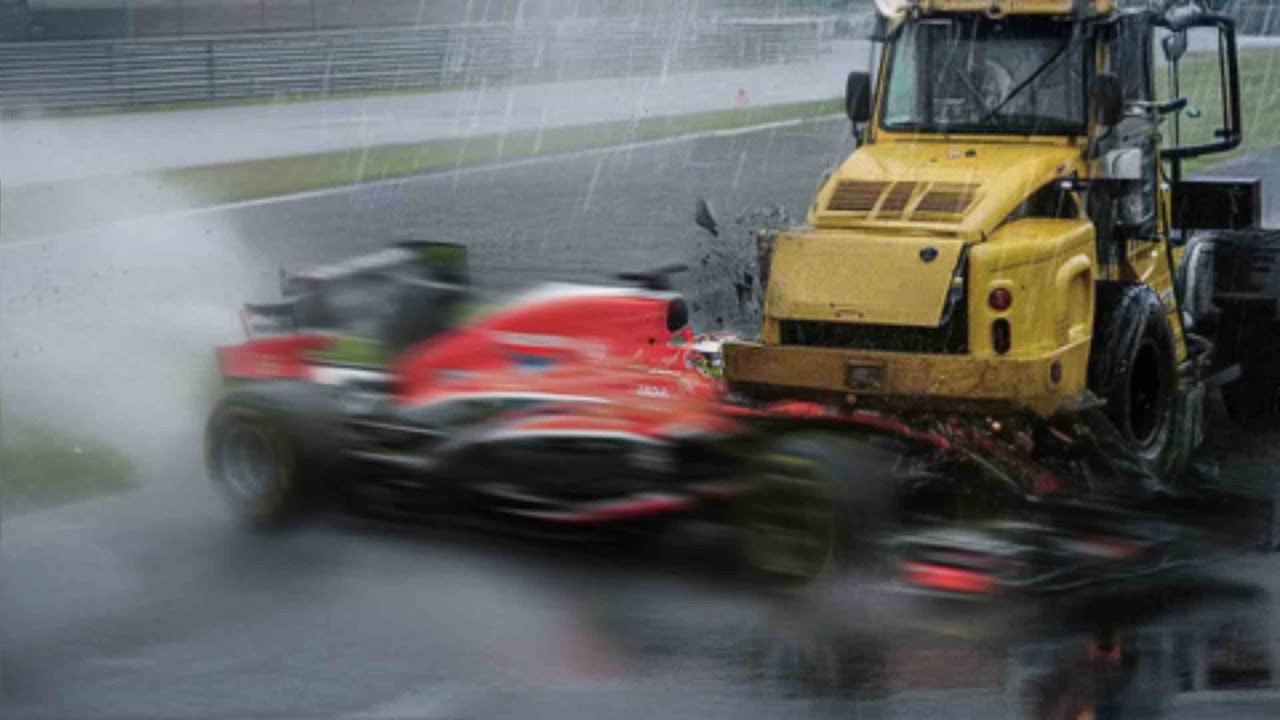
Instead of deploying the safety car or red-flagging the race, they made the decision to send a recovery vehicle, a massive crane tractor, onto the track to retrieve Sutil’s damaged car. This was standard practice at the time, but it was a decision that would prove to be catastrophically wrong. For over three minutes, the race continued with the crane on the circuit, and the drivers, despite the yellow flags, were still racing at high speed, their visibility hampered by the spray from the cars ahead.
The television broadcast cut back to the scene of Sutil’s crash, showing the crane tractor positioned alongside the stricken Sauber. The commentary team was confused, unsure of what was happening. Then, the medical car was seen rushing towards the scene, but it wasn’t for Sutil, who was already out of his car and being attended to.
It was for another driver. Jules Bianchi, in his Marussia, had lost control at the exact same corner, on the exact same line as Sutil, just one lap later. He had aquaplaned off the track at over 75 mph and slammed directly into the back of the recovery crane.
The impact was instantaneous and devastating. The car was destroyed, and Bianchi was critically injured.
The race was immediately red-flagged, and the world was plunged into a state of shock and confusion. There was very little information coming from the track. It was confirmed that Bianchi had been taken to a nearby hospital by ambulance, as the medical helicopter was grounded due to the weather.
The podium ceremony was a somber, muted affair, with the gravity of the situation dawning on everyone. Hours later, the news broke that Bianchi had suffered a diffuse axonal injury, one of the most severe forms of traumatic brain injury. He was in a critical condition, on a ventilator, in intensive care.
The 120 seconds between Sutil’s crash and Bianchi’s impact had exposed a fatal flaw in the sport’s safety protocols.
 The aftermath of the crash was a period of intense scrutiny and soul-searching. How could this have happened? Why was a recovery vehicle on the track while cars were still racing?
Why had the race not been stopped earlier, given the appalling conditions? The answers were complex and damning. The FIA’s investigation concluded that there was no single cause for the accident, but rather a combination of factors, including the extreme weather, the decision to use the crane, and the fact that Bianchi had not slowed sufficiently under the double-yellow flags.
The investigation also highlighted the dangers of racing in such conditions, and the need for a more robust system to protect drivers.
Bianchi was transferred from Japan to a hospital in his hometown of Nice, France, where he remained in a coma. The F1 world held its breath, hoping for a miracle. But it was not to be.
On July 17, 2015, after nine months of fighting for his life, Jules Bianchi passed away. He was just 25 years old. The news sent a wave of grief through the sport.
He was remembered not only as a talented driver, a member of the Ferrari Driver Academy who was destined for greatness, but also as a humble, kind, and genuinely wonderful human being. His death was the first in Formula 1 since Ayrton Senna’s fatal accident at Imola in 1994, and it served as a brutal reminder of the inherent dangers of the sport.
Bianchi’s legacy, however, was not just one of tragedy. His accident acted as a catalyst for a fundamental overhaul of F1’s safety procedures. The most significant change was the introduction of the Virtual Safety Car (VSC) in 2015.
This system requires all drivers to slow down to a pre-determined speed in specified sectors of the track when a hazard is present, eliminating the need for a physical safety car and ensuring that drivers are not racing at full speed past an incident. The practice of sending recovery vehicles onto the track while cars are racing was banned, with a new protocol requiring the race to be neutralized or stopped before any such machinery could be deployed. New rules were also introduced regarding race start times, preventing races from starting in the late afternoon unless they are official night races, to avoid the dangerous low-light conditions that contributed to the tragedy.
Furthermore, the crash accelerated the FIA’s research into closed cockpits, culminating in the introduction of the Halo device in 2018. This titanium structure, which sits above the driver’s head, has been credited with saving the lives of several drivers since its introduction, including Charles Leclerc at the 2018 Belgian Grand Prix and Romain Grosjean’s miraculous escape from a fiery crash in Bahrain in 2020. While the Halo was initially met with resistance from some fans and drivers who found it aesthetically unappealing, it has since become an accepted and vital piece of safety equipment.
Bianchi’s death was a tragedy, but it forced the sport to confront its own shortcomings and make the sport significantly safer for the generations of drivers that followed. His memory lives on, not only in the hearts of those who knew him but in every piece of safety innovation that now protects the drivers. His godfather, Charles Leclerc, now a multi-race winner and Ferrari’s lead driver, carries his legacy forward, a constant reminder of the talent that was lost and the importance of the fight for safety that his accident ignited.