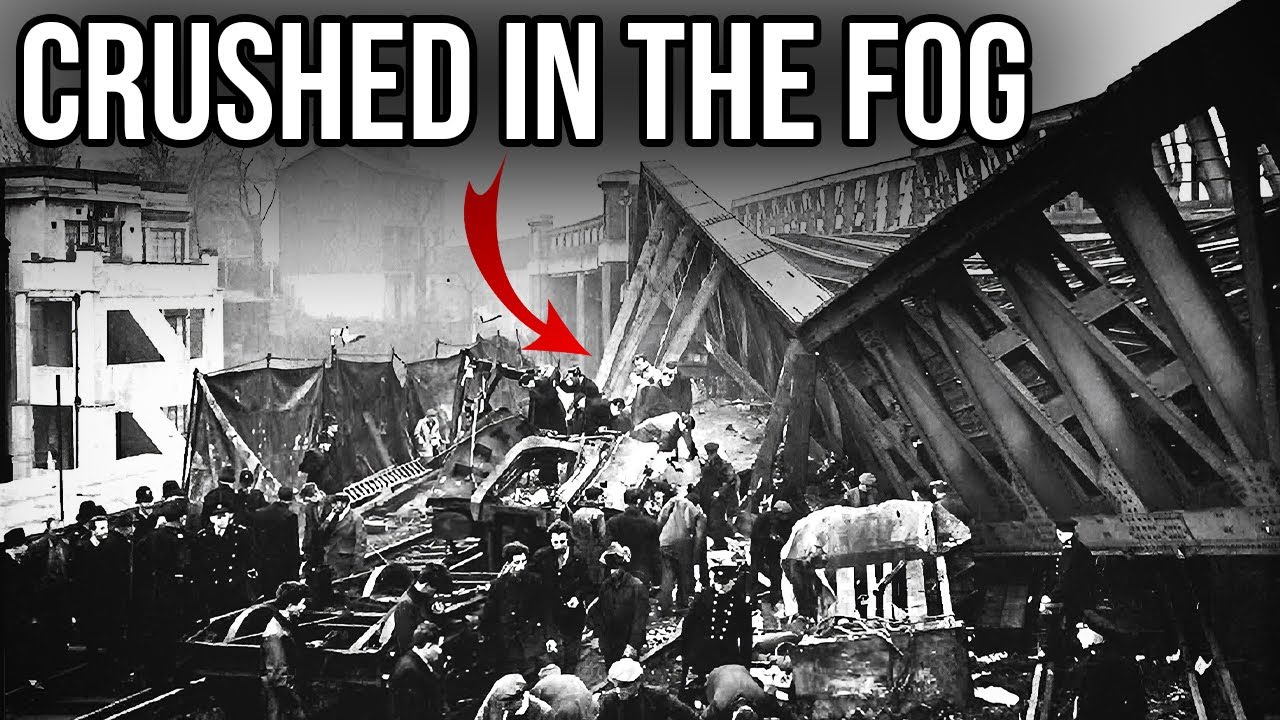
The fog on the evening of December 4, 1957, was not just a weather event; it was a shroud that would conceal one of the most catastrophic moments in British railway history. In the dense, freezing gloom of south London, a packed commuter train sat motionless beneath a steel bridge, its 1,500 passengers unaware that a steam locomotive was thundering toward them through the darkness, unable to see the signals that might have saved their lives. The collision that followed would not only destroy two trains and kill 90 people but would also bring down a 350-ton bridge, crush carriages into unrecognizable metal, and spark a legal and safety revolution that would reshape the nation’s railways forever.
The Lewisham rail disaster, as it would come to be known, remains the third worst in British history, and its echoes can still be felt in the safety systems that protect millions of commuters today.
 The scene was set hours before the fatal impact, as a thick, pea-soup fog settled over the southeast of England, a chilling reminder of the Great Smog that had killed thousands just five years earlier. The conditions were so poor that visibility on the tracks had been reduced to a matter of yards, and the Southern Region’s color-light signaling system, which relied on visual cues, was rendered almost useless. The fog had thrown the entire commuter network into chaos, with thousands of passengers crammed into London terminals, desperate to get home.
Trains were running off schedule, and the dense timetable, already strained by the mix of electric multiple units, diesel trains, and steam-hauled expresses, was on the brink of collapse. It was into this maelstrom of confusion and poor visibility that the two doomed trains were about to converge.
The first train involved was the 5:18 p. m. Charing Cross to Hayes service, a ten-coach electric multiple unit that was packed shoulder-to-shoulder with an estimated 1,500 commuters.
The train had been stopped at a red signal at the Parksbridge Junction, just beyond St. John’s station, and it sat waiting in the freezing cold, its passengers no doubt miserable as they anticipated a delayed journey home. The second train was the 4:56 p.
m. Cannon Street to Ramsgate Express, an eleven-coach Battle of Britain class Pacific steam locomotive, number 34066, named Spitfire. At the controls was 62-year-old driver W.
J. Trew, a veteran with four decades of railway service, accompanied by his fireman, a 32-year-old with twelve years of experience. The express was carrying an estimated 700 passengers, many of them commuters heading home after a long day in the city.
As the Ramsgate Express approached St. John’s station, it passed a red caution signal without slowing down. The fog was so thick that the signals were virtually invisible until a train was right on top of them, and the driver, peering through the front portal of his cab, could see only a glimmer of the lights.
The fireman, who had been asked to look out for the next signal, spotted the final red starter signal just before entering the station and shouted a warning to the driver. Trew immediately pulled the brake handle, but it was too late. The train, traveling at an estimated 30 miles per hour, had only 138 yards to stop before it would reach the stationary Hayes train.
The brakes had no time to take effect, and at 6:20 p. m. , the Ramsgate Express slammed into the rear of the electric train with a force that would prove catastrophic.
 The impact was devastating. The Hayes train had been sitting with its air brakes applied, which meant that instead of being pushed forward by the momentum of the collision, it remained rigid, absorbing the full force of the blow. The tenth coach of the electric train was struck, forcing the ninth coach forward and over the eighth, in a phenomenon known as telescoping.
The entire ninth coach was driven through the eighth, destroying it completely and killing almost everyone inside. The Ramsgate Express, meanwhile, did not stay on the tracks. The rear of the engine tender and the front of the leading coach were crushed together by the impact, and the locomotive was thrown off the rails to the left, where it struck the steel middle column supporting the bridge above.
The bridge, a lattice girder structure weighing about 350 tons, collapsed immediately, crashing down onto the Ramsgate train as it continued to move forward. The leading coach, already crushed against the locomotive, was completely destroyed, along with the second coach and the first half of the third. All three carriages were flattened by the sheer weight of the steel that had just been dumped on top of them.
The noise of the collision and the collapsing bridge must have been deafening, a sound that would have echoed through the surrounding streets of Lewisham. Residents who lived alongside the tracks heard the crash and rushed to the scene, followed quickly by the emergency services. The first ambulance arrived just three minutes after the initial collision, but the fog was so thick that it was almost impossible to assess the scale of the disaster.
As more ambulances, police, fire crews, and volunteers arrived, the true horror of the scene became clear. The emergency services worked tirelessly in the freezing, foggy conditions, crawling into the wreckage to rescue the injured. Members of the St.
John’s Ambulance Brigade, the Women’s Voluntary Service, and the Salvation Army all joined the effort, along with countless members of the public who had heard the crash and come to help.
Among those who rushed to the scene was a local window cleaner named Henry Chadwick, who lived about 180 yards from the crash site. Chadwick, described as a small and enthusiastic man, crawled into the wreckage to help the injured, spending nine hours inside the destroyed carriages. He administered painkilling injections to trapped passengers and came into contact with the remains of the deceased, scenes that would haunt him for the rest of his life.
At about 3 a. m. , he returned home to his wife, covered in mud and blood, and handed her a small brooch he had found on a young boy who had been killed.
 In the days, weeks, and years that followed, Chadwick changed completely. He suffered from nightmares, became disinterested in everything, and could barely work. He died in 1962 from an unrelated illness, but not before he had begun legal proceedings against the British Transport Commission, arguing that he had suffered severe trauma from what he had experienced.
His wife continued the fight after his death, and in a landmark ruling, the English High Court concluded that it was foreseeable that members of the public would jump in to help in a disaster, and that rescuers who suffered trauma could be treated as primary victims. The case of Chadwick versus the British Railways Board would remain the authority on rescuers suffering from nervous shock for decades.
The immediate aftermath of the crash was a scene of unimaginable horror. The eighth coach of the Hayes train had been completely destroyed, and the bodies of the dead and injured were scattered throughout the wreckage. In total, 90 people lost their lives, including 88 passengers and the guard on the electric train.
Another 109 people were seriously injured, and 67 suffered minor injuries or shock. The youngest victim was three-year-old Graeme Freeman, who had spent the afternoon visiting Father Christmas on Oxford Street and was found deceased next to a crushed toy drum, still clutching a soft toy. The driver of the Ramsgate Express, W.
J. Trew, was not physically injured but suffered from severe shock and was unable to give a coherent statement for days. The fireman, who was seriously injured, later confirmed that he had seen the red signal and warned the driver, but that there had been little reduction in speed before the impact.
The inquiry into the disaster, which was held in the months following the crash, laid bare the failures that had led to the tragedy. It was found that the Hayes electric train had been stopped at the signal by mistake, due to confusion caused by the fog disrupting the schedule. The signalman at St.
John’s had been expecting a different train, and the Hayes train had been stopped in error. It was also found that special fog signaling measures, such as the explosive charges used on other sections of the railway, were not in place on this section of track. The inquiry concluded that the fog was so dense that driver Trew would not have been able to see the signals until it was too late, and that even with a better view from the cab, he probably still would not have seen the two yellow warning signals before the final red.
The brakes of the Ramsgate train were tested exhaustively and found to be in full working order, and the signals along the route were also confirmed to be functioning correctly. The inquiry ultimately held driver Trew solely responsible for the accident, but the coroner substituted a charge of accidental death for gross negligence, and after two trials at the Old Bailey, Trew was acquitted of manslaughter.
 The inquiry also made a strong endorsement of the Automatic Warning System, or AWS, which had been approved for installation in late 1956 but was not yet fitted on this section of railway. The AWS system uses magnets placed along the track to trigger an alarm in the cab if a signal is not clear, and if the driver fails to acknowledge the alarm, the emergency brakes are applied automatically. The inquiry concluded that an AWS system on board the Ramsgate train would likely have prevented the collision.
The disaster is often cited as the catalyst for the acceleration of AWS installation across key routes across the country, along with improvements to cab visibility and windscreen design, and a doubling down on training for operating in fog conditions.
The cleanup operation took weeks. The damaged coaches had to be disentangled from the trains, and the fallen bridge had to be cut up where it lay. A temporary bridge, a military trestle structure, was constructed and opened on January 13, 1958, and it remains in place to this day, over 60 years later.
The disaster also had a profound personal connection for the narrator of this account, who only recently discovered that their grandfather, a police officer on duty in the area at the time, was called to the scene in the immediate aftermath. His role was to help with the cleanup of what was left of those who had not made it out alive. He never spoke about the experience in detail, a silence that reflects the generation that followed those who fought in the war, a generation that carried their trauma quietly and without complaint.
The precedent set by the Chadwick case, however, brought awareness to the secondhand trauma suffered by rescuers, a legacy that continues to influence how such events are understood and treated today.
The Lewisham train crash was a tragedy of immense proportions, a disaster that killed 90 people and injured hundreds more. But it was also a turning point, a moment that forced the British railway system to confront its shortcomings and implement the safety measures that would prevent future catastrophes. The AWS system that is now standard on railways across the country owes its widespread adoption, in part, to the lessons learned from this foggy December night.
The bridge that collapsed has been replaced, but the memory of those who died, and the bravery of those who rushed to help, lives on. The disaster serves as a stark reminder of the fragility of human life and the importance of vigilance in the face of danger. As the trains continue to rumble over the tracks at Lewisham, the ghosts of that night remain, a silent testament to the cost of a moment’s oversight in the fog.