The persistent claim that ancient humans routinely dropped dead by age 30 is one of the most widespread misconceptions about our own species. It appears in textbooks, documentaries, and casual dinner conversation as an accepted fact. But the number is not a biological limit—it is a mathematical illusion distorted by a brutal reality: infant mortality. In many prehistoric societies, roughly half of all children never reached their fifth birthday.
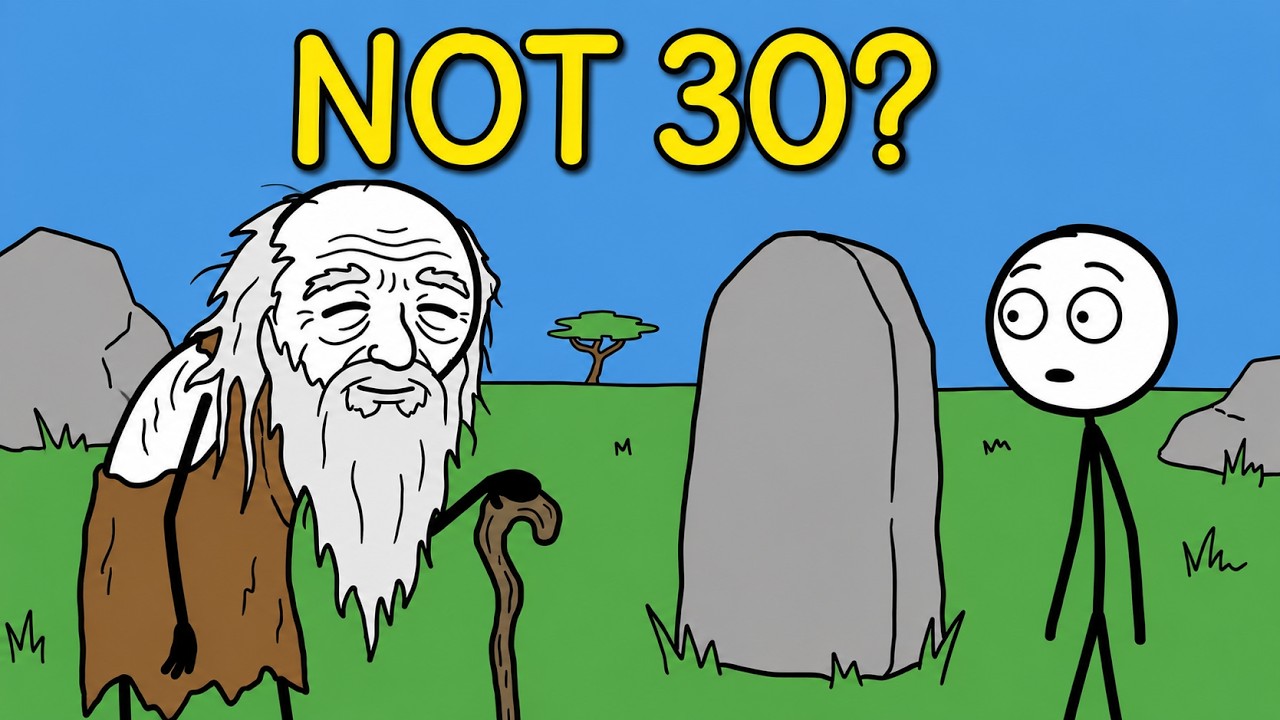
When researchers cite a life expectancy of 30 or 35, they are calculating the average at birth, which is dragged down dramatically by these early deaths. If half a population dies in infancy and the other half lives to 70, the average is exactly 35—yet nobody in that group actually died of old age at 35. Those who survived childhood were fully capable of living to 60, 70, or even 80 years old. The oldest evidence of human longevity dates back 1.
8 million years to a site called Dmanisi in Georgia. In 1991, archaeologists found a Homo erectus skull, labeled D3444, belonging to an individual who had lost nearly all of his teeth. The jawbone had completely healed and resorbed, meaning he lived for years without the ability to chew. In the Paleolithic, with no blenders or processed foods, survival without teeth required someone else to keep him alive—likely by pre-chewing tough, fibrous food into a paste.
This suggests that early hominins were caring for their elderly more than a million years before modern humans existed. A similar case appears at Shanidar Cave in modern-day Iraq, where the remains of a Neanderthal man known as Shanidar 1 were found. He had suffered a crushing blow to the left side of his head, likely blinding him in one eye. His right arm was withered and amputated below the elbow, he walked with a severe limp, and analysis of his skull revealed dense bone growths in his ear canals indicating profound deafness.
Despite these disabilities, his bones had healed, and he lived to an estimated age of 40 to 50—a very old man by the standards of his ice-age environment. His group protected and fed him for decades rather than leaving him behind. To understand how long human bodies are actually designed to last, researchers have studied people who still live as our ancestors did. In 2007, anthropologists Michael Gurven and Hillard Kaplan published a study analyzing mortality rates among modern hunter-gatherer groups, including the Aché in Paraguay, the Hadza in Tanzania, and the Tsimane in Bolivia.
They found that once a person in these societies survives past age 15, the most likely age of death is between 68 and 78, with a modal age of 72. The difference between us and them is not that their bodies are built to last less time—it is that modern medicine keeps more of our babies alive to reach that same natural limit. The Tsimane people of the Bolivian Amazon provide striking evidence of what natural aging can look like. A 2017 study published in The Lancet found they have the healthiest hearts ever recorded in any human population.
An 80-year-old Tsimane elder has the vascular age of an American in their mid-50s, and 85 percent of Tsimane adults show zero risk of heart disease. They achieve this through constant movement, averaging 16,000 to 17,000 steps per day, and a diet of wild game, fresh fish, and unprocessed plants. Around 30,000 years ago, something shifted in human longevity. A 2004 study by researchers Rachel Caspari and Sang Hee Lee examined the teeth of hundreds of fossilized humans and found that the ratio of older adults to younger adults suddenly quadrupled during the Upper Paleolithic.
This was not a genetic mutation but a cultural revolution: better tools, warmer clothing, and more complex social networks made it possible to keep elders alive. These elders became the storehouses of cultural knowledge—they remembered droughts, knew which plants were toxic, and held information essential for survival. The physical condition of ancient elders also contradicts modern assumptions about frailty. A 2014 study from Cambridge University used 3D scanning to analyze the internal bone structure of ancient hunter-gatherers and found their bone density was 20 percent higher than that of modern humans.
Because they built massive bone mass through constant physical stress in childhood and early adulthood, the natural bone loss of aging barely affected them. Osteoporosis was practically nonexistent among them. When ancient humans died young, it was usually not because their bodies gave out. The world was simply lethal.
The single most common cause of death was infection—a minor scratch or a tooth abscess could turn fatal without antibiotics. Predators posed a constant threat, and a long winter or a shifted migration route could mean starvation. Their bodies were not frail; the environment overwhelmed them. They were not passive victims of pain, either.
A 2017 study published in Nature analyzed dental plaque from a Neanderthal found in El Sidron Cave in Spain who suffered from a severe dental abscess. The plaque contained traces of poplar bark, which contains salicylic acid—the active ingredient in modern aspirin. The same individual had traces of Penicillium mold, a natural antibiotic. Researchers have also found evidence of prehistoric dentistry: a 59,000-year-old Neanderthal tooth from Siberia with a hole intentionally drilled to scrape out infected tissue, and a 6,500-year-old human tooth from Slovenia with a cavity filled with beeswax.
Cancer is not a modern invention—the oldest known case of bone cancer dates back 1. 7 million years. Arthritis was also common, visible in nearly every ancient skeleton. But the metabolic diseases that define modern aging—type 2 diabetes, hypertension, obesity, and heart disease—were virtually nonexistent.
Ancient elders aged on their feet, with dense bones and clear arteries, until the very end of their lives. The 30-year myth persists because it misunderstands what the statistic means. Life expectancy at birth was low because the world was remarkably efficient at killing children. Modern medicine did not extend the biological limit of human life; it simply allowed more people to reach the same limit that has existed for hundreds of thousands of years.
The bodies of ancient humans and modern humans run the same genetic software—designed to last for decades, move constantly, and consume unprocessed food.