I had taken exactly one photograph all night, and it was of a name. The ballroom was the kind of room built to make people feel chosen: gold light off the chandeliers, a band playing low standards, four hundred people in dark suits and long dresses pretending they weren’t checking each other’s place cards. At the far end sat a head table on a low dais, and behind it, on a freestanding wall the foundation set up every year, the names of the fallen. I had walked the length of the room to stand in front of that wall, lifted my phone, and photographed one line of small white letters near the bottom: Sergeant Wyatt Boon.
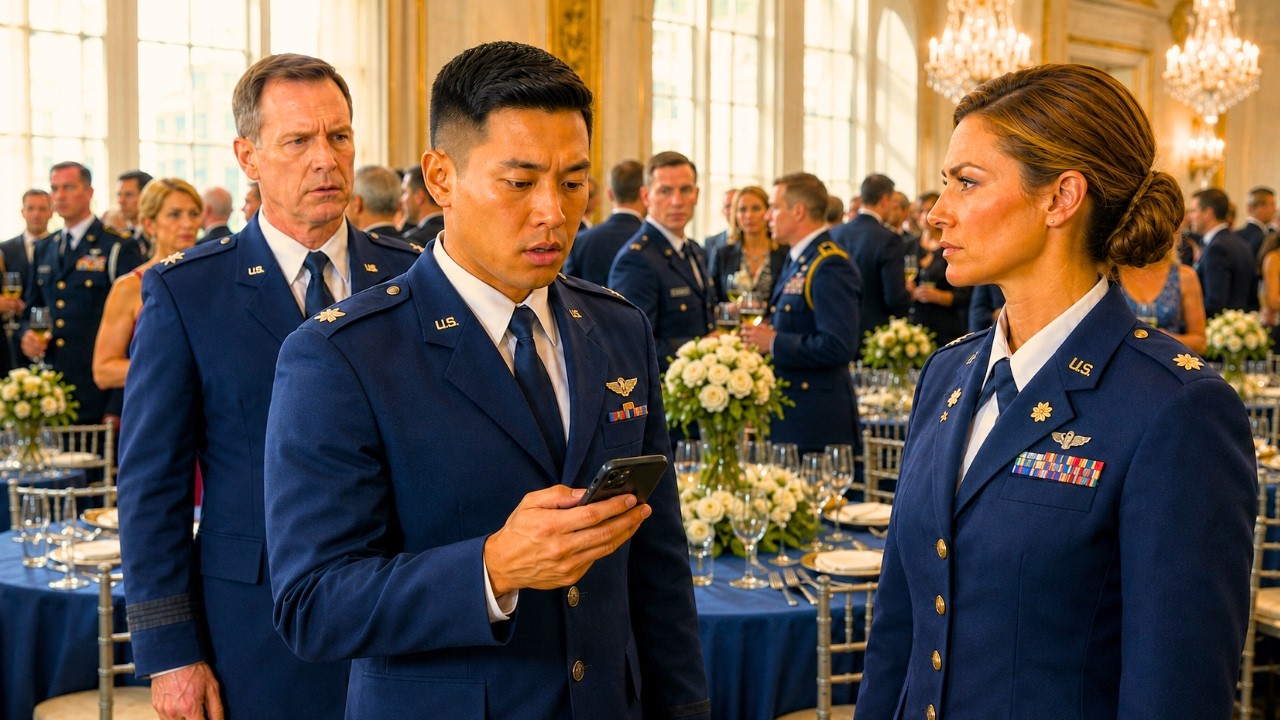
That was all I wanted from the evening—five minutes in front of a name and a picture to send to a woman who couldn’t be there. So when the voice came across the tables, it took me a moment to understand it was about me. “Security. This woman’s been recording the head table.
Take her phone. ”
The voice belonged to a colonel at the end of the dais. I didn’t know him yet. He was a tall man going soft at the collar, the kind of officer who wears his rank the way other men wear a good watch, and he was pointing at me across forty feet of carpet with one finger.
The way you point at a thing, not a person. Heads turned. The band didn’t stop, but the tables near me went quiet in that fast, embarrassed way a crowd goes quiet when it senses someone is about to be made an example of. I lowered the phone.
I didn’t say anything. Eighteen years in the army had taught me that the most expensive thing I owned in a room like this was my own composure, and I had learned not to spend it on men who pointed. A young captain reached me before I had finished the thought. He had come down off the dais at a half jog, and now he stood at my elbow with his hand out and an expression I recognized, because I had worn it myself a hundred times as a lieutenant: the expression of a junior officer who has been given an order he already suspects is wrong and has not yet found the spine to question it.
“Ma’am, I’m sorry,” he said, very low, just for me. “The colonel wants the phone. ”
I looked at the colonel one more time. He had folded his arms and was watching with the satisfied patience of a man who expects to be proven right in front of an audience.
I could have ended it in a single sentence. I had a sentence available to me that would have closed his mouth and emptied the color out of his face faster than anything that was about to happen. I chose not to use it. I have spent my whole career declining to use that sentence.
Instead, I turned my phone face up and set it in the captain’s open palm myself. “It isn’t locked,” I said. “There’s nothing on it you’ll find interesting. ”
He did not snatch it.
To his credit, he held it the way you hold something that belongs to someone else. He thumbed the screen to wake it, and I watched him start to do the thing he had been sent to do: find the footage of the head table and delete it so the colonel could feel important. Around us, the room was doing what rooms do. A woman at the nearest table had turned in her chair to watch with the frank, hungry attention people give to someone else’s small humiliation, the relief of it not being theirs.
Two men by the bar had stopped their conversation. A waiter with a tray of champagne hovered, unsure whether to keep moving or freeze, and chose to freeze so that a whole constellation of full glasses trembled at his shoulder. I noticed all of it, the way you notice everything when you have decided not to react, when all the energy that would have gone into anger gets rerouted into simply seeing. I saw the colonel adjust his cuffs.
I saw an older general two tables over frown, not yet sure what he was frowning at. I saw the band singer glance over and keep singing. And I saw the captain’s thumb stop. He didn’t find any footage.
He found the list of recent calls. I knew the exact moment he saw it because his thumb stopped moving. He had been scrolling with the loose carelessness of a man performing a chore, and then he wasn’t scrolling at all. He went very still, the kind of still that is louder than movement.
He read the screen once, top to bottom. Then he read it again, slower, and the second time his jaw came open just slightly, the way a person’s mouth opens when the floor they were standing on turns out to be a different floor than they thought. The captain stopped looking at the phone and started looking at me. I want to tell you who I actually was, standing there in a borrowed-feeling dress with a stranger holding my telephone, because the gap between that and what the colonel saw is the whole of this story.
I had come to the gala alone on purpose. No escort, no aide, no entourage, nothing on my person that announced anything. The dress was navy and plain, bought two days earlier because the invitation said black tie and I owned almost nothing that was not a uniform. I had asked the people who ran this fund every single year for twelve years to keep my name off the program, off the donor wall, off the little cards on the tables.
I did not want a seat at the head table. I had given a great deal of money and a great deal of myself to the thing this room had gathered to celebrate, and my one condition had always been that no one in the room would ever know it was me. The fund had started small the year after the crossing, with a single college tuition I paid for one child and told no one about. It grew because grief, if you let it, will look for work to do, and mine had a great deal of energy and nowhere honest to put it.
I found a woman named Helen Ashby, a former army spouse who had buried a husband of her own and knew how to build a thing that would outlast the people who started it. I handed her the money and a list of conditions, and the first and last condition on the list was always the same: my name appears nowhere. Not on the letterhead, not on the donor wall, not in the thank-you notes, not in the room. If anyone asks who funds it, you say a group of veterans who prefer to remain private.
That is true enough. I am a group of veterans. I just happened to be one person. I told myself this was humility.
I told myself the work was cleaner without a face on it, that a scholarship means more to a grieving family if it seems to come from the whole grateful country rather than from one guilty captain who could not save their soldier. There was even some truth in that. But the deeper truth, the one I didn’t look at directly for twelve years, was that staying behind the wall was simply easier. If no one knew it was me, then no one could thank me.
And if no one thanked me, then I would never have to stand in a bright room and accept gratitude for the worst night of my life. Anonymity was not only a gift to them. It was a hiding place for me. So I had a plain navy dress and a seat at a back table under a name that was not on any program, and a phone in my clutch, and a single simple plan for the evening: watch the girl get her scholarship, stand in front of the wall, leave before anyone learned my name.
That night I was a colonel in the United States Army. I had been selected three months earlier for promotion to brigadier general. There was a line of officers in that ballroom who would have stood up if I had said either of those facts out loud, and a colonel near the dais who would have sat down very fast. I said neither.
The whole point of being who I was for almost two decades had been the discipline of not saying it. A classified career is a strange kind of poverty. You are paid year after year in work that no one is ever allowed to see, and then the bill comes due in rooms exactly like this one, where the currency is being recognized and you have none of it to spend. People had been mistaking me for the help my entire adult life.
I had stopped minding a long time ago. Mostly, the reason I was at the wall, the reason I had my phone up at all, was a girl I had never met and a man I had known for one night. Her name was in the program: Hannah Boon, eighteen years old, this year’s named recipient of the fund’s largest scholarship. I had read her name on the printed card at my table and felt something in my chest tighten and let go at the same time, the way it does when a thing you set in motion years ago finally arrives.
And the man was on the wall. Her father. I had photographed his name to send the picture to Rachel, his widow, who lived four states away and couldn’t make the trip, and who had asked me in a text that morning to stand in front of it for her since she could not. That was the entire plot of my evening.
I came to watch a girl get a scholarship and to stand for five minutes in front of a name. I had not planned to be in this story at all. Across the small space between us, the captain leaned toward the colonel, who had come down off the dais, now impatient, and I watched a young officer decide in real time, and at some cost to himself, that he was standing on the wrong side of something. I didn’t yet hear what he said.
I only saw the colonel’s posture change as he listened: the folded arms coming loose, the chin coming down. You should understand that being treated as no one in a bright room was not new to me. It was the oldest and most familiar weather of my life. There was the reception where a general’s wife handed me her empty glass and asked me to find her another, and I found her another because it was easier than the conversation.
There was the briefing where one star asked which colonel I worked for, and I said I worked for him, and he laughed because he thought I was joking. There were a dozen coat checks I was waved toward, a dozen times I was asked to fetch the slides, a dozen evenings I let a man explain my own operation to me because correcting him would have taken longer than letting it pass. I had a wall of awards I had never hung and a record that lived mostly in rooms with no windows. The practical result of all of it was that I had learned to move through the world like a person who is not quite there.
I had made my peace with that. What I had never made my peace with was the night underneath it, the night the whole rest of my life was built on top of, like a house over a grave. It was the spring of 2011. I was a captain, thirty years old, responsible for getting roughly forty people out of a place that was about to stop being safe for them.
They were not soldiers. They were interpreters, the men who had driven our trucks and washed our dishes and pointed at the right doors, and their wives and their children. All of them marked now, all of them out of time because a line on a map was about to move. I had a small element of my own soldiers and a plan that was mostly nerve, and we ran them out in the dark toward a crossing at a dry riverbed, a wadi with steep banks where a relief element was supposed to meet us and did not.
Not on time. There was a gap at the crossing, a place where the banks opened and anyone behind us could see straight down the line of vehicles. Somebody had to hold that gap on foot long enough for forty frightened civilians and a string of trucks to clear it. And that somebody was a sergeant named Wyatt Boon.
He was twenty-nine. He had a daughter who was three years old. He told me her name twice, standing at the tailgate with his weapon, so that I wouldn’t forget it if the night went the way both of us knew it might. “Go, ma’am,” he said.
“I’ve got the gap. Get them across. ”
I got them across. Every one of them.
Forty civilians and all of my soldiers but one, because Wyatt Boon held that crossing until the relief element finally arrived, and he was killed in the last few minutes before it did, when the whole thing was nearly over and he had nearly made it. They gave me a medal for that night in a closed room with three people present and no photographs. They gave him one, too, folded into a flag and handed to a widow with a toddler on her hip. I have never told the long version of that night to anyone who was not there.
And I am not going to tell all of it to you now, but I will tell you enough that you understand what the wall meant. We had perhaps six hours of warning that the line was moving and that everyone who had helped us was about to be on the wrong side of it. Six hours to find them in a dozen houses across a sprawl of dirt streets, to convince men who had already lost everything once to leave the little they had left in the dark, with a captain they were not sure they could trust. I went house to house on foot with two soldiers and an interpreter, knocking, whispering, holding up my hands to show I had nothing in them, watching mothers wake their children and wrap them in whatever was nearest and decide in thirty seconds, on my word, to walk away from the only walls their family had ever owned.
By the time we had them moving, it was past midnight. A column of trucks and people far too long and far too slow, and the only way out ran through that wadi. I can still see the crossing. The banks were steep and pale in the moonlight, the floor of the riverbed loose stone that turned an ankle if you ran on it.
And the gap, the open stretch where the high ground fell away and anyone behind us would have a clean line down the length of the column, was about eighty meters of nothing. We had to put forty civilians and a string of vehicles through eighty meters of nothing slowly in the dark, and we needed someone to stand at the near edge of it and make sure that if anything came down on us from behind, it had to come through him first. Wyatt Boon did not wait to be told. He had already moved to the position before I finished thinking the thought.
When I caught up to him to give the order I’d been dreading, he had taken a knee behind a shoulder of rock with a clean view back up our own trail. He looked up at me with an expression that was almost gentle, almost apologetic, as if he were the one about to inconvenience me. “Go, ma’am,” he said. “I’ve got the gap.
Get them across. Don’t you dare stop the column for me. You stop that column, and all of this was for nothing. ”
“You come across the second the trucks are clear,” I told him.
“That is an order, Sergeant. ”
“The second they’re clear. Yes, ma’am. ”
And we both knew the shape of what we were saying to each other under the words.
The crossing took nineteen minutes. I know because I counted it vehicle by vehicle, child by child, my heart keeping a clock I could not turn off. A little girl on the fourth truck would not stop crying, and her mother could not quiet her, and I remember thinking, with a clarity that has never left me, that the sound of that child was the most important sound in the world and that Wyatt Boon was buying every second of it with his own body eighty meters back, alone, behind a rock. The relief element was late.
They had been turned around by a collapsed culvert, and they came in hard from the wrong direction. And in the confusion of their arrival, in the last few minutes when it was nearly over, the night reached out and took him. We went back for him. I want you to know that we did not leave him at the gap.
Four of us went back across that crossing on foot, against the flow of our own rescue, and we carried him out. He was not heavy. He had never been a big man, and I held one corner of him the whole way. And I have never, in fifteen years, entirely set that corner down.
The little girl who would not stop crying got across. She is a grown woman now, with papers and a life and a country. So did the other thirty-nine. So did every one of my soldiers.
So did everyone but the one man who decided that eighty meters of nothing was his to hold. I put my medal in a drawer. I have never taken it out. I did not feel like a person who had saved forty lives.
I felt like a person who had spent a sergeant to do it. And I built the entire rest of my life around the arithmetic of that, quietly, where no one could see me doing it. The name on that wall was the only after-action report I had ever fully believed. Here is the thing that changed the ground that night, and I want to be precise about it, because it was not a person and it was not a uniform and it was not anyone recognizing my rank.
It was the telephone in the captain’s hand. He had been sent to find evidence that I was filming the head table. What he found instead was the list of the last calls that telephone had made and received, and that list was not the list of a woman who crashes galas to photograph colonels. The most recent missed call, from twenty minutes earlier while I had been walking into the building with my phone in my clutch, read on the screen as a personal number with a name attached.
The name was Bennett Shaw. The captain knew that name. Everyone in his chain of command knew that name. General Bennett Shaw wore four stars and sat at the top of the structure that the colonel pointing at me reported up through, two echelons removed.
And the call had not come from an office line or a duty desk. It had come from the general’s personal cell, the one a four-star gives to perhaps forty people in the world. And it had come to me. Above it and below it were the others.
A call that afternoon to the office of the Secretary of the Army. A call two days before from an aide to the Chairman. A string of names and numbers that a junior captain reads exactly once and never forgets, because the list of people who keep those numbers in their phone is short, and he had just learned, holding it in a ballroom, that the woman the colonel had called a thief was on it. “Sir,” the captain said to the colonel, and I could only just hear him.
“Read the contacts. ”
The colonel did not understand yet. He took the phone with the brisk confidence of a man expecting to be handed his vindication. He looked down at the screen, ready to find a reporter’s number, a producer, something he could wave at the room.
I have watched men lose altitude before. It always happens in the eyes first. The eyes go somewhere else for a half second, doing math, and then they come back changed. I watched it happen to him over the space of two or three seconds, the smile sliding off his face like something that had not been fastened down very well.
I think what undid him was not any single name. It was the pattern of them. A reporter has one number that matters and a hundred that do not. The list on that screen was the opposite: nothing but numbers that mattered, stacked one on top of another, the private cells of people whose names he had only ever seen on the top line of orders he received and obeyed.
There is a particular kind of fear that belongs to a careful man when he realizes he has been careless in front of exactly the wrong audience. And it is not loud. It goes inward. He had spent an entire career being the most important officer in most of the rooms he entered, and he had just learned, holding a stranger’s telephone, that he had badly misjudged which kind of room he was standing in.
He looked up from the phone, once, at me. It was the first time all night he had actually looked at my face rather than at the idea of me. I held his eyes, and I did not help him. I did not nod.
I did not soften. I did not give him the small reassuring smile that would have told him it was going to be all right. I simply let him look at the person he had pointed at, and I watched him understand that he had no idea who she was. “That last one,” the captain added, even quieter, because he could see his colonel needed help reading the instrument.
“That’s General Shaw’s personal cell. She missed his call on the way in. ”
The tables nearest us had gone fully silent now, and the silence was spreading outward in a ring without anyone knowing why. The captain stepped back half a pace from me.
Not away from me as a person. Away from me the way you step back from something that you have just realized is live, and not the inert thing you assumed it was. The phone had spoken. I had not said a word.
And for the first time all evening, the colonel had finally started to listen. What happened next was that the colonel offered me the easy way out, and I felt for one long moment how badly I wanted to take it. He recovered faster than I expected. Men like him have a great deal of practice recovering.
He set my phone back into my hand with both of his, as if returning something precious he had been minding for me, and he arranged his face into the warm, regretful expression of a host who has discovered a small misunderstanding among friends. “There’s clearly been a mix-up,” he said, pitched loud enough for the near tables to hear. “My apologies. No harm done.
Please enjoy your evening, ma’am. ”
He was not apologizing. I want to be clear about that because it took me years to learn to tell the difference, and I will not pretend I learned it gently. He was not sorry.
He was asking me to help him bury it. He wanted me to smile back, to murmur that it was nothing, to let the band come back up and the room turn its attention to its salmon, so that the thing he had just done could quietly cease to have happened. He was asking me for the same favor I had granted a hundred men over eighteen years. Make yourself small again.
Let me keep my comfort. Be no one for one more night. And the terrible truth is that I almost did it. I stood there with my own phone back in my hand, and I felt the entire weight of my training pulling me toward the easy answer: nod, step back toward the wall, let the evening close over the moment like water over a dropped stone.
I thought about the drawer with the medal in it. I thought about the windowless rooms and all the years of being unseen, and how being unseen had never once cost me anything I could not afford. It had always been easier to swallow it than to be looked at. You have to understand how deep that channel ran in me.
Eighteen years is a long time to practice a thing. I had a whole body’s worth of reflexes built around being overlooked and staying that way. When a man explained my own work to me, my face went pleasant and patient on its own without my asking it to. When someone handed me a coat to check or a tray to carry, my hands took it before my pride could object.
I had turned the swallowing of insults into something so smooth and automatic that I no longer experienced it as a cost. It felt like manners. It felt like maturity. It felt, most of the time, like winning, because I got to keep my dignity in a locked place where no one could touch it.
And the loud, certain men got to be wrong about me forever. And I told myself that was the better deal. And it had been the better deal as long as I was the only name on the ledger. That was the quiet, rotten logic at the center of it.
My silence only ever cost me. And I had decided long ago that I could afford it, that I would always be able to afford it, that there was no insult cheap enough to be worth the expense of a scene. I had built a fortress out of that logic, and I had lived inside it comfortably for the better part of two decades. I was three seconds from nodding.
And then I saw the girl. She had come in through the side doors at the far end of the room, eighteen years old, in a pale green dress that she had very obviously bought for that specific night, holding her little beaded bag in front of her with both hands the way you hold something when you are not sure you belong in the place you are standing. She was looking for the restrooms. She looked lost and brave at the same time, which is exactly how an eighteen-year-old looks when she has walked alone into a room full of important strangers because the program has her name in it.
It was Hannah Boon. I had never seen her face before, but I knew it the way you know a face you have been imagining for fifteen years. And I knew her father’s jaw on her, and her father’s way of squaring up to a doorway. She was about to walk into a room that had just decided, out loud, that the woman behind her scholarship was a thief who had to have her phone taken away.
For eighteen years, staying small had only ever cost me. That was the math. And the math had always worked because I was the only one on the ledger. Standing there watching that girl hold her little bag, the math changed.
For the first time, the price of my disappearing was going to be paid by someone else. So I did not nod. I did not take the easy exit. And I want to tell you that I also did not take the cruel one, because there was a cruel one available, and a younger version of me might have reached for it.
I did not raise my voice. I have never once in my life needed to raise my voice. And I was not going to start in a ballroom in front of a frightened teenager. I simply did not let the moment close.
“Keep it a moment, Captain,” I said, and I held the phone back out toward the young officer, who took it again, confused. “You haven’t actually deleted anything. I’d like the colonel to see the thing he was so certain I was hiding. ”
The colonel’s smoothing smile faltered.
This was not the script. In his version, I accepted the apology and vanished, and the evening forgot us both. He had not budgeted for a woman who declined to be rescued from his own mistake. “Open the photographs,” I told Captain Marsh.
I had read his name tape by then. “There’s only one from tonight. It’s the last one I took. ”
He opened it.
He turned the screen so the colonel could see, and then, after a beat, so the people at the nearest table could see too, because I think some honest instinct in him understood that the room had earned the right to look at what it had condemned. It was the wall. One line of small white letters near the bottom: Sergeant Wyatt Boon. “That’s what I was recording, Colonel,” I said, my voice very even.
“A name on your foundation’s memorial wall. He held a blocking position at a river crossing in the spring of 2011 so that about forty people could get across it alive. He was twenty-nine years old. His daughter is in this room tonight, and she is the reason I came, and the reason I will be leaving quietly the moment she has her scholarship in her hand.
”
I did not say the rest of it. I did not say that I had built the fund. I did not say what I had been on that crossing, or what I would be wearing on my shoulder in a few months, or whose call I had missed on the way in. I had decided something in the space of those few seconds.
And it was not that I would destroy this man. I had no interest in ending his career on a ballroom floor in front of his own captain. I had simply decided that I was done. Done agreeing to be no one.
Done handing my composure to strangers as though I owed it to them as rent for the space I took up. There is a difference, and it took me most of my life to learn it, between standing up for yourself and stepping on someone else. And the difference is almost everything. The cruel version was right there in reach.
I could have said the sentence. I could have named my rank and my list and my missed call and watched the man fold in half in front of his own captain. And a part of me, the tired part, the part that had been handed too many empty glasses, wanted to. But contempt answered with contempt is just more contempt.
And I had spent eighteen years declining to add any to the world. I was not going to start now. Not in front of a girl in a green dress. Not under a wall with Wyatt Boon’s name on it.
He had not held that gap so that I could become the kind of person who breaks a foolish man for sport. I was not going to make him small. I was only going to stop being small myself. And then, instead of stepping back toward the wall the way the whole room expected, I turned and took one step forward toward the head table.
The truth did not arrive as a salute. It arrived the way truth usually does, sideways, through a man who had simply been looking for me. General Bennett Shaw had come to the gala to give the keynote. I had known he would be there.
It was, in fact, half the reason I had been so careful to stay near the back and the wall, because Bennett Shaw was the one man in that ballroom who could not be made to pretend he did not know me. He had called me twice that day. I had not answered because I knew exactly what he wanted. And what he wanted was for me to sit at the head table and let him introduce me.
And I had decided to dodge him for one more year. He came off the dais looking mildly annoyed, scanning the floor for the colonel who was supposed to be managing his evening. And he found instead a small knot of silence near the memorial wall: a captain holding a phone, a colonel the color of paper, and me standing one step out from the crowd with my chin up. “Marin,” he said.
Not “Colonel Holloway. ” Not “ma’am. ” Marin, the way you say a name you have said across a hundred briefing tables in places you are not allowed to name. “I called you twice today.
I wanted you on that stage tonight, and you turned me down by simply not picking up. ”
You could hear the room rearrange itself around the first name. Four stars on his shoulder, walking out of his own keynote to scold a woman in a plain navy dress by her first name. The colonel’s mouth opened and produced nothing.
Then the floor gave way under the colonel entirely, because a command sergeant major crossed it. Silas Ward was Bennett Shaw’s senior enlisted adviser. And he had been a younger man at a river crossing in the spring of 2011. One of the soldiers I walked out of that valley.
He had a chest full of ribbons and a face like a closed door, and he came across that ballroom carpet at a pace that turned every head. He passed me and stopped in front of me, and he did not salute because we were both in civilian clothes. But he came to a kind of attention that did not need a uniform to read. “Colonel Holloway carried my entire element out of that valley,” he said, to the colonel, to the captain, to the tables, to anyone who was listening, and by then everyone was.
“Every man. I have been trying to buy this officer a drink for fifteen years, and she will not let me. And you pointed at her across a room and called her a thief. ”
I watched the arithmetic move through the crowd.
A woman in a plain dress, no name on the program, photographing a wall. A colonel on the general’s list. The first name in a four-star’s mouth. And then, last, the thing the foundation had spent twelve years not saying, which arrived now in the person of Helen Ashby, the fund’s director, who had pushed through the crowd with her hand over her mouth and her eyes wet and furious.
“She founded it,” Helen said. “The scholarship. All of it. Twelve years.
She made us promise never to use her name. ” Helen looked at the colonel, and her voice did a thing I had never heard it do. “You ordered security on the woman who built the reason every one of you is in this room. ”
For a moment, nobody moved.
I have stood in some quiet rooms in my life, briefing rooms where the quiet meant a decision was about to cost lives. And this quiet had that same density to it: four hundred people holding very still while a thing rearranged itself in front of them. I could hear the band somewhere far away still playing as if the world were normal. I could hear a fork set down on a plate.
I could feel the particular heat of being looked at by a great many people at once, which is a thing I had spent eighteen years arranging my entire life to avoid, and I made myself stand in it and not look away. I did not enjoy it. I want to be honest with you about that, because there is a version of the story where the wronged woman drinks in the moment the room turns, and that was not how it felt. It felt like being unclothed.
Every instinct I had was screaming at me to deflect it, to make a small joke, to wave it off and send everyone back to their dinner, to do the thing I always did: take the attention and quietly hand it to someone else. I held still instead. I let them look. It was one of the hardest things I have ever made myself do.
And I did it for a girl in a green dress who had not yet found her way back from the side doors. Bennett Shaw let the silence sit exactly as long as it needed to, and not one second longer. He had a gift for that. Then he turned slowly and looked at his colonel.
The colonel understood then, fully, in front of four hundred people, in front of his own general, in front of the young captain who had tried to warn him. He understood exactly whose phone he had ordered confiscated, and there was nowhere in that bright gold room for him to put his face. What happened to the colonel happened quietly, and I made sure of that, because I have seen what public ruin does to a room, and I did not want it in this one. Bennett Shaw turned to him.
I had served alongside that man for the better part of a decade, and I had seen him angry perhaps three times, and his anger never got loud. It got cold and very precise, like a temperature dropping. “You’ll report to me at 0800,” Shaw said. “Not here.
Not tonight. You will not say another word in this room. Go and stand by the doors and think about how you speak to people whose names you do not know. ”
He could have broken the man on the spot.
He had the rank and the audience and the justification to take Colonel Desmond Faulk apart at the seams right there on the carpet, and a part of the room clearly wanted him to. He glanced at me first, just for a second. A question between two people who had spent years reading each other across tables. I shook my head once, very slightly, and he saw it, and he understood, and he let it go.
Later, when the band had come back up and the room had been given other things to look at, I found Shaw near the bar and told him plainly what I wanted. “Correct him,” I said. “Don’t end him. Make him sit with it.
I want him to remember this every single time he looks at a stranger for the rest of his career. I don’t want him to lose the career. A man who loses everything in one night learns to feel sorry for himself. A man who has to keep getting up and doing the job after a night like this learns something that actually sticks.
”
Shaw looked at me for a long moment. “You are a more generous officer than I am, Marin. ”
“No,” I said. “I just know what it costs to be made small.
I am not going to hand it to him and call it justice. ”
The colonel’s apology, when it came, found me near the doors. It was stiff and graceless, and it cost him something to deliver, and I believed it precisely because it was so clearly difficult. I did not forgive him warmly.
I did not pretend we were going to be anything to each other. I took the apology and told him the truth: I hoped he would be a better officer in the morning than he had been at dinner. And we stepped into the permanent, correct distance that two people occupy when one has wronged the other and both intend to behave like adults about it for the rest of their lives. That was all.
Not friendship, not warmth, just the clean, cool space of a thing set right. And then I turned to the captain, because the captain was the one who actually mattered. He was twenty-six years old, standing a little apart from all of it, holding himself the way young officers hold themselves when they have just watched their own chain of command be wrong in public and do not yet know what they are allowed to feel about it. He had been handed an unlawful sort of order, a petty one, and he had carried it out.
And then, the second he saw what he was actually holding, he had stopped, and he had told his colonel the truth instead of the convenient thing. That is a harder act than people understand who have never worn the rank. “Captain Marsh,” I said. He straightened.
“You stopped looking at the phone and you started thinking. The moment you understood you were wrong, you said so, to the one man in this room it was hardest to say it to. That is the entire job. Most officers take twenty years to learn it, and some never do.
Don’t you dare lose it. ”
He swallowed and said, “Yes, ma’am. ” And I could see that he would carry that sentence longer than he would carry anything else about the night. And that was the point.
He was young, and he had just learned in the space of an hour what a uniform is actually for. I was not going to let the evening teach him the other lesson, the cynical one, the one that says keep your head down and your mouth shut and never tell a colonel he is wrong. The army has enough officers who learned that lesson. I needed him to keep the better one.
I thought about Wyatt Boon while I said it to him, though I did not tell the captain that. I thought about a sergeant who did not wait to be told, who saw the thing that needed doing and moved toward it before anyone gave him permission, who told his captain not to stop the column even though stopping the column was the only thing that might have saved him. That is the same instinct, in the end, scaled up and scaled down: the instinct to do the right thing the moment you see it is the right thing, before you have calculated what it will cost you. Boon had it on a riverbank in the dark.
This captain had a small, ballroom-sized version of it. And a small version of a thing is still that thing. And I was not going to stand by and watch the institution train it out of him because one colonel found it inconvenient on one bad night. I have thought since that this may have been the truest thing I did all evening.
Not standing up for myself. Standing up for a habit in a young man that the world is forever trying to talk people out of. The room was not punished. It was corrected.
And by the time the dessert plates came out, it knew the difference. I should tell you that none of it made me feel the way you might think. There is a story we like to tell about moments like that one, where the truth comes out and the wrongdoer is shamed and the overlooked woman is finally seen. And the story says that the seeing is the reward, that recognition is a kind of arrival, that the ache goes away once the room finally understands.
I had believed some version of that story for a long time without ever quite admitting it. I had told myself that if the right people ever truly knew what I had done, the weight of 2011 would lift. It did not lift. I stood by the wall again, alone for a moment in the middle of four hundred people, and I understood with great clarity that being seen is not the same thing as being whole.
I had spent eighteen years confusing the two, and the confusion had cost me almost everything in my life that was not work. The recognition was real, and it was even, in its way, sweet. But Wyatt Boon was still a name on a wall. No amount of a four-star saying my first name in front of a colonel was going to change the only fact that had ever actually mattered, which was that I came across that crossing, and he did not.
That was where I was inside my own head when Hannah found me. She had been told by then, you could see it on her. Someone had explained to the lost girl in the green dress that the woman the colonel had pointed at was the reason her name was in the program. And she had come to find me with her whole face open and uncertain.
She stopped a few feet away and said the only thing there was to say. “You knew my dad. ”
I had rehearsed this conversation for fifteen years. I had a hundred careful versions of it filed away for a day I assumed would never come.
And standing in front of her, I found that every one of them was gone. I had nothing prepared at all. “I knew him for one night,” I said. “It was the most important night of my life.
He talked about you. He told me your name twice so that I would not forget it, and I never did. Hannah, I have known your name longer than you have been able to spell it. ”
Her eyes filled.
She did not look away, which is a thing her father would have done too. So I told her, not the closed-room version, not the sanitized citation, but the true and plain account of the crossing. I told her that her father stood in the one place everyone else needed to get past, on his own two feet in the dark, and that he chose it, that no one ordered him into that gap, that he volunteered for it so that about forty people he had never met could go home to their own children. I told her he was not afraid, or if he was, he did not let any of us see it, and that the last thing he did with his time was make sure a captain he barely knew would remember his daughter’s name.
“I carried that night by myself for fifteen years,” I told her, “because I thought it belonged to me. It never did. It was always yours. I’m sorry it took me this long to bring it to you.
”
She was quiet for a while. She had her father’s stillness, the same stillness he had shown me behind that rock: the stillness of a person taking in something large and choosing not to flinch from it. When she finally spoke, it was not what I expected. “My mom told me there was someone,” she said.
“My whole life, she said there was someone who paid for things, who sent the cards at Christmas, who covered the camp and the braces and the car when it broke, and who never once signed a name. She said it was a soldier who was there the night dad died, and that she had promised never to ask who. I used to make up stories about you. When I was little, I thought you were a secret.
I thought maybe you were an angel. ”
She laughed a wet, small laugh. “You’re not an angel. You’re a colonel a man just called a thief.
”
“I am both of those things less than I am the captain who was there when your father said your name,” I told her. “Everything else is just rank. ”
She stepped forward then and put her arms around me, this eighteen-year-old girl in a green dress in a gold ballroom, and she held on the way you hold a person who is connected to someone you have lost, which is to say, she held on as if I were a door she could walk back through to him. I am not a person who is easy to hold.
I have spent a career keeping a careful foot of air around myself at all times. I let her hold on, and I held on back, and somewhere in the middle of it the careful foot of air closed up and I stopped minding. The grief did not go away. I want to be honest about that, because I think people deserve the honest version.
It did not lift, and it did not heal, and it did not resolve into something tidy. But for the first time in fifteen years, I was not the only person holding it. And a weight shared between two people is a different weight than a weight carried alone. It was lighter.
Not light. Lighter. That turned out to be the most I was ever going to get. And it turned out to be enough.
I ended up on the stage after all. Bennett Shaw asked me again near the end of the night, and this time I said yes, but not for the reason he wanted. I did not go up to be celebrated. I went up because I had decided I wanted to put the scholarship into Hannah Boon’s hands myself, and I wanted to read four names off that wall out loud in my own voice in front of everyone.
And one of the four was her father’s. I stood at the podium in my plain navy dress with no rank on me anywhere, and I looked out at the room that had watched me be pointed at an hour before, and I told them the truth I had spent twelve years refusing to tell. “I funded this quietly for twelve years,” I said, “because I believed the work should not have a face. I believed that if I kept my name off it, the help would somehow be pure.
I was wrong about that, and a young woman in a green dress taught me so tonight without saying a word. The faces are not a vanity to be avoided. The faces are the entire point. So I am going to stop hiding behind my own gift, and I am going to read you four names, and I am going to ask you to carry them out of here with you.
”
I read the four names slowly, with the small pause between them that a name deserves, the pause I had learned to give them at memorial formations where the only sound is the wind and the reading of the roll. I read Wyatt Boon last. And then I called Hannah up, and she came across the stage with her father’s square shoulders, and I put the folder in her hands, and the room stood. And it was not for me.
And that was exactly right. I want to tell you what it is like to give away a thing you have guarded for twelve years. I had been so certain that the wall protected the gift, that my name on it would somehow cheapen the help, that the families were better served by a benefactor who stayed a rumor. Standing on that stage, watching an eighteen-year-old hold a folder against her chest with both hands, I understood that I had it exactly backward.
The anonymity had never protected her. It had protected me. The families did not need their help to come from a faceless, grateful nation. They needed to know that a specific person had looked at their specific loss and decided it mattered enough to do something about it every year for the rest of their lives.
A face is not a vanity. A face is a promise that someone is still there. There was a man at the back of the room I had not expected. When the applause settled and I could see past the lights, I found him.
Tariq Hakim had been an interpreter on that crossing, a young man then, terrified and steady, holding a child of someone else’s on his hip as we ran the line of trucks. He was forty now, a citizen, a father of his own children, in a good suit at the back of a ballroom in the country he had helped us in and then been brought to. Our eyes met across all of it. Forty people walked out of that valley in the spring of 2011, and a good number of them, it turned out, were grown and safe and scattered across this country.
And some of them were in that very room, applauding a girl they had never met. That was the arithmetic I had been too busy grieving to ever sit down and add up. The ledger had another column on it, and I had never once let myself look at it. I called Rachel from the parking garage that night, leaning against my car in the concrete quiet, and I told her that her daughter knew the whole story now.
All of it. The true version, in her father’s own daughter’s hands. Rachel was quiet for a while. Then she said, “You can stop carrying it alone, Marin.
You always could have. You were always allowed to come inside. ”
We had known each other for fifteen years, Rachel and I, almost entirely at a distance: a card at Christmas, a check that arrived without a return address, a phone call on the anniversary that we both pretended was about something else. I had kept her the same careful foot of air I kept everyone, and I had told myself it was out of respect, that she did not need the woman who survived showing up on her doorstep to remind her of the man who did not.
But that was the fortress logic again, the same rotten beam holding up the same hiding place. The truth was that I could not look at her without seeing the gap at the crossing. And so I had loved her family from behind a wall, by wire transfer, for fifteen years, and called it grace. “I’d like to come inside,” I told her, and my voice did something it had not done in a very long time.
“I think I’m done standing in the yard. ”
She laughed, and it broke a little in the middle, and she said, “It’s about time, Colonel. ”
I stood in the concrete quiet of the garage a while longer after we hung up, holding the phone that had given me away, and I found that I was not angry at it anymore. I drove home that night having said yes, for once in my life, to being known.
It is a small thing, and it is the hardest thing, and I had needed a vain man with a pointing finger and a phone full of the wrong numbers to finally make me do it. I want to talk to you for a moment if you are still here. Not to the room. To you.
If you have spent years being the person no one in the room thinks to look at, the one who gets handed the empty glass, the one who is assumed to be the assistant, the help, the plus one, the nobody, then I want to tell you something I learned far too late, and at a price I would not wish on you. For a long time, I believed that staying invisible was a kind of strength. I thought my silence was discipline. I thought that swallowing it every time, keeping my composure, letting the loud and certain people be wrong about me without correcting them, made me the bigger person.
And there is a version of that which is true. You do not owe every fool a lesson. You do not have to win every room. The power really is often in what you do not do.
But I had let it curdle into something else. I had let being unseen become a place I went to hide. I had told myself I was being humble when really I was just being safe. And the difference between humility and disappearing is whether anyone else has to pay for it.
The night I finally stopped, the night I stepped one pace forward instead of one pace back, I did not do it for my pride. I did it because a girl in a green dress was about to walk into a room that had decided I was no one. And my smallness had finally found a way to cost somebody other than me. So here is the one truth that night left me with.
Staying invisible to keep a room comfortable is not humility. It is just another way of agreeing quietly that you are no one. And you are not no one. You are allowed to be recognized.
The work you do does not become less honest by letting it have your face. You do not have to raise your voice. I never have. But you are allowed to stop handing strangers your own composure as if you owe it to them, as if your dignity were a fee you pay for the space you take up in the world.
Keep it. It was always yours. There is a name on a wall, and a girl with a future she earned, and a woman who finally, at forty-five years old, stopped disappearing. If any part of that sounds like you, then do the thing I waited eighteen years to do.
Take the step forward. Let yourself be known. I will see you out there.