A human femur recovered from a site in South Dakota and dated to more than 4,000 years ago looks profoundly different from a modern bone donated by a hospital. Set side by side, the ancient bone is denser, thicker at the walls, and built to withstand falls, fights, and decades of carrying weight. The modern bone is lighter and thinner in ways a radiologist would flag on a scan. Same species, same number of years lived — two entirely different skeletons.
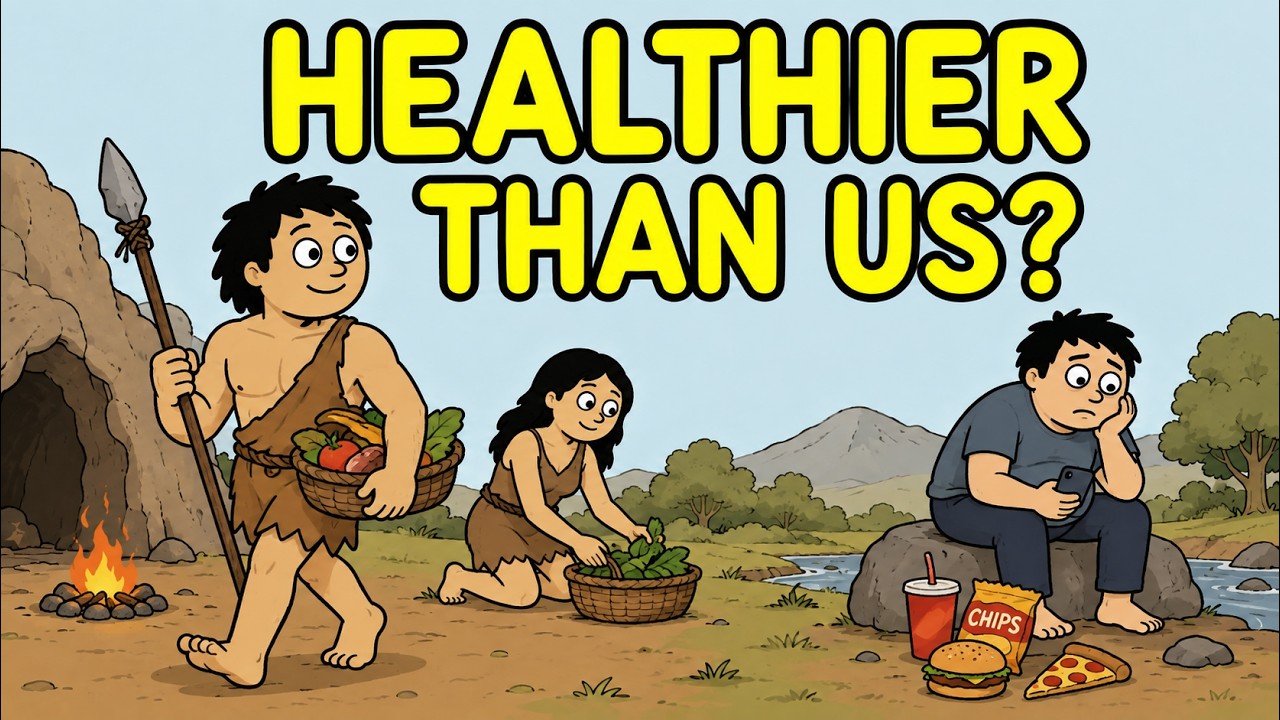
Bioarcheologists report this pattern repeatedly when studying remains from thousands of years ago: denser bones, straighter teeth, wider jaws, and joints with less degeneration. That raises an uncomfortable question. If ancient humans had no antibiotics, no surgery, no vaccines, and no clean water systems, how did their bodies end up measurably stronger in some ways than ours? The common assumption is that ancient people simply died before their bodies could fall apart.
Researchers say that answer is wrong, or at least incomplete. The widely repeated claim that early humans rarely lived past 30 is based on a statistical trap. Life expectancy at birth for hunter-gatherer populations does sit between roughly 20 and 35 years, according to anthropologists Michael Gurven and Hillard Kaplan. But that figure is dragged down by extremely high infant and childhood mortality.
When the researchers calculated life expectancy from age 15 onward, they found adults could expect several more decades of life. Their modal adult lifespan — the most common age at death for adults — fell between 68 and 78 years. The key distinction is between lifespan, how long a person lives, and healthspan, how long the body stays functional. Modern medicine has become extraordinarily effective at extending lifespan through antibiotics, vaccines, trauma surgery, and clean water.
But keeping the body strong throughout those years is a separate project. On that front, the ancestral body had advantages worth understanding — most of which remain available today. Movement is the most visible difference. Hunter-gatherers did not have a separate category of life called exercise.
Movement was simply what obtaining food, water, and shelter required. Researchers studying the Tsimane people of Bolivia, who still rely heavily on hunting, fishing, and small-scale farming, tracked their daily steps with the same devices modern fitness trackers use. Adult men averaged around 17,500 steps a day; adult women over 15,000. The average adult in an industrialized country takes under 6,000 steps a day, roughly a threefold gap.
The type of movement mattered as much as the amount. Ancestral days included walking long distances, climbing trees, digging for roots, carrying carcasses or children, throwing spears, and swimming across rivers. Each action loads the skeleton differently. Bone is living tissue that responds to mechanical stress the way muscle does — it grows denser where repeatedly loaded and thins where it is not.
A body doing many kinds of physical work every day builds a skeleton reinforced in many directions. Modern exercise science has tried to compensate for a sedentary day with a dedicated block of intense activity. Research suggests the 45-minute gym session helps but cannot fully undo the metabolic effects of 10 to 12 hours of near-total stillness. The body was not built to switch on for an hour and stay off the rest of the day.
It was built to be lightly, continuously active nearly all the time. Rest explains part of the puzzle as well. Researchers led by David Raichlen studied the Hadza, a hunter-gatherer population in Tanzania, and found they spend a comparable number of total hours resting as people in industrialized countries. The difference is posture.
Industrialized humans rest in chairs, couches, and car seats with leg muscles doing essentially nothing. The Hadza rest squatting or kneeling on the ground. Electromyography studies show that squatting and kneeling require continuous low-level contraction in calf and thigh muscles just to maintain balance. That activity keeps an enzyme called lipoprotein lipase switched on, which pulls fat out of the bloodstream for fuel.
Sitting motionless for hours causes that enzyme activity to drop. Food arrived on a different schedule in ancestral life. There were no refrigerators or stocked pantries. Meals came when a hunt succeeded or a plant came into season, sometimes after a full day or more of fasting.
That regular experience of running out of incoming food meant the body learned to switch fuel sources — burning stored sugar first, then shifting to stored fat. This switching ability, called metabolic flexibility, stays sharp with use and grows sluggish without it. Modern eating patterns, with food every two to four hours from waking to bedtime, keep insulin elevated almost all day. Over years, that constant signal is a central mechanism behind insulin resistance and type 2 diabetes.
The food itself was also vastly different. Wild meat, fish, roots, nuts, and seasonal fruit were smaller and less sweet than cultivated modern produce. There were no added ingredients, no refined sugar, no chemically extracted oils, and no preservatives. Seasonal shifts in what was available also kept the gut microbiome diverse, because different bacterial populations rose and fell with the changing diet.
Modern grocery stores stock identical produce year-round, which to a gut microbiome built for seasonal change reads as monotony rather than abundance. Sugar deserves particular attention because it explains modern cravings. In the wild, concentrated sweetness was rare and costly — ripe fruit, or a beehive defended at real physical risk. Because sugar was scarce and valuable as a fast energy source, the brain evolved a powerful dopamine reward response to it.
That wiring made sense when sugar was hard to get. It fails in an environment where sugar is sold in bulk at every corner store. Modern food companies deliberately engineered combinations of sugar, fat, and salt that do not occur in nature because they trigger that same ancient reward circuit far more intensely than any wild food could. Sleep followed a rule modern life has quietly deleted.
When it got dark, the day ended. Without artificial light beyond dim firelight, melatonin began rising in the brain as the sun went down. Melatonin makes a person sleepy while acting as a powerful antioxidant that supports overnight repair. Morning sunlight triggered cortisol release, promoting alertness and resetting the internal clock.
That cycle, the circadian rhythm, stayed locked to the sun for nearly the entire span of human existence. Modern screens and household lighting emit blue light, which is exactly what suppresses melatonin most effectively. Scrolling a phone at night delays melatonin release, fragmenting sleep and pushing it later. Sleeping outdoors or in a simple shelter also meant the surrounding air cooled naturally overnight, working with the body’s natural drop in core temperature that signals deeper sleep stages.
Sleep researchers now routinely recommend cooling bedrooms deliberately to restore that evolutionary cue. Stress followed a different shape as well — not necessarily different in total amount, but different in duration. An ancestral stress event had an obvious source and a definite end. A predator appears, the body floods with adrenaline and cortisol, the person runs or fights, and the threat resolves within minutes.
Modern stress rarely resolves. Unpaid bills do not disappear after a sprint. A stream of work notifications does not end after one confrontation. Because these threats cannot be physically outrun or fought off, the stress response never completes its loop.
The body stays mildly flooded day after day, and chronic low-grade cortisol elevation is now linked to damage to blood vessel linings, abdominal fat storage, disrupted digestion, and weakened immune response. Time outdoors did more than most people give it credit for. Sunlight on skin triggers vitamin D production, needed for calcium absorption and bone strength. Bright outdoor light also stimulates dopamine release inside the retina, which appears to restrain how much the eyeball elongates during childhood growth.
Outdoor daylight commonly measures in the tens of thousands of units of brightness; a well-lit room measures in the hundreds — a difference of roughly two orders of magnitude. Studies tracking children’s outdoor time link low daily exposure to higher rates of myopia, now affecting a rapidly growing share of children worldwide. Exposure to dirt, unfiltered water, and animals did something for the immune system that clean modern environments stopped providing. This is called the hygiene hypothesis, one of the better-supported ideas in modern immunology.
Early in life, repeated contact with a wide range of harmless microbes teaches regulatory T cells to distinguish genuinely dangerous threats from unfamiliar ones. An immune system raised in an environment scrubbed nearly clean of microbial contact often fails to learn that distinction. Long-term studies associate low-exposure childhoods with higher rates of allergies, asthma, and autoimmune conditions. The gut microbiome plays a second layer in the food story.
Trillions of bacteria in the digestive tract break down fiber the human body cannot digest alone, producing compounds called short-chain fatty acids, including butyrate, which maintains intestinal lining integrity and helps control systemic inflammation. Diets built on intact plant fiber feed a broad, resilient bacterial population. Diets built on refined, low-fiber ultra-processed food feed only a narrow slice of that population. A thinner, less diverse microbiome is associated with a weaker intestinal barrier, sometimes called leaky gut, in which substances leak into the bloodstream and provoke low-grade immune activation elsewhere in the body.
Even the shape of the human face carries this story. Skulls from ancient burial sites tend to show wide, well-formed jaws with straight teeth and wisdom teeth that erupted with ample room. Harvard evolutionary biologist Daniel Lieberman has studied why. Jawbone, like every other bone, grows in response to physical forces placed on it during childhood.
Extended breastfeeding and tough, fibrous food required muscular effort at every meal for years. That repeated strain caused the jaw to grow wide, leaving room for every adult tooth. Modern children raised on soft, preprocessed food never give the growing jaw that mechanical loading, which helps explain why braces have become standard and why crowded teeth, impacted wisdom teeth, and narrow airways linked to sleep apnea have become so common. Ancient humans also rarely overate, for a simply documented reason: every calorie cost real physical effort to obtain.
There was no free supply of 2,000 extra calories within arm’s reach. Natural fullness signals worked as designed because the food supply never overwhelmed them. Modern ultra-processed food breaks that link. It is energy-dense while stripped of the fiber and water that trigger fullness signals early.
The result is a gap between calories consumed and how full the body believes it is — a major reason overeating has become the default. Community was not optional in ancestral life. Humans evolved in small interdependent bands sharing food, labor, child care, and protection. Researcher Julianne Holt-Lunstad led a large analysis pooling data from over 100 studies covering more than 300,000 people.
It found that lacking strong social relationships was associated with increased mortality risk on a scale comparable to smoking up to 15 cigarettes a day. She has been careful to frame that as a benchmark for scale, not a literal equivalence, but the core finding has held across further research. A follow-up analysis in 2015, covering millions of participants, confirmed that both loneliness and social isolation independently raised the risk of early death. Biologically, the nervous system registers isolation as a physical threat, activating genes that increase inflammation while suppressing genes that fight viral infections.
Purpose worked on the same logic. In ancestral life, every task connected directly and visibly to the survival of people you cared about. Researchers studying purpose and mental health increasingly point to the disconnect between daily effort and tangible outcomes in large abstract institutions as a contributor to high rates of anxiety and low mood in industrialized populations. The brain’s information diet changed just as dramatically.
For nearly all of human existence, information was slow, physical, and grounded in immediate surroundings — wind shifting, tracks in soil, bird calls. A modern smartphone delivers a volume of information no ancestral brain ever had to process. Researchers studying attention and cognitive load estimate that a single day of modern media consumption exposes a person to more raw information than an ancestral human might have encountered across weeks. That constant stream keeps attention and decision-making circuitry almost continuously engaged, with little downtime, producing what a growing body of research describes as cumulative mental fatigue, shortened attention spans, and a persistent inability to fully switch off.
Temperature also played a role. Ancestral humans moved through real daily and seasonal temperature swings. Cold exposure activates brown fat, which burns energy to generate heat and appears to improve insulin sensitivity. Heat exposure triggers repair proteins that help damaged cells refold.
These hormetic stressors — manageable physical challenges — prompt the body to adapt and grow stronger. Living at a constant comfortable temperature removes that challenge, and the body has less reason to maintain adaptive machinery it is never asked to use. None of this means ancient life was a paradise. A minor cut could turn fatal with no antibiotics.
Intestinal parasites were common and caused chronic anemia. A broken bone could mean permanent disability. Childbirth carried significant risk of death with no surgical intervention available. Conflict between groups and predator attacks were genuine threats.
These were routine parts of ancestral life and the primary reason life expectancy at birth sat so low. The people who survived childhood did so in an environment their biology was closely matched to, and that match produced the dense bones, wide jaws, and resilient metabolism. The trade-off is worth stating honestly. Modern people face a far lower chance of dying from routine infection, difficult birth, or untreated fracture than any hunter-gatherer ever did — arguably the greatest public health achievement in the history of the species.
What modern people have picked up in exchange is a much higher lifetime risk of slow, chronic conditions that build quietly over decades: heart disease, diabetes, obesity, autoimmune disorders, chronic anxiety. Researchers increasingly describe these as diseases of mismatch. Genetic change through natural selection happens slowly across thousands of years. Cultural and technological change happens fast — farming replaced foraging in a few thousand years, and smartphones replaced farming lifeways in a few hundred.
The human genome has not had time to catch up. We are, in a concrete sense, ancient biology running inside a modern shell. The practical implications do not require rejecting modern life. They involve rebuilding a handful of ancient inputs deliberately.
Move throughout the day rather than only in a scheduled workout. Sit on the floor sometimes instead of always in a chair. Build meals around whole, minimally processed food and give the body genuine breaks between meals. Get outside in real daylight, especially in the morning, and dim screens at night.
Invest in relationships that involve physical presence. Let children chew tough, real food. Let the body experience heat, cold, and physical effort now and then. None of this requires giving up what makes modern life genuinely good.
It requires remembering that the body carrying you through that modern life is, underneath, the same body that walked 17,000 steps a day, slept when the sun went down, and rested in a squat instead of a chair. It was healthier not because it was ancient, but because it was living inside the world it was built for.