The man who once embodied the cool, detached glamour of Swinging London died exactly as he had lived: on a film set, mid-production, with his scenes finished and his heart simply giving out. David Hemmings, the actor whose face defined a generation in Michelangelo Antonioni’s Blow-Up, collapsed and died on December 3rd, 2003, in Bucharest, Romania. He was 62 years old.
Hemmings was walking back to his dressing room after completing his day’s work on the supernatural thriller Blessed when he suffered a fatal heart attack. Paramedics worked on him at the scene but could not revive him. His fourth wife, Lucy Williams, was at his side.
 The actor had joked only months earlier that he might not live to see 70, a darkly prophetic statement that proved devastatingly accurate.
The death marks the final chapter in a life that was as turbulent and contradictory as the era that made him famous. From his start as a boy soprano prodigy under the obsessive wing of composer Benjamin Britten, to his sudden rise as a global 𝒔𝒆𝒙 symbol, to his later years as a journeyman director of television shows like The A-Team, Hemmings’ career was a study in spectacular ascents and equally spectacular falls.
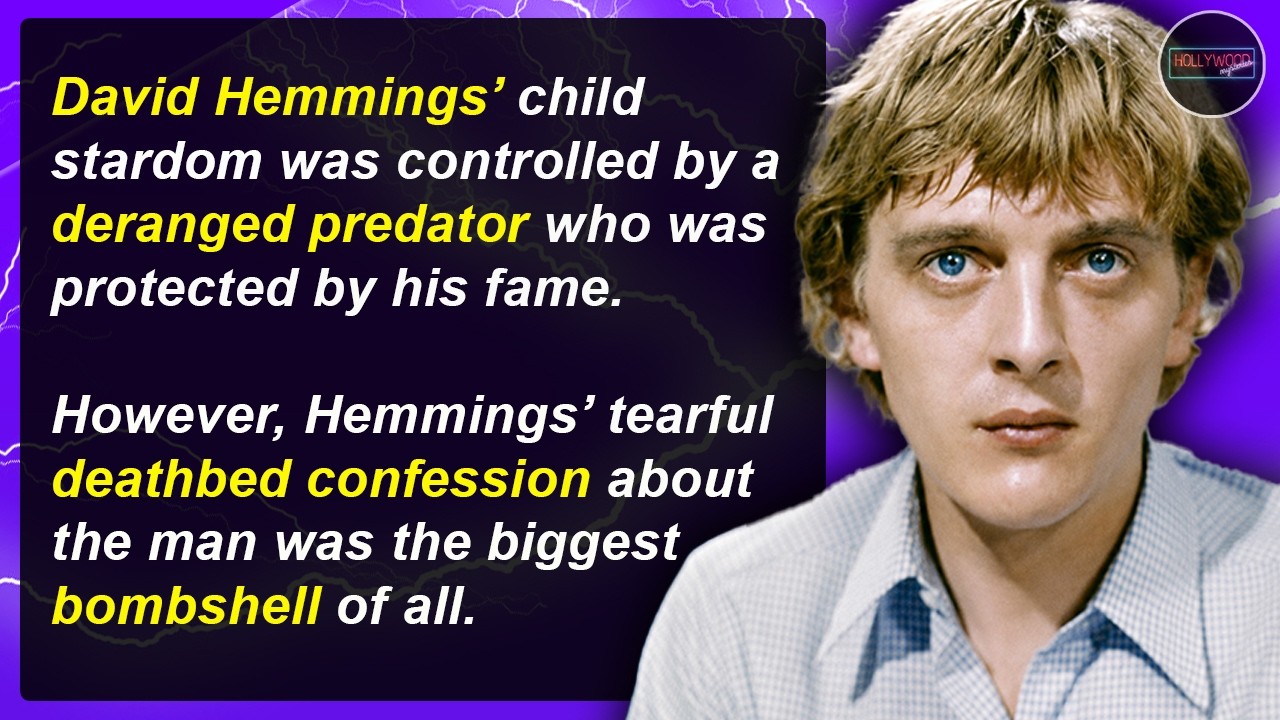
His early life was defined by a relationship that has haunted his legacy for decades. At age 12, Hemmings became the muse of Benjamin Britten, one of England’s greatest composers, who wrote the role of Miles in The Turn of the Screw specifically for the boy. The relationship was intensely possessive, with Britten showering the child with gifts, letters, and attention, even sharing a bed with him during stays at Aldeburgh.
Hemmings always insisted the relationship was never sexual, famously deflecting questions with the line that he was “more heterosexual than Genghis Khan.” He maintained until his death that Britten was “a father and a friend.” Yet the end came with brutal suddenness when Hemmings’ voice broke on stage in Paris at age 14, and Britten waved him away, never speaking to him again.
The psychological scar of that abandonment seemed to define his personal life. Hemmings married four times and fathered six children, but his chronic womanizing and heavy drinking left a trail of damage. He was a serial philanderer who admitted to hiding half-dressed in closets to escape wives, a man of enormous charm who always seemed to be leaving a room before anyone could leave him first.
His professional peak came in 1966 with Blow-Up, a film that nearly didn’t happen. Antonioni initially dismissed him as “too young” for the role of Thomas, the jaded fashion photographer who believes he has captured a murder on film. The director’s constant head-shaking during the audition left Hemmings convinced he had failed, unaware that Antonioni had a neurological tic that made him shake his head regardless of his mood.
The film was a sensation, earning $20 million on a $2 million budget and effectively ending the Hollywood production code with its full-frontal nudity. Hemmings became the most photographed young man of his moment, but the role became an albatross. His subsequent choices, including singing in Camelot and starring in Alfred the Great, failed to match that early summit.
Perhaps his greatest professional irony was his association with Hemdale Films, the company he co-founded in 1967. The firm would go on to produce The Terminator, Platoon, and The Last Emperor, winning back-to-back Best Picture Oscars. Hemmings sold his share early, walking away from one of the great fortunes in modern cinema to dismiss producing as “a thankless task akin to hotel management.”
His final years brought an unexpected renaissance. Ridley Scott cast him in Gladiator in 2000, and audiences who remembered the slender boy of Blow-Up squinted at the stout, gravel-voiced man with magnificent eyebrows. The role led to a flood of work, including Spy Game, Gangs of New York, and a poignant turn in Last Orders, where his own son Nolan played his younger self.
The symmetry of his death was not lost on those who knew him. His old friend and drinking partner Oliver Reed had died in 1999, collapsing in a Malta bar during the making of Gladiator. Hemmings was in that very film.
Four years later, he followed his friend into a sudden death on a set in a foreign land, working until the very end.
He was buried in the churchyard of St. Peter’s at Blackland in Wiltshire, a long way from the opera houses of his boyhood and the beaches of his prime. His memoir, Blow-Up and Other Exaggerations, appeared posthumously the following year.
The film he died making was dedicated to his memory.
Producer Nick Powell spoke for many when he noted the cruelest irony of all: “His acting career was really flowering.” The boy whose voice broke on a Paris stage and ended one life turned out to be the overture to a stranger, longer, messier one. Britten cast him out for growing up.
The movies, in the end, loved him for exactly the same thing.