A belief that has been held by tens of millions of people in one of the world’s most technologically advanced countries has been blamed for deaths for more than half a century: the idea that sleeping in a closed room with a running fan will kill you. South Korea, a nation with bullet trains and world-class hospitals, has had its consumer product safety commission list “fan death” as a cause for concern. Some electric fans sold there have come with built-in timers, marketed not as a convenience but as a safety measure. The belief has persisted across generations, social classes, and urban and rural communities alike, even among a highly educated population with full access to modern science.
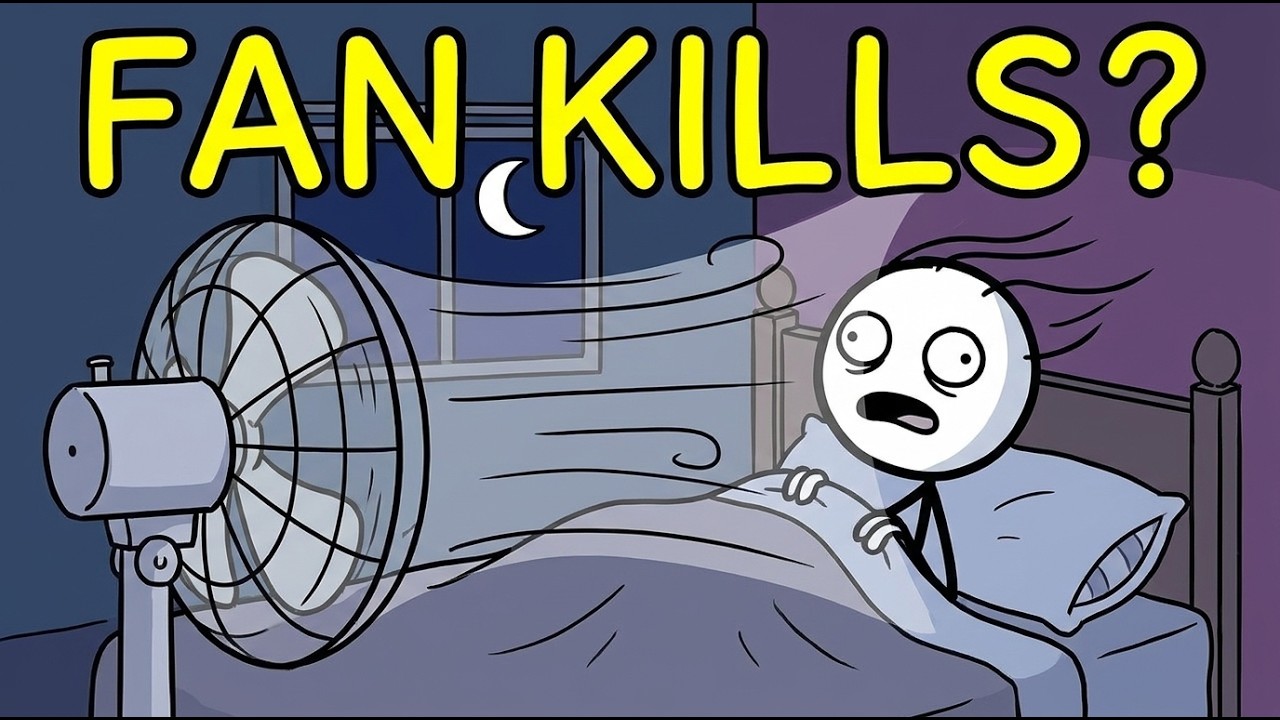
The question is whether tens of millions of people have been wrong about something basic for decades, or whether there is something about fans and enclosed spaces that deserves a closer look. What a fan actually does is not cool the air. A thermometer in a room with a running fan will stay the same, or even rise slightly due to the motor’s heat. The fan moves air across the skin, which accelerates two of the body’s four heat-loss methods: convection and evaporation.
This is why a fan feels cold even when the air temperature has not changed. The body senses the rate of heat loss, not the air’s temperature. That cooling effect has a limit. When ambient air temperature rises above roughly 35°C, the skin’s surface temperature, the fan stops helping.
The air is warmer than the body, so moving air can add heat through convection while drying out the skin and airways. The World Health Organization and several heat-emergency guidelines have acknowledged that in extreme temperatures, a fan without any cooling element, such as a wet towel or cool water, can worsen heat stress. The Korean belief itself comes in several versions. One theory holds that fan blades chop up oxygen molecules.
Fans spin at 300 to 1,200 revolutions per minute, while an oxygen molecule is about 0. 3 nanometers across. The speed required to meaningfully interact with individual gas molecules does not exist outside particle accelerators. The fan pushes bulk air; it does not slice molecules.
This mechanism is physically impossible. Another theory suggests that moving air creates a low-pressure zone that pulls air out of a sleeper’s lungs. Fans do create localized pressure differentials, but the force required to overcome the resistance of the diaphragm and rib cage would need to be on the scale of industrial machinery, not a household appliance. This mechanism has also been dismissed.
A third theory involves hypothermia: the fan cools the body’s core to fatal levels during sleep. This one is at least mechanistically coherent. Core body temperature must drop to about 35°C to enter the clinical definition of hypothermia, with unconsciousness at 32°C and cardiac arrest becoming likely below 28°C. For a fan to drive this process, the air would need to be genuinely cold, and the sleeper would need to be sweating heavily, uncovered, and either elderly or very young with impaired thermoregulation.
Some Korean scientists have tentatively acknowledged this as a plausible edge case for vulnerable individuals, though unlikely for healthy adults. The fourth theory is carbon dioxide buildup. A running fan in a sealed room recirculates the same air, and CO2 builds to lethal levels. A typical bedroom is not sealed; air leaks under doors and through window frames.
The human body produces CO2 at a rate that would take many hours to reach dangerous thresholds in a room-sized space. However, CO2 levels in poorly ventilated bedrooms are a real area of sleep research. Studies show CO2 rises meaningfully overnight, not to lethal levels but enough to affect sleep quality and next-day cognitive performance. A fan might help by distributing that CO2, or it might hurt by creating a more efficient rebreathing cycle if the airflow directs exhaled air back toward the face.
This is unsettled science, but not dangerous in the way the belief describes. There are documented South Korean cases where people were found dead in rooms with fans running, and the fans were blamed. Autopsies typically attributed the deaths to cardiovascular events, heat stroke, or acute alcohol intoxication. The fan was present, and the fan was blamed, but it may have been entirely incidental.
This is a classic problem in epidemiology called confounding: the conditions that led people to use fans aggressively at night were the same conditions that elevated risk, such as summer heat waves, excessive alcohol, and pre-existing cardiac conditions. The fan was a bystander. The belief itself is not irrational in origin. People observed a real pattern of deaths in hot summer months in rooms with fans, generated a causal hypothesis, and lacked the controlled studies to separate the fan from the real causes.
The society reinforced the belief at every level: media, government, and family. This is how human beings form beliefs, even wrong ones. Fans can genuinely affect the body in other ways. Running one all night accelerates moisture evaporation from the skin, eyes, nasal passages, throat, and mouth, which can worsen sinus inflammation, dry eye, and respiratory discomfort.
For people with asthma, a fan blowing dust, pet dander, or pollen can trigger symptoms. Fans can also disturb sleep through noise and air movement, causing micro-awakenings in light sleepers and reducing deep sleep stages, which can accumulate into a sleep debt over time. There is also the ceiling fan problem. Fans are installed by people of varying skill levels in ceilings of varying structural integrity.
A poorly mounted, wobbling ceiling fan is a multi-kilogram object spinning at speed over a sleeping person. The U. S. Consumer Product Safety Commission has documented injuries and deaths from ceiling fan failures, including fans falling on sleeping people.
This is the most literal way a fan can kill someone, and it is rarely discussed. Electrical fires are another real risk. Fans running continuously for eight or more hours, especially older, cheap, or improperly maintained models, are electrical devices in close proximity to sleeping people. This is not a significant risk with a quality, well-maintained fan, but it is a real one.
The conclusion is that a fan under normal conditions, for a healthy adult, in a reasonably ventilated room, at temperatures below 35°C, will not kill you. The popular Korean conception of sudden asphyxiation or thermal death in an otherwise healthy sleeping person is not supported by evidence. The proposed mechanisms are either physically impossible, biologically implausible, or require such extreme conditions that the fan is almost incidental. The real risks are different: heat stress in vulnerable individuals at extreme temperatures, mechanical and electrical failure, and the slow cumulative effects of dry air on respiratory passages.
The Korean belief system produced behavior that was not entirely unreasonable. Running fans on timers reduces cumulative dehydration, electrical fire risk from continuous operation, and hypothermia risk on cold nights. The conclusion was wrong, but the practice was, in some ways, not entirely wrong. Fan death as a scientific claim is false.
Fan death as a cultural response to the real phenomenon of people dying in bad sleeping conditions during heat events is a story that made sense given what people knew and observed. The fan moves air. That is all it does. The real killers in those cases were summer heat, alcohol, aging hearts, and sealed apartments in August.
The fan just happened to be running when the body was found. The story reflects a deeply human pattern: we look for a cause, find something nearby, build a story around it, and teach that story to our children. In South Korea, a spinning plastic blade became the villain in a tale of death, and it took decades of science to acquit it. Your fan is not guilty.
But checking the mounting screws is still a good idea.