Animals rescuing humans has become a staple of internet storytelling, but the phenomenon is far more complex than simple heroism. While the public narrative often frames these incidents as animals acting on pure altruism, a closer look at evolutionary biology suggests that a mix of ancient instincts, domesticated traits, and measurable hormonal responses is likely driving these behaviors. The reality is less about conscious goodwill and more about the deep-seated wiring of the animal brain. The most common stories involve dogs, and for good reason.
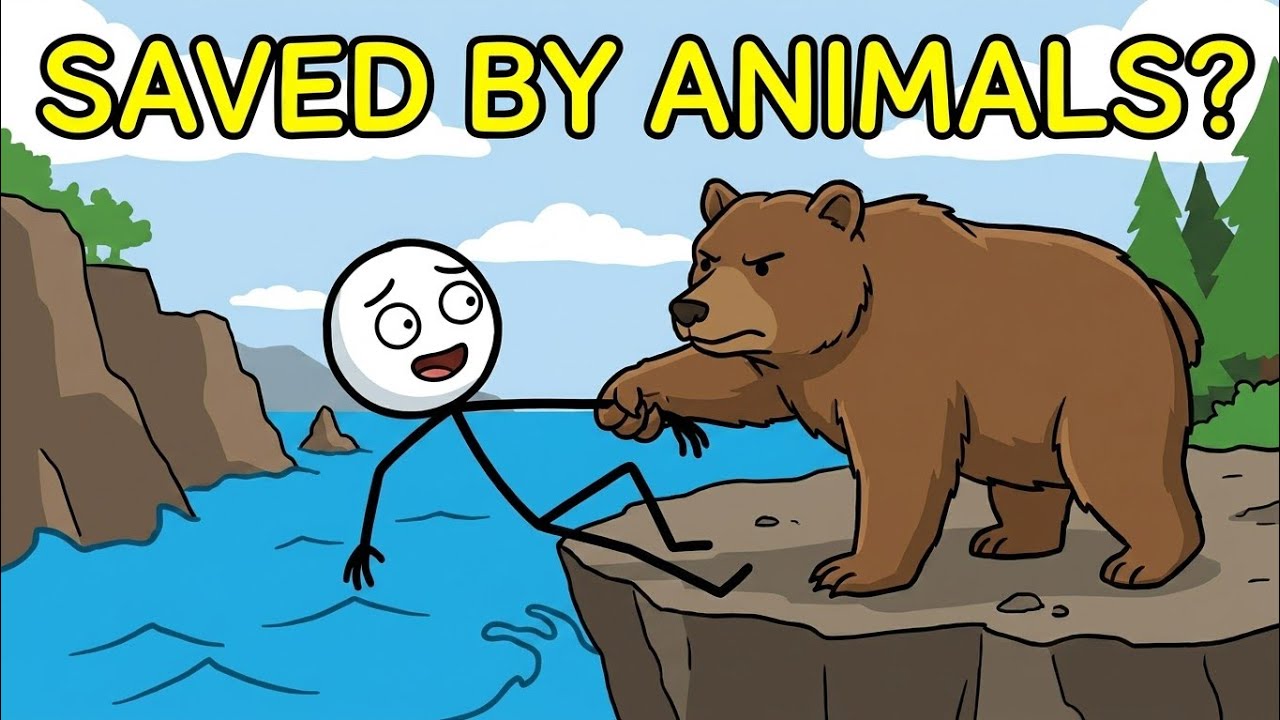
Roughly 15,000 years of domestication have rewired the canine brain. The key adaptation was not intelligence, but a refined social instinct. Dogs evolved to understand human cues as part of their social structure, where pack members protect each other. When a family dog alerts a human to a gas leak or wakes a parent during a seizure, it is often the animal’s hyper-social instinct to maintain the safety of its pack extending to its human family.
It’s not a moral judgment by the dog, but a reflexive extension of cooperative protection. However, this behavior is not limited to dogs. Highly social species like crows and ravens frequently alert humans to danger. They do not necessarily perceive a philosophical need to protect, but rather a practical one.
A distressed human’s panic signals can trigger an animal’s own fear response. When a startled crow makes a racket, it is often just as much about its own safety as it is about the human’s. Yet, over time, a pattern emerges; a crow that has learned a specific human is a non-threat may issue alarm calls that seem specifically targeted at warning that human of a hidden predator. The mystery deepens when considering animals intervening in danger that has nothing to do with predators.
When a dog drags its owner from a fire or a marine mammal pushes a struggling swimmer to the surface, these are non-predator threats requiring abstract assessment. In these cases, the animal is not merely reacting to a fight-or-flight trigger. Instead, a flood of oxytocin—the bonding hormone—released during positive interactions with its human can create an overwhelming urge to protect that translates into remarkably sophisticated problem-solving under pressure. There are documented cases of gorillas shielding children who have fallen into their enclosures.
These powerful animals, capable of tremendous harm, instead position themselves between the frightened child and their own troop. They are protecting the child because the vulnerability of the little human mirrors the cues of their own infants. The protective circuitry designed for offspring runs on the same neurological pathway, and in a moment of stress, the pure instinct to safeguard a small, fragile life overrides any perceived threat. The same protective drive found in dogs and marine mammals appears in less obvious species, such as geese.
A startled goose is a loud alarm system, and while the bird is simply reacting to something unusual in its environment, its very existence and alarm call can alert an entire household to a fire or an intruder. This isn’t deliberate heroism; it is a hyper-sensitive prey animal doing exactly what evolution built it to do, with a human accidentally being the beneficiary of the resulting chaos. Solitary animals, however, rarely rescue humans. They lack the social wiring that allows them to generalize protection to others.
It’s not that they are crueler, but that their evolutionary toolkit never required building the circuitry for cooperative protection. Their protective instincts fizzle out because there is no pack to protect. The rescue stories we do see are overwhelmingly from species that, for millions of years, have survived by looking out for each other. Yet, even with all this biological explanation, some cases are incredibly difficult to dismiss as coincidence.
Cases where animals actively position themselves between a human and a a predator, bypassing their own flight instinct, appear to be a genuine risk assessment *on behalf of* the human. This suggests that the protective circuitry sometimes ‘misfires’ and extends toward a species outside its own. It isn’t a bug in their system, but a feature of an imprecise filter that has evolved to protect the vulnerable within a tightly knit family unit. Crucially, this is also a story about human influence.
We are not passive recipients of this generosity. Over thousands of years, humans have accidentally selected for animals that show protectiveness. We bred horses that respond to our cues and dogs that seek out our approval. We have engineered the exact circumstances for these behaviors to surface.
If an animal is already wired to intervene for a distressed pack member, we have basically been training ourselves into the pack, becoming part of the family it will lay down its life for. The notion that an animal reserves its bravery for a specific person is supported by the measurable hormonal response of oxytocin. This chemical is triggered by familiarity and positive interaction. In a bonded human-dog relationship, the same system that a mother uses to care for her young is activated.
When a dog protects an abusive owner, or a cat risks its life for a dying elder, the animal is not seeking cosmic justice. It is reacting to a deep, instinctively driven urge to protect its most trusted companion. So, what seems like a universal law of nature saving us is actually a very specific combination of coincidences. It suggests that some animals are capable of factoring human safety into their decision-making, even above their own comfort.
They have formed a deep-seated bond where a human is treated as if they are a child of the herd. It’s a measurable, chemical, and behavioral response that bridges the gap between species. Humans have played a direct role in creating these conditions. Every time we show patience to a stressed animal, every time we choose coexistence over conflict, we reinforce its protective instincts.
We are not just the beneficiaries of this kindness; we are active participants. We helped build the world where saving a human is a logical, instinctual thing for an animal to do. We are part of a cosmic coincidence where our own vulnerability happens to trigger the most ancient, powerful protection systems in nature.
In a universe built on indifference, we have accidentally engineered our own lucky breaks.