It was a little before 5:00 in the morning, the hour out here when the mountains are only a darker shade of dark, and the heat has not yet decided what it will do to you. I was on the flight line with the night’s maintenance reports still folded in my hand, thinking about a weather system building over a valley eight thousand miles east of me, and whether the crews on the floor had enough fuel to wait it out before they had to make a decision they could not take back. I had crossed that apron so many times that my body did not understand there was anything to stop for. The air was still cool the way it only is for about forty more minutes, and I was already running the morning’s checklist in my head, the way you do, the way you always do, letting the rhythm of it carry you forward until the day is already half over before you have truly arrived in it.
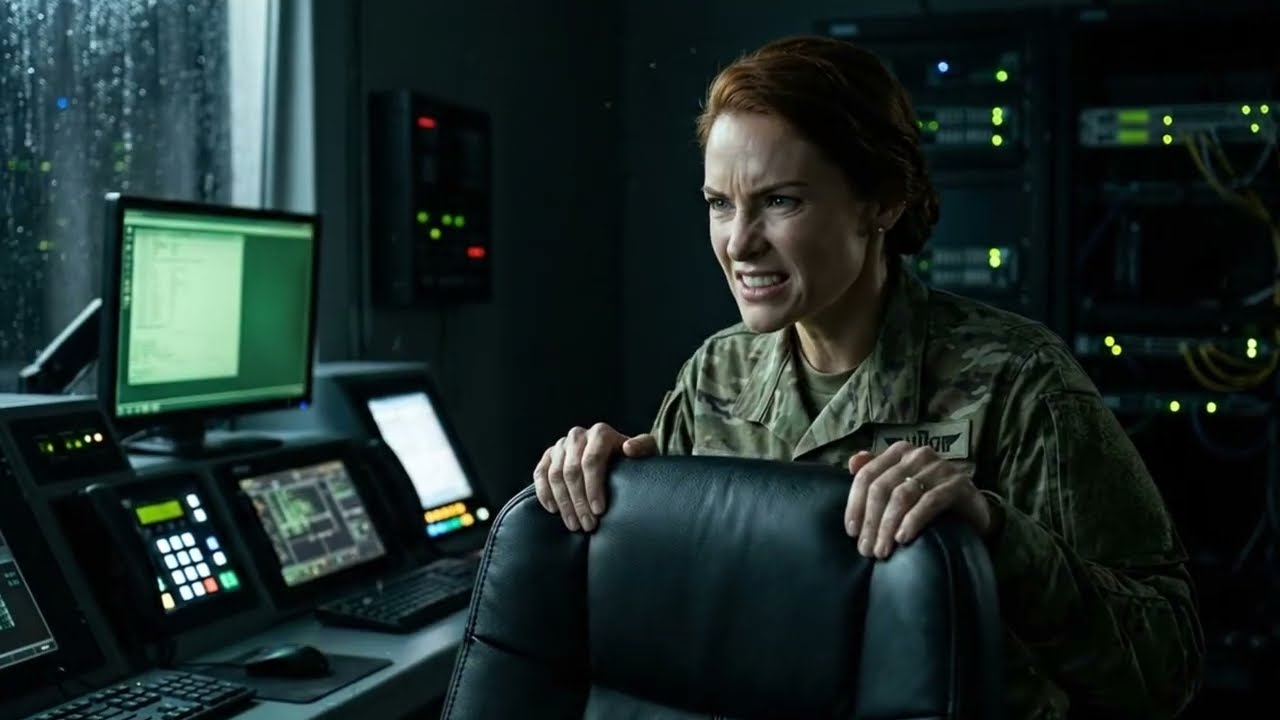
He stepped into my path and put his hand flat on my shoulder and pushed. Not hard enough to put me down, but hard enough to make a point in front of his friend. He was wearing the uniform, the same one I had been wearing since before he was old enough to know what it meant, and he looked at me the way you look at something that has wandered into your day and does not belong there. “Get her off my line before she breaks something,” he said over his shoulder, and the airman with the phone laughed.
“The gift shop’s the other way. ”
I stopped because you do not walk into a brand new airman’s hand and keep walking, not out here, not when the whole point of the morning is that everybody on that line is supposed to know what their hands are for. “Take your hand off me,” I said, and my voice was level, the way it gets when I am holding something down, the way it has gotten a thousand times before. He left it there a beat longer than he needed to.
The other one was filming, and because he was nineteen years old and three weeks into the only assignment he had ever had, and a quiet woman in leggings was the easiest target the morning had handed him, he pushed again, just a little, just enough to feel it, and then he said it. “What are you going to do about it, sweetheart? ”
And that is where I have to stop the story, because you need to understand something about what happens next. It is not the thing you think.
It is not the thing the movies would give you. It is the thing that only makes sense if you have ever been the one who has to watch and cannot move, who has to carry the weight of the window, the single second, the entire outcome of a whole life, and only get to act through a screen and a prayer. There is a term for it, something the crews whisper in the dark, something I have never repeated out loud in a room full of people who do not know. It is not anger.
Anger has a heat to it, a color, a shape you can name. This is colder. It is the thing that grows in the place where panic used to live, after you have spent enough hours watching people you cannot reach. It is the place where you keep the pictures, the moments, the names of the ones who did not make it back because the window was not there for them.
And I stood there, with his hand on my shoulder and his friend’s phone recording, and I let the cold do its work. I let it settle over me like a second skin, the way it has settled a hundred times before in rooms with no windows and skies with no friendly place to land. And I did not raise my voice. I did not move his hand.
I just stood there, looking at him, the way you look at a formation you are about to correct, and I spoke. “First,” I said, “you will remove your hand from my person before I decide that you are a threat to the safety of this flight line, and I will act accordingly. Second, you will go to your squadron commander and you will tell him that you placed your hands on a senior officer and you will let him decide what that means for you. And thirdly, Airman, when you have finished being embarrassed about this, you will come and find me, because we are going to have a conversation about the mission you think you understand.
”
He blinked. His hand fell away. He looked at his friend, who had stopped filming, and then he looked at me, and the confident nineteen-year-old who had owned the morning two minutes ago was gone, replaced by a boy who had just realized he had no idea what he was standing in front of. “You have got to be kidding,” he said, but it was weak, already falling apart.
“You should understand what you have actually walked up to on this apron,” I said, and I was quiet, the kind of quiet that makes the whole line feel like it is holding its breath. “Because almost nobody does. Not the fighter pilots, not the infantry, not the relatives at holidays who do not understand. You think you know what I do?
You think this is a game? ”
He shook his head, but he was not sure anymore. “I am only telling you which way the wind is blowing before you decide anything else today,” I said. “You have until the end of the week to decide, but the wind only blows one way for the people you think you are mocking.
You want to practice your weekend warrior routine, you do it somewhere else. ”
I turned and walked away, and the cold was still there, but it was quieter now, and I was angry, angry in a way I had not allowed myself to be in years, because the truth of it is that I have heard that joke a hundred times. I have heard it from the fighter pilots and the infantry and the relatives at holidays who do not understand what it is that people like me actually do. And I want to be honest with you about that, because the boy on the flight line was only the most recent person to make it, and he was the youngest, and the most forgivable.
The cruelest version of it is the one the crews do themselves. It is the look that passes between men when you tell them what you fly, the practiced way you answer with the story about weather, a hard landing, a night you ran low on fuel over the ocean in the Hercules. It is the man who notices, after a year, that you never speak about the deployment the calendar on your wall plainly marks, and the careful, kind way you change the subject until he stops asking, and then, eventually, stops staying. But the one I remember, the one that got in under the skin and stayed there, happened twelve years ago, on a ramp a long way from here, when I was still young enough to believe that if you did your job, it would be enough.
When I was still hungry for the thing I had not yet earned. I understand now that I have skipped ahead of something, that the story has a shape that needs honoring, so let me bring you back. Back to the ramp, back to the sun, back to a time before I learned every single thing I now know about what happens in the dark. I will call him Wade, because that is his name, and it is not the name you will find on any of the official paperwork I have filed, but it is the name I have carried with me for twelve years.
Wade Carrasco, twenty years old, a specialist, a sensor operator, the man whose job it was to sit in the seat next to mine and see. He had a face like a lot of them do, still boyish, still open, like the world had not yet gotten the chance to write its lessons on him. And I loved him the way you love your first hard thing, the way you love the thing that almost breaks you and leaves you better for it. We were sitting in the dark, the low red light they run so the crews’ eyes stay tuned to the screens, watching a feed only we could see.
It was the first hour of the operation, and that is the only part of the story that matters, the only part that has ever mattered, because that was when the call came in. There was a unit on the ground, a squad that had walked into something they should not have, and they were pinned down, and they were calling for everything we had. And the window opened. That is the phrase we use.
The window, the opening, the single second where all the planets align and you have a clear shot, and you know that the only thing in the whole world that is going to save the men on the ground is you, and your thumb, and the split second you have to decide if the target you are looking at is the one you have been sent to take. I had the feed. I had the crosshairs. I had my finger on the trigger, and I was already feeling the old familiar calm settle over me, the calm that is the only thing that gets you through the dark, and that was when I saw him.
The boy I was sent to kill. He was young, sixteen, maybe seventeen, and he was standing there holding a launcher, and he was looking up at the sky, and I remember thinking, clear as day, that he was just a boy. That he had a mother somewhere, a family that would not know, and that the war would go on without him. And I hesitated.
That is the word. I hesitated, and the moment stretched, and I heard the voice of the man on the ground, screaming into the radio, and I heard the sound of the fire, and I knew that Wade was screaming too, screaming something I could not quite make out, and then the window closed. The boy got off his shot. The launcher bucked, and I saw the tracer arcing through the air, and I knew, I knew with a certainty that has never left me, that it was over.
That I had missed my chance, and that the price of my hesitation was not going to be paid in that moment, but in the next, in the one after, in the ones that would leave Wade Carrasco in the dirt of a wash, hit in the first hour before the weather closed and the window shut, dead of his wounds while I watched through a camera and could not reach him. And I screamed. I screamed inside a silence I was not allowed to break, and I watched him fall, and I have spent twelve years editing that one hour into the whole story, the story I tell myself in the middle of the night when the quiet gets too loud. I have never told the story of the Distinguished Flying Cross.
The one in the box in my drawer, the one I keep in the dark, the one that says I did something right. Because every time I open it, I am back in the room, in the same room, sitting in front of the feed, and I am watching Wade die again, and I am doing the math, over and over, the math of the one second I could have saved him, the one second I did not take. They gave me the medal. They pinned it on my chest with the others, and they said the words that are the only thing you are ever flying for, the words that mean you counted, that you made a difference, that you were there.
And I wore it. I wore it down the ramp, past the line of men who did not know, past the faces of the people who thought they understood, and I stood in front of the flag and I watched them fly the flag that had covered his coffin, and I felt nothing. I felt nothing for years. I built a life on the nothing, a life of quiet competence and dry humor and a practiced way of changing the subject.
I taught myself to be the person who seems fine, who seems strong, who seems like she has it all together, because the alternative was to sit in the dark and count the seconds I did not have. And then, a few weeks ago, I opened the drawer and I took out the case, and I held it in my hands for the first time in years. And I sat there, in the same chair I have sat in for the last six years, in the same room with the same low red light from the screens that I now command, and I looked at the medal, and I thought about the boy on the flight line, the one who had pushed me, the one who had called me a sweetheart, the one who had no idea who he was dealing with. And I started to laugh.
It was the most God-awful sound, a laugh and a sob all rolled into one, and I bent over and put my head in my hands, and I laughed until I cried. Because the joke was too good, don’t you see? The irony was too perfect. All these years, I had been carrying the weight of a dead boy’s name, and I had been doing it all wrong.
I had been carrying it like a punishment. I had been treating the medal and the memory like it was the thing that had broken me. And all the while, I had forgotten that the thing that had broken me was not the thing that had been done to me. It was the thing I had believed about my own job.
I had let the 19-year-old on the ramp, the fighter pilots, the infantry, the relatives at the holidays, I had let all of them tell me that what I was doing was not real. I had let them make me feel like I was not a warrior, just a woman who pushed buttons. And the cruelest part was that Wade would have hated that. Wade, who died doing the job that I do, who would have told you that the hardest part is not the moment, not the split second, not the eye on the screen.
The hardest part is the chair, and the patience, and the half second, and the drive home after. The hardest part is the discipline not to let the violence reach your hands, to keep it right where it belongs, in the part of you that makes the call, and not the part of you that has to live with it. I am not the only one who knows this. There is a reason the uniform is an equalizer, a reason that the men and women who do this work, who sit in the dark and watch, are the quiet ones.
We are all carrying the same weight, telling ourselves the same story, trying to make it through to the next mission without letting the dark swallow us whole. I look at my hands, the same hands that held the trigger, that hit the button, that made Wade’s death real, and I think about the night it all went wrong. I think about the promise I made in that dark room, a long time ago, that if I was ever going to send crews to do this, I would never forget in my body what it costs. And I have not forgotten.
I have never forgotten. I have just spent a long time thinking that the forgetting was the whole point, when it was the opposite. The remembering is the point. The quiet, unglamorous, daily act of remembering is the whole entire point.
The boy on the flight line came to find me three mornings later. He was a wreck, a nervous wreck, all bluster and apology, and I listened to him trip over his words as he stood at parade rest and tried to hand me a written apology that was missing half its letters. “Ma’am, I am so sorry,” he said. “I did not know.
I had no idea. If I had known, I never would have. I swear, I would rather have lost my own hand than touched you like that and I want to say I am fully prepared to accept whatever consequences, that I deserve whatever you decide to throw at me, and I have already, uh, failed my remedial PT test and I am ready for the worst, I am ready for anything. ”
I held up my hand to stop him.
He snapped his mouth shut, and I watched him brace, waiting for the boom. “Airman, what do you know about the mission we did in the Sangin Valley in 2009? ” I asked him. He blinked.
“I am going to be honestly, ma’am, not much. I joined up in 2022. My recruiter said it was all about the language school, you know, the intel side of things, mapping the networks. I only decided to come to security forces because, well, I did not want to sit at a desk all day and my dad said the Air Force would be a good way to get a trade, but I guess I got the wrong idea about, uh, about things.
”
“You did,” I said. “You have been working a job that is invisible to you. You see the screens, you see the uniforms, you see a woman who doesn’t look like she belongs on your flight line. And you have been carrying around a story about all of it that is not real.
That is not your fault, and it is not your shame to carry. But it is your responsibility to understand. That is the only thing I am going to order you to do. You will get remedial training.
And you will have a standing requirement to spend time with the crews, during the most boring parts of the shift, the parts where nothing is happening, the parts where the weather is bad and the air is thick and you are just sitting there, watching the screen and counting the seconds. Do you understand? ”
He nodded, his eyes wide. “And if you ever, ever put your hands on another person again, it will not be because you are a bad person.
It will be because you have not learned the lesson yet. But you have an opportunity to learn a better lesson. Do not waste it. ”
He stood there for a long moment, and then he asked the question that proved he was starting to understand.
His voice was quiet when he said, “Is it true? Is it true what they are saying? That you were in the chair that night? That you saved that whole squad?
”
I looked at him, and I saw the boy he had been, and the man he could become. “I was the one holding the signal,” I said. “I was the one who had to make the call. But I do not get to keep that moment for myself.
None of us do. We share it. That is the only way to keep it from eating us alive. ”
I saw him leave, the bounce gone from his step, replaced by the weight of the knowledge I had just given him.
The weight that I carry every day. The weight that I have learned, at long last, not to be afraid of. Later that night, I went back into my office, and I opened the drawer, and I took out the medal case. It felt different in my hands, less like a tombstone and more like a compass.
I opened it and I looked at the Distinguished Flying Cross, and for the first time in twelve years, I did not flinch. I am not okay. I do not think any of us are ever completely okay. The ones who say they are over it are lying to themselves and to you.
We carry it all with us, in the silence, in the evenings, in the corners of the day. But you do not carry it in the way you think. You do not carry it like a wound. You carry it like a promise.
And the only way to make good on that promise is to stop keeping it a secret. To let go of the version of the story where you are the one who failed, and to take up the version where you are the one who stayed. I closed the case and put it back in the drawer. Then I walked over to the window and I looked out at the flight line, where the lights were still reflecting off the wings of the aircraft I have spent my life learning to understand.
The sun will not come up for another few hours. That is okay. I am not afraid of the dark anymore. I am not afraid of the quiet.
I am not afraid of the memory of a dead boy’s name, or the weight of a medal I have never worn. I am ready for the morning. I am ready for the next mission.
And for the first time in twelve years, I am ready to be seen.