In 1917, a German archaeologist working on the coast of the Atacama Desert in northern Chile uncovered human remains that would force a major rewrite of history. The mummified bodies he found belonged to the Chinchorro people, a community of fishermen who had developed an elaborate, multi-step preservation process more than two thousand years before the pyramids were built in Egypt. Their mummies, the oldest intentional ones ever discovered on Earth, date back as far as 5050 BC, and they were not created in royal workshops but by a small community living along one of the most brutal coastlines on the planet. Physical anthropologist Bernardo Arriaza, who published a comprehensive typology of the Chinchorro mummies in the 1995 book *Beyond Death: The Chinchorro Mummies of Ancient Chile*, documented three distinct embalming techniques.
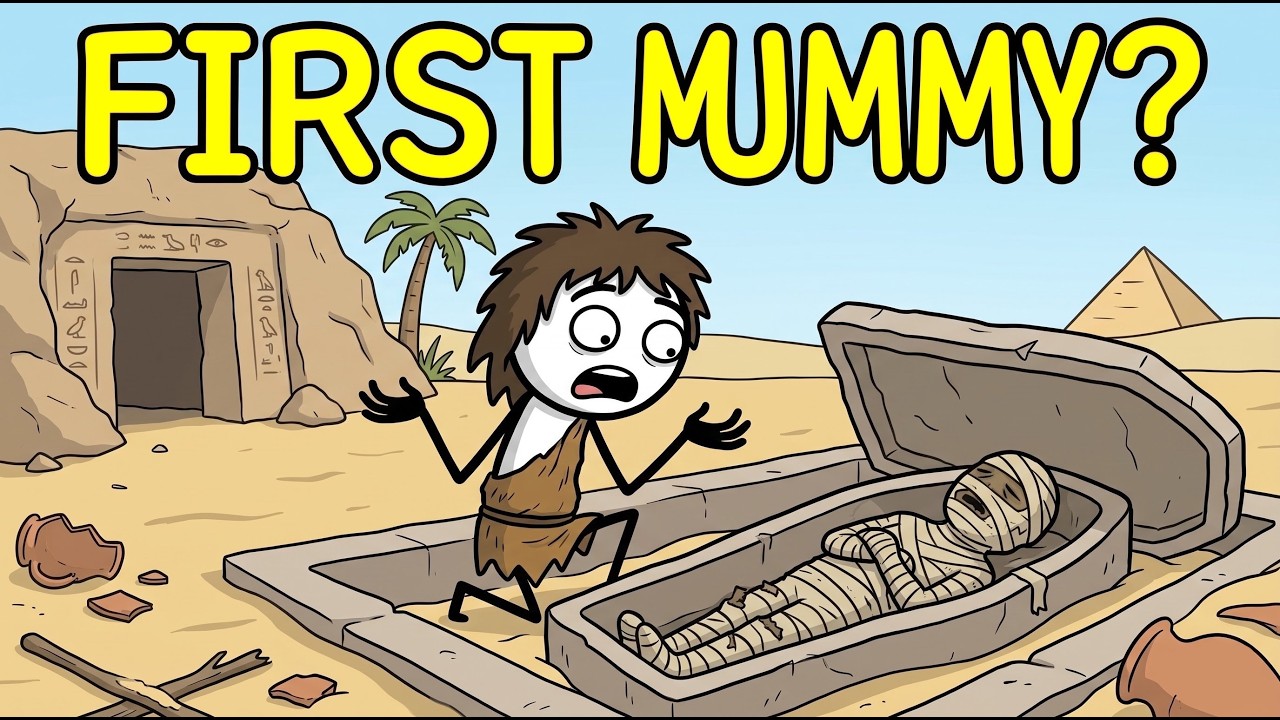
The earliest versions, known as black mummies, required the living to dismantle the dead completely. Embalmers removed the skin, stripped the flesh from the bones, reinforced the skeleton with wooden sticks and vegetable fibers, and then reassembled the entire body before coating it in a thick paste of black manganese. Later red mummies were treated through incisions, with organs removed, cavities packed with plant material, and the exterior painted with red ochre. The simplest form involved encasing the body in a protective shell of clay.
Arriaza noticed a pattern that suggests why these fishermen went to such lengths. A disproportionately high number of Chinchorro mummies were infants and young children. Infant mortality in the region was severe, likely worsened by naturally occurring arsenic in the local water supply. Arriaza proposed what he called the grief hypothesis: mummification did not begin as a religious ceremony or a display of political power.
It began as grief. Parents who could not bear to let go of a dead child transformed the body into something permanent they could keep close. The Chinchorro were not working without a model. The Atacama is the driest non-polar environment on Earth, so arid that some weather stations have never recorded a drop of rain, and naturally preserved bodies were a known sight.
Arriaza documented naturally desiccated remains in the region dating to roughly 7020 BC, over two thousand years before the Chinchorro began their intentional work. The desert had been demonstrating what was possible for generations, and the Chinchorro simply decided to do it on purpose. Historians and archaeologists overwhelmingly reject the idea that mummification spread from a single origin. Chile and Egypt sit about 12,000 kilometers apart, separated by the Atlantic Ocean, with no plausible transmission route in antiquity.
The methods were fundamentally different: manganese paste, natron, smoke curing, freeze-drying, and lacquer-based techniques emerged independently on multiple continents. The evidence points to convergent invention, with a probability estimated at roughly 90 to 95 percent that different cultures developed preservation on their own. Any society with access to naturally preserved bodies and an emotional attachment to the deceased would eventually attempt to replicate what nature was doing. Nature had, in fact, been producing preserved bodies long before any human intervention.
Ötzi the Iceman, discovered by two German hikers in the Ötztal Alps in 1991, was a naturally freeze-dried body roughly 5,300 years old, carrying a copper axe, wearing over 60 tattoos, and bearing an arrowhead wound in his left shoulder. In Nevada in 1940, archaeologists Sydney and Georgia Wheeler discovered a naturally preserved body in Spirit Cave that was later radiocarbon dated to roughly 9,400 years before present, making it the oldest known natural mummy in North America. Genetic testing in 2016 proved a direct biological link between that individual and modern Native American populations, and the remains were repatriated to the Fallon Paiute Shoshone Tribe. Peat bogs in northern Europe also preserved human remains so perfectly that some bog bodies, including Tollund Man and Grauballe Man found in Denmark, looked fresh enough to prompt murder investigations even though they were over two thousand years old.
Egypt went on to perfect mummification, but it did not invent it. The early Egyptians learned from the same natural processes. The Gebel el-Arak Predynastic mummies, now in the British Museum, date to roughly 3400 BC and were buried in shallow pit graves in hot, dry sand. No treatment, no wrapping, no chemicals, yet the aridity preserved skin, hair, and internal organs completely.
The invention of Egyptian embalming was triggered by an unintended reversal. When Egyptians began constructing tombs and enclosed burial chambers, they separated bodies from direct contact with the desiccating sand, and the dead began to rot. In trying to honor their dead more, they were losing them faster. That gap forced the development of artificial preservation.
Scientific studies have pushed the Egyptian timeline back dramatically. In 2014, Dr. Stephen Buckley of the University of York and Dr. Jana Jones of Macquarie University published research in *PLOS ONE* showing that prehistoric funerary wrappings from Upper Egypt dating to roughly 4500 to 3100 BC contained a complex chemical recipe: plant oils or animal fats mixed with heated conifer resin, aromatic extracts, and natural petroleum.
A 2018 follow-up in the *Journal of Archaeological Science* analyzed the Turin Mummy, dating to roughly 3600 BC, providing the first unambiguous scientific proof that ritualized embalming was practiced in Egypt over a thousand years earlier than the old textbook timeline suggested. By the New Kingdom, roughly 1570 to 1070 BC, Egyptian mummification had become industrialized. The Greek historian Herodotus, visiting Egypt in the 5th century BC, documented three price tiers. The most expensive option involved extracting the brain through the nose with hooked metal tools, removing the major organs through an incision in the left abdomen, washing them in palm wine, and storing them in four canopic jars.
The body was then buried in natron, a naturally occurring salt that aggressively draws water out of tissue, for 40 days, followed by washing, stuffing, anointing, and wrapping in hundreds of meters of linen. The full process took 70 days. The moderate option involved injecting cedar oil through the rectum, plugging the body, and placing it in natron. When the plug was removed, the liquefied organs drained out with the oil.
The cheapest option was an enema followed by 70 days in natron. The theological motive was survival of the soul, not just the body. Egyptians believed a person had multiple spiritual components: the ka, a life force needing sustenance; the ba, a personality able to travel between worlds; and the akh, the immortal spirit. If the physical body was destroyed, the ka had nowhere to return and the ba had nothing to recognize.
Each bandage and drop of resin was part of a project designed to give the soul a permanent address. The god overseeing it all was Anubis, the jackal-headed deity said to have invented mummification when he preserved the body of Osiris after his murder by Set. Priests performing the rituals wore Anubis masks. The irony was deliberate: jackals were the animals that dug up graves and devoured corpses, and the Egyptians made their worst nightmare their divine protector.
In 2018, researchers led by the late Egyptologist Dr. Ramadan Badry Hussein uncovered a mummification workshop complex at Saqqara dating to the 26th Dynasty, roughly 664 to 525 BC. Thirty meters underground, they found labeled pottery vessels still containing residues of cedar oil, beeswax, and bitumen. The labels bore instructions such as “to wash” and “to put on his head.
” Some materials had been imported from as far away as Southeast Asia and Sub-Saharan Africa, revealing that mummification was a supply chain as well as a religious practice. Over roughly three thousand years of Egyptian civilization, historians estimate that approximately 70 million human mummies were produced. Most are gone, destroyed by tomb raiders, used as fuel, ground into powder and sold as medicine in medieval Europe, or simply lost. Substantial numbers were also animal mummies, with individual catacombs containing millions of specimens.
Other cultures developed entirely independent methods. In China in 1972, workers digging an air-raid shelter near Changsha opened a tomb at Mawangdui and found Xin Zhui, a Han Dynasty noblewoman who died around 168 BC. Her skin was still soft, her joints still bent, her internal organs intact, and blood still in her veins. She had been sealed inside four nested lacquer-sealed coffins surrounded by charcoal and white clay, creating a completely oxygen-free, moisture-stable environment.
In western China, the Tarim Basin mummies, dating from roughly 2100 BC to the first century BC, were preserved naturally by desert aridity. A 2021 genomic study showed they were a genetically isolated indigenous population descended from ancient North Eurasians, not the Western migrants their European-looking features had suggested. The Inca mummified their dead at extreme altitude. In 1999, archaeologist Johan Reinhard found three children on the summit of Llullaillaco on the Argentina-Chile border, the victims of capacocha sacrifices.
Analysis showed they had consumed heavy amounts of coca leaves and corn beer in their final months. The cold freeze-dried their bodies almost perfectly. Inca royal mummies, called mallquis, were kept politically active: dressed, fed by burning food before them, paraded through the streets at festivals, and consulted on matters of state. Most were destroyed by the Spanish conquistadors, who understood that a mummy that still rules is a king that never dies.
Practitioners of Shingon Buddhism in Japan practiced self-mummification, called sokushinbutsu. Over years, a monk would eat nothing but nuts, bark, and pine needles, then consume toxic cycad nuts and drink a toxic tea brewed from urushi tree sap to make the flesh repellent to insects. When ready, the monk was sealed alive inside a stone tomb with a breathing tube and a bell. When the bell stopped ringing, the tube was removed and the tomb sealed.
Roughly 18 to 24 successful examples survive in temples in Yamagata Prefecture. In the highlands of Papua New Guinea, the Anga people smoked their dead. The body was suspended over a low fire for months, with bamboo tubes inserted to drain fluids. The smoke deposited compounds that formed a barrier against tropical decay.
The finished mummies were strapped to cliff faces overlooking the village, watching over the living. Modern attempts have continued the same impulse. Rosalia Lombardo, a two-year-old who died in Palermo in 1920, was preserved by embalmer Alfredo Salafia using a formula of formalin, zinc salts, alcohol, salicylic acid, and glycerin. She lies in the Capuchin Catacombs of Palermo and still looks as if she is sleeping.
The body of Vladimir Lenin has been continuously maintained since 1924, preserved longer by ongoing human intervention than most ancient mummies. In Salt Lake City, an organization called Summum offers modern mummification using chemical preservatives, fiberglass, and bronze mumiforms. Its founder, who legally changed his name to Corky Ra, died in 2008 and became the first person to undergo the process. His golden mumiform sits inside a small pyramid legally classified as a bonded winery.
Every technique, from Chinchorro manganese paste to Egyptian natron to Japanese lacquer tea, solves the same two biological problems. Autolysis is the body digesting its own cells from the inside after death. Putrefaction is the external attack of bacteria already present in the gut and on the skin. Together they can reduce a body to bones within weeks in warm, humid conditions.
Mummification works by stopping one or both: removing water, creating airtight seals, binding proteins, depositing antimicrobial compounds, or shutting down all metabolic activity through cold. The chemistry, theology, and motivation varied across cultures, but the underlying impulse remained consistent: refusal to let loved ones disappear. The body is the last physical thing left after someone dies, and for seven thousand years, using every material available, humans have worked to make it stay.