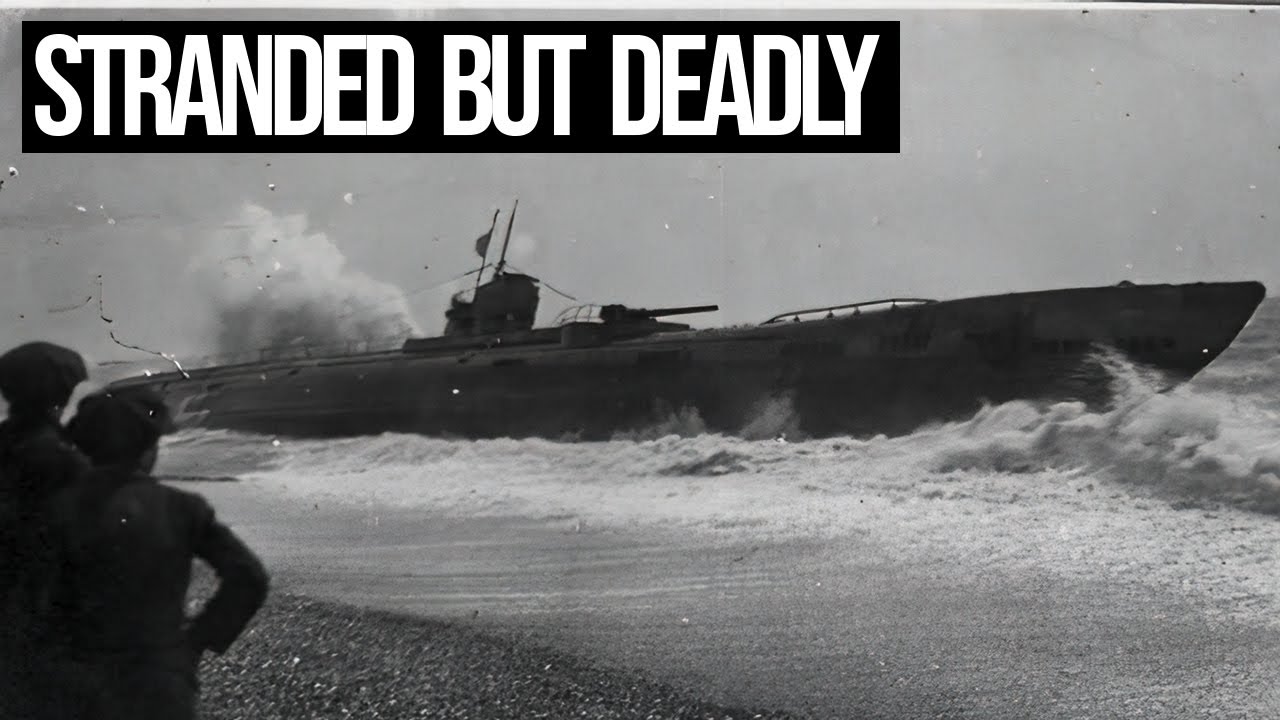
The sea gave up its ghost on the morning of April 15th, 1919, not with a roar, but with a silent, ominous arrival that would transform a sleepy British seaside town into a macabre spectacle. Residents of Hastings, East Sussex, awoke to find a colossal steel leviathan from the depths of the First World War resting squarely on the pebbled shore opposite the Queen’s Hotel. It was SM U-118, a 240-foot Imperial German mine-laying submarine, a weapon of war that had terrorized the Atlantic, now lying helpless and aground as a monument to a conflict that had ended just five months prior.
But the story of this beached behemoth was far from over; it was about to claim two more victims, proving that the machinery of war remains deadly long after the guns fall silent.
 The initial reaction to the stranded submarine was one of sheer disbelief and frenzied excitement. For a town that had endured the anxieties of the war, the sudden appearance of this enemy vessel was a surreal spectacle. Thousands of people descended upon the beach, eager to catch a glimpse of the rusting, barnacle-encrusted monster that had been brought low by the very elements it was designed to conquer.
The local papers, such as the Hastings and St. Leonard’s Observer, chronicled the scene with breathless prose, describing the throngs of onlookers who braved the wind and spray to stand in the shadow of the U-boat. It was a sensation, a tangible piece of the recent conflict that had washed up on their doorstep, and the town was determined to make the most of it.
The U-118 had a storied, albeit brief, wartime career. Built at AG Vulcan in Stettin and launched in February 1918, she was a state-of-the-art UE2 type minelayer, a vessel designed for stealth and destruction. Under the command of Kapitänleutnant Herbert Stohwasser, she prowled the Atlantic shipping lanes, armed with fourteen torpedoes, forty-two mines, and a formidable 15-centimeter deck gun.
Her deadly work included the sinking of the British steamer Wellington in September 1918 and the tanker Arca in October of the same year. She was a hunter, a predator of the deep, and her presence on the beach at Hastings was a stark reminder of the peril that had so recently lurked beneath the waves.
Following the Armistice, the U-118 was surrendered to the British at Harwich in February 1919, part of the vast haul of German naval hardware that was to be divided among the victors. After weeks of deliberation, it was decided that she would be towed to France to be broken up for scrap. A flotilla of surrendered U-boats set out across the English Channel, but a violent storm intervened.
The tow lines snapped, and the U-118, unmanned and at the mercy of the gale, drifted helplessly until it grounded on the shingle beach at Hastings. It was a twist of fate that turned a scrapping operation into a public spectacle, and the Admiralty, ever pragmatic, saw an opportunity.
The town clerk was granted permission by the Admiralty to charge a small admission fee for visitors to view the submarine, a scheme that raised a respectable sum of around £300—a significant amount in 1919. This money was earmarked for a noble cause: welcoming home returning soldiers from the war. For weeks, the U-118 remained the town’s primary attraction.
 Families posed for photographs in front of the massive hull, and enterprising locals offered informal tours of the exterior. The initial fear of the enemy vessel quickly gave way to a sense of ownership and curiosity. It was a strange, somber carnival, a celebration of victory juxtaposed with the grim reality of the war’s leftovers.
But the true danger lay not in the torpedoes or mines that had once been her payload, but in the toxic atmosphere that had festered within her sealed compartments.
The first men to board the vessel were Coast Guard Chief Boatman William Charles Herd and Officer William Moore. Tasked with the initial inspection, they spent hours inside the submarine’s cramped, dark interior. When they emerged, both men were visibly unwell.
Herd was described as “greatly flushed” and immediately vomited upon returning home. Moore also complained of severe nausea. Other witnesses who had ventured below deck reported a foul, gassy smell and an oppressive, humid atmosphere that caused profuse sweating.
They attributed the sickness to rotting food left aboard, but the truth was far more sinister. The submarine’s batteries, damaged and leaking, were generating chlorine gas, a lethal chemical weapon that had been used to devastating effect in the trenches of the Western Front.
Despite his initial illness, Herd’s duties continued. As the U-118 became a tourist attraction, he was tasked with giving tours of the vessel, spending prolonged periods inside the toxic hull. By April 25th, he began to complain of a sharp pain in his shoulder, which he dismissed as a minor ailment.
 But the pain worsened, and by April 30th, he was bedridden, unable to continue his duties. His doctor, George Dean Comston, was called to his home and found him in a grave state, suffering from a high fever, rapid pulse, and a blue tinge to his face—classic symptoms of severe respiratory distress. The initial diagnosis was pneumonia, but Herd’s condition did not improve.
For eight agonizing months, Herd remained bedbound, his health deteriorating as the chlorine gas had its insidious effect on his body. The poison had caused severe abscesses to form in his right lung and, most devastatingly, on the left side of his brain. By Christmas, he began to show signs of paralysis, and he was finally moved to hospital on January 1st, 1920.
Despite the best efforts of surgeons, including the pioneering Dr. Mary Elizabeth Bey, Herd’s condition was terminal. He remained conscious until shortly before his death on February 12th, 1920.
The post-mortem examination revealed the full extent of the damage: a large abscess on the brain, evidence of meningitis, and a massive abscess in the right lung. The coroner’s inquest returned a verdict of death by accidental inhalation of gas, with the jury expressing deep sympathy for Herd’s widow and daughter.
Officer Moore, who had been exposed to the same lethal environment, had already succumbed to the poison two months earlier, in December 1919. The deaths of these two men cast a dark shadow over the U-118’s time in Hastings. The tours were immediately halted, and the submarine, once a source of fascination, became a grim reminder of the hidden dangers of the war machine.
The local community, which had initially seen the U-boat as a boon, now viewed it with a mixture of fear and sorrow. The £300 raised for the returning soldiers was a small consolation for the loss of two of their own.
 With the tours over, the problem of removing the U-118 remained. The hulking wreck was firmly embedded in the shingle, and multiple salvage attempts failed. Tractors were brought in, but they were no match for the weight of the submarine.
The French naval battleship even fired upon it in an attempt to break it apart, but the steel hull held firm. Explosives were considered, but the proximity of the vessel to the town’s buildings and infrastructure made that option far too dangerous. Finally, in late 1919, the Admiralty sold the wreck to a scrap company for £2,200, and by December of that year, the beast was finally dismantled piece by piece.
The deck gun and other fragments were salvaged and are now displayed at the Hastings Museum, silent relics of a deadly episode.
Today, there is little sign that the U-118 ever graced the shores of Hastings. The beach has been reshaped, and the old Queen’s Hotel has been replaced by modern buildings. But the memory of the event lingers, a strange footnote in the town’s history.
It is believed that parts of the submarine’s keel may still lie buried beneath the sand, a ghostly remnant of the vessel that brought both spectacle and tragedy. The story of SM U-118 serves as a poignant and chilling reminder that the instruments of war are not rendered harmless by the signing of a peace treaty. The chlorine gas that killed Herd and Moore was a silent, lingering killer, a final, deadly salvo from a ship that had already surrendered.
The men who died were not soldiers in combat but public servants doing their duty, victims of a war that had officially ended but whose lethal legacy continued to claim lives on a quiet English beach.