Falling dreams are not metaphors or abstract symbols. They are produced by real biological processes, and they are one of the most universal human experiences on record. Across cultures and centuries, an overwhelming majority of people report experiencing the sensation of falling during sleep, often accompanied by a sudden full-body muscle contraction known scientifically as a hypnic jerk. .
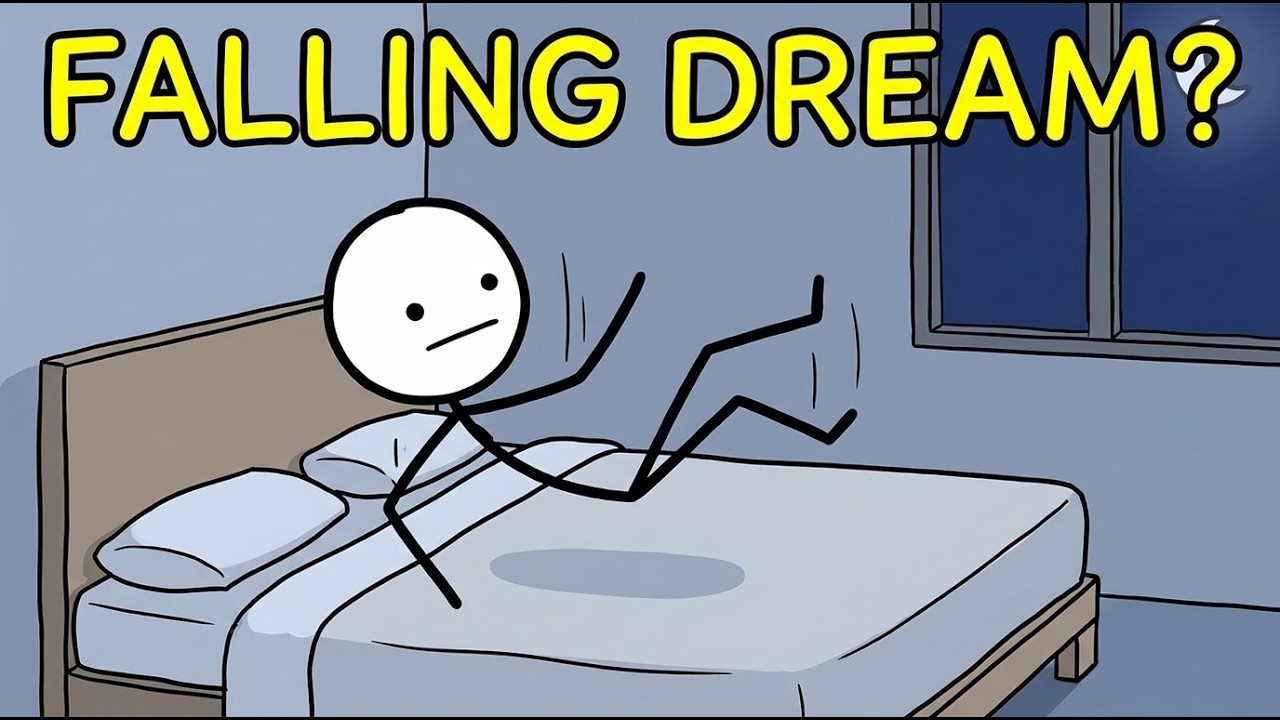
The physical event is a myoclonic discharge. As the brain transitions from wakefulness to sleep, motor control systems gradually relax. But this transition is not always smooth. When some brain systems down regulate faster than others, the motor system can fire unexpectedly, producing the involuntary jerk.
The sensation of falling that accompanies it is not a separate event. It is the brain’s interpretation of real sensory changes. When muscles relax during sleep onset, proprioceptive and vestibular systems produce signals that closely resemble what the body feels during a loss of support. The brain constructs a narrative from that input: falling.
The jerk is the motor system responding to that narrative, attempting to catch itself before impact. The experience feels more real than most dreams because it is grounded in genuine sensory processing, unlike the purely confabulated content typical of dream states. The sensory signals are real; only the story the brain builds around them is interpretive. .
One leading hypothesis for why this reflex exists is rooted in evolution. The tree sleeping hypothesis proposes that hypnic jerks are an adaptive artifact from an era when human ancestors slept on tree branches. Maintaining muscle tone was essential to avoid falling during sleep. The brain evolved a monitoring system that fired when muscle relaxation became too complete, restoring tone and preventing falls.
In modern environments, the system still fires even on a perfectly safe, flat mattress, responding to a threat that no longer exists. The nervous system is still catching you from a fall out of a tree that isn’t there
. Frequency and intensity of hypnic jerks vary meaningfully between individuals. Caffeine is a major contributor.
By blocking adenosine receptors, it delays sleep drive and creates a conflicted state transition, leading to more abrupt motor discharges. Physical exhaustion also plays a role; more tired people fall asleep faster, causing simultaneous drops in waking systems rather than gradual shifts, which increases the likelihood of a jerk. Stress and anxiety elevate arousal systems, making smooth sleep onset harder. Exercise close to bedtime similarly keeps sympathetic nervous system activity elevated, mimicking the caffeinated state.
All these factors are modifiable, meaning people can reduce their frequency of hypnic jerks by addressing them
. Falling dreams that occur during REM sleep, rather than at sleep onset, involve a different but related mechanism. REM sleep features high brain activity alongside full motor inhibition, a state called REM atonia. The vestibular system, lacking confirmation from body movement, can produce disturbances that the dreaming brain incorporates into its narrative.
Because falling is the most common waking-life situation involving sudden vestibular disturbance, it becomes the most natural story for the brain to construct around this signal. Emotional intensity in these dreams is amplified by the amygdala, which is highly active during REM. Falling triggers genuine threat responses: adrenaline release, increased heart rate, deeper breathing. These physiological changes are incorporated into the experience as confirming evidence, intensifying the felt reality of the dream in a feedback loop
.
Most falling dreams end before impact. This is not because some protective mechanism censors the dream. It is because the emotional and physiological arousal generated by the fall crosses a threshold that breaks sleep itself, waking the dreamer before the narrative concludes. The universal presence of falling dreams across unconnected cultures is strong evidence that they are not culturally constructed, but rather products of shared human neurology responding to sleep onset conditions
.
Broadly, falling dreams reveal the constructive nature of conscious experience. The brain does not record reality passively; it builds a model of reality from sensory inputs, memories, and narrative frameworks. The feeling of realness is a feature of that model, not necessarily proof of its accuracy. In the falling dream, the brain builds an experience as coherent as it can from genuine but ambiguous signals.
It is doing exactly what it always does; the only difference is that the seams are visible. The caffeine, the late workout, the stress, and the ancient tree sleeping circuitry all combine to produce a convincing experience of falling from a height that doesn’t exist, and the dreamer wakes up safely horizontal, staring at the ceiling, while the nervous system insists it just saved their life. .