Sir Gary Oldman has told the story of a simple vintage Paul Smith scarf he once gave away to his friend, the late British actor John Hurt, and how it made its way back to him more than a decade later. At 68, one of Britain’s most celebrated actors sat down and spoke publicly about losing Hurt, a friendship that was born on the set of the Cold War thriller Tinker Tailor Soldier Spy, and the long, deeply emotional journey that ultimately reunited him with the piece of fabric. To understand the weight of that story, it helps to know where Oldman came from. Born on March 21, 1958, in the working-class neighborhood of New Cross in Southeast London, Oldman was the son of a welder and former sailor who walked out when he was seven years old.
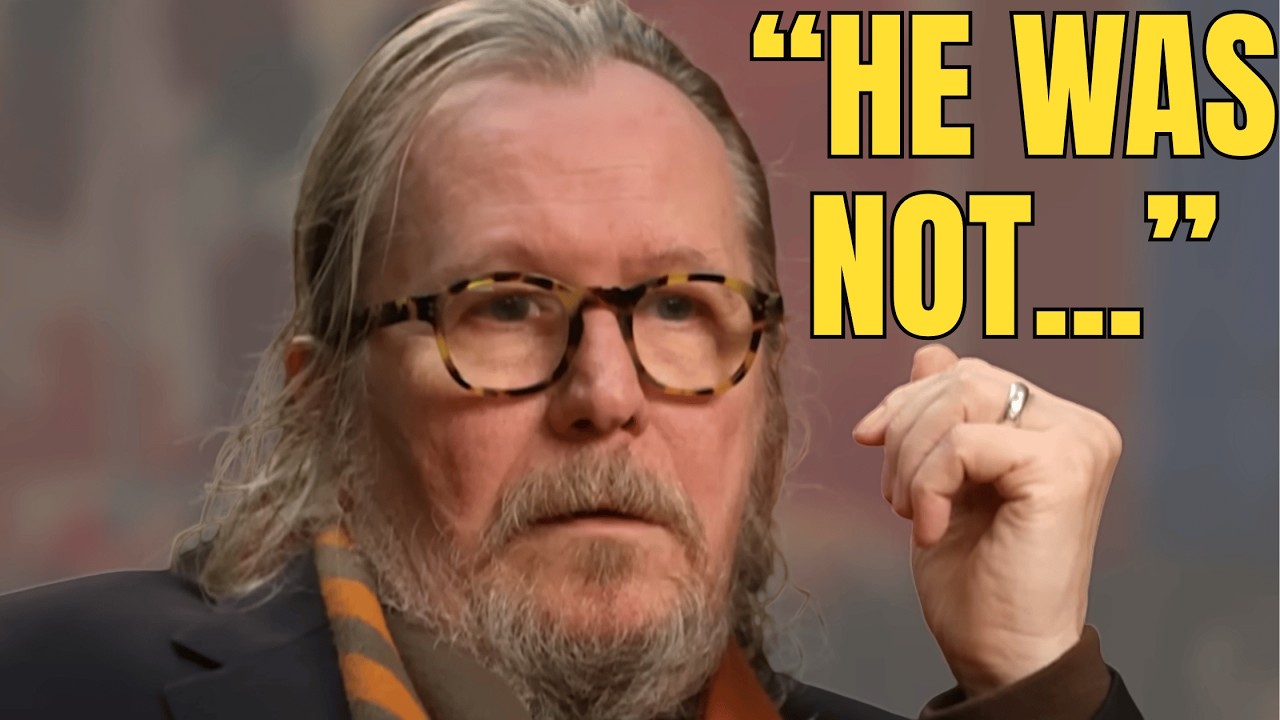
His mother, Kathleen, worked two jobs and sang in pubs to keep her three children fed. He left school at 16 with no qualifications and found work in a sports shop. Around the age of 13, he watched Malcolm McDowell in The Raging Moon, and something in that dark cinema changed his direction. “I want to do that,” he said.
He applied to RADA, Britain’s most prestigious drama school, and was turned down. He instead found his way to a youth theatre, earned a scholarship to Rose Bruford College, and graduated in 1979. That same year, he made his professional stage debut at the Theatre Royal in York. After a grind of repertory theatre through the early 1980s, his breakthrough came in 1986 when he played Sid Vicious in Alex Cox’s Sid and Nancy.
He lost weight, studied footage, and absorbed the chaos of the Sex Pistols’ bassist so completely that John Lydon, the real Johnny Rotten, praised his performance despite despising the film itself. Less than two years later came Prick Up Your Ears, in which he played playwright Joe Orton. Then Francis Ford Coppola cast him as the title character in Bram Stoker’s Dracula, a role that made the vampire both terrifying and heartbreaking. “I have crossed oceans of time to find you,” he said of the line he knew he had to say.
Oliver Stone’s JFK gave him Lee Harvey Oswald in 1991, and in 1994, Luc Besson’s Leon: The Professional gave him Norman Stansfield, a corrupt DEA agent who became one of cinema’s most unhinged antagonists. Oldman has revealed that the famous scream, “Everyone! “, was improvised as a joke to make Besson laugh, and that he warned the sound technician beforehand to protect their ears. In 2011, director Tomas Alfredson cast him as George Smiley in the film adaptation of John le Carré’s Tinker Tailor Soldier Spy.
Almost 30 years after his first film, after more than 25 years in the industry, it earned Oldman his first Academy Award nomination for best actor at age 53. But the film gave him something else as well. It gave him John Hurt. Hurt, born in 1940 in Chesterfield, Derbyshire, had built one of the most quietly devastating careers in British acting: the emperor Caligula in I, Claudius; the chest-bursting victim in Alien; Joseph Merrick in The Elephant Man; Mr.
Ollivander in Harry Potter. Two Oscar nominations. No wins. In Tinker Tailor Soldier Spy, Hurt played Control, the head of MI6.
On that set, for the first time, the two men shared a room. Oldman has described meeting Hurt as something close to meeting a hero while quietly terrified of disappointing him. “John was a darling,” he has said, “a great storyteller, a man of warmth and humour and generosity of spirit. ”
They laughed constantly between takes, and a lasting friendship took root.
After filming ended, they stayed in touch. Oldman caught up with Hurt in California, where Hurt was performing Samuel Beckett’s Krapp’s Last Tape, the desolate one-man play about an old man listening to his younger self. Oldman went backstage afterward, and one of the first things Hurt said was, “Oh, I love your scarf. ”
Oldman took it off, placed it around Hurt’s neck, and said, “It’s yours now.
”
Hurt died on January 25, 2017, of pancreatic cancer. He was 77, and his final film was Pablo Larraín’s Jackie. His wife, Anwen, said in tribute that he was “the most sublime of actors and the most gentlemanly of gentlemen. ”
It was a strange world without him.
Oldman carried that private loss quietly until 2024, when he returned to York’s Theatre Royal, the stage where he made his professional debut in 1979. He went back to play Krapp’s Last Tape—the same Samuel Beckett play Hurt had performed in California, the play that had been in the room the night the scarf changed hands. There was another layer no one could have planned. The reel-to-reel tape recorder Oldman used through performances was the same machine Hurt had used in his own production, and Michael Gambon had used it as well.
Both were now gone. Oldman dedicated his performance to their memory. He directed the production himself and designed the set. He performed Krapp’s Last Tape at the Theatre Royal from April to May 2025, then transferred it to London’s Royal Court, where he had done so much early work and where the play had first been staged in 1958.
John’s widow, Anwen, came to see the performance in York. She came backstage afterward, and gave Oldman a framed first-night card she had originally made for John. Then she reached into a small bag and produced the scarf—the vintage Paul Smith Scott had placed around John’s neck all those years ago. She gave it back.
Oldman has tried to describe what that moment meant. He says it went all the way around. “The scarf went out and it came back in a sad but very beautiful way. ”
He says he sometimes puts it on now just to have John with him.
He says hello to his friend. Today, Oldman, knighted by King Charles III in the 2025 Birthday Honours, plays Jackson Lamb in the Apple TV+ series Slow Horses—brilliant, disheveled, and ferociously intelligent. Some audiences appreciate the irony that Hurt, a legendary actor with two Oscar nominations, never won the award. Oldman has said nothing publicly about that specific wound, but the tenderness with which he speaks about Hurt’s talent makes the feeling clear.
In a way, the story has come to its natural shape. Two men from the same demanding world of British acting. Two men who met on a Cold War spy film and found something no script could have written down. A scarf sent out and returned.
Grief, in this story, is the price of love.