The air in the Neolithic village was thick with the smoke of cooking fires, but a different scent—pungent, herbal, and unfamiliar—clung to the fringes of the settlement. It was the smell of a weedy, unremarkable plant growing in the nitrogen-rich soil of the garbage heaps, a plant that would, over the next twelve millennia, be pulled in two diametrically opposed directions by human hands. This was the genesis of a biological experiment so vast and so successful that it would eventually split a single species into two distinct organisms: one a towering industrial giant, the other a short, resin-drenched shrub capable of altering human consciousness.
The story of cannabis domestication is not a simple tale of a farmer planting a seed. It is a saga that begins on the rocky hillsides of the northeastern Tibetan Plateau, roughly 12,000 years ago, where the wild ancestor of modern cannabis grew as a lanky, foul-smelling annual. It was a plant perfectly adapted to disturbed soils, thriving in the clearings and waste areas created by the first human settlements.
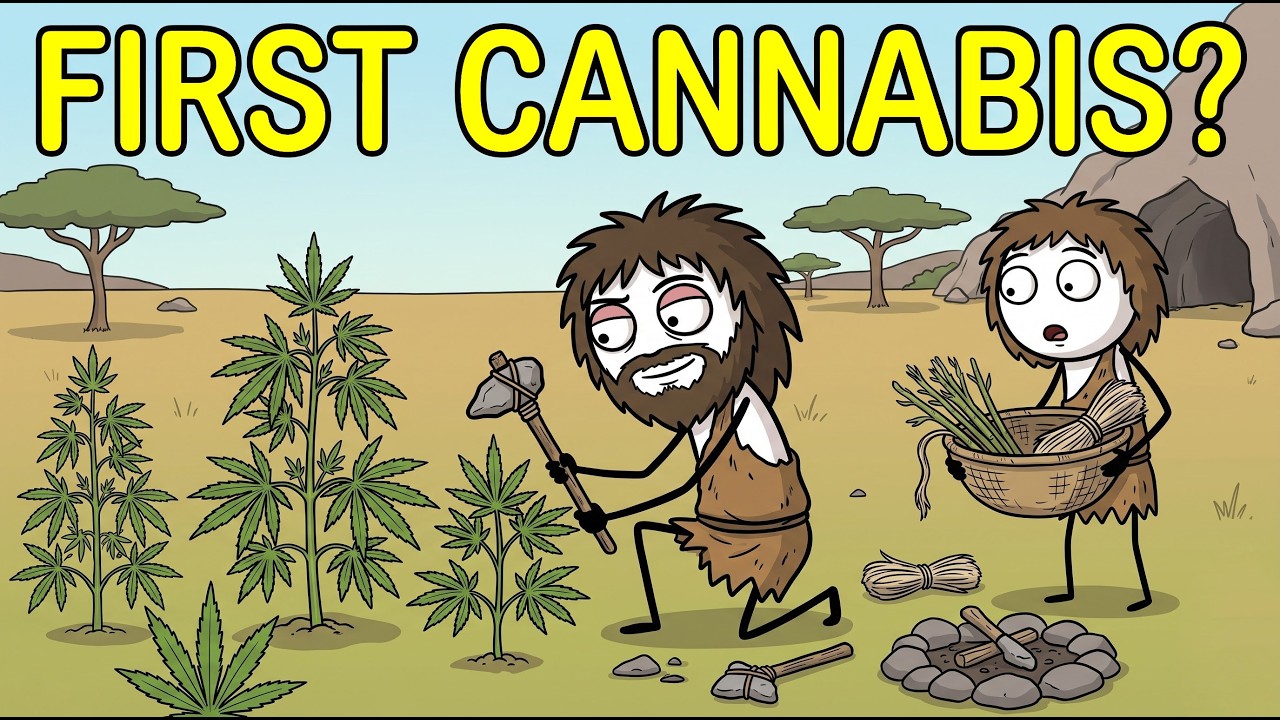 The plant was not sought out; it came to us, establishing itself in the biological shadow of our earliest campsites, waiting for a relationship that would change the course of both human history and its own evolutionary destiny.
According to a landmark 2021 genomic study led by Lingming Ren and published in Science Advances, the origin of all domesticated cannabis points to a single domestication event in eastern China, specifically in the provinces of Qinghai and Gansu. The team sequenced 110 complete genomes from plants across six continents, and the family tree was unambiguous. The most genetically diverse and ancient cannabis populations still growing today are the feral plants of those Chinese foothills.
This finding rewrites a century-old assumption that placed the plant’s origin in a broad Central Asian zone, a theory championed by the legendary Soviet botanist Nikolai Vavilov in the 1920s. The genetic data now suggests that every hemp field in Europe and every potent strain in Amsterdam descends from that one ancestral population.
This timing is critical. Cannabis was domesticated at the very dawn of the agricultural revolution, contemporaneous with the first cultivation of einkorn wheat in the Fertile Crescent and rice in the Yangtze Valley. It was not a latecomer adopted by sophisticated farmers; it was a founding crop, a pioneer of the Neolithic era.
The reason for its early adoption was its sheer versatility. This single plant offered at least four distinct resources that were vital for early human survival, a combination unmatched by any other species. It was a multi-tool of the plant kingdom, providing fiber for textiles, nutritious seeds for food, medicinal compounds for healing, and psychoactive resin for ritual and recreation.
The first use was fiber. The stalks of wild cannabis contain long, tough bast fibers, ideal for twisting into cord, weaving into fabric, and braiding into rope. Impressions of hemp cord have been found on Neolithic pottery in China and Japan dating back 10,000 to 12,000 years, representing some of the oldest evidence of textile technology on Earth.
Before the widespread use of cotton or linen, East Asian communities were already manufacturing rope and cloth from this versatile plant. The second use was food. Cannabis seeds are remarkably nutritious, containing roughly 30% oil and 25% protein, along with all essential amino acids.
In a world of scarce calories, the oil-rich seeds provided a crucial source of fat for cooking, lighting lamps, and waterproofing materials.
The third use was medicine. The oldest surviving reference to cannabis as a medicinal plant is found in the Pen Ts’ao Ching, a Chinese text traditionally attributed to the legendary Emperor Shennong. While the text was likely compiled around the 1st or 2nd century AD from older oral traditions, it recommended cannabis for a range of ailments, including joint pain, constipation, and malaria.
 The fourth use, and the one that would eventually define the plant in the modern era, was its psychoactive resin. This resin contains delta-9-tetrahydrocannabinol (THC), a molecule that interacts with the human body’s endocannabinoid system, a receptor network that exists to process naturally produced chemicals like anandamide, named from the Sanskrit word for bliss.
The domestication of cannabis was not a single, linear process, but rather a divergence driven by human selection for these different traits. You cannot optimize a plant for all four uses simultaneously. A tall, straight stalk ideal for fiber is a poor 𝒹𝓇𝓊𝑔 plant, while a short, bushy, resin-drenched plant is useless for making rope.
The 2021 genomic study revealed that the split between hemp-type and 𝒹𝓇𝓊𝑔-type cannabis occurred roughly 4,000 years ago. For the preceding 8,000 years, humans had grown cannabis as a general-purpose crop, selecting for basic domestication traits like larger seeds and non-shattering seed heads. But around 2000 BC, the selection pressure split, pulling the species in two opposite directions.
The genetic mechanism behind this split is a fascinating example of molecular evolution. Cannabis produces its cannabinoids through a biosynthetic pathway that begins with a precursor molecule called CBGA. From this single precursor, two competing enzymes go to work.
One, encoded by the THCAS gene, produces THCA, which becomes THC when heated. The other, encoded by the CBDAS gene, produces CBDA, which becomes CBD. These two genes are alleles competing for the same location on the same chromosome.
It is a molecular either/or. A plant that expresses a lot of THCAS produces high THC and low CBD, while a plant that expresses a lot of CBDAS produces high CBD and low THC. This is the genetic switch that separates hemp from 𝒹𝓇𝓊𝑔 cannabis.
Humans, without any knowledge of this biochemistry, pushed this switch in both directions. In 𝒹𝓇𝓊𝑔 cultivars, the THCAS gene was amplified, with multiple copies increasing expression and flooding the pathway with the THC enzyme. In hemp cultivars, the opposite occurred, with THCAS reduced or non-functional and CBDAS taking over.
Wild cannabis produces THC at roughly 1 to 3% by dry weight. Modern 𝒹𝓇𝓊𝑔 varieties can reach 25 to 30%, a ten-fold increase achieved entirely through selective breeding. Modern hemp, by legal definition in most countries, contains less than 0.
 3% THC, a threshold set in 1976 by Canadian botanist Ernest Small as a practical, somewhat arbitrary cutoff that governments later adopted as law.
The physical architecture of the plant also reflects this divergent selection. Wild cannabis is a moderate-sized annual, perhaps 1 to 2 meters tall, with a branching pattern that distributes energy across multiple stems. For fiber, humans selected for plants that grew tall and straight with minimal branching, resulting in modern hemp that can reach 5 meters in a single growing season.
For 𝒹𝓇𝓊𝑔 production, they selected for the opposite: short, bushy plants with heavy branching and dense clusters of resinous buds. The technique of sinsemilla, growing only unpollinated female plants, was developed to maximize resin production, as unfertilized females produce dramatically more trichomes in a prolonged effort to catch pollen that never arrives.
The archaeological record provides dramatic evidence of this specialized use. In 2008, a study in the Journal of Experimental Botany described the contents of Tomb M90 at the Yanghai burial site in western China. Inside a 2,700-year-old grave belonging to a Gushi culture shaman, researchers found nearly two pounds of cannabis.
This was not raw material; the seeds and stems had been carefully removed, leaving only the flowering tops, and chemical analysis confirmed the presence of THC. This was cannabis cultivated specifically for its psychoactive properties, processed with expertise, and buried with a man whose community considered it valuable enough for the afterlife. Five hundred years later, at the Jirzankal Cemetery in the Pamir Mountains, people were burning high-potency cannabis on heated stones during funeral rituals, selecting plants with significantly higher THC levels than those growing wild in the region.
The spread of domesticated cannabis across Eurasia was a slow, westward migration along the trade routes that would eventually become the Silk Road. By 500 BC, the Greek historian Herodotus was describing Scythian nomads on the Central Asian steppe crawling inside small felt tents and throwing cannabis onto red-hot stones, breathing in the smoke as a ritual. His account was long dismissed as exaggeration until Soviet archaeologist Sergey Rudenko excavated the frozen Pazyryk tombs in Siberia and found exactly what Herodotus described: tent frames, heated stones, and cannabis seeds preserved in permafrost for over 2,000 years.
By this time, cannabis had spread from China to the Caucasus, from India to the eastern Mediterranean, where the Assyrians called it kunibu, the word from which “cannabis” derives.
While the psychoactive use of cannabis was spreading, the fiber side of the story was equally consequential. Hemp rope and fabric have been found at archaeological sites across China, Japan, and eventually Europe. By the medieval period, hemp was one of the most important industrial crops on the continent, used for rope, sailcloth, and canvas—a word that comes from the Latin cannabis.
 The entire age of exploration was held together by hemp rigging. When European colonists arrived in the Americas, they brought hemp seeds with them, and the Virginia Assembly passed a law in 1619 making hemp cultivation mandatory for farmers. The two domestication stories, fiber and 𝒹𝓇𝓊𝑔, were now pulling the species further apart, both geographically and genetically.
The 20th century brought a dramatic interruption to this 12,000-year relationship. In 1930, Harry Anslinger became head of the U. S.
Federal Bureau of Narcotics and launched a campaign that systematically tied cannabis to racial minorities and fabricated links to violent crime. The 1937 Marijuana Tax Act effectively criminalized the plant, and the 1970 Controlled Substances Act placed it on Schedule I, the same classification as heroin. The 1961 UN Single Convention on Narcotic Drugs extended these restrictions globally.
A plant that had been cultivated for millennia, woven into the sails of ships, ground into medicine, and burned in temples, was declared too dangerous to exist. But prohibition did not stop domestication; it accelerated it. Illicit growers working in basements and under artificial lights applied selection pressure at a pace that would have stunned any Neolithic farmer, crossing Afghan indicas with Southeast Asian sativas and pushing THC levels from the 3-5% range of the 1970s to the 20-30% range of today.
The answer to how humans domesticated cannabis is that we did it the same way we domesticated everything else: slowly, through the accumulation of countless small decisions made over thousands of years. We noticed a useful plant growing in our waste piles, saved seeds from the plants we liked best, and replanted them. We bred hemp that grows 5 meters tall with almost no THC, and we bred 𝒹𝓇𝓊𝑔 cannabis that barely reaches your waist with 30 times the THC of its wild ancestor.
The 2021 Ren study’s whole-genome analysis points to a single origin with roughly 85-90% probability, and it also found that virtually every wild population sampled showed genetic signatures of contact with domesticated varieties. The original unmodified version of cannabis may no longer exist. We found a weed in our garbage 12,000 years ago, and we liked what it did.
We kept the seeds, replanted them, and picked the ones that did it better. We did this for so long, across so many generations and continents, that the original plant is gone, absorbed and overwritten by the versions we preferred. Tomorrow, a farmer will plant a hemp seed that will grow 16 feet tall, and somewhere else, someone will tend a squat, crystalline plant bred to produce 30% THC.
Both are the same species, and both are the product of 12,000 years of human decisions.