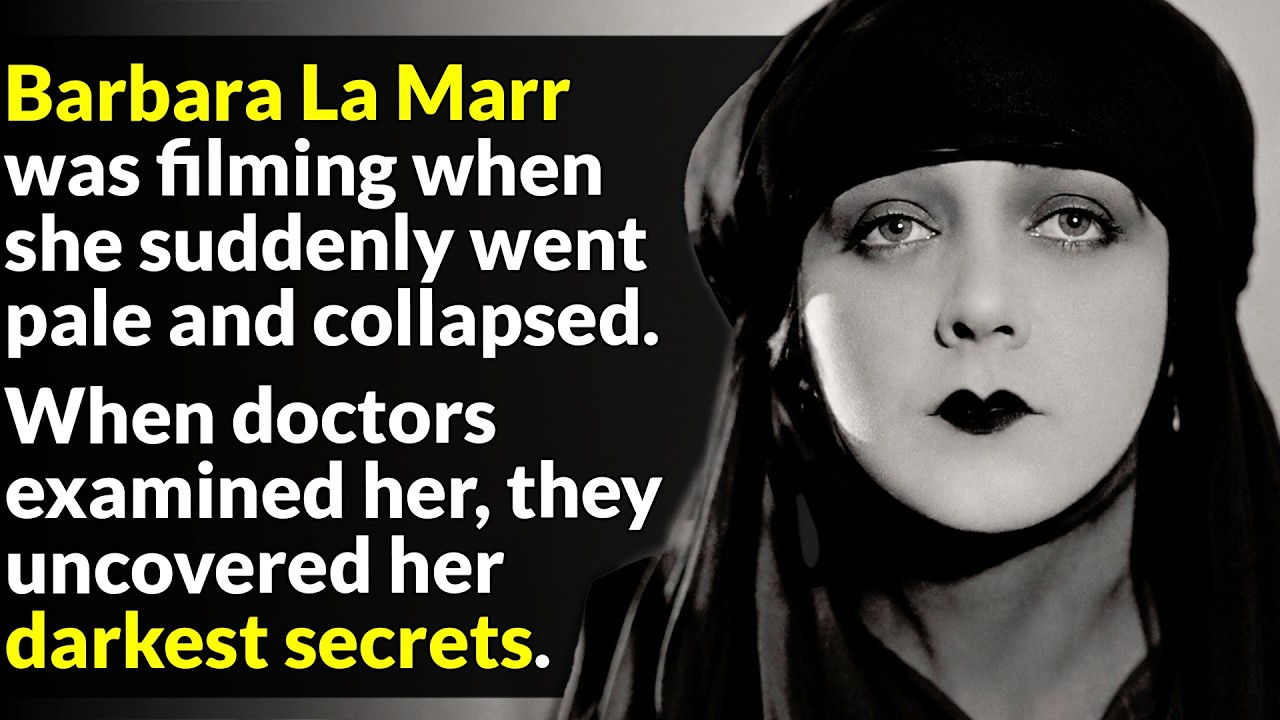
Hollywood has always had a voracious appetite for youth, beauty, and 𝒔𝒄𝒂𝓃𝒹𝒶𝓁, but few stars of the silent era embodied that toxic trifecta as tragically as Barbara La Marr. When she collapsed on a film set in 1925, the world was introduced to a woman whose life was a carefully constructed web of deception, addiction, and heartbreak. The doctors who examined her uncovered a truth far darker than any of the fictional vamps she played on screen.
La Marr was not just a fading star; she was a dying one, and the secrets she had fought so hard to bury were finally clawing their way to the surface.
 Born Reatha Watson at the turn of the century, La Marr’s origin story seemed destined for the silver screen. She was a vaudeville dancer as a child, a precocious talent with a hunger for the spotlight that would eventually consume her. Her family moved to Los Angeles chasing the California dream, but for a teenage girl with ambitions as vast as the Pacific Ocean, the city offered more than just sunshine.
It offered a dangerous path to fame, one that would lead her down a rabbit hole of lies, illicit relationships, and a desperate need for attention that she would never be able to satisfy.
At the tender age of fifteen, La Marr’s thirst for stardom drove her into the seedy underbelly of burlesque. She was determined to break into the fantastical world of Hollywood, but she was unprepared for the nightmare that awaited her. In 1913, her life was turned upside down for all the wrong reasons.
Her half-sister, Violet, and a man named C. C. Boxley invited her on a trip to Santa Barbara.
Naively, La Marr accepted, unaware that she was walking into a trap that would define her relationship with the press and the public for the rest of her life.
As the days passed in Santa Barbara, a cold dread settled over La Marr. She realized that her companions were not friends but captors, and she began to fear she would never see home again. However, before she could formulate an escape, her kidnappers discovered warrants for their arrest.
They released her, but the damage was done. When the press got wind of the story, they went into a frenzy. La Marr, instead of retreating into the safety of her family, embraced the notoriety.
She testified against her sister and then, when the facts ran dry, she began fabricating lies to keep the journalists hooked, even going so far as to claim she was adopted.
Police reports from the time, however, painted a different picture. They noted that the teenager didn’t seem particularly worried about her ordeal. In fact, she appeared to be in high spirits and told some that she had enjoyed the trip.
This was the moment the monster was born. La Marr realized that 𝒹𝓇𝒶𝓂𝒶 was currency, and she was determined to be the wealthiest woman in Hollywood. She would never let her life be devoid of 𝒔𝒄𝒂𝓃𝒹𝒶𝓁 again, and the very next year, she returned from Arizona with a tale of whirlwind romance and tragic loss, claiming she had married a cattleman named Jack Lattell who died of pneumonia three weeks later.
 Whether he ever existed remains a mystery.
Her first documented marriage was a catastrophe of epic proportions. In July 1914, she wed a man named Max Lawrence, only to discover days later that his real name was Lawrence Converse and he was a mercenary. Even worse, he was already married with children.
The authorities were already on his trail, and the day after the wedding, he was arrested for polygamy. La Marr was returned to her parents, but the 𝒹𝓇𝒶𝓂𝒶 didn’t end there. Three days after his arrest, her bigamist husband died of a cerebral hemorrhage.
La Marr was living a lifetime in a week, and she had no intention of slowing down. She was addicted to the chaos, and her next move was to marry a man who was entirely wrong for her.
In 1916, she married dancer Philip Ainsworth, an heir to a fortune. Predictably, the marriage imploded when Ainsworth was jailed for writing bad checks. They divorced within a year, and La Marr’s life took another bizarre turn.
A rumor spread that she had died in Salt Lake City from a broken back. She wasn’t dead, of course, and the news of her survival created more waves than her supposed death. She was becoming famous for being famous, and she had more tricks up her sleeve.
She quickly moved on to another dancer, Ben Dee, a man twice her age who was a gambler and a drunk. He pulled her into his world of vice, but he also inadvertently pushed her toward a career in entertainment.
La Marr began writing screenplays to fund their extravagant habits. By 1920, she had penned several films, and she was also touring as a dancer with partners like Rudolph Valentino and Clifton Webb. Her star was rising, but it was her encounter with legendary actress Mary Pickford that changed everything.
Pickford saw La Marr writing a script and told her she was too beautiful to be behind the camera. Within a year, La Marr had leveraged her striking features to become one of the biggest vamps of the era, a precursor to the femme fatale. Her roles in films like “The Prisoner of Zenda” and “Trifling Women” cemented her image as a predatory beauty full of dark secrets.
 She was given the nickname “The Girl Who Is Too Beautiful” after a judge insisted she go home because she was too lovely to be alone in the city. The press latched onto it, and it helped propel her career forward. But she was moving too fast.
She was constantly in the party circuit, known for her sharp wit and her love of life. She famously joked that she chose lovers like bouquets of roses, by the dozen. But she was also incredibly savvy, refusing to be called a “star” to increase her mystique and leaking her own poems to the press “by accident.”
The public was captivated, but everything that rises must fall, and in 1921, her life began to crumble.
Her husband’s gambling and drinking led to a divorce, and La Marr, instead of learning from her mistakes, dove headfirst into more parties. She admitted to sleeping only two hours a night, claiming she had better things to do. In 1923, she announced a surprise: she had fallen in love with a baby boy at an orphanage.
She adopted him on the spot, naming him Marvin. To support her new son, she rushed into a marriage with actor Jack Daugherty, even before her divorce from Dee was finalized. This was a fatal error.
That same year, while filming “Souls for Sale,” she injured her ankle and reportedly became addicted to opiates during her recovery.
Her weight began to fluctuate, and terrified that Hollywood would no longer find her beautiful, she resorted to extreme measures. She tried fad diets, and when those failed, she reportedly ingested tapeworms in a desperate attempt to stay thin. Her ex-husband, Ben Dee, returned to haunt her, claiming that because of her quick marriage to Daugherty, he was still her legal husband.
He tried to blackmail her for money, threatening to reveal all her dirty secrets. In court, La Marr appeared distraught, unable to read the complaint through her tears. The 𝒹𝓇𝒶𝓂𝒶 took a toll on her career, and her popularity began to plummet.
Critics noted that she hadn’t evolved as an actress, and the press turned on her, vilifying her for her multiple marriages and wild parties.
 The backlash sent her into a nervous breakdown. She was confined to her home for weeks, planning her next move. She decided she needed a comeback and left her bed to film “The Girl from Montmartre,” playing a good girl for the first time in her career.
But her body was failing. Years of neglect, poor nutrition, and addiction had taken their toll. She collapsed on the set and fell into a coma.
Doctors diagnosed her with tuberculosis and nephritis, a direct result of years of abusing her health. Realizing she was fading, she made the painful decision to give her son, Marvin, to her friends, actress Zazu Pitts and her husband Tom Gallery. They eventually adopted the boy, renaming him Donald Gallery.
On July 30, 1926, Barbara La Marr succumbed to her illnesses. She was just 29 years old. Her friend, film producer Paul Bern, was by her side until the very end.
Her funeral attracted 3,000 mourners, with some women fainting in the crowd. Fans rushed the procession, hoping to tear off pieces of her floral arrangements. But the greatest secret of her life was yet to be revealed.
Despite claiming she had adopted Marvin, the truth was that he was her biological son, born out of wedlock between her marriages to Dee and Daugherty. She had orchestrated the entire adoption scheme to cover up the 𝒔𝒄𝒂𝓃𝒹𝒶𝓁, giving birth, sending the child to an orphanage, and then “finding” him to adopt him.
The identity of Marvin’s father remained a secret she took to her grave. No one ever came forward. Her son, later known as Donald Gallery, believed his father was Paul Bern, the man who stayed with La Marr until the end.
However, this theory was largely debunked, and the identity of La Marr’s mysterious lover remains an unsolved puzzle. Her legacy, however, lived on. When Louis B.
Mayer was looking for a stage name for a new starlet, he chose Hedy Lamarr in tribute to Barbara. La Marr’s life was a cautionary tale of fame, addiction, and the destructive nature of secrets, a story that continues to fascinate and horrify a century later.