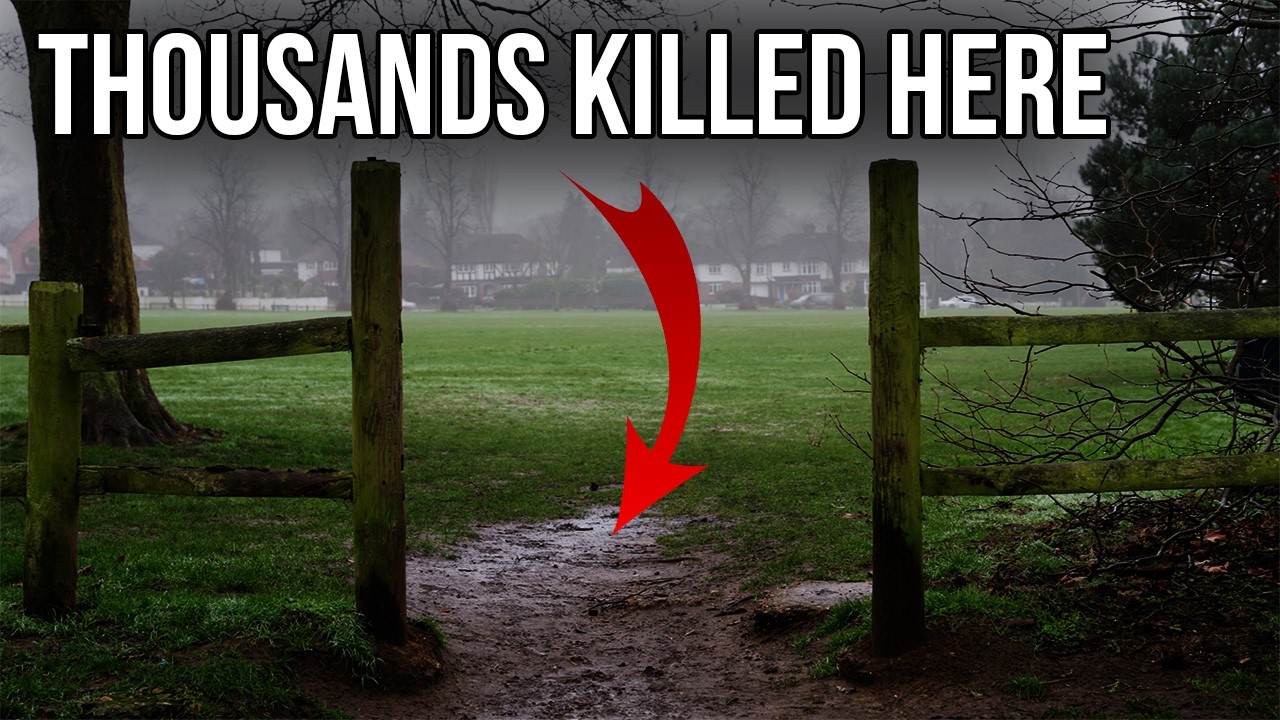
The cheerful shriek of a child on a swing cuts through the damp Kentish air, a sound of innocent joy that seems almost obscene given the ground it echoes across. Here, in the heart of Maidstone, what is now a tidy recreational area with manicured lawns and a modern play park was once known by a far more sinister name: the killing fields of Kent. For centuries, this unassuming patch of green served as the primary place of execution for the entire county, a site where justice—or what passed for it—was meted out with terrifying finality.
The history of Penenden Heath stretches back over a millennium, long before the first swing was ever hung. Its origins are deeply rooted in the Saxon era, where it was not a place of death, but of governance. First recorded in the Domesday Book of 1086 as “Pinadena,” the heath was the administrative heart of Saxon Kent.
 It was here that open-air courts, known as shire moots, were convened. These assemblies were a primitive form of representative governance, drawing together bishops, abbots, and lay leaders from across the county to debate legal, political, and religious matters. It was, in essence, an early experiment in democracy, a place where the foundations of English law were laid in the open air.
The heath’s significance only grew following the Norman Conquest. In a display of medieval power politics, William the Conqueror himself ordered a three-day hearing to be held here to address accusations of fraud against his own half-brother, Odo of Bayeux, the former Earl of Kent. Nobles from across the realm were summoned to Penenden Heath to witness the proceedings, which ultimately resulted in the return of vast tracts of land and property to the crown and the church.
This event cemented the heath’s status as a venue of immense legal and political importance, a place where even the most powerful could be held to account.
But the heath was not just a seat of law; it was also a stage for rebellion. In 1381, Wat Tyler, the leader of the Peasants’ Revolt, gathered his followers on this very ground. From Penenden Heath, they marched through Maidstone and towards London, directly confronting the royal authority that would eventually crush their uprising.
Centuries later, during the English Civil War, the heath once again became a military gathering point. In May 1648, George Goring, the Earl of Norwich, assembled a Royalist force of around 7,000 men here in a desperate attempt to defend Maidstone from the Parliamentarian army led by Thomas Fairfax. The attempt failed, but the heath’s reputation as a central, strategic location was solidified.
The shift from governance to grim punishment was a gradual but definitive one. The very name of the heath may offer a clue to its dark purpose. While the etymology is debated, some historians believe “Penenden” derives from the Saxon word “pineon,” which means “to punish.”
 Given the sheer scale of executions that would take place here, the connection is difficult to ignore. The location was chosen for its visibility. Situated on a prominent hill in the middle of Kent, the gallows were designed to be seen from miles around, a stark and permanent reminder of the consequences of breaking the law.
For hundreds of years, the gallows stood on what was aptly named Gallows Hill, just a short distance from the current playground. The original instruments of death were not purpose-built structures but three tall trees that stood at the very peak of the hill. These “hanging trees” were a sinister landmark, visible to all who approached Maidstone.
The surrounding area was littered with place names that preserved the memory of its purpose, including Hangman’s Lane, now known as the more innocuous Heathfield Road, and Gallows Wood. These names were only wiped out by the residential development that eventually swallowed the heath, erasing the physical reminders of its bloody history.
The executions themselves were public spectacles, drawing large crowds who came to witness the ultimate price of criminality. The list of crimes punishable by death at Penenden Heath is a chilling indictment of the era’s harsh justice system. While murder and arson were expected capital offenses, the records from 1735 to 1830 reveal that men and women were hanged for far lesser crimes.
William Fidget was executed in 1735 for burglary. William Pullen met his end in 1742 for the crime of sheep theft. Highway robbery was a common charge, as was “uttering,” a term for counterfeiting documents.
 The gallows were indiscriminate, claiming the lives of the poor, the desperate, and the unlucky with terrifying regularity.
Perhaps the most tragic chapter in the heath’s dark history involves the execution of seven women in 1652. Accused of witchcraft, they were tried and convicted in Maidstone. Their alleged crimes included entering pacts with the devil and possessing “familiars”—spirits that did their bidding.
One pamphlet from the time describes how Anne Ashby, one of the condemned, “swelled into a monstrous and vast bigness” in court and confessed that the devil had given her a piece of “scorched flesh” to use for her malevolent purposes. These women were almost certainly innocent, victims of mass hysteria, poverty, or mental illness. They were healers and outcasts, scapegoats for a society that feared what it did not understand.
The tragedy of their deaths is a permanent stain on the heath’s legacy.
The final execution at Penenden Heath took place on Christmas Eve, 1830, a date that should have been filled with goodwill but instead was marked by a hanging that many believed was a grave miscarriage of justice. The condemned were John Dyke and two brothers, William and Henry Packman, aged just 20 and 18. They were found guilty of arson, accused of burning down a hay barn.
 The jury had actually recommended mercy for the young brothers, believing they had been led astray by the older Dyke, but the judge overruled them. As they stood on the scaffold, Dyke proclaimed his innocence loudly, declaring, “I am innocent, and Huitt and his wife have sworn falsely against me.”
The execution was botched and grim. The hangman, William Calcraft, a notorious figure who would go on to execute over 400 people, fumbled with the ropes, initially missing William Packman. As he tried to place the white hoods over their heads, William tore his off, defiantly declaring he wished to see the faces of the crowd one last time.
They were hanged, and their bodies were cut down an hour later. The tragedy was compounded years later when, according to local legend, another man confessed to the arson on his deathbed. John Dyke’s grave in nearby Bredhurst bears a marker declaring his innocence, a silent testament to a justice system that could not take back its fatal mistakes.
The heath’s reign of terror finally ended in 1831, when executions were moved to the newly constructed gallows outside Maidstone Prison. With its grim purpose fulfilled, Penenden Heath underwent a remarkable transformation. In the late 18th and early 19th centuries, it had already begun to host cricket matches.
Then, in 1882, following extensive landscaping, it was officially designated as a public recreation ground. The gallows were torn down, the hill was flattened, and the woods were cleared for housing. The “killing fields” were replaced with swings and slides, and the memory of what happened here was pushed to the fringes of local consciousness.
Today, the heath is a place of leisure, a green space for families and dog walkers. But the past is never truly buried. When a new clock was constructed at a nearby crossroads, workers reportedly unearthed around 300 skeletons, the remains of those executed and buried in unmarked graves.
It is a chilling reminder that beneath the laughter of children and the gentle rustle of leaves, the soil of Penenden Heath is steeped in the blood of hundreds, perhaps thousands, of people who met their end here. The little park with the dark past is a monument to a brutal history, a place where the echoes of the condemned still linger, just beneath the surface of a seemingly peaceful present.