For almost 14,400 years, the charred fragments sat buried in the Black Desert of northeastern Jordan, overlooked by history. Then, in 2018, researchers announced a discovery that rewrote the story of human food: these were the remains of the oldest bread ever found, baked by hunter-gatherers who had never planted a single seed. The site, known as Shubayqa 1, was inhabited by the Natufian culture, a people who lived in permanent settlements but still survived entirely by hunting and gathering. In two stone fireplaces, archaeologists found 24 charred food remains, thin blackened pieces of something that had once been pressed onto a hot surface.
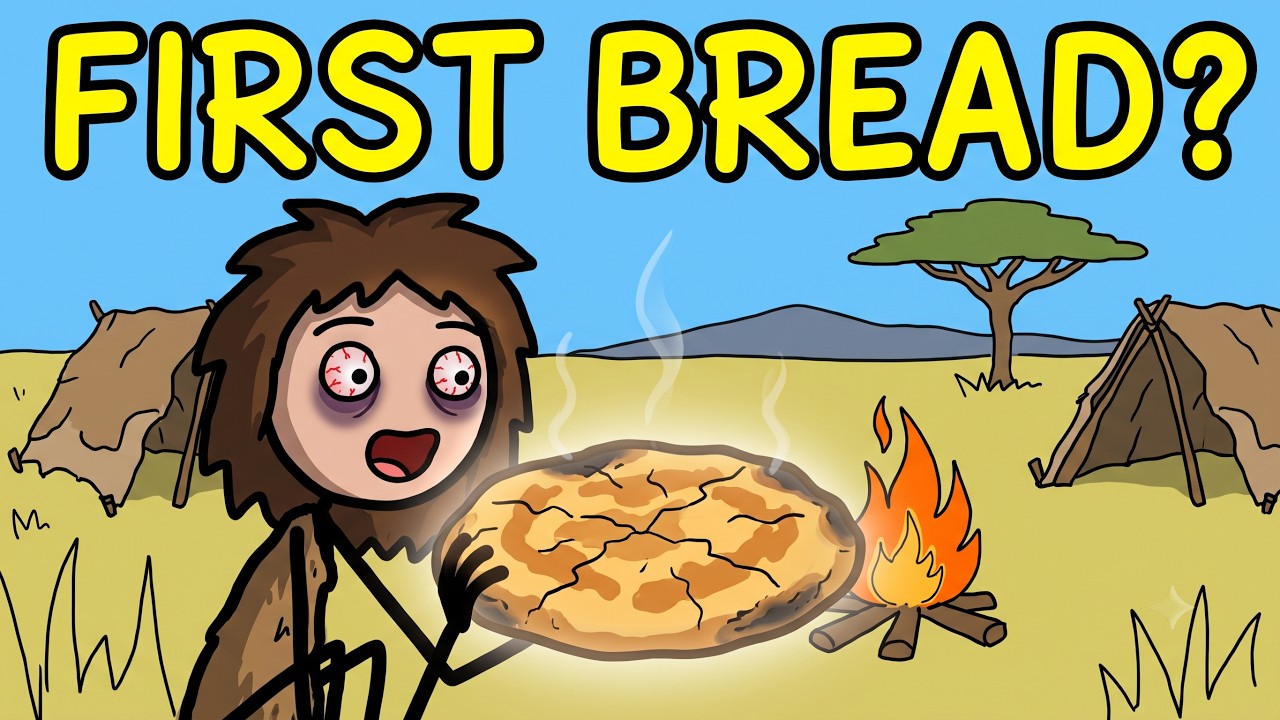
Molecular analysis identified wild einkorn wheat, barley, oats, and starch from a wetland tuber. The structure was not porridge. It was flatbread. This discovery challenged a long-held assumption.
Bread was believed to be a product of farming, made possible by the reliable grain supplies that agriculture provided. Yet Shubayqa 1 was built thousands of years before farming began. The people who made this bread had gathered wild grain by hand, a laborious process requiring hours of grinding between stones to produce even a modest amount of flour. The researchers argued that such effort meant this early bread was not an everyday food.
It was likely a luxury, made for special occasions, a way to impress or mark a gathering. The strange consequence of that conclusion is the question it raises: if bread was so difficult to make that it became a special treat, what drove people to keep making it? Some researchers now argue that bread may have come before agriculture, and that the desire for this specific food was one of the pressures that pushed hunter-gatherers to stop wandering and start farming. The idea is not that someone suddenly decided to become a farmer.
Rather, people kept returning to the same patches of wild grain year after year, eventually managing those patches, staying near them, clearing competing plants, and protecting them from animals. At some point, the line between managing wild grain and farming it disappears. The discovery at Shubayqa 1 was not an isolated accident. It built on knowledge that was already ancient.
Around 23,000 years ago, at a site called Ohalo II on the shores of the Sea of Galilee, people lived in small huts and processed wild grains. A grinding stone found there preserved starches from wild barley, wheat, and oats, processed and crushed roughly 12,000 years before agriculture began. The layout of the hut even separated the grinding area from the tool-making area, an early sign of organized division of labor. The story runs even further back.
In 2011, researchers studying dental plaque from Neanderthal teeth at Shanidar Cave in Iraq and Spy Cave in Belgium, dated between 40,000 and 46,000 years old, found starch granules showing structural damage that only occurs when starch is cooked in water. Neanderthals were boiling plant foods tens of thousands of years before modern humans made their first flatbread. They were not the club-wielding meat-eaters of popular imagination. They gathered plants, processed them, and cooked them.
Bread was not the only thing people made from grain. This is a debate that has divided archaeologists for decades. In 1953, archaeologist Robert Braidwood suggested that humans began farming primarily to make bread. Botanist Jonathan Sauer immediately disagreed, arguing that the quantities and methods made more sense if people were fermenting grain into beer.
At Göbekli Tepe in southern Turkey, a site built by hunter-gatherers about 11,000 years ago, archaeologists found large limestone basins. Chemical analysis detected calcium oxalate, a compound produced during grain fermentation, what brewers call beerstone. The basins held up to 160 liters. The honest answer to whether farming came from a passion for bread or beer is likely both, and neither was fully intentional at first.
The most dramatic accident in bread’s history came later. By about 3000 BCE in Egypt, bread was being produced on a massive scale. Hundreds of types were made, bakeries lined the streets of cities along the Nile, and the workers who built the pyramids were paid in bread and beer. It was not just food; it was currency, wages, and the backbone of the economy.
But early Egyptian bread was still dense flatbread, made by mixing flour with water and baking it. Then, at some point no one recorded, someone forgot a batch of dough. It sat in the warm Egyptian air, wild yeast drifted in, the dough expanded, and when it was baked anyway, the result was lighter than anything made before, with a crust that cracked and an interior full of air pockets. Leavened bread was born from neglect.
Bakers eventually learned that adding a piece of yesterday’s dough made the new batch rise faster. Some sourdough starters used in commercial European bakeries today contain yeasts that are hundreds of years old. The chain from that forgotten Egyptian bowl has never fully broken. Even the language preserves the link: Egyptians called bread aish, a word that still means life in Arabic.
Pyramid workers received three to four loaves a day as part of their wages. The entire pharaonic economy, its taxes, labor duties, and state hierarchy, revolved around who controlled the grain supply. The cost of this history fell on human bodies. At Abu Hureyra, a Neolithic settlement in Syria about 9,500 years old, physical anthropologist Theya Molleson found that the big toes of the women’s feet were permanently bent upward, their knee joints enlarged from constant kneeling, their lower backs, elbows, and hips marked by the repeated motion of grinding grain on a flat stone.
At Neolithic sites in central Europe, a 2017 study used 3D laser scans to compare the arm bones of prehistoric women to those of elite modern athletes. The prehistoric women’s arm bones were far stronger than those of Cambridge University rowers, about 30 percent stronger than typical modern women. The rowers trained for hours daily; the Neolithic women apparently worked harder every single day, grinding grain for hours to produce flour for just a few meals. The bread that sits on a table today represents work that destroyed the joints of people who died thousands of years ago, most of them women.
The sequence of accidents that began at Shubayqa 1 never really ended. Someone ground wild grain and pressed it onto a stone and forgot it. Someone wanted the result badly enough to start managing the fields where wheat grew. Someone left dough in a bowl and found it alive.
Someone noticed that yesterday’s dough made today’s rise. Accident piled on accident until wheat was no longer something picked from the ground but something traded for a week’s wages, something armies were built on, something civilizations used to measure their wealth. Every loaf of bread ever found began with an error, grain no one meant to process that way, dough no one meant to leave, yeast no one invited in. If anyone in that long chain had been asked what they were doing, none would have said they were building civilization.
They were just trying to eat.