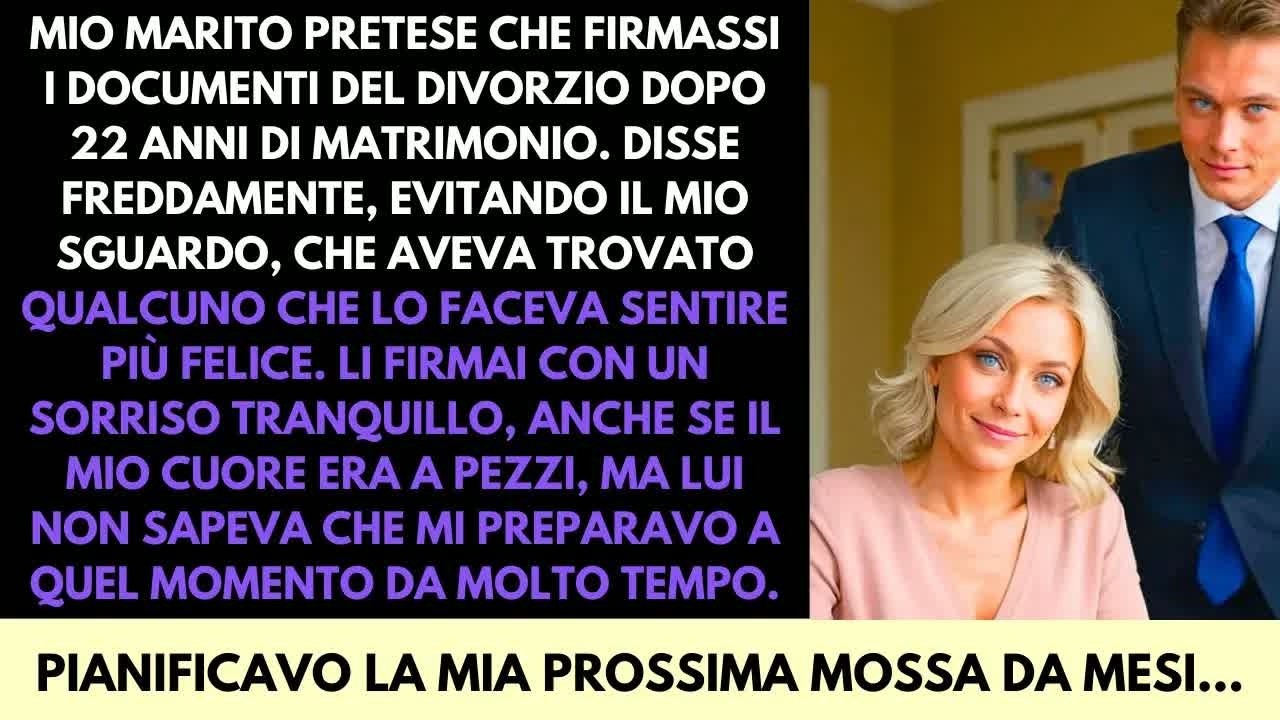
“I found someone who makes me happy,” Riccardo said coldly, refusing to meet my gaze as he slid the divorce papers across the polished cherry wood of our dining table. The same table we had chosen together years ago, when his company had finally started turning real profits. I signed them with a smile, though I felt my heart shatter into a million tiny fragments. What Riccardo didn’t know, what he couldn’t possibly imagine, was that I had been meticulously planning my next move for months.
If you have ever felt undervalued or made invisible in your life, you will see yourself in Chiara’s journey. This is the story of a marriage gone up in flames, and a woman who takes back her power. It all began with a receipt. A single, fragile piece of paper that would reveal everything.
I was doing the laundry, a task I had performed with silent faithfulness every Sunday for twenty-four years, when I found it crumpled in his jacket pocket. The Cresta Verde Hotel. A double room. Champagne service.
Chocolate-covered strawberries. The date stamped on it was our wedding anniversary. While I had been at home picking at a takeaway pizza and sipping a bottle of wine I had bought to celebrate the occasion alone, Riccardo had been celebrating with someone else. I wish I could say I stormed into his study and confronted him on the spot, but that’s not what happened.
Instead, I carefully smoothed out the receipt, folded it, and put it back exactly where I had found it before continuing to fold his collection of designer shirts, those I had ironed to a perfect, impeccable finish for over two decades. That was when I noticed it. A subtle, persistent smell of perfume that was definitely not mine. It was a heavy, opulent fragrance, something with orchid and sandalwood, so different from the light, delicate rose scent I had worn every day since we met at university.
That evening I watched Riccardo from across the table. I studied him as he compulsively checked his phone every few minutes. A small, private smile playing on his lips as he read messages that were clearly not from me. I wondered when exactly I had become so invisible to him.
Had it been a slow, gradual fade, like hair turning gray, or had there been one specific, definitive moment when he looked at me and no longer saw the woman he had promised to love and honor forever? “Everything going well with the Rossi client? ” I asked in a casual tone, referring to his most important client. “Fine,” he mumbled, eyes still glued to his phone screen.
“Just some details Isabella is sorting out for me. ” Isabella. His new executive assistant. Twenty-eight years old, with impeccable hair, a wardrobe of elegant work suits, and a master’s degree from Bocconi.
I had met her briefly at the company Christmas party about six months prior. I had noticed then how he hung on her every word, how her laughter was a little too loud at his jokes, the way her hand lingered on his arm when she spoke to him. At the time, I had dismissed my discomfort as simple jealousy. Now I wondered if I had simply been desperately blind.
My entire adult life had been poured into the Sterling Financial Group. During our final year of university, while we were dating, Riccardo had shared his grand vision of launching his own financial consulting firm. “We’ll build it together, Chiara,” he had promised, flashing that incredibly charismatic smile that once made my heart beat faster. “With your business degree and my contacts, we’ll be unstoppable.
” And for a while, we were. I put aside my own plans for law school to help him start the company. For the first five years, I worked alongside him, unpaid, of course. We were, as he put it, investing in our future.
I drafted business proposals, networked at mind-numbingly boring industry events, and stayed up until the early hours reviewing contracts. When we could finally afford to hire real employees, I gracefully transitioned into the role of the supportive wife. “You’ve done more than enough, darling,” Riccardo assured me, patting my hand. “Now you can focus on making our home perfect.
” And so I did. I organized impeccable dinner parties that charmed his clients and partners. I joined the right charitable foundations to elevate our social standing. I became the quintessential corporate wife, always smiling, always accommodating, always present.
Meanwhile, my own ambitions gathered dust, just like the business degree hanging in my home office, a room I hadn’t truly used in almost twenty years. Somewhere along the way, Riccardo’s “we” slowly and deliberately became “I. ” It was his success, his company, his achievements. The woman who had helped him draft his first business plan became simply his wife, and eventually, I was reduced to little more than an accessory to be displayed at corporate events.
This systematic exclusion happened so gradually that I barely noticed it as it occurred. First, I was no longer invited to the quarterly strategic meetings. Then Riccardo stopped discussing new clients or potential deals with me. On our fifteenth anniversary, he had opened a separate corporate bank account to which I had no access.
“It’s just to simplify the tax matters,” he had explained with a careless wave of his hand. I accepted each of these changes, every small erosion of our partnership, with the silent grace expected of me. About three years ago, something in Riccardo changed more drastically. Late nights at the office became more and more frequent.
Essential business trips multiplied. He installed a new fingerprint lock on the door of his home study. “Corporate security requirements,” he had stated. His phone was never left unattended, and he began taking low, excited calls on our back patio, abruptly ending conversations the moment I entered the room.
I started paying closer attention to the small details. Credit card statements arrived showing dinners for two at luxury restaurants we had never visited together. I found a second, undeclared mobile phone while looking for batteries in a drawer of his desk. I saw email notifications pop up on his laptop screen from accounts I didn’t recognize.
The numbers didn’t add up either. The income Riccardo declared on our joint tax returns seemed completely disconnected from our increasingly lavish lifestyle. The new holiday home in Cortina d’Ampezzo, the speedboat, the growing collection of vintage cars. When I casually asked about a particular investment that seemed to have materialized out of nowhere, Riccardo just gave me a condescending pat on the hand.
“Don’t worry your head with these complicated things, Chiara. I have it all under control. ” That single, paternalistic dismissal was the spark. It awakened something in me that had been dormant for years.
I began paying much closer attention to the company’s financial documents that occasionally came through the home fax machine. I noticed discrepancies, large sums of money moving through a series of shell companies, highly questionable deductions, and revenue streams that seemed to evaporate before they even made it onto the official reports. I might have continued my silent, passive observations indefinitely if it hadn’t been for what happened last month. Riccardo had left his tablet at home, an unprecedented act of negligence for a man who guarded his digital life like a fortress.
The notification lit up the screen while I was dusting a nearby table. “Meeting confirmed. Cresta Verde Hotel. 8:00 PM.
Tonight. ” I hadn’t planned to follow him. I really hadn’t. But twenty-four years of accumulated doubt, rejection, and silent humiliation drove me into my car that evening.
I parked across the street and watched Riccardo check in, looking nervously over his shoulder like a common criminal. Thirty minutes later, Isabella arrived, wearing an elegant black dress that seemed to accentuate everything I felt I had lost to age and resignation. I didn’t get out of the car. I didn’t scream or make a scene.
Instead, I drove home in absolute silence, while a strange, profound calm took hold of me. The betrayal hurt, of course, but the confirmation, its finality, was almost a relief. Now I understood. Now I could see everything with perfect clarity.
That night, I began my research. Not just into their sordid affair, but deep into the company’s finances. I created a private, untraceable email account. I started photographing documents late at night.
I discreetly recorded conversations. I contacted an old university friend who now specialized in financial forensics. For three entire months, I built my case, all while impeccably playing the part of the oblivious, devoted wife. And when Riccardo finally found the courage to discard me for his younger, more malleable model, I was ready.
I signed those divorce papers with a genuine smile, not because I was strong at that moment, but because I knew exactly what was about to happen. The next day, his company would receive an anonymous, detailed tip about tax fraud worth thirty million euros. The Guardia di Finanza would raid his office within hours. Sometimes, revenge doesn’t roar.
Sometimes, it whispers, patient and meticulous, gathering its strength in the shadows. That morning, hours before the Guardia di Finanza would receive my meticulously compiled evidence, I was woken by the sound of Riccardo’s expensive Italian leather shoes clicking on the marble of our entryway. He had supposedly stayed at the office for the last three nights to sort things out, but I knew the truth. The Cresta Verde Hotel must have his credit card on file by now.
I pulled my silk robe tighter around myself and descended the grand staircase, finding him in our kitchen. He was not alone. A lean, stern-looking man with metal-rimmed glasses was seated at the counter of our island, a heavy leather briefcase open in front of him. “Chiara,” Riccardo said in a purely professional tone, devoid of any warmth.
“This is Martino Vanni. My lawyer. ” Not our lawyer. The man we had used for estate planning for two decades was now his lawyer.
The distinction was a deliberate cut, the first of many to come. He nodded politely as I measured out the ground coffee for my morning beverage, maintaining the facade of domestic normalcy that had become second nature to me. “Would you care for a coffee? ” “We don’t have time,” Riccardo replied brusquely.
He was wearing his power suit, a tailored anthracite gray number from Milan. He reserved it for closing important deals. How appropriate, I thought, that he was wearing it to close our marriage. Martino Vanni cleared his throat.
“Signora Sterling, we have some matters to discuss. ” He pulled a document from his briefcase and slid it across the cold granite of the kitchen island. The exact spot where, twenty years earlier, we had popped a bottle of champagne when Riccardo had landed his first six-figure contract. That night, I had surprised him with his favorite dish, and we had made love right there on the counter, drunk on success and the intoxicating feeling of a shared future.
The divorce papers stared back at me, their sterile, official text filling the space. Riccardo still wouldn’t meet my gaze. “I’ve been unhappy for a while, Chiara,” he began, reciting what was clearly a well-rehearsed speech. His hands were steady, not fidgeting the way they always did when he spoke from the heart.
This was Riccardo in full negotiation mode. Calculated, controlled, and utterly convincing. “Twenty-four years is a long time,” I said quietly, tracing the edge of the papers with my finger. “Too long to stay in something that doesn’t work,” he replied.
“We’ve drifted apart. We want different things. ” I noticed he was standing near the door, physically keeping his distance, as if he expected me to become hysterical or start throwing objects. The Riccardo who had once known me so well now had absolutely no idea who I was.
The real me, the one who had schemed meticulously while he carried on his affair, remained completely invisible to him. “The agreement is more than fair,” Martino Vanni interjected, pushing another document towards me. “Mr. Sterling is willing to be quite generous.
” I skimmed the terms, sipping my coffee slowly. The generous offer was anything but. The beach villa in Costa Smeralda was to be sold, with Riccardo keeping seventy percent of the proceeds. Our primary residence, this house I had furnished and managed for over two decades, would be entirely his, with a clause giving me sixty days to move out.
I would receive a lump sum payment, a one-time payout that amounted to about three years of Riccardo’s declared income. The most revealing aspect was that the agreement stipulated I would forfeit any claim on his business ventures, including future earnings from investments made during our marriage. “I helped you found Sterling Financial,” I said, looking Riccardo straight in the eye for the first time. “I put my career on hold.
I worked unpaid for five years. ” A flicker of discomfort crossed his face, but it was quickly replaced by cold, studied detachment. “That was a long time ago, Chiara. The company’s growth over the last fifteen years has had nothing to do with you.
” It had, though. I knew about the Henderson acquisition that had doubled their market share. A deal closed only because I had befriended Mrs. Henderson at a charity gala.
I knew about the government contract that had been secured after I spent months preparing him for his presentation and rewriting his proposals. I knew about the initial seed investors who had only joined because of my father’s connections. “I found someone who makes me happy,” Riccardo continued, checking his watch. “Isabella and I.
” “Your executive assistant,” I stated dryly. His eyes narrowed almost imperceptibly. “Isabella understands the demands of my position. She shares my vision for the future.
” What he really meant was: she’s twenty-eight and totally impressed by his wealth. She hasn’t seen him fail or doubt himself. She believes the polished mythology of Riccardo Sterling, the self-made man, without understanding the messy, collaborative reality of how our success was actually built. “She’s young,” I observed, keeping my tone perfectly neutral.
“This isn’t about age,” he snapped, a little too defensively. “It’s about connection. Finding someone who sees the real me. ” The irony was so thick I could have choked on it.
I almost laughed. The real Riccardo had vanished years ago, replaced by this carefully constructed persona of untouchable corporate success. He couldn’t even recognize how rehearsed and clichéd he sounded, reciting lines that unfaithful men had been using for generations. Martino Vanni shifted uncomfortably in his chair, his gaze darting between us.
“Perhaps Signora Sterling would like some time to review the documents with her lawyer. ” “That won’t be necessary,” I replied, picking up the Mont Blanc pen Riccardo had given me for our fifteenth anniversary. “I understand perfectly. ” Their surprise was palpable.
They had clearly expected tears, recriminations, perhaps even some desperate bargaining. They had prepared for a dramatic scene. Instead, I signed every page with a practiced, pleasant smile, the same one I had perfected at hundreds of corporate events over the years. “I wish you happiness, Riccardo,” I said, and I meant it more than he could ever understand.
By the next afternoon, his entire world would come crashing down like a house of cards. Martino Vanni collected the signed documents, a look of obvious perplexity on his face at my easy cooperation. Riccardo looked both relieved and suspicious. “You can stay in the house until you find a suitable place,” he offered, a weak, belated gesture of generosity now that I had surrendered so completely.
“How kind of you,” I said, holding his gaze until he was the first to look away. After they left, I poured myself another cup of coffee and allowed myself exactly ten minutes to feel the pain. Not for losing Riccardo, but for the years I had lost, being Signora Sterling instead of just Chiara. Then I got to work.
That night was the last I would ever spend in our bed. Sleep was out of the question as I spread my collection of documents across the antique desk in my bedroom. There were tax returns showing inexplicable discrepancies, statements from accounts in the Cayman Islands, accounting ledgers with convenient errors that always favored Riccardo. I had photographic evidence of cash payments to building inspectors and printed emails discussing creative accounting practices that clearly crossed both ethical and legal lines.
For three years, I had gathered this evidence while pretending not to understand the complexities of corporate finance. Every time Riccardo had patronizingly told me not to worry my pretty head about business matters, I had added another document to my secret collection. Every time he had excluded me from a meeting I should have attended, I had found another piece of the puzzle in the early hours of the morning. My eyes burned from lack of sleep, but my determination was solid as steel.
I organized the final package of evidence, encrypting the digital files and composing the email that would land in the inbox of the Guardia di Finanza’s economic-financial police unit exactly at nine o’clock, including specific details about thirty million euros of fraudulent deductions, hidden income streams, and deliberate false statements on tax documents for eight consecutive years. As the sun began to rise, I showered and dressed with care, choosing a simple blue suit that had once been Riccardo’s favorite. Today marked the end of our marriage, but it also marked the beginning of my revenge. By sunset, Riccardo would finally understand the true cost of underestimating the woman who had stood silently in his shadow for twenty-four years.
My plan had actually begun three months earlier, long before Riccardo presented me with those divorce papers. The day after I discovered his affair with Isabella, I drove fifty kilometers to a public library in a neighboring province. I couldn’t risk using our home computer or any of my personal devices. Riccardo had insisted on installing invasive security software on everything we owned after a supposed corporate cyberattack a few years prior.
The elderly librarian barely looked up from her crossword puzzle as I registered for a computer using my maiden name, Chiara D’Amico. I chose the terminal in the farthest corner, with my back to the wall, and created a new anonymous email address, untraceable. Perfect. That first day, I uploaded only three documents.
Copies of the 2018 tax returns showing clear, undeniable discrepancies between his declared income and actual bank deposits. I knew I had to be methodical. If this was going to work, the evidence had to be airtight and indisputable. For the following weeks, I developed a rigorous routine.
On Tuesdays and Thursdays, Riccardo had fixed business dinners that, by his account, regularly ran late. I told him I had joined a book club. By that point, he was so profoundly disinterested in my personal activities that he never asked a single question. Instead of discussing literature with a group of suburban housewives, I spent those evenings in different libraries across the province, patiently building my case piece by piece.
One particularly rainy Tuesday, sitting in my parked car with trembling hands, I dialed a number I hadn’t called in ages. “Pronto. ” Maria Bianchi answered, a lively, professional voice. “Maria, it’s Chiara Sterling.
From Bocconi University. ” There was a moment of silence, then a voice full of genuine warmth. “Chiara, oh my God, it’s been what, five years since your last Christmas card? How are you?
” I swallowed hard against the lump forming in my throat. “I need some advice, Maria. Professional advice. It’s complicated.
” Maria and I had been roommates for all four years of university. While I had followed Riccardo into his risky business ventures, she had pursued a career in forensic accounting, eventually becoming a highly respected specialist with the economic-financial police unit. We had drifted apart over the years, mostly my fault, as I retreated further and further into Riccardo’s world. But we had always maintained vague, occasional contact.
“Sounds serious,” she said, her tone shifting from friendly to professional. “Do you want to meet? ” We agreed to meet at a quiet café in Monza, almost an hour’s drive from my house. Maria was exactly as I remembered her.
Practical haircut, comfortable shoes, and intelligent, watchful eyes that missed nothing. I felt a sharp pang of regret for letting our friendship fade. “Before you tell me anything,” she said after we ordered our coffees, “you need to understand that I’m bound by certain professional obligations. ” “I know,” I replied.
“That’s why I need your guidance. Hypothetically, of course, what would be the correct procedure for documenting potential tax fraud without becoming implicated yourself? ” Her eyebrows rose slightly. “This hypothetical situation would involve someone close to you?
” “A spouse,” I said, my voice surprisingly steady. “A spouse who has systematically hidden income, created false business expenses, and transferred funds to offshore accounts for nearly a decade. ” Maria’s expression remained perfectly neutral, but her eyes softened with deep, unspoken understanding. “The spouse’s declaration of non-involvement exists for a reason, Chiara.
Many partners genuinely have no idea what their spouses are doing financially. ” “And if that spouse suspected something was wrong but didn’t have concrete proof until recently? ” She sipped her coffee thoughtfully. “Document everything from the moment of discovery onward.
Demonstrate that you took reasonable steps to act once you became aware. The Guardia di Finanza is very good at distinguishing between willful blindness and genuine ignorance. ” Over the next hour, Maria, without ever directly advising me to report Riccardo, walked me through the intricacies of whistleblower provisions, documentation requirements, and the critical importance of establishing a clear, defensible timeline. She never asked for details, maintaining her plausible deniability, but she gave me the exact framework I needed.
“Whatever you decide to do,” she said as we parted, “protect yourself first. ” That conversation gave me the confidence to take my next crucial step. I contacted Professor Alessio Finzi, who had taught my commercial law course during my brief time at law school, before I dropped out to help Riccardo launch his company. Now semi-retired, Professor Finzi agreed to meet me for lunch, clearly curious about the student who had shown so much promise before vanishing from the program.
“Spousal immunity isn’t automatic,” he explained after listening to my carefully worded hypothetical situation. “You’ll need to demonstrate that you had no actual knowledge or reason to know about the underreporting on the tax returns. ” “Even if we filed jointly? ” I asked.
“Especially then. But a reasonableness standard applies. The tax agency will consider your educational background, your financial situation, and whether there were lavish or unusual expenses relative to your normal lifestyle. ” He studied me over his glasses.
“Your background in economics and accounting could work against you, but your gradual, documented exclusion from business matters definitely helps your case. ”
With the guidance of both Maria and Professor Finzi, I refined my approach. I began methodically and silently separating my finances from Riccardo’s without arousing his suspicions. I opened a new bank account at a local credit union using my maiden name and gradually transferred small amounts from my personal account.
I documented every single instance where Riccardo refused to discuss corporate finances with me, recording dates and his exact condescending phrases in a diary I kept locked in the trunk of my car. Meanwhile, I continued to gather evidence. Riccardo’s negligence grew in direct proportion to the intensity of his affair with Isabella. He began leaving sensitive financial statements on his desk in the home office.
He forgot to lock his computer, and sometimes he even discussed questionable business practices out loud, completely unaware that I was within earshot in the next room. Each of his slip-ups provided another crucial piece for my growing file. The hardest part was maintaining our daily routine while I silently prepared for his complete and total collapse. I still cooked Riccardo’s favorite dishes, maintained our shared social calendar, and played the role of the devoted, smiling wife at corporate events.
I even endured Isabella’s presence at the company’s annual picnic, smiling politely as she stood a little too close to my husband, her hand casually touching his arm as they laughed at some private joke. The morning after I signed the divorce papers, I made my final preparations. I drove to a small internet point in a town three towns away. I paid cash for an hour of computer use and uploaded the complete, annotated file on the Guardia di Finanza’s secure portal.
Eight years of systematic tax fraud, multiple shell companies, hidden accounts in the Cayman Islands and Switzerland, falsified expense reports, cash transactions deliberately structured to avoid reporting requirements, properties purchased through anonymous holding companies. The evidence was overwhelming. Thirty million euros of fraudulent activity, all carefully documented and cross-referenced, including a detailed timeline showing Riccardo’s systematic efforts to hide his actions from me, along with my documentation of my gradual exclusion from all business matters. I simultaneously filed the spouse’s declaration of non-involvement through a separate channel, following Maria’s guidance to the letter to protect myself.
As I pressed send on the anonymous tip, I felt no sense of triumph. Just a hollow feeling of completion. This wasn’t just about revenge. Not entirely.
It was about justice. It was about consequences. It was about reclaiming a small measure of dignity from a man who had discarded me after twenty-four years as if I were nothing more than worn-out furniture. Three hours later, Riccardo texted me to let me know he had moved the last of his essential personal effects into his temporary apartment.
We both knew he meant Isabella’s apartment. He asked if I needed anything before he left the house keys. I replied with a single word: “No. ” By morning, his entire world would be changed forever.
The irony wasn’t lost on me that after years of dismissing my business acumen, it would be my meticulous documentation and silent diligence that would bring down his entire empire. The woman he had so casually underestimated would be the architect of his ruin. That night, I slept surprisingly well. Better than I had in months.
When the alarm went off at 6:30, I woke with a sense of determination, dressed in a simple gray suit, professional but discreet, and drove into the city. The Sterling Financial Group occupied the top three floors of the Mercurio Tower, a gleaming structure of glass and steel that dominated the city skyline. I parked in a public garage two blocks away and walked to Caffè da Magda, a small bar that offered a perfect, unobstructed view of the building’s main entrance. “The usual, Signora Sterling?
” Magda asked me in person, a woman in her sixties who had been serving downtown professionals for decades. “Just Chiara today,” I replied with a genuine smile. “And yes, the usual. ” I took a seat by the window and sipped my cappuccino, watching the morning flow of office workers entering the building.
Riccardo would arrive promptly at 8:15, as he had done for twenty years, early enough to seem dedicated, but late enough to make a grand entrance. His executive staff would already be there, preparing for the 8:30 meeting that started every single day. At 9:47, much faster than I had anticipated, three black unmarked sedans pulled up to the curb. Eight men and women in dark suits got out, carrying briefcases and boxes of documents.
Despite their anonymous work attire, something about their synchronized, efficient movements screamed federal agents. Two uniformed police officers accompanied them, standing guard at the entrance while the others went inside. My phone vibrated at 9:52. It was Riccardo.
I silenced it and continued watching. Through the massive glass walls of the atrium, I could see the building’s security guards frantically trying to contact someone on the upper floors. More calls came in. Riccardo again.
Then his personal assistant, Claudia. Then the company’s legal counsel. I let every single call go to voicemail. At 10:01, I saw Riccardo himself burst from the elevator into the atrium.
His face was a mask of panic and disbelief as he confronted the agents blocking the main exit. Even from across the street, I could read his body language. The aggressive gestures. The arrogant indignation.
And then the gradual, visible deflation, as the stark reality of the situation finally sank in. My phone vibrated again. This time, I answered. “What the hell is going on?
” Riccardo’s voice was tense, barely controlled fury. “The Guardia di Finanza and the police are here with search warrants. They’re seizing computers, files. They’re interrogating my staff.
” “Sounds serious,” I replied, my voice perfectly calm. “What do they want? ” “They’re claiming there’s tax fraud, securities violations, money laundering. It’s complete nonsense.
Someone has made false accusations. ” His breathing was ragged and uneven. “I need you to come down here. They’re asking questions about our joint finances.
” “I’m rather busy today, Riccardo. The divorce papers were quite clear about our separation. ” “This isn’t about the divorce,” he yelled, then immediately lowered his voice to a hiss. “Chiara, please, I need you.
Twenty years to build this company. I can’t lose everything. ” The raw desperation in his voice would have moved me once. Now it just sounded like delayed justice.
“I have an appointment at eleven,” I said dryly. “I’ll see what I can do afterwards. ” My appointment was indeed at eleven o’clock. With Special Agent Davide Russo at the Palace of Justice, six blocks away.
After an informal call that morning confirming receipt of my report, he had requested an in-person meeting to discuss my spouse’s declaration of non-involvement. Agent Russo was younger than I expected, perhaps in his early forties, with kind eyes that contrasted sharply with his precise, methodical questioning. After establishing that our conversation was being recorded, he walked me carefully through my history with the Sterling Financial Group. “When did you first begin to suspect financial irregularities, Signora Sterling?
” I described my gradual exclusion from all business matters, the lavish lifestyle that far exceeded our declared income, the strange phone calls, and the hidden documents. “And why didn’t you report these suspicions earlier? ” This was the crucial question. The one that would determine whether I was an innocent spouse or a complicit partner.
“I had suspicions, Agent Russo. Not proof,” I explained. “Riccardo always told me that business was too complicated for me to understand. After years of hearing that, I began to believe it myself.
” I showed him the diary where I had documented specific instances where Riccardo refused to discuss finances. The email exchanges where he had deflected my questions. The statements from separate accounts to which I had no access. “You have a degree in economics,” Russo noted, his eyes scanning my evidence.
“You helped start the company. ” “Yes,” I said. “But Riccardo systematically pushed me out of all operations as soon as we could afford to hire other people. He controlled all financial information.
When we filed our taxes each year, he only presented me with the pages to sign. Never the full returns. ” At the end of our two-hour meeting, Agent Russo seemed satisfied with my cooperation, though he maintained professional neutrality regarding the outcome of my declaration. “We should speak again,” he said as we wrapped up.
“In the meantime, please don’t discuss this investigation with anyone. Especially not your husband. ”
As I left the Palace of Justice, my phone showed twenty-seven missed calls from Riccardo, along with dozens of messages ranging from pleading to threatening. I scrolled through them sitting in my car.
“Call me immediately. This is all a misunderstanding that I can explain. ” “I need you to tell them you handled the household accounts. ” “If they freeze our assets, we’ll both have nothing.
” “I swear I’ll make this divorce a living hell if you don’t help me. ” The last message, sent just fifteen minutes earlier, sent a chill down my spine. “It was you, wasn’t it? This is your revenge.
” I didn’t respond to any of them. Two days later, Agent Russo called to request another meeting. This time, he wasn’t alone. Special Agent Laura Morales from CONSOB joined him, along with an assistant prosecutor named Pietro Garroni.
“Signora Sterling, we’ve made some significant discoveries since we last spoke,” Agent Russo began, his tone more formal with the others present. “We believe you should be aware of them, as they may have a direct impact on your financial situation. ” Agent Morales opened a file. “We’ve established that Isabella Conti was not just romantically involved with your husband.
She appears to have been an active participant in manipulating the company’s financial records. ” They showed me printed emails between Riccardo and Isabella discussing creative accounting solutions, some exchanges dating back three years, almost to the time she had joined the company. In one particularly damning exchange, Riccardo had instructed Isabella to ensure that “Chiara never sees these accounts,” to which she had replied, “Maximum discretion guaranteed. ” “Ms.
Conti received substantial, undeclared bonuses that were linked to the periods of most significant financial manipulation,” Garroni added. “She also received gifts. Jewelry. A car.
A down payment on her apartment. All correlated with specific instances of fraudulent filings. ” The betrayal shouldn’t have hurt. I had already discovered Riccardo’s infidelity.
I had already signed the divorce papers. But something about seeing their conspiracy in black and white reopened wounds I thought had already begun to heal. Then came the real shock. “The most troubling discovery,” Agent Russo continued, “concerns the employee pension fund.
” He explained that Riccardo had illegally diverted approximately four million euros from the company’s employee retirement accounts, replacing sound, secure investments with essentially worthless shares in his own shell companies. Dozens of loyal employees. People whose names I knew. People who had attended our Christmas parties for years and had trusted Riccardo with their futures.
They would discover that their retirement savings had been completely decimated, just when they needed them most. The company had a supplemental contribution program. People were putting their life savings into those accounts. “Yes,” Agent Morales confirmed grimly.
“And it appears these diversions began shortly after Ms. Conti took over management of those funds. ” The sheer magnitude of Riccardo’s betrayal finally hit me. It wasn’t just his betrayal of me.
It was his betrayal of everyone who had placed their trust in him. Loyal employees who had worked nights and weekends to help him build his dream. Clients who had placed their faith in his financial guidance. My own parents, who had invested a portion of their pension funds in his very first venture.
To my deep shame, I burst into tears right there, in front of the three federal officials. Not delicate, silent tears, but ugly, wrenching sobs that came from a deep, wounded place inside me. “I’m sorry,” I managed to stammer between breaths. “I knew he was defrauding the state.
But I never imagined he would steal from his own employees. ” Agent Morales silently handed me a box of tissues, while Agent Russo poured me a glass of water. They waited patiently while I struggled to regain control. “Signora Sterling,” Garroni said gently once I had calmed down.
“Your cooperation and meticulous documentation have been invaluable. Based on everything we have seen, I will fully support your request for a declaration of non-involvement. ”
As I drove home that evening, Riccardo called again. This time, I answered.
“They’re saying I stole from the pension fund,” he said without preamble, his voice hollow and defeated. “They’re freezing everything. They took my passport. ” I stayed silent, letting the full gravity of his situation sink in for him.
“Did you know? ” he asked finally, his voice barely a whisper. “About the tip-off? ” “Goodbye, Riccardo,” I said quietly, and ended the call.
Justice, I was discovering, didn’t taste like triumph. It tasted like grief. Grief for the man I thought I had married. For the years I had lost.
For all the innocent people who had been caught in the crossfire of his insatiable greed. The weeks following Riccardo’s arrest passed in a whirlwind of legal meetings and endless paperwork. My request for a spouse’s declaration of non-involvement proceeded with surprising efficiency, supported by Agent Russo’s strong endorsement and the mountain of evidence I had provided. The Guardia di Finanza and CONSOB had frozen most of our joint assets, but my lawyer managed to secure an emergency allowance for living expenses that gave me the breathing room I needed to plan my next steps.
I left our sprawling suburban house without a single pang of regret, taking with me only my personal belongings and a few family heirlooms. The designer furniture. The expensive artwork chosen solely to impress Riccardo’s clients. The state-of-the-art kitchen appliances I had never even used.
I left it all behind, shedding the trappings of a life that had been slowly, inexorably suffocating me. My temporary residence was a modest hotel suite downtown, paid for with the small emergency fund I had scrupulously set aside during those months of secret preparation. Every morning, I walked to a nearby café, ordered a coffee, and made lists of all the things I needed to do to rebuild my life from scratch at the age of fifty-five. One particularly sunny Tuesday, I found myself staring at the contact information for Giorgio Caldini, my former supervisor at the D’Amico Caldini accounting firm.
The firm where I had worked before leaving to help Riccardo start his business. On impulse, I dialed the number, half-expecting to speak with his assistant or perhaps discover he had retired long ago. “Pronto. ” Caldini answered with his familiar gruff voice.
“Giorgio, it’s Chiara Sterling. Well, soon to be Chiara D’Amico again. ” “Chiara. ” The surprise in his voice quickly turned to genuine warmth.
“I’ve been following the news about Sterling Financial. Nasty business. Are you okay? ” That simple, direct question of genuine concern nearly broke me.
For twenty-four years, Riccardo had only ever asked how I was as a polite prelude to talking about himself. “I’m finding my way,” I replied honestly. “Actually, I was wondering if you had time for a coffee. I could use some professional advice.
” We met the following day in his firm’s offices. Giorgio had aged well. His hair was now completely silver, but his handshake was still firm and his mind sharper than ever. He listened attentively as I laid out my situation, nodding occasionally but reserving judgment until I had finished.
“So,” I concluded, “I need to restart my career after a twenty-four-year detour. Any suggestions? ” Giorgio leaned back in his chair, a thoughtful expression on his face. “We actually have an interesting situation here.
Our compliance and fraud detection division has grown considerably in recent years. We’re looking for someone with a unique perspective. Someone who understands how these schemes work from the inside. ” “Are you offering me a job?
” I asked, stunned. “I’m suggesting a conversation with our department head,” he clarified with a small smile. “Your experience, both professional and personal, would be invaluable. Besides, you always had an incredible gift for spotting irregularities in financial statements.
” Two interviews later, I was employed again for the first time in over two decades, with my own office, a title, and a team of colleagues who respected my insights. The deep irony wasn’t lost on me. Riccardo’s financial crimes had inadvertently resurrected the very career I had abandoned for him all those years ago. As my professional life began to stabilize, I faced another challenge.
Riccardo’s preliminary hearing. My lawyer advised me that my presence wasn’t required, but after considerable thought, I decided I needed to attend. Not for vengeance or some morbid sense of satisfaction, but for the closure I knew I needed to truly move on. The courthouse was an imposing building, all marble and mahogany, designed to intimidate with its sheer grandeur.
I sat in the last row, wearing a simple navy blue suit and no makeup, my wedding ring conspicuously absent from my finger. Riccardo entered with his court-appointed lawyer, his shoulders hunched in an ill-fitting suit that had clearly once been tailored to perfection. Gone were the designer glasses, the expensive watch, the confident stride. He looked older, diminished somehow, scanning the courtroom with nervous, darting eyes.
When his gaze finally landed on me, he froze for a moment. Something flickered across his face. Not the anger I had expected, but an expression of profound sadness, tinged with what looked like genuine regret. For the first time in years, he seemed to truly see me.
Not as an extension of himself or a convenient support system, but as Chiara. A whole, separate person he had methodically erased. He gave a slight, almost imperceptible nod of recognition. I returned the gesture but kept my expression impassive.
There was nothing left to say to each other. The hearing was brief and procedural. Riccardo pleaded not guilty to seventeen federal charges, including tax evasion, wire fraud, and theft of employee pension plans. The judge denied bail, given the severity of the charges and the clear flight risk.
As they led Riccardo away in handcuffs, he turned to look at me one last time, a look that seemed to say, “I’m so sorry. How did we get here? ” I left the courthouse feeling lighter than I had in years, as if I had finally set down a heavy burden I hadn’t even realized I was carrying. Two months later, I signed the lease on a new apartment downtown.
It was a corner unit on the twelfth floor with floor-to-ceiling windows that flooded the entire space with natural light. It was less than a quarter of the size of our former house, but it felt infinitely more comfortable and welcoming. I furnished it simply, with pieces I genuinely loved rather than objects chosen to impress other people. My books, neglected for years while I focused on Riccardo’s interests, filled the shelves once more.
My grandmother’s hand-stitched quilt adorned my bed. My collection of sea glass, gathered during vacations Riccardo had always been too busy to enjoy with me, sat proudly displayed in a hand-blown glass bowl near the window. The official letter from the tax agency arrived six months after Riccardo’s arrest. By that point, he had accepted a plea deal, admitting to a reduced number of charges in exchange for his cooperation against others involved in related schemes.
Isabella had also plea-bargained, testifying against Riccardo to minimize her own sentence. I opened the envelope with steady hands. The whistleblower reward was substantial. Fifteen percent of the total recovered funds, amounting to just over four million euros.
The validation was sweet, but the money itself felt almost secondary at that point. I had already reclaimed something far more valuable. My independence. My identity.
My future. That evening, I called Maria, my old college roommate who had provided that crucial initial guidance. “I need to do something meaningful with this money,” I told her. “Something that really matters.
” Two weeks later, I filed the paperwork to establish the Nuovi Inizi Foundation, an organization dedicated to supporting women who were rebuilding their lives after divorce and financial abuse. The foundation would provide emergency grants, pro bono legal assistance, career counseling, and financial literacy training. All the resources I would have desperately wanted during those first terrible, disorienting days after my marriage collapsed. At the foundation’s very first board meeting, I shared my vision with the diverse group of professionals I had assembled: lawyers, financial advisors, therapists, and community organizers.
“Too many women stay in difficult, even dangerous situations because they can’t see a financial way out,” I explained. “We’re going to change that. ”
With the arrival of spring, I settled into my new, fulfilling routines. Mornings at the accounting firm, analyzing complex financial statements and training younger staff to recognize the subtle red flags of fraud.
Afternoons at the foundation, reviewing grant applications and helping to develop new programs. Evenings often spent on my small balcony, watching the city lights emerge as dusk fell, usually with a good book in hand. A simple pleasure I had rediscovered. One afternoon, I ran into Riccardo’s former assistant, Claudia, at a café near my office.
After an initially awkward exchange, she thanked me. “The employees recovered most of their pension funds because of you,” she said quietly. “No one blames you for what happened. ” Her words healed a part of me I hadn’t even realized was still wounded.
I hadn’t just gotten revenge on Riccardo. I had inadvertently protected the very people who would have been devastated by his selfish actions. On the first anniversary of the day I signed those divorce papers, I hosted a small dinner at my new apartment. The first time I was entertaining guests in my new home.
Maria was there, along with Giorgio, my sister who had flown in from Rome, and two new friends I had met through the foundation. As we raised our glasses for a toast, I realized with startling clarity that I wasn’t just surviving after Riccardo. I was thriving. The life I had so carefully rebuilt from the ashes of my failed marriage wasn’t a consolation prize.
It was the authentic, meaningful life I should have been living all along.