A vulture bone carved with precisely spaced holes, discovered in a German cave, has been confirmed as a 40,000-year-old musical instrument. When researchers reconstructed and played it, it produced a clear, controllable musical tone across a recognizable scale, demonstrating that early humans possessed sophisticated musical knowledge thousands of years before previously assumed. The Hohle Fels flute, along with other instruments from the same era found at European sites, provides the oldest direct physical evidence of music. The planning required to drill evenly spaced tone holes onto a curved bone surface reveals an understanding of the relationship between hole placement and pitch, indicating that those who made it already possessed developed musical concepts.
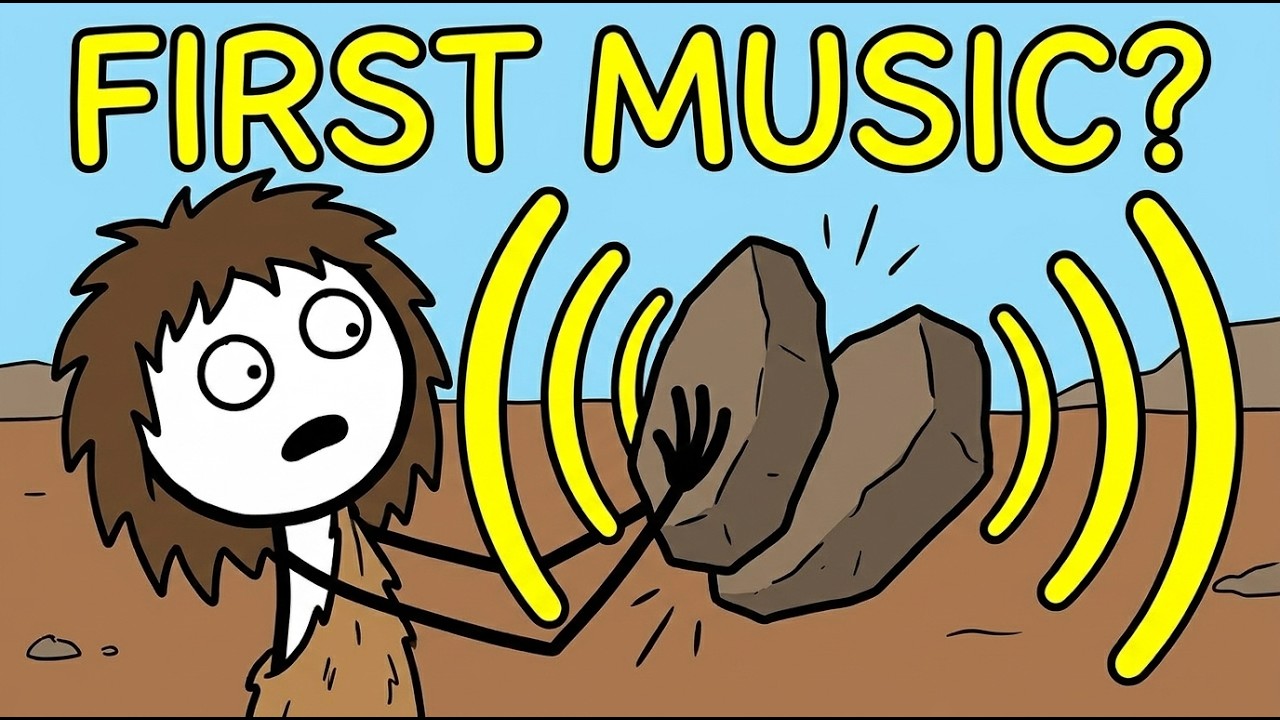
Yet, this instrument is likely not the beginning of music, but rather the product of a far older, untraceable practice. Musical instruments serve music, and tools typically emerge after the function they support is already established through simpler means. Thus, the flute maker was creating more capable sound-producing technology for a musical practice that already existed using methods leave almost no archaeological trace
The human voice is the obvious starting point for early music, as it is present in every human group and leaves no archaeological trace. It is capable of melodic lines, harmonics, rhythmic patterns, and emotional expressiveness, meaning whatever social functions music serves, they were available to all humans regardless of material culture
Body percussion, including clapping and stomping, also requires no tool-making and is documented across all human cultures.
Great apes engage in rhythmic behaviors, such as chimpanzees drumming on tree roots, suggesting the capacity for rhythmic sound production predates the split between humanand chimpanzee lineages
Rhythm’s unique function distinguishes it from melody. Rhythmic sound at certain tempos induces synchronization of physical movement, called rhythmic entrainment, documented in humans and several non-human species. Such movement synchrony enhances group cohesion, cooperation, and trust, offering a functional advantage that natural selection could plausibly act on
Collective physical work becomes more efficient when synchronized, and rhythmic vocalization during work serves as a practical coordination tool across many cultures. Work songs aren’t merely entertainment; they actively align the timing of physical effort across individuals, improving group outcomes.
This offers a direct selection path for rhythmic musical behavior to establish itself
Robin Dunbar’s work proposes that group musical activity, particularly synchronized singing, produces endorphin release through the same physiological pathway as physical grooming, bonding many individuals simultaneously. Research confirms elevated pain thresholds—a proxy for endorphin release—in people who sing in groups compared to passive listeners, supporting the social bonding hypothesis
Archaeoacousticians studying prehistoric caves found that the locations of cave paintings correlate with areas of greatest acoustic resonance. Spaces where human vocalizations produce powerful echoes may have generated extraordinary auditory experiences associated with ritual activity. The discovery of resonant cave spaces likely shaped organized musical behavior, not through planned invention, but through accidental encounter with natural acoustics
Music and language share structural features, both organizing sounds through learned, culturally transmitted systems.
They exhibit similar developmental patterns, brain lateralization, and neural substrates. Some propose they evolved from a common precursor, musilanguage, others argue music emerged for social bonding while language for information transmission, yet others view music as a byproduct of language evolution. Each hypothesis fits some evidence but not all, leaving the question unresolved
Infant-directed speech—the melodically rich register used with prelinguistic infants—shares properties with music, including higher pitch, rhythmic regularity, and emotional expressiveness. Infants prefer it tonormal speech from birth, suggesting a pathway where music emerged from the emotional dimensions of caregiver-infant vocal communication, which is both ancient and functional
Cross-cultural research by Samuel Mehr found listeners unfamiliar with other cultures’ music could reliably identify recordings’ social functions—healing, ceremonies, love songs, dancing—at rates above chance.
This suggests certain acoustic features universally signal social contexts, implying music’s connection to social functions is deeply rooted, not culturally arbitrary
The discovery of specific acoustic phenomena likely shaped music’s evolution invisibly. Resonance of hollow objects, acoustic properties of spaces, natural clustering of vocal harmonics, and involuntary movement synchronization from certain tempos—none required intentional invention. They required people to notice interesting effects and culturally elaborate them across generations, accumulating into sophisticated musical traditions
Geoffrey Miller’s sexual selection hypothesis proposes musical ability functions as a costly signal of genetic quality, shaped partly by mate preference dynamics. Some evidence shows professional musicians have elevated reproductive success, though confounding variables complicate the effect
Neuroscience reveals music processing engages motor systems, emotional centers, reward pathways, memory, and social cognition simultaneously.
This multi-system integration suggests music has been functionally significant long enough for specialized processing to develop, rather than being a recent cultural overlay. Music-induced chills, triggered by violated musical expectations, demonstrate deep integration into the brain’s emotional architecture
Divje Babe bone fragment from a Neanderthal site in Slovenia, dated around 50-60,000 years ago, contains holes some interpret as a musical instrument, though others argue carnivore tooth marks explain them. If genuine, it would push instrument origins back further and suggest music predated modern Homo sapiens, but the interpretation remains contested
Tempos that reliably produce rhythmic entrainment cluster around 60-120 beats per minute, matching human walking pace, resting heart rate, and infant rocking rhythms. This calibre suggests the nervous system’s entrainment response maybe calibrated to biologically significant internal rhythms, explaining why dance music’s preferred tempo range is consistent across cultures
Every studied human culture has music, and infants respond with emotional engagement and rhythmic movement before learning cultural associations.
Music’s neural architecture appears species-specific, suggesting deeper origins than pure cultural learning. Rather than being invented after humans became fully human, music was part of what made us human, embedded in social bonding, emotional regulation, group coordination, and cognitive development
The vulture bone flute stands as impressive evidence of musical sophistication 40,000 years ago. Yet, it likely represents not the story’s beginning, but are far later chapter.
The original beginning was when a human first made a sound, noticed something about it felt worth repeating, long before our ancestors were fully human enough to notice anything at all