The invention of money did not begin with coins, trade, or even a royal decree. It began with an uncomfortable social problem that has never fully disappeared: how can two people agree on what has value? In early human communities, there was no marketplace in the modern sense. A hunter who returned with more meat than his family could eat did not negotiate a per-pound price.
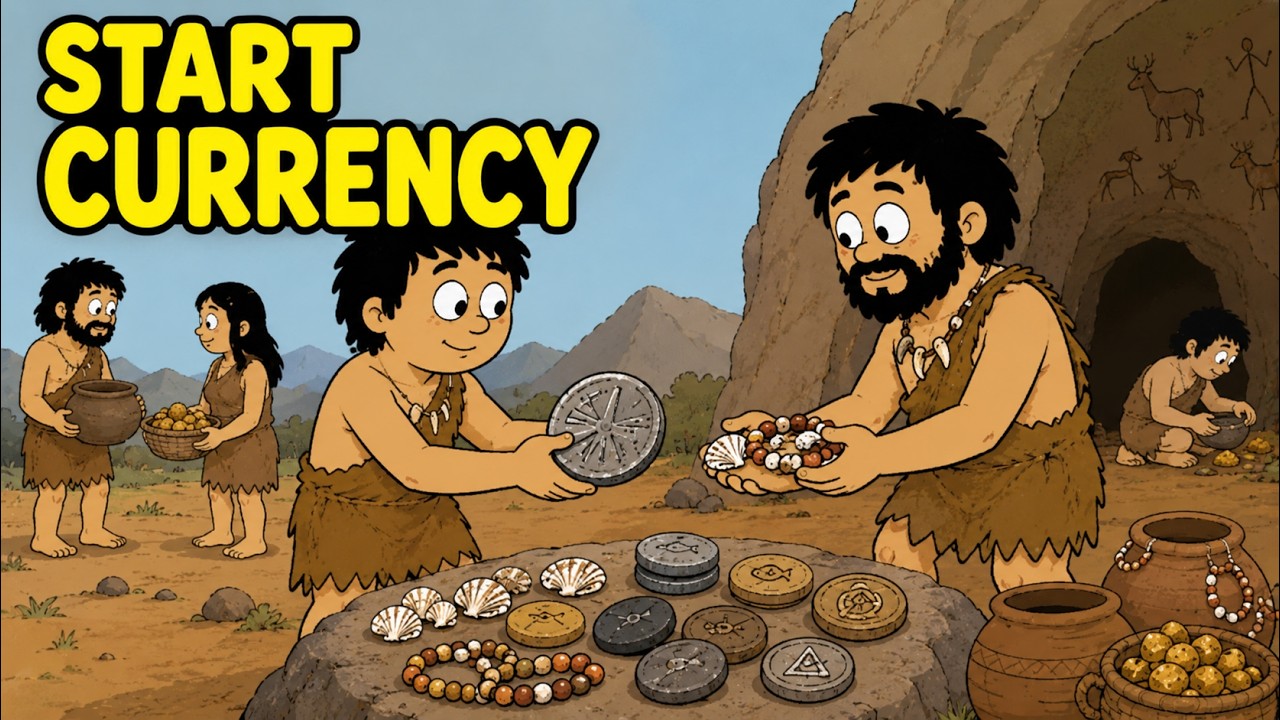
He distributed it. The community’s memory served as the economic ledger; if one family shared food during a drought, the debt lived in social memory and was repaid when roles reversed. No coin changed hands, but an obligation existed. Anthropologist David Graeber spent years examining the historical and ethnographic record for the famous barter economy described in textbooks, the system where ancient humans traded fish for axes until frustration drove them to invent coins.
He concluded that it never existed. No human society has ever been documented using pure barter as its primary economic system. Barter happened only at the edges, between strangers from different communities who had no shared social fabric or existing mutual obligations. Early humans ran on a system closer to ongoing social credit, an unwritten accounting system enforced by memory, reputation, and the threat of being cast out.
Wealth was measured not by what a person accumulated, but by what they had given and what they reliably would give when called upon. Communities did not stay small forever. When a settlement grew from 50 people to 5,000, the informal memory ledger collapsed. External records became necessary, and the technology that arrived was clay.
Around 8,000 years ago in the Fertile Crescent, communities used small clay tokens to track quantities of goods; a cone represented grain, a sphere represented oil, and a cylinder meant an animal. Over time, administrators sealed tokens inside hollow clay balls to protect records from tampering. They pressed tokens against the wet clay exterior to identify contents without breaking the seal. Eventually, the impressions alone carried all the necessary information, the hollow ball became a flat tablet, and those impressed marks became the first writing.
Writing was not invented so poets could record feelings or priests could document prayers. It was invented so bureaucrats could track grain deliveries and outstanding debts. The first thing humans felt the need to write down was an IOU. By the third millennium BCE, Mesopotamia’s temples and palaces were managing economies of staggering scale, issuing standardized rations, recording surpluses, and tracking loans with interest across generations.
Hundreds of thousands of excavated cuneiform tablets are receipts, inventories, wage records, and loan agreements, not epic poetry. These complex economies operated without coins. Silver circulated as “hack silver,” irregular lumps cut from larger pieces as needed, weighed against standard stone balances, with every transaction recorded on a tablet. The institution behind the record was what made the system function; the silver was merely the object.
Money serves three functions: a unit of account, a medium of exchange, and a store of value. The Mesopotamian silver shekel functioned primarily as a unit of measurement, pegged by institutional decree to a specific quantity of barley, while wages were often paid in grain, oil, and wool. Every commodity tried as money revealed weaknesses. Cattle could not be divided without destroying the animal.
Grain rotted. Shells lost value when trade routes shifted. The most persistent weakness, however, was verification: how could each party in a transaction know the true value of what they were receiving? The turning point came with an idea so simple it is easy to underestimate.
Someone in authority took a piece of metal and stamped it. The earliest known coins date to the late 7th century BCE, from the Greek world and the kingdom of Lydia in modern Western Turkey. Made of electrum, a naturally occurring gold-silver alloy from the River Pactolus, these coins solved a serious problem: raw electrum’s gold-to-silver ratio varied wildly by location, making its value impossible to assess on sight. The Lydian kings melted the electrum, standardized its composition, formed consistent shapes, and struck each piece with a lion’s head, the royal symbol.
The stamp was a declaration that the metal had been weighed, tested, and certified by state authority. Merchants no longer needed scales, touchstones, or chemical tests. The coin sold trust, not metal; the metal was the vehicle, and the trust was the product. Counting coins replaced weighing metal, accelerating the velocity of commerce.
Rulers quickly discovered that coinage was also a political instrument. It simplified tax collection, which previously meant accepting a cumbersome assortment of perishable goods. Citizens needing coins to pay taxes had to provision the king’s soldiers and administrators, the people distributing the coins. A ruler’s face stamped on every coin served as daily propaganda in an era before mass communication, reminding every merchant, farmer, and soldier of centralized authority.
Armies drove the spread of coinage faster than any merchant network. States mobilizing mercenaries needed to pay them in something compact, durable, and universally acceptable across long distances. Soldiers spent coins wherever they were stationed; locals who received coins then needed more to pay their taxes; to acquire coins, they had to produce goods soldiers and administrators wanted. The state had created a market economy as a side effect of coins, taxes, and armies operating together.
Athens minted the silver tetradrachm bearing the owl of Athena, maintaining its silver content so consistently that it functioned as a reserve currency from Egypt to the Black Sea. Merchants carrying Athenian silver did not need to renegotiate value in every port. Money had become a network that allowed strangers to cooperate economically without any personal relationship. This transformation had a price.
In the village, debt connected people; in the monetized economy, debt became a mathematical claim that grew exponentially regardless of harvest conditions. When farmers could not pay, they lost land, labor, and often freedom. Debt slavery was a recurring crisis in ancient economies, threatening to concentrate all productive land and labor into the hands of wealthy creditors. The response, documented in Mesopotamian records going back nearly 4,000 years, was the debt jubilee.
Kings like Ammi-Saduqa of Babylon issued proclamations canceling agrarian debts, returning forfeited lands, and freeing debt slaves. These were acts of statecraft, not charity. The tradition survived into the Hebrew Bible, where the jubilee year, every 50th year, became a divine commandment commanding the cancellation of debts and the freeing of slaves. The darker application of monetary power was debasement.
Rulers who controlled the mint controlled every coin’s content, and the temptation to quietly reduce silver content while maintaining face value was rarely resisted. The difference functioned as a hidden tax on every holder of the currency. Roman emperors debased the silver denarius so severely that by the reign of Gallienus in the 3rd century, it contained less than 2% silver, down from roughly 90% four centuries earlier, contributing to inflation so severe that the government regressed to payment in kind. The lesson of every debasement is the same one stamped on the first coin: money works only as long as the trust it represents survives.
Money evolved through layers of innovation, each solving one problem and introducing another. Clay tablets solved the memory problem but required institutional infrastructure. Silver solved portability but created a trust problem. Coins solved the trust problem but created the debasement problem.
When trade volumes grew beyond what metal could support, merchants in medieval China and Europe issued paper receipts for metal stored in vaults. People began accepting these promises without redeeming them; the paper became money because enough people trusted the institution behind it. When that trust failed, bank runs followed, and the institution collapsed. Every major banking crisis has been at its core a collapse of collective belief in the promise behind the money.
The response was the central bank: the Bank of England in 1694, the U. S. Federal Reserve in 1913, institutions designed to serve as lenders of last resort and maintain collective trust. In 1971, the United States severed the last formal link between its currency and gold.
The dollar became backed not by anything tangible, but by confidence in the U. S. government, the Federal Reserve, and the global financial system. Every major currency operates this way today.
The paper in your wallet is not a receipt for stored gold; it is a promise backed by institutional authority, legal frameworks, and collective agreement. Strip away those social structures through war or hyperinflation, and the paper becomes what it physically is: paper. The numbers in your bank account do not exist as physical objects anywhere. They are records, the modern descendants of the clay tablets in the temples of Sumer: institutional records of obligation, of credit, of what one party owes another.
A merchant recording a grain debt in ancient Ur and a person checking their balance on a phone are doing the same thing in the deepest structural sense. Both are consulting an institutional record of trust, relying on a shared social agreement that the record means something. Neither is touching anything intrinsically valuable. Humanity did not invent money for convenient shopping.
Money was invented, and reinvented repeatedly over 5,000 years, because humans wanted to cooperate with people they could not personally know or trust. Each evolution extended the reach of that cooperation: the clay tablet extended it across time, the coin across space, the banknote across scale, the electronic transfer across distance. Each extension required new institutions to maintain it and created new crises when those institutions fell short. Hyperinflation, banking collapse, and currency crises are not aberrations; they are intervals where the system reveals the limits of current trust and forces either expansion or collapse.
Digital currencies and the debate over central bank digital currencies are the latest chapter in this same story. The form has changed; the question has not. What can one person give another that both will trust has value? Every coin, note, and digital balance is humanity’s latest answer.
Not the final answer, because trust is never a problem solved once and set aside. It is a relationship maintained generation by generation, institution by institution, transaction by transaction. Money is not a thing invented in the past.
It is a process happening right now in every transaction on the planet.