For roughly 3 million years, before the first controlled flame, no human ancestor ever cooked a meal, warmed themselves by a fire, or sat in a circle of light while darkness stayed outside. Fire did not belong to them, and the life they lived without it was so far removed from anything known today that it barely looks human. Because before fire, humans were not at the top of the food chain; they were nowhere near it. In 1924, a fossilized skull of a child was found in a limestone quarry in Taung, South Africa, identified as Australopithecus africanus and dated to roughly 2.
8 million years old, For decades, scientists assumed a leopard or a saber-tooth cat had killed it, Then in 1995, researchers Lee Berger and Ron Clarke took another look at the skull, which bore puncture marks and deep gouges carved into the eye sockets, They matched perfectly with the talon marks of a large African Crowned Eagle,, The Taung Child had not been dragged away by a cat;, it had been snatched off the ground by a bird, carried to a nest, and eaten,,Your ancestors were small enough, slow enough, and defenseless enough that eagles hunted them,,And eagles were only one problem: leopards, hyenas, saber-tooth cats, crocodiles, and wild dogs,,Researchers estimate that 6 to 10% of early hominids were killed by predators per generation, roughly the same rate as a modern gazelle on the African savanna,,For millions of years, your ancestors occupied the same position on the food chain as a medium-sized antelope,
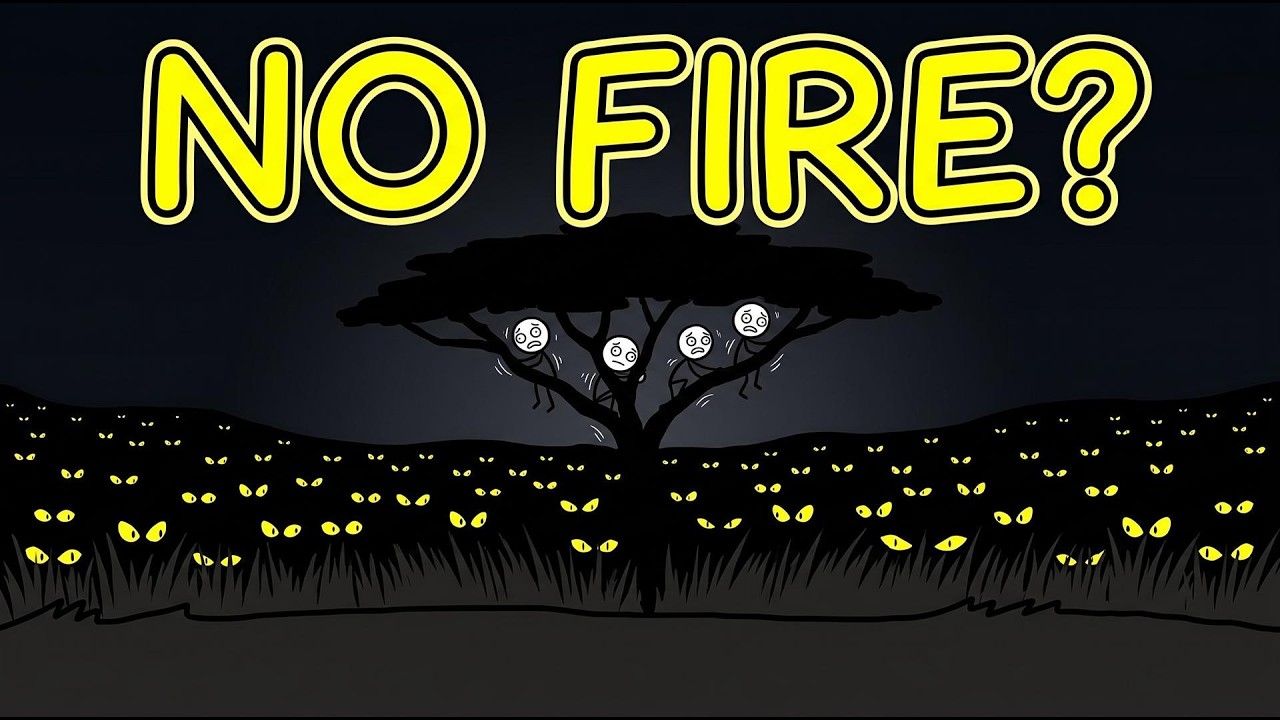
Every single night was the worst part,,Without fire, your ancestors could not stay on the ground after dark,,Human eyes are terrible in low light compared to animals that hunted them,: leopards see six times better than a human in the dark,,So, when the sun set, your ancestors climbed the tallest tree they could reach, wedged themselves into a fork between branches, and stayed there until morning,, Not lying in a bed, Not even lying down,,They gripped bark with both hands, legs wrapped around a limb, trying not to fall,,Every primate in the wild still sleeps this way,,And for millions of years, so did humans,There is a familiar sensation that may be a relic of this era,: the sudden jolt that snaps you awake just as you are drifting off,,The falling sensation,,Your muscles fire, your arms jerk, your heart races for no reason,,It is called a hypnic jerk,,and researchers believe it may be an evolutionary reflex built to wake you before you slipped off a branch and died,,Your body still rehearses a survival drill for a bed that has not existed in over a million years,
Without fire, there was no cooking,,And without cooking, the human body was a fundamentally different machine,,Chimpanzees spend roughly 5 to 6 hours every single day just chewing,,Their food is raw, tough,,and fibrous,: leaves, bark, wild fruit with thick skins, hard roots,,Pre-fire ancestors ate the same way,,They scavenged carcasses that larger predators had already stripped clean,,cracked open thick leg bones with crude stone flakes for the marrow inside,,scooped fat out of broken skulls with their fingers,,and ate whatever insects they could pull from the dirt,: termites, grubs, beetles, and fat white larvae the size of a thumb,,All of it raw and tough,,taking hours to chew through,
In 1995, anthropologist Leslie Aiello and Peter Wheeler published what they called the expensive tissue hypothesis,,The brain and the gut are the two most energy-hungry organs in the body,,Both are enormously expensive to run,,and in every primate that eats raw food, the gut is massive,,Raw plants and raw meat take hours of chemical processing to break down,,A gorilla’s digestive tract is roughly twice the size of a human’s relative to body weight,,and a gorilla’s brain is roughly a third the size of a human’s,,The equation was simple,: big gut, small brain,,That was the rule for every primate on Earth,,and for millions of years human ancestors were trapped inside it,,Their brains could not grow larger because their guts consumed all the available energy just to digest raw food, leaving no calories left over to run anything bigger between their ears
Richard Wrangham, a primatologist at Harvard, calculated that a human trying to survive on a completely raw wild diet would need to chew for more than 6 hours a day just to extract enough calories to stay alive,,And even then, the math does not work,: modern humans who attempt strict raw wild diets consistently lose weight and break down,,The human body is is no longer built for raw food,
What did a day actually look like? You woke in a tree at dawn,,You climbed down carefully because a fall from any real height could shatter a bone, and a broken bone in a world without medicine meant death,,You spent the morning moving, scanning the ground for roots, insects,,or anything edible,,If you were lucky, you found a carcass that something bigger had abandoned, fought off vultures and jackals for the scraps,,smashed bones with rocks to get at the marrow inside,,and ate it raw, gray, slick,,and dripping fat,,Then you kept walking,,Staying in one place too long meant being found by something that could kill you,
The useful day ended the moment the sun went down,: maybe 12 hours in summer, as few as eight in winter,,Once the light was gone, you climbed back up, gripped the branches,,and waited for morning,,No campfire, no stories, no warmth in the dark,,no talk about where your people came from or where they were going,,That requires something ancestors did not have yet,: extra time, extra calories,,and a brain large enough to imagine things that do not exist,,Pre-fire ancestors lived in an eternal present,,They responded to what was in front of them,,ate what they found,,ran from what chased them,,And they did this every single day for roughly 3 million years
Then something happened,,The earliest solid evidence of controlled fire comes from Wonderwerk Cave in South Africa, roughly 1 million years old,,Burned bone fragments and ashed plant remains were found 30 meters deep inside the cave,,far too deep to have been caused by a wildfire,,Someone carried flame into that darkness and kept it alive,,But fire did not just add warmth and light,,It completely restructured the human body,,Cooking is predigestion,,It breaks food apart before it reaches the stomach,,The gut no longer needed to do all the work, so it shrank,,And the enormous amount of energy that had been feeding a massive digestive system was suddenly free,,It went to one place,: the brain,,Within a few hundred thousand years of habitual fire use, the human brain nearly doubled in size,,Jaws got smaller,,Teeth shrank,,The face flattened,,The gut shortened,,Fire did not just change how ancestors lived,,It changed what they were,,Intelligence, language,,and the ability to sit and understand these words all trace back to learning to control a chemical reaction that happens when wood gets hot enough
The transition was not a single moment,,It was hundreds of thousands of years of watching lightning strike dry grass, watching the savanna burn, learning not to fear it, learning to carry it, learning to feed it,,and learning that if the flame was kept alive, it would keep them alive,,too,,The human body still carries the memory of both worlds,: the flinch when something moves in the dark,,the jolt as you drift off to sleep,,the craving for fat and sugar that kept ancestors alive between kills,,the instinct to huddle close to others when afraid,,and the uneasy feeling of being watched when standing alone outside at night,,All of it was written in a world without fire,,a world that lasted 3 million years,,a world a modern human would not survive for 48 hours if dropped into it tonight,,But that world built you,,Every reflex, craving,,and unexplained fear was forged in darkness, hunger,,and teeth in the night,,Fire did not erase that programming,,It just gave enough light to forget it was there