A 4. 35-ton stone statue on Easter Island was never dragged, rolled on logs, or hauled flat on a sled. According to a 2025 study that combined physics modeling, 3D scanning, and a full-scale replica, it walked upright across the landscape, rocked gently side to side by a small team pulling ropes. The researchers successfully walked the replica 100 meters in about 40 minutes using only 18 people.
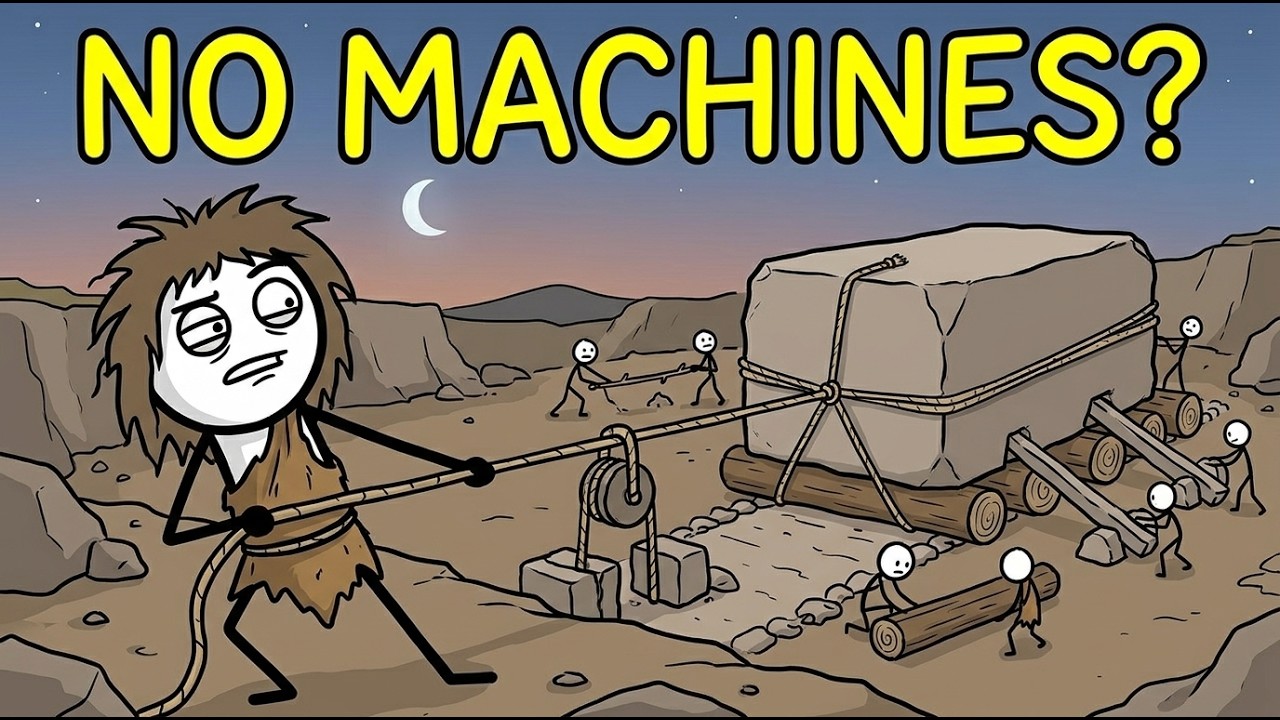
The findings finally validated what Rapa Nui oral tradition had insisted for generations, that the statues “walked” to their destinations. The breakthrough offers a compelling explanation for one of archaeology’s most debated questions, and it fits into a larger pattern of how ancient civilizations solved enormous engineering problems with simple tools and remarkable coordination. The Great Pyramid of Giza, built more than 4,500 years ago, contains over 2. 3 million stone blocks weighing up to 90 tons each.
It was constructed without the wheel in common load-bearing use, without iron tools, and without modern lifting machinery, yet it remains standing today with a precision modern engineers still find impressive. The popular image of vast slave labor forces is largely inaccurate. Archaeological evidence, including logbooks describing organized crews of about 40 men, suggests roughly 4,000 primary laborers worked on the pyramid, supported by 16,000 to 20,000 secondary workers handling ramps, tools, and supplies. It was a coordinated logistics operation sustained over years.
The leading theory for moving the stones involves ramps, but a single massive straight ramp reaching the pyramid’s peak has been largely discredited. Building one would have required more material and labor than the pyramid itself, and no archaeological trace of such a structure has ever been found. French architect Jean-Pierre Houdin quit his stable job in 1999 to solve the mystery. Using detailed computer modeling, he proposed the internal ramp theory, which suggests builders used an external ramp for the lower third of the pyramid, then switched to a spiraling ramp built into the structure’s interior.
This explains the absence of external ramp evidence, because the ramp stones were recycled into the pyramid’s upper levels. Other research, based on a 2012 papyrus discovery, suggests ancient Egyptians used branches of the Nile River to transport massive blocks close to the construction site, letting water do much of the heavy lifting. Wet sand also played a critical role. Wall paintings depicting workers pouring water in front of sledges were long assumed to be ceremonial, but experiments show wetting sand dramatically reduces friction, sometimes cutting the required pulling force by half.
At Stonehenge, erected around 2,500 BC, the greatest challenge was transportation, not assembly. Some bluestones originated from the Preseli Hills of Wales, nearly 200 miles from the construction site in Wiltshire. The leading theory involves a hybrid system of sledges and rollers for overland travel, with rafts carrying the stones along rivers and coastline. Raising the stones into position likely relied on counterweights and sustained leverage, slowly rocking each pillar upright rather than attempting a single risky lift.
This approach redirected the problem into a sequence of small, manageable steps, a principle that appears repeatedly in ancient engineering. The Easter Island moai, some weighing over 80 tons, puzzled researchers for generations. Academic theories assumed horizontal transport by sledge or log roller, but the roads themselves contradicted this. Surveys found no sledge marks, no roller depressions, and no trackways, none of the physical evidence expected from repeated dragging.
Oral tradition said the statues walked, a claim long dismissed as folklore. The 2025 study, led by anthropologists Carl Lipo of Binghamton University and Terry Hunt of the University of Arizona, took that tradition seriously. Analyzing nearly 1,000 statues, the team found that successfully transported moai shared specific design features: a wide D-shaped base and a forward lean of 5 to 15 degrees. These features were not purely aesthetic.
They were functional engineering. With ropes attached to either side, a coordinated team could rock the statue from edge to edge. The forward lean caused the rounded front base to act as a pivot, translating the rocking motion into forward steps. The physics is similar to walking a heavy refrigerator across a floor by rocking it corner to corner.
The study’s credibility comes from its hands-on testing. The team built a full-scale replica incorporating the design and walked it successfully with just 18 people. Calculations suggest an average moai could cover roughly 1,000 feet per hour once the rocking rhythm was established. The hardest part was starting the motion from a standstill, after which pendulum dynamics made each step progressively easier.
Even the roads supported the theory. They measured around 4. 5 meters wide and were concave in cross-section, a shape that would interfere with dragging a flat statue but would stabilize an upright rocking one. Statues found abandoned along the roads were not evidence against the theory.
Roughly half were located within 2 kilometers of the quarry, with abandonment decreasing with distance, consistent with mechanical failures during the early stages of transport. These three projects, separated by oceans and centuries, share a common approach. None of these societies had wheeled transport for heavy loads, iron tools, or mechanical power beyond human and animal muscle. Yet each independently arrived at solutions built on the same core principles: reduce friction wherever possible, break impossible problems into manageable steps, and let natural forces carry as much of the burden as possible.
None of this required modern technology. It required societies willing to commit sustained collective effort toward a single goal, generation after generation, combined with an intuitive understanding of physics that never needed to be written down in equations. The pyramids, Stonehenge, and the moai were built not by magic, but by patient, coordinated human effort, one careful step at a time.