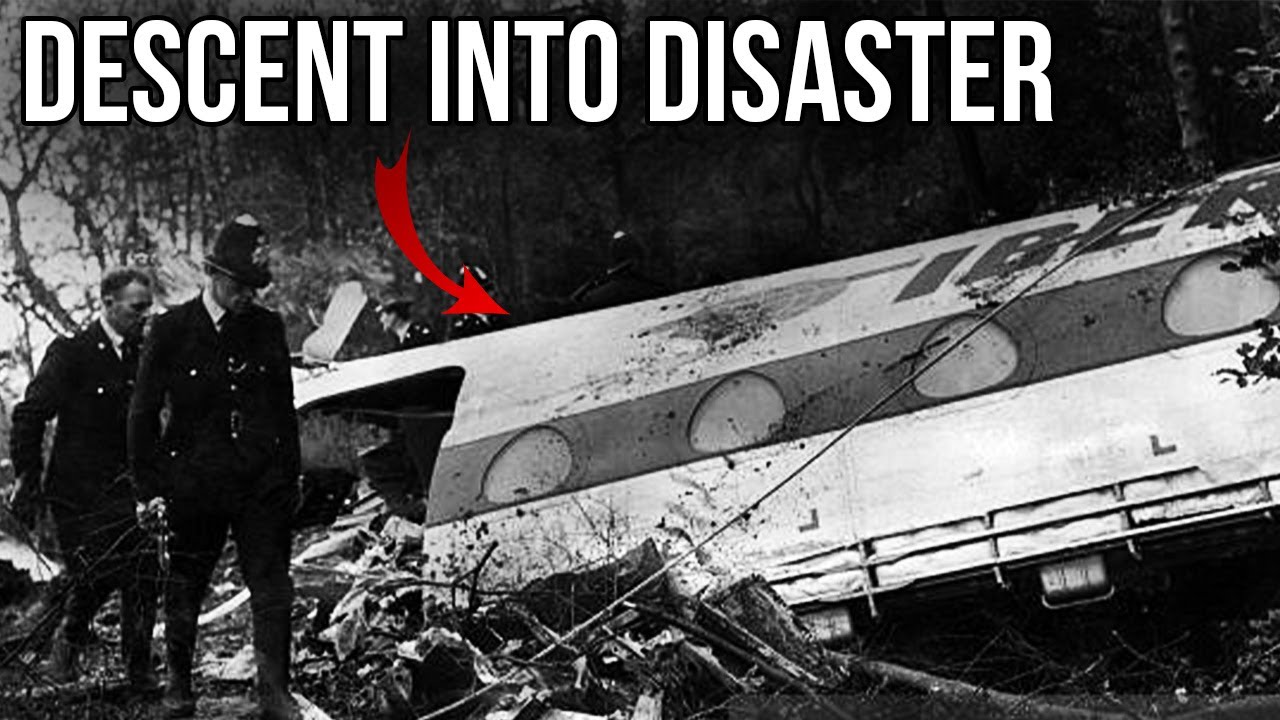
One of Britain’s most baffling aviation mysteries unfolded over the quiet West Sussex countryside on the night of November 4, 1967, when Iberia Flight 062 descended smoothly and without apparent distress straight into Black Down Hill, killing all 37 people aboard and leaving investigators with a question they could never fully answer.

The aircraft, a Sud Aviation Caravelle SE210 that had been in service barely eighteen months, was operating a routine evening service from Malaga to London Heathrow with 30 passengers and seven Spanish crew on board. Among the passengers were British film and television actress June Thorburn, who was five months pregnant, Coventry City Football Club vice president John Clarkson, and Donald Campbell of the Campbell Aircraft Company.
The flight had proceeded without incident for most of its journey. After departing Malaga at 7:40 p. m.
, the Caravelle climbed to its cruising altitude of approximately 30,000 feet and cruised north for roughly an hour and forty minutes. At 9:42 p. m.
, while passing over Alden, the crew contacted London Airways to report they were at flight level 310, beginning what should have been a completely standard descent into Heathrow.
Air traffic control cleared the aircraft to descend in stages, first to 21,000 feet, then to 11,000 feet, and finally to 6,000 feet. Each descent was clearly transmitted, correctly acknowledged, and properly read back by the crew. Cockpit voice recordings recovered from the wreckage revealed no confusion, no language difficulties, no urgency, and no stress.
Everything appeared entirely routine.
At 9:53 p. m. , the aircraft reported descending through 14,500 feet, confirming the crew were aware they were passing below 15,000 feet.
The final instruction from London came at 9:56 p. m. , directing the aircraft to proceed direct to Epsom on a magnetic track of 050 degrees.
The reply came instantly: “Roger. Direct to Epsom heading 050.”
Radar showed the aircraft turning smoothly onto its new heading. Nothing appeared out of the ordinary. But what air traffic controllers did not realize was that the Caravelle had already passed through its cleared altitude of 6,000 feet and had failed to level off.
Instead, it continued descending at a steady rate of approximately 2,200 feet per minute.
Just one minute and forty-seven seconds after passing through 6,000 feet, the aircraft’s altitude had dropped to about 1,000 feet above sea level. At approximately 9:58 p. m.
, as the Caravelle descended to around 596 feet, it struck the tops of tall trees on the southern slope of Black Down Hill.
The aircraft continued cutting through trees for more than 100 meters as parts of the structure, including the wings, were torn away. It destroyed a garage and narrowly missed a nearby house, causing serious damage but leaving the occupants unharmed. Approximately 400 meters after the initial impact, the fuselage finally came to rest, embedding itself in the hillside just beyond Upper Blackdown House.
The first person on the scene was Police Constable William Cooper, the local officer for Haslemere, who was off duty and relaxing at home when his telephone rang shortly after 10:00 p. m. Control room staff informed him that a loud bang had been reported south of Haslemere, and with all other units busy dealing with Bonfire Night incidents, they asked if he could investigate.
PC Cooper, known as Bill, had been the local constable since 1964, covering a large rural area on his lightweight police motorcycle. As he made his way to the top of Black Down Hill near Fernhurst, the weather was cold with mist hanging in the air. He noticed a faint glow of what appeared to be fire in the distance and parked his motorcycle to investigate on foot.

It was at this point that the battery in his torch failed, leaving him in near-total darkness. With no radio, he could not call for backup. He began walking toward the glow, and as he crossed a field, his leg struck something on the ground, causing him to trip.
Feeling around, he realized it was a sheep, and it was very dead.
Continuing forward, he stumbled into something else. When he backed up to see what he had walked into, he realized it was a huge wheel. A strong smell, which he described as resembling paraffin, filled the air.
Pausing beneath a tree to work out where he had left his motorcycle, he felt something dripping on him.
Initially assuming it was rainwater, he looked up and discovered the horrifying truth. What was falling on him was not rain. It was bodily fluids from the victims of the crash.
There were bodies in the trees.
The accounts from other first responders painted an equally harrowing picture. PC Steve Gilbert and his colleague Doug Brazier were among the first to arrive. The nose of the aircraft was still intact, buried in soft earth.
PC Gilbert climbed inside, calling out, but was met with dead silence. He saw the bodies of the flight crew still strapped in their seats.
The main fuselage aft of the flight deck was completely broken up, with naked body parts, shoes, and clothing scattered everywhere. Some body parts were impaled on trees. PC Gilbert described it as a sight he would never forget.
Powerful lighting was erected so emergency services could see the entire scene, and a large canvas sheet was laid out so the remains of the passengers could be collected. PC Gilbert explained that the reason only unclothed body parts were found was the sheer speed of impact, which had literally stripped the clothing from their bodies.
He also spoke of how there was no time off and no counseling for the obvious shock suffered in the wake of the disaster. It simply was not heard of in those days. His wife, however, recognized how deeply affected he was and found him some hospital brandy.
Among the dead was actress June Thorburn. According to accounts from those at the scene, the body of her unborn baby was found in the trees. A young police constable who had been out of training school for just two weeks walked the scene with investigators and pointed out the remains of the actress beneath an oak tree.
Villagers from nearby Fernhurst helped provide essential support. The village hall was turned into a temporary mortuary, and the Women’s Royal Voluntary Service provided food and drink for the emergency services. The wreckage trail stretched more than 400 meters through trees, across farmland, and around Upper Blackdown House.

The investigation quickly concluded that the accident was not survivable. During examination of the wreckage, only one fastened seat belt was found, indicating that not a single passenger had even begun preparing for landing. In this case, however, a seat belt would have made little difference.
Investigators found that both engines had been rotating under full expected power at the point of impact, meaning the aircraft was likely traveling between 250 and 290 knots, or approximately 287 to 333 kilometers per hour, when it struck the ground. There was no evidence of any pre-crash failures or components that were not functioning as they should have been.
All navigation aids were working properly. The altimeters were extensively tested, though severely damaged, and no sign of pre-impact malfunction could be proven. Post-mortem examinations of the crew revealed no evidence of incapacitation that might have caused the accident.
With no technical faults, no environmental factors, and no indication of crew incapacitation, investigators reached a bizarre and confusing conclusion. The aircraft had simply descended smoothly, steadily, and normally straight through its assigned altitude and into the ground. Nothing dramatic had occurred.
There had been no midair breakup. The Caravelle had casually descended to its doom.
The closest the investigation could come to a proper conclusion was that the crew had been distracted during a high-workload phase of the flight, the approach to landing at Heathrow, and had simply failed to notice they were still descending. The report concluded simply and coldly: “The accident was due to the aircraft having continued to descend through its assigned flight level down to the ground. No reason could be established for the continued descent.”
One factor the investigation highlighted was the difficulty of reading the altimeters installed on this aircraft type. The investigation produced images comparing how the instrument dial would appear at different altitudes. At 16,000 feet and 6,000 feet, the difference in the position of the small hand was roughly a centimeter, yet that centimeter represented a difference of 10,000 feet.
Similarly, at 1,600 feet and 600 feet, the difference in hand position was equally slight. During a descent, those hands would be in constant motion, making accurate readings even more challenging, especially when crew members were distracted by other tasks. Misreading the altimeter and believing you are 1,000 or 10,000 feet higher than you actually are could be extremely dangerous.
The investigation noted that the crew had confirmed descending through 14,500 feet to air traffic control, which should have meant they knew their altitude. But with no other plausible explanation, a momentary lapse in concentration combined with altimeter misreading remains the most likely scenario.
Visibility was supposed to be acceptable that night, but it was pitch black outside, and the final section of the flight passed over miles of fields and woodland with no ground lights or landmarks to provide visual reference. The crew would have been entirely reliant on their instruments.
The investigation also referenced three other incidents in which aircraft found themselves in almost identical situations. In August 1965, a Boeing 727 descending at night passed through its assigned altitude of 6,000 feet before crashing into the ground at 577 feet. The last radio message had been another routine exchange.
Investigators could not determine why.

In October 1966, a DC-9 descending at night from 14,000 feet to its assigned altitude of 9,000 feet continued descending until it crashed into a mountainside at 3,830 feet. The autopilot had been engaged, and at the time of the aircraft’s final communication, it was already 1,500 feet below its assigned altitude. Again, investigators could not determine the cause.
The third case, fortunately, did not result in an accident. An aircraft descending over water at night from 33,000 feet to 6,000 feet passed through its assigned altitude while all three crew members were preoccupied with other duties. The first officer was retuning a VOR receiver, the commander was conducting radio communications and using weather radar, and the flight engineer was working at his panel.
Only when the flight engineer realized there was no pressurization did the crew become aware of their situation. They were able to pull up and land safely.
The legacy of the Black Down disaster includes the introduction of improved altitude alert systems, including clearer visual indicators and audio alerts in cockpits. It also contributed to improvements in crew resource management, ensuring that flight crews are less distracted from vital monitoring tasks during descents.
The human cost of the disaster extended far beyond that night. PC Bill Cooper, the first man on the scene, suffered what would today be recognized as post-traumatic stress disorder. The smell of aviation fuel gave him flashbacks, and he could no longer fly.
He was later involved in an accident in a police van, which seemed to lead to a nervous breakdown, leaving him off sick for a period.
During this time, nobody associated his struggles with what he had experienced in the aftermath of the air crash. After an early retirement, Bill and his wife moved to Spain, where he passed away in 2007. Approximately forty years after the disaster, he returned to the site with his grandson, walking down to Upper Blackdown House before reaching a point where he could not continue.
It was clear the experience had lived with him every day of those four decades.
Today, a memorial to the victims stands in Brookwood Cemetery in Surrey, approximately 20 miles north of Black Down Hill. The cemetery contains 19 graves, mostly of British victims, though one Spanish crew member is also buried there. The families of other victims chose to have them buried elsewhere.
The memorial, surrounded by 19 gray headstones, has seen better days. Subsidence has caused some headstones to sink into the ground. Among those commemorated is Paula Clarkson, listed as born in Blackdown, though records suggest this likely refers to Blackdown near Leamington Spa rather than the site of the crash.
She was the four-year-old daughter of John Clarkson, the Coventry City vice president who died in the disaster.
Almost exactly 24 hours after the Black Down crash, the Hither Green train disaster occurred, making that Bonfire Night weekend one of the deadliest in modern British history. For the families and communities affected by both tragedies, the memories remain vivid more than half a century later.
The mystery of why Iberia Flight 062 descended through its assigned altitude and into the ground may never be definitively solved. All that can be said with certainty is that everything appeared calm on the flight deck, and there was no evidence the crew attempted to pull up at the last second. Hopefully, those on board did not have time to realize what was happening before it was too late.