Anthropologist Sarah Blaffer Hrdy’s 2009 book Mothers and Others put forward a stark argument: humans are cooperative breeders. Unlike chimpanzees, where a mother raises her offspring almost entirely alone, humans evolved to raise children in groups. Researchers argue this wasn’t a social nicety but the only way to keep fragile infants alive. Without shared care, the enormous energy cost of growing a large human brain inside a helpless body would have driven the species to extinction.
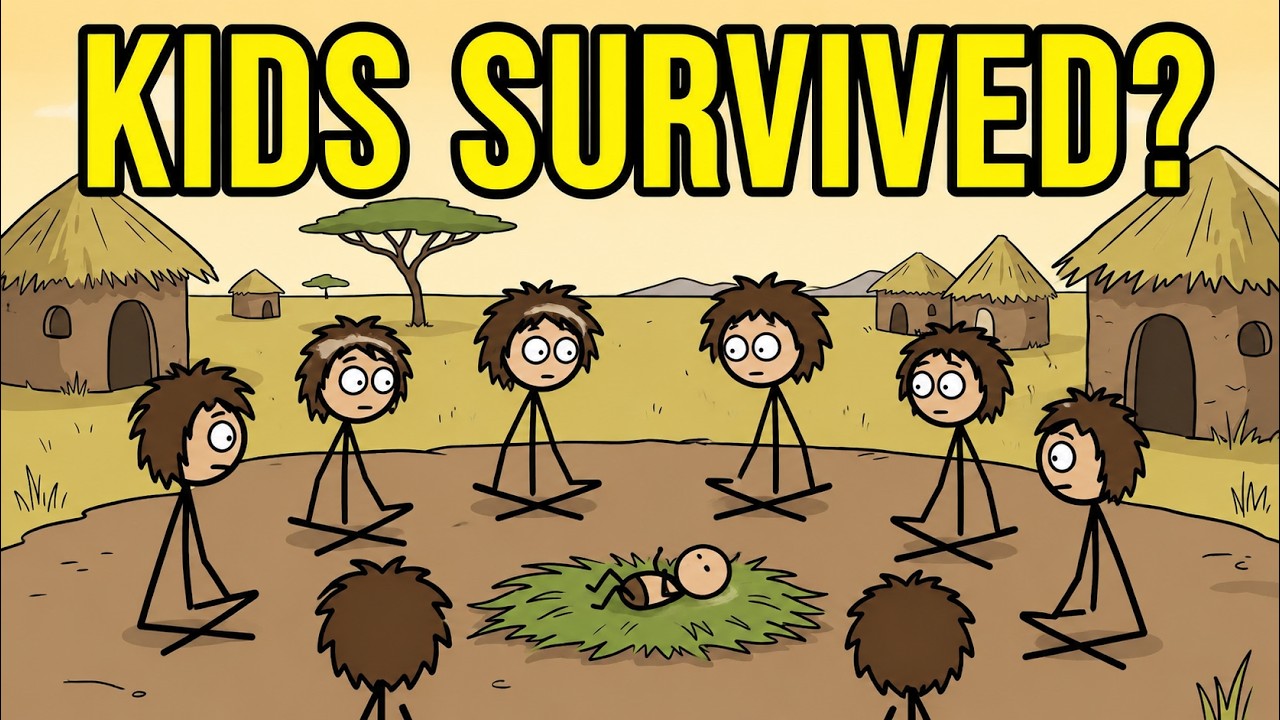
The vulnerability of human infants is extreme. A newborn horse can walk within hours, and a newborn chimpanzee can grip its mother’s fur. A human baby cannot hold up its head, cannot walk for a year, and cannot feed itself for years. This helplessness is tied to brain size.
Human brains are so large that they could not fit through the birth canal if they grew to the same proportion as a chimpanzee’s before birth. Humans are therefore born with brains roughly 25% of adult size, compared to a chimpanzee’s 40%. This means 75% of human brain development happens after birth, while the infant is completely dependent on others. For most of human history, that dependence was shared.
Data from the Efe foragers in the Ituri forest of the Congo shows that a baby is held by an average of 14 different people in a single eight-hour period. The mother holds the infant about 40% of the time, while the other 60% is spent in someone else’s arms. This includes older siblings, grandmothers, neighbors, and unrelated women, some of whom breastfeed the baby themselves. Among the Aka of Central Africa, anthropologist Barry Hewlett found that fathers are within arm’s reach of their infants more than 47% of the day.
Carrying was not just about transportation; it was survival technology. When early humans became bipedal, they lost the body hair that primate infants once clung to. Human mothers fashioned slings from animal hides and plant fibers, carrying their babies every hour of the day. Scientific research shows that when a human infant is picked up and held, its heart rate drops and breathing stabilizes.
This is called the transport response, an ancient biological program wired into the nervous system. In the wild, a crying baby attracts predators. A baby that goes silent when carried is more likely to save itself and its mother from danger. Feeding ancient infants also differed drastically from modern practice.
Mothers breastfed for a minimum of two to three years, and often four years or longer. There was no formula, no bottles, and no clean water safe for an infant. Breast milk was the only sterile, nutritionally complete food available, and it carried antibodies. Extended breastfeeding also suppressed ovulation, effectively spacing births.
Having two helpless infants at the same time in the Paleolithic would have raised the odds of losing both dramatically. Weaning involved a practice Western parents would likely find shocking: premastication. Mothers or grandmothers chewed meat or tough roots until soft, then pushed the food directly into the baby’s mouth, lip to lip. Saliva carried digestive enzymes and immune cells into the child.
Some anthropologists now believe this practice is the evolutionary origin of human kissing, not romantic affection but a mother feeding her child in the only way possible. The role of grandmothers is central to understanding human longevity. Most animals die shortly after they stop reproducing, but human women live for decades after menopause. In 1997, anthropologist Kristen Hawkes studied the Hadza people of Tanzania and found that post-menopausal women were among the most productive foragers in the group.
They spent hours digging tough tubers and collecting foods that young children could not obtain, feeding their grandchildren directly. This allowed mothers to have another baby sooner. Hawkes called this the grandmother hypothesis. The theory states that human women outlive their fertility because grandmothers who helped raise grandchildren passed on more of their genes.
The modern reality stands in sharp contrast to this entire history. In hunter-gatherer bands, a mother typically had between 5 and 15 people actively helping her raise each child every day. In most industrialized countries today, that number is two, often one. The exhaustion and loneliness of modern parenting is not a failure of character.
It is the result of attempting to do alone what the species never did alone for hundreds of thousands of years.