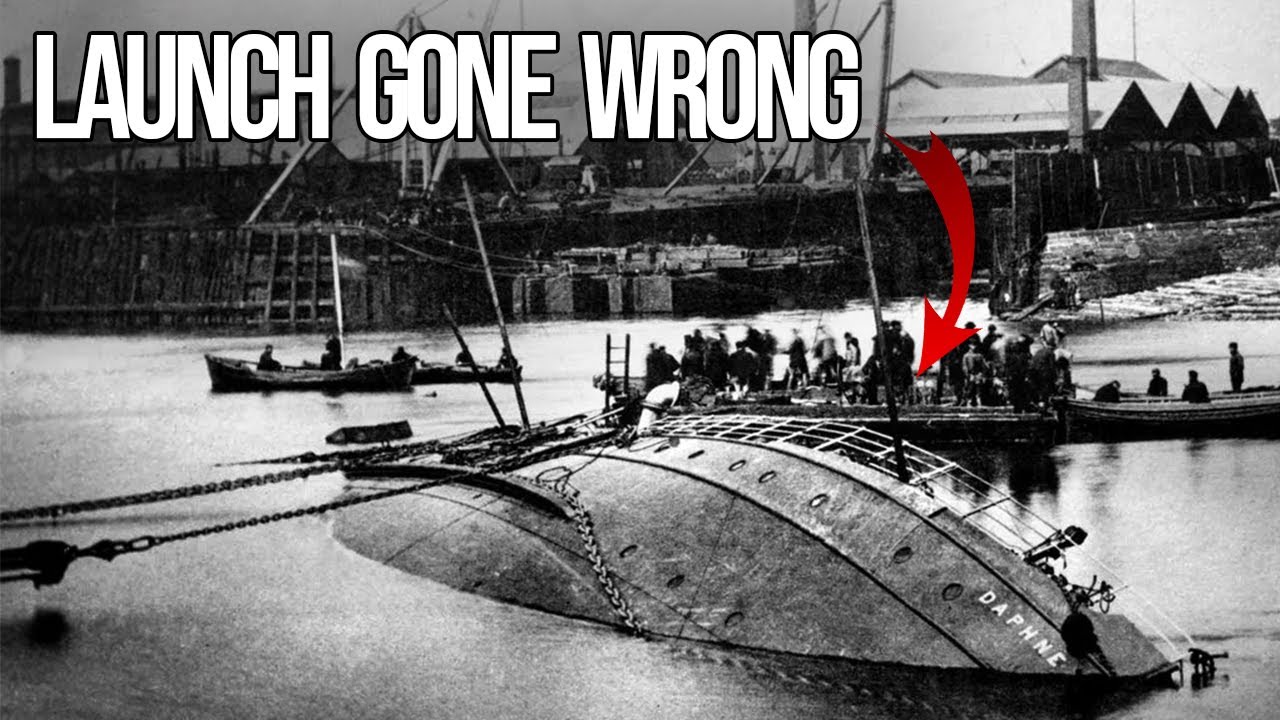
GLASGOW — The River Clyde, calm and unremarkable on an ordinary summer morning, became the stage for one of the deadliest shipbuilding disasters in British maritime history when the SS Daphne capsized moments after her launch on July 3, 1883, killing at least 124 men and boys in full view of the families who had gathered to celebrate her birth.

The 500-ton cargo steamer had been scheduled to enter the water at approximately midday from the Linthouse yard of Alexander Stephen and Sons, a company that had been building ships on the Clyde in one form or another since 1750. Crowds lined both banks of the river. Flags flew.
The mood was festive. Within three minutes, that mood had turned to horror that witnesses would carry with them for the rest of their lives.
According to eyewitness accounts preserved in contemporary newspapers and later gathered by maritime historians, the Daphne entered the water smoothly at first. Then she began to list to port. She paused, as though suspended between two possible fates.
Then she rolled over completely, her hull turning skyward as water poured into open hatches and sealed compartments that had been intended to keep her afloat.
The men aboard never had a chance. Between 150 and 200 workers had been stationed on the vessel during the launch, a common practice of the era intended to allow fitters, engineers, and laborers to begin work on funnels, fittings, and internal machinery the moment the ship was afloat. Efficiency was the watchword of Clyde shipbuilding in the 1880s, and the practice of carrying a full complement of workers through a launch was considered not reckless but resourceful.
That resourcefulness cost more than a hundred lives in less than 200 seconds.
One eyewitness reported that the ship “heeled over to port, paused, and then rapidly rolled over.” The Glasgow Herald described how the air was immediately filled with screams from those watching on the riverbanks and from the men still aboard. Some men clung to the hull as it turned.
Others were dragged under. Some scrambled around the side of the ship in a desperate effort to reach the bottom of the now-upturned vessel, only to be washed into the water as waves swept over the capsizing hull.

Men who had been working inside the ship became trapped in engine rooms and behind bulkheads. The Glasgow Herald later reported that the bulkheads were airtight, sealing men below as the ship rolled. The hatches had not been battened down, and water flooded in within seconds.
Those inside were plunged into darkness as the vessel turned over.
What followed was a scene of unimaginable horror. The River Clyde, calm moments earlier, was suddenly filled with thrashing men, floating debris, and the upturned hull of a ship that had been meant to sail that day. The luckiest men—those who had been thrown clear or who had managed to jump—fought to stay afloat or clung to planks of wood and anything else that could serve as a makeshift raft.
Worse still were the reports of screams heard from inside the upturned hull, where men trapped in small pockets of air cried out for rescue that could not reach them in time. The loose tools and machinery that had been lying around the unfinished ship were thrown violently about when she capsized, adding to the chaos and the injuries suffered by those inside.
Rescue efforts began immediately. Boats were launched from neighboring yards down the river. Ropes, planks, and anything that might float were thrown into the water.
Some men were pulled from the river alive. But for those trapped inside the Daphne, there was almost no hope. A diver was eventually called for, and efforts began to retrieve bodies from the interior of the ship—an incredibly dangerous task that took days.
As bodies were recovered, a makeshift mortuary was established so that family members and friends could identify the dead. The reports from the scene are heartbreaking. The Glasgow Herald described how “a young widow with tearless eyes and grief-stricken countenance was to be seen fondly caressing the brow of her dead husband,” while “a newly made widow gave vent to piercing shrieks as she recognized the form of him who had been her stay and comfort.”
Parents with bent forms and gray heads came to look for the remains of their sons. Brothers and sisters wept as they identified the friends they had lost.

The human cost extended far beyond the death toll. In Govan alone, one street saw three adjacent houses lose a total of 12 men between them. Dozens of families lost their sole wage earners.
Many of the victims were boys—apprentices and junior fitters who had been on board to learn their trade. The youngest confirmed victim was a 14-year-old boy named John Ladden.
It is now believed that approximately 124 men and boys died in the disaster, leaving roughly 70 survivors. But the exact number remains uncertain, because so many people were working on the ship that no complete record of who was aboard existed. Some bodies were never recovered, swept downriver by the current and lost to the Clyde.
The Board of Trade inquiry that followed uncovered a series of grave mistakes. No ballast had been installed in the Daphne before her launch—a critical omission that left her unstable the moment she hit the water. Her engines had already been fitted or were in the process of being fitted, raising her center of gravity.
Large sealed compartments trapped air inside the hull, preventing her from righting herself once she began to list. Anchors attached by cable to slow her progress into the water had failed. And the river’s current caught the vessel as soon as she was afloat, flipping her immediately.
The inquiry concluded that the cause of the accident was a lack of stability due to poor launch preparation. The design specifications, it was found, had been based purely on the fact that no similar ship had capsized before—a stunning admission that safety standards of the era were built on assumption rather than calculation.
On July 28, 1883, once the Daphne had been raised, stability tests were carried out. They revealed the shortcomings of the design in stark terms. But the Board of Trade ultimately decided not to hold the Stephen yard criminally responsible.
 Instead, the tragedy was attributed to outdated practices and a general commonplace underestimation of risk—the same culture of speed over safety that had put 150 to 200 men aboard an unfinished ship in the first place.
The disaster did produce some changes. Shipyards began to ensure that launched vessels had at least partial ballast installed. The practice of having a large crew aboard during a launch became generally discouraged.
Watertight bulkheads were redesigned to allow for pressure equalization and safe escape routes. The Daphne tragedy did not immediately revolutionize safety in shipbuilding, but it contributed to a growing awareness that speed was not a good enough excuse to forget safety.
Memorials to the victims stand today in Craigton Cemetery in Glasgow, about a seven-minute drive from the riverbank where the disaster occurred. The first memorial, erected shortly after the sinking, bears the names of some of the dead—John Manson, Malcolm Morrison, Henry Clark among them—though not all 50 victims buried there are listed. Two later memorials were added.
In a section of the cemetery where nearly every other headstone has toppled over, the Daphne memorials remain standing, a small but poignant testament to the weight of what happened on that July day.
As for the SS Daphne herself, she was raised, repaired, and renamed. In what some have described as an incredibly misplaced pun, she was christened the SS Rose. She went on to have an inauspicious career: grounding at Farlane Point in Millport in early 1884, being refloated without damage, sold later that year and renamed, sent to the Eastern Mediterranean, sold again in 1890 and renamed once more, and finally lost on December 10, 1918, when she was mined off Tenedos in Greece.
But it is not her later career that matters. It is the three minutes on July 3, 1883, when a ship killed the men who built her, in full view of their families, on a riverbank that had gathered to celebrate. More than 140 years later, the story of the SS Daphne remains a stark reminder of what is lost when efficiency is valued above human life—and why those who died in the Clyde that day must not be forgotten.