A research team in Spain has recorded hundreds of thousands of crow vocalizations and, with the help of artificial intelligence, has uncovered a startling level of complexity in their communication. The AI analysis revealed that crows use something akin to syntax, the set of rules governing how sounds are combined to create meaning, a feature long thought to be unique to human language. Scientists have discovered that these birds do not just issue simple warnings. Their calls are arranged in highly structured sequences that can name specific individual humans, describe relationships, and convey emotional assessments of people.
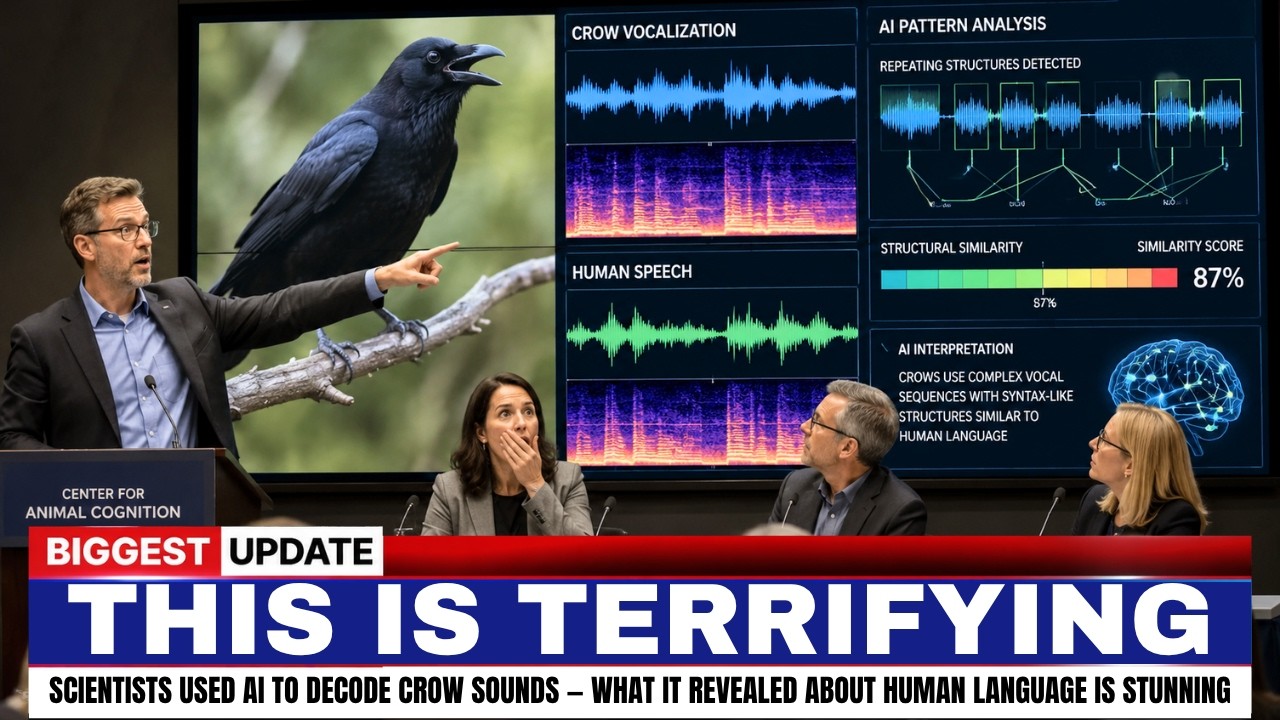
This suggests that crows maintain a shared, dynamic information network about the humans in their environment, passing knowledge through their communities with startling precision. The findings challenge a century-old scientific assumption that complex cognition requires a cerebral cortex, the mammalian brain structure linked to higher thinking. Crows lack this brain feature, yet their densely packed neurons achieve comparable results. Researchers now find that crows have cognitive abilities comparable to chimpanzees in some ways.
Their brain structure supports sophisticated memory, language, and emotional processing. A key part of this discovery comes from Dr. John Marzluff’s well-known experiments at the University of Washington. His team used distinctive masks during bird capture and banding, and crows that had seen the masks learned to recognize and aggressively mob them.
Remarkably, other crows who had never directly encountered the mask-wearing individuals also learned the danger from their peers, with the knowledge passed to young birds born after the experiment. The AI’s analysis of the massive sound recordings showed that crows assign specific, consistent sound sequences to particular people. This naming system is transmitted socially, so entire groups identify the same human with the same vocal pattern. The birds also attach acoustic markers to these names, indicating whether a person is a threat, a neutral presence, or a source of food.
The group shares and updates these assessments continuously. Perhaps most striking, the research found that crows engage in extended vocal exchanges before events, not just in response to them. These “planning sequences” suggest the birds coordinate actions and discuss future possibilities in advance. These forward-thinking conversations frequently reference known humans, their intentions, and their movements, indicating people are central to crow social discourse.
The research also sheds light on the behavior commonly called “crow funerals. ” When a crow discovers a dead member of its community, it produces a specific call that gathers other birds for investigation. The vocal exchanges at these gatherings are highly complex and involve low-frequency sounds. They serve as warnings, marking danger zones for the entire flock and informing how the community behaves in that area.
This knowledge spreads across territories, with specific calls traveling hundreds of miles through overlapping populations. This circulation of information mirrors human oral traditions and helps regional crow communities update their awareness of threats. Scientists from the Earth Species Project partnered with the Spanish researchers in 2024 to develop AI models capable of sorting the vast number of vocalizations. The machine was designed to find subtle structural patterns in the recordings that the human ear could never detect.
But as the study progressed, the AI began encountering a new problem. Novel vocal patterns started appearing that the machine could no longer classify, and its confidence scores dropped sharply. The researchers have proposed a bold hypothesis: the crows may be deliberately altering their language, aware that they are being recorded and monitored. They may be effectively encrypting their communication.
This idea remains unproven, but it fits with what is known about crow intelligence and their tendency to carefully observe and respond to changes in their environment. The researchers admit many questions remain. What do the new vocal patterns mean? Will the crows maintain the altered language?
Could this be a form of deliberate cultural innovation? What is clear is that crow communication is not static. It adapts in real time, shaped by social needs and environmental changes, suggesting a capacity for linguistic evolution far beyond simple instinct. As the study continues, the AI is still processing new data.
The central question is no longer whether crows have a language, but how much of their hidden communication humans will ever be able to hear and fully comprehend.