The smell of stale coffee and industrial bleach had become Saraphina Gomez’s entire life. It clung to her hair, her apron, and what was left of her dreams. At twenty-four, she was a waitress at the Crimson Sparrow, a professional juggler of rent, electricity bills, art supplies, and the crushing weight of a future that kept slipping further away. The rain didn’t just fall that Tuesday night.
It hammered the plate glass windows, and the neon sparrow outside flickered in a sickly red glow. It was eight o’clock, the graveyard shift for hope. “Gomez! ”
Sarah flinched, sloshing coffee onto her tray.
Mitch, the night manager, was a man shaped by his own sour mood—perpetually slumped, with a thin mustache that seemed desperate to escape his lip. He pointed a greasy spatula at a plate of fries. “Table four says these are cold again. ”
Sarah looked at Mrs.
Davenport, a woman who wore pearls to a diner at eight at night. Sarah had delivered those fries fresh from the fryer less than three minutes ago. “Just fix it, Gomez, and try to smile. You’re scaring away the high rollers.
”
He gestured sarcastically at the three other customers, one of whom was asleep. Sarah took the plate without a word, her cheeks burning. She dumped the fries and returned to the kitchen, her mind racing. The rent was due Friday.
Price Development Group, the faceless corporation that owned her building, had slipped notices under every door. The entire block was being evaluated for urban renewal—a polite term for demolition. She had sixty days to get out. She ran her thumb over a small callous on her finger, not left by coffee pots, but by charcoal sticks.
In her tiny, drafty apartment, canvases were stacked against the walls—portraits of the city’s tired, forgotten faces. That was who she wanted to be. Saraphina Gomez, the artist. But the world only seemed to want Sarah, the waitress.
She delivered the fresh fries to Mrs. Davenport with a smile so bright it felt like a crack in a mask. The woman poked one with a painted nail and said, “It’ll do. ” Sarah retreated to the counter and polished silverware that was already clean.
She was tired—tired of the smell, tired of Mitch, tired of being poor. It was in that moment of profound self-pity that the bell above the door chimed. Sarah looked up, ready with her practiced smile. “Welcome to the Crimson—”
The words died in her throat.
The man in the doorway was not a customer. He was a specter. Old, perhaps late seventies, with a thin, soaked coat hanging off a skeletal frame. His hair was a tangle of white and gray plastered to his skull.
But it was his eyes that stopped her—clear, sharp blue, filled with a desperate, crushing shame. He shuffled inside, dripping a puddle onto the clean checkered floor. Mitch looked up from his paperwork, his face twisting with disgust. “Oh, no.
Not tonight. ”
The old man didn’t look at Mitch. He looked right at Sarah. “Please,” he whispered, his voice a dry rasp.
“I just need to get out of the rain for a minute. ”
Mitch was already moving. “Hey, you. We’re not a shelter.
We reserve the right to refuse service. Get out. ”
“Mitch, wait,” Sarah said. “Don’t ‘Mitch wait’ me, Gomez.
You know the rule. He can’t pay. He doesn’t stay. ”
The old man fumbled in his pocket and pulled out a small, damp collection of coins—quarters, dimes.
He held them out, his shame replaced by frantic pleading. “I have money. I can pay. Just a cup of coffee, please.
It’s so cold. ”
Mitch laughed, a short, barking sound. “That won’t even cover the tax, old man. Now hit the road before I call the cops.
”
The man’s shoulders slumped. The light in his blue eyes died, leaving only hollow emptiness. He turned to leave. Sarah watched him, and in that moment she didn’t see a vagrant.
She saw the faces she painted. She saw the exhaustion she felt in her own bones. She saw a human being treated like refuse. “No.
”
Mitch stopped. “What did you say? ”
Sarah stepped out from behind the counter, planting herself between Mitch and the old man. “I said no.
He’s a paying customer. He wants a coffee. ” She looked at the old man, her voice softening. “And the special, sir?
The Crimson Comfort Combo is on the house tonight. Manager’s special. ”
The old man stared at her, bewildered. Mitch’s face went from pale to blotchy red.
“Gomez, you are so fired. ”
“Then I’m fired,” Sarah said, her voice shaking but steady. “But not until I get this man his meal. ”
She ignored her sputtering manager and gestured to a warm booth in the corner.
“Please, sir. It’s warm over there. ”
The old man shuffled to the booth and slid in, his soaked coat squelching on the vinyl. He wrapped his arms around himself, shivering, his eyes fixed on Sarah with a mixture of disbelief and weariness.
“Gomez, my office now,” Mitch barked. “In a minute,” Sarah called back. “I have a customer. ”
She walked to the terminal, her hands shaking.
She couldn’t use the manager’s special code—Mitch would void it. Instead, she punched in her own employee ID and selected her one employee meal for the shift. It was supposed to be her dinner, the one hot meal she’d have all day. She didn’t hesitate.
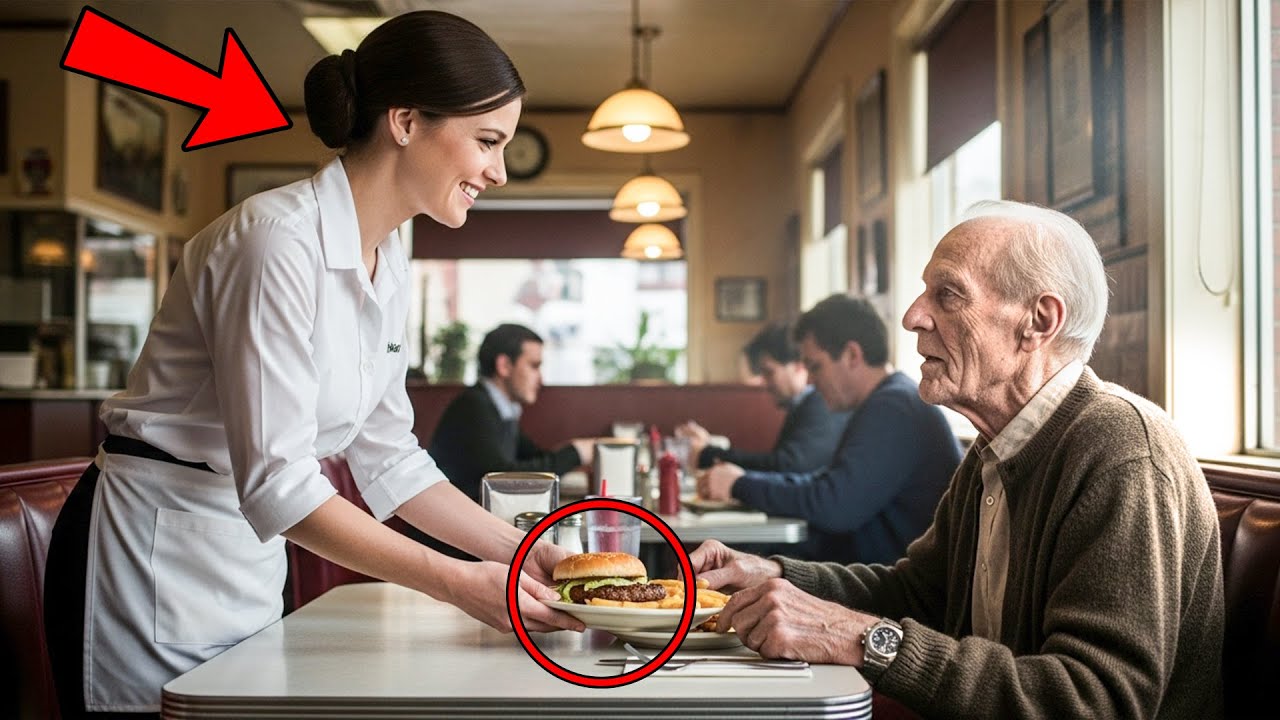
She added a coffee, a deluxe cheeseburger, a large fries, and on a whim, a slice of apple pie with ice cream. She hit confirm, sealing her fate. She poured the coffee herself and carried the heavy mug to the booth. The old man reached for it with both hands as if it were a life raft.
He brought it to his lips, his eyes closing as the first hot sip went down. “Thank you,” he whispered. “Thank you, child. ”
“My name is Sarah,” she said, giving him a small smile.
“Your food will be right out. What’s your name? ”
He hesitated, looking down into his cup. “It’s Art.
Just Art. ”
“Well, Just Art. You sit tight. I’ll be right back.
”
In the kitchen, the cook, a burly man named S, had already seen the order. “That for the old guy? ”
“Yeah. Is that okay?
”
S grunted, throwing a thick patty onto the grill. “Mitch is going to skin you. ”
“Let him,” Sarah said, folding her arms. “The man is starving.
”
S looked at her for a long moment, then turned back to the grill. “Extra bacon,” he muttered. “Mitch can take it out of my check if he has a problem. ”
Sarah felt a small, genuine smile touch her lips.
“Thanks, S. ”
When the food was ready—a glorious, steaming platter of quintessential American comfort—she carried it to the booth. Art’s eyes widened, and his clear blue eyes swam with tears. “I can’t,” he stammered, pushing the plate away.
“This is too much. ”
“It’s just food,” Sarah said softly. “Please eat. ”
He picked up the burger with trembling hands and took a bite.
He ate like a man who hadn’t tasted real food in days, but he savored it with a dignity that seemed at odds with his appearance. As Sarah passed Mrs. Davenport’s table to get him some water, the woman sniffed loudly. “I can’t believe you’re letting that in here.
He probably has diseases. I’ve lost my appetite. ”
She threw a ten-dollar bill on the table for a twelve-dollar meal and stormed out, her pearls clacking. Sarah sighed and cleared the table.
When she returned, Art had finished the burger and was slowly working on the pie. Color had returned to his face. He looked less like a specter and more like a man. “This is the finest meal I have ever had,” he said.
“It’s just a burger, Art. ”
“No,” he said, his gaze intense. “It’s kindness. That’s a rare delicacy these days.
”
He looked at her, really looked at her. “You have your mother’s eyes. ”
Sarah was taken aback. “I don’t know about that.
I never knew her. ”
“Ah,” he said, a shadow passing over his face. “Yes. I know that.
”
He continued to study her. “You’re not happy here. This place is a cage for a bird like you. ”
“It’s just a job.
It pays the bills. Mostly. ”
“No,” Art said, shaking his head. “You’re an artist.
I can see it. You see the world in shapes and shadows. You see the pain in people. That’s why you helped me.
”
Sarah’s breath caught. It was as if he had read her diary. “Your hands,” he said, pointing. “Mine used to be like that—strong, calloused from building.
Yours have the stains of creation on them. Faint under the smell of bleach. But I can see the graphite under your nail. ”
Sarah instinctively hid her hand.
She’d been sketching on her break. “Don’t hide it,” Art said, his voice firm. “The world will try to make you hide it. It will try to make you practical.
Don’t let it. ”
He finished the last bite of pie and pushed the plate away. He seemed to grow in his seat, the tattered coat looking more like a misplaced robe. “I must go.
I’ve taken enough of your kindness, and I’ve put you in a very difficult position with your manager. ”
“I’ll be fine,” Sarah said. “No, you won’t,” Art said simply. “But you will be.
You will be. ”
He reached into his pocket, then fumbled with a thin cord around his neck. He pulled out a small, intricately carved wooden bird—a sparrow. “I have no money,” he said, his voice thick with shame.
“I can’t repay you for the food. ”
“You don’t have to. It was a gift. ”
“No,” he insisted, undoing the clasp with fumbling fingers.
“A gift for a gift. ” He pressed the worn, smooth carving into her hand. “It’s just a trinket, something I made a long time ago. For—” His voice trailed off.
“But I feel you should have it. A sparrow for a sparrow. ”
Sarah closed her hand around the warm, smooth wood. “Thank you, Art.
”
“No, Miss Saraphina Gomez,” he said, his blue eyes locking with hers. “Thank you. ”
He turned and walked to the door. He didn’t shuffle.
He walked with a straight back, pushed the door open, and disappeared into the raging storm. Sarah stood there for a long moment, the wooden bird clutched in her hand. “Gomez! ”
The roar from Mitch’s office shattered the spell.
The adrenaline faded, replaced by cold, hard reality. She slipped the sparrow into her apron pocket and turned to face the music. Mitch’s office was a cramped, windowless closet that smelled of old receipts and instant noodles. He sat in his squeaky chair, hands steepled, trying to look like a mob boss.
“You’ve got a lot of nerve, Gomez. First you mouth off to me on the floor. Then you comp a twenty-dollar meal to some bum off the street. And you drove away a paying customer.
”
“That man was starving,” Sarah said quietly. “That’s not your problem. Your problem is to take orders, deliver food, and smile. You’re not Mother Teresa.
You’re not an artist. ” He sneered the word. “You’re a replaceable cog in a fast-food machine. And you just broke the machine.
”
“I used my own employee meal. ”
“You undermined my authority,” he shouted, standing up. “You’re done. Clock out.
Your check will be mailed to you. Minus twenty bucks for the Crimson Comfort. ”
Sarah stood frozen. The rent.
The eviction. She had no savings. Nothing. “Mitch, please.
I need this job. ”
“Should have thought of that before you decided to run a soup kitchen. ”
Numbly, Sarah walked to the locker room, untied her apron, and hung it up. She grabbed her thin jacket and her backpack.
Her fingers brushed the small wooden sparrow in her pocket. A sparrow for a sparrow. It felt like a cruel joke. A bird with a broken wing, falling fast.
She walked out without looking back. The rain had slowed to a miserable drizzle. She started the two-mile walk home. The next few days were a blur of cold panic.
She circled ads for waitress jobs. Three interviews—a high-end restaurant where the manager glanced at her worn-out shoes and said they’d call, a dive bar that smelled worse than Mitch’s office, and another diner that had just hired someone. She started rationing food—an apple for breakfast, a packet of ramen for dinner. She turned off the heat and wore two sweaters indoors.
She took her portfolio to art galleries. “Your work is raw,” one gallery owner said, peering through tiny square glasses. “But it’s not commercial. Misery doesn’t sell, darling.
Not unless it’s ironic. ”
Sarah felt the last of her hope draining away. On Friday, the day rent was due, she found herself walking past the Crimson Sparrow. She stood across the street, watching the lunchtime rush.
A terrified young blonde waitress was serving. Mitch was yelling through the pass. It was just as it had always been, only she wasn’t in it. Then she saw him.
Art was standing a few yards away, but he wasn’t looking at the diner. He was looking at her. He was clean, wearing a simple tweed jacket and a flat cap. He looked like a retired professor, not a homeless man.
But his eyes were the same—sharp, blue, locked on her. “Art? ” she took a step toward him. He didn’t smile.
He simply nodded—a slow, solemn acknowledgement. Then he turned and walked briskly around the corner and was gone. Sarah stood bewildered. It felt like he was checking on her.
A strange seed of doubt began to sprout. Who was Art? The question was shoved aside by a long, impossibly black car that pulled up right in front of her—a Maybach, so quiet it seemed to absorb the sound of the city. The back window lowered, revealing a man on the phone.
“I don’t care about the zoning committee. I bought the committee. I bought the block. I want those buildings down by the first of the month.
I want a crater where those slums are. ”
He was young, maybe early thirties, with a face so perfectly chiseled it looked computer-generated. He wore a dark blue suit that probably cost more than Sarah’s apartment. When he hung up and turned, his eyes were the color of ice.
He saw her staring and simply looked through her—so cold, so dismissive, it was like being erased. A small silver logo on the side of the car caught her eye. P and D intertwined. Price Development.
He barked at his driver, “The Crimson Sparrow. I need coffee. Get the name of the manager. ” The window slid up, and the car hummed like a predator.
Sarah backed away, her heart pounding. That was the man evicting her. That was the face of the corporation tearing her life apart. She had been fired for giving a twenty-dollar meal to a starving man, and the man who was making her homeless was going into her diner for coffee.
The injustice hit her like a physical blow. She stumbled back, turned, and ran. She didn’t stop until she was back in her cold, empty apartment, the wooden sparrow clutched so tightly in her hand that its edges bit into her palm. Damian Price did not like diners.
He did not like coffee that wasn’t single-origin, shade-grown, and prepared by a barista who could lecture on fermentation. But he was here, sitting in his temperature-controlled Maybach, staring at a flickering neon sign. His father was missing again. Arthur Pendleton, the man who had founded the empire Damian had rebuilt, had a habit of vanishing on his “walkabouts”—living in flophouses or, according to the security detail, on the streets.
A man named Art frequented this specific greasy diner. “Just go in, find out what he knows, and pay him off,” Damian had ordered Cole, his driver and former special forces operative. Cole reported back. “The manager, Mitch, is highly agitated.
He says the old man hasn’t been back, but the waitress who served him—he fired her. ”
“For what? ”
“Giving him food. Apparently, she used her own meal allowance.
”
Damian scoffed. “A martyr. Just what I need. Find the girl.
Give her a month’s severance and make her sign an NDA. ”
“And your father, sir? He was spotted across the street not ten minutes ago. He was watching the diner.
Then he watched the girl. Then he left. ”
“He’s testing you, sir. ”
A cold, familiar rage filled Damian’s chest.
He thought of his mother, Matilda, in that hospital bed, her hand thin and frail in his. He thought of his father, not there. Always working, always building. “Find the girl,” Damian ordered, his voice flat and deadly.
“Find her and bring her to me. I want to know what my father told her. ”
Sarah was trying to sketch, trying to capture the arrogance in the man’s face from the car, but her hands were shaking too badly. There was a knock at her door—a hard, official bang.
She froze, holding her breath. Price Development was coming to throw her out. “Miss Saraphina Gomez. ” It was the driver from the Maybach.
“My employer would like to speak with you. ”
“Who is your employer? ”
“Mr. Damian Price.
The man you were staring at this afternoon. He is prepared to be generous for your time and your silence. ”
“Silence about what? ”
“About the man you served at the diner.
The old man. Art. ”
Sarah’s hand flew to her pocket and the wooden sparrow. Art.
This was about Art. This wasn’t a random encounter. The homeless man and the billionaire were connected. A new cold resolve settled over her.
She unlocked the deadbolt and slid into the back of the Maybach. It smelled of rich leather and quiet, limitless power. Damian Price was scrolling through a tablet. “Miss Gomez.
Thank you for joining me. ”
“I don’t think I had a choice. ”
He looked up, his icy blue eyes sweeping over her. “You always have a choice.
You just made the wrong one—getting fired over a twenty-dollar burger. ”
“I chose to feed a starving man. I’d do it again. ”
“Yes, your bleeding heart.
That’s what this is about. What did he say to you? ”
“He said I had my mother’s eyes. He said I was an artist.
He gave me this. ”
She pulled the wooden sparrow from her pocket and held it up. Damian Price’s reaction was instant and terrifying. His mask of indifference shattered.
He recoiled as if struck. His face went dead white. “Where did you get that? ” he whispered, his voice a raw, strangled sound.
“Art gave it to me. He said he made it. A sparrow for a sparrow. ”
Damian stared at the bird, and for a second, Sarah didn’t see a ruthless billionaire.
She saw a little boy who had been shown a ghost. He lunged across the car, grabbing her wrist with steel-like force, and snatched the bird from her hand. “Hey! Give that back!
”
He wasn’t listening. He was turning it over and over. “He gave it to you. Not me.
After all these years, he gave it away. What is so special about a stupid wooden bird? ”
Damian looked at her, his eyes burning. “My mother.
He carved that for my mother. She held it in her hand when she died. He stole it from her. And he gave it to you.
A waitress. A nobody. ”
Sarah was reeling. “That old man is your father?
”
“He is my father,” Damian snarled. “Arthur Pendleton. He built an empire from nothing. He was a god in this city.
He was also never ever home. My mother, Matilda, was everything. She was kind like you. She painted.
She loved birds. She gave up everything for him. When she got sick, he wasn’t there. He was working.
”
“I was seventeen. I sat there. I held her hand. I watched her fade and I watched the door.
He never came. ” His voice went flat. “The day of her funeral, his lawyers called me. His big project had failed.
He was bankrupt. He gambled away everything she’d built with him. I disowned him, took her maiden name, Price, and rebuilt. I conquered.
I bought his old properties. I crushed his rivals. I put him in a house and told him to stay out of my life. For fifteen years, he has.
Until now. ”
He looked down at the bird. “Which brings us to you. You are a loose end.
He likes you. He’s fixated on you. I am in the middle of the largest urban renewal project this city has ever seen. ”
“You mean my home,” Sarah said.
“I mean a blighted, rat-infested block,” he corrected, “which I am going to turn into a monument of steel and glass. And I will not have my estranged father wandering through my construction site, talking to a disgruntled ex-waitress. So here’s the generous part. ” He pulled out a checkbook and tore off a check.
Fifty thousand dollars. “That’s for the bird and for your silence. You will sign an NDA. You will forget you ever met Art.
You will be out of your apartment by Monday. ”
Fifty thousand dollars. A new apartment. Art supplies for a decade.
Escape. All she had to do was take it and walk away. She looked at the check, then at the bird in his hand. She thought of Art’s words: “Don’t let the world make you practical.
”
She pushed the check back into Damian’s chest. “No. ”
Damian Price stared at her. No one said no to Damian Price.
“I must have misheard you. ”
“You heard me. I won’t take your money, and I won’t be out by Monday. And I want the sparrow back.
”
“The sparrow belonged to my mother. ”
“It was given to me by your father, and I won’t sell it. ”
“You’re making a catastrophic mistake. ”
“Maybe.
But you’re the one who’s made the bigger one. You think your father is a monster. I think he’s just sad. And I think you’re wrong about him.
You looked at me and saw a disgruntled waitress. He saw an artist. He saw a person. You’ve been so busy conquering the world, you’ve forgotten how to look at it.
” She jabbed a finger at his chest. “That man you despise is a better man in his old coat than you’ll ever be in your ten-thousand-dollar suit. Let me out. ”
“Cole, don’t let her out.
”
“I’ll scream,” Sarah said. “Right here in front of your project. ‘Billionaire kidnaps waitress. ’ How’s that for a headline?
”
Damian’s eyes were slits of pure fury, calculating the cost. Finally, he nodded. The lock clicked. Sarah scrambled out, breathing the cold, dirty city air as if it were mountain fresh.
“Miss Gomez. ” His voice came from the car. He was holding the check. “Fifty thousand.
It’s your last chance. ”
“Keep it,” Sarah said. “You’ll need it. I think your crater is going to cost you a whole lot more than you planned.
”
She turned and walked away, head held high, body trembling. Inside the car, Damian watched her go, then looked at the wooden sparrow. “Cole. Find my father.
Now. ”
Sarah didn’t go home. She went to the one place that felt like the center of the storm—the Crimson Sparrow. She slipped in the back.
S was at the grill. “Sarah, what are you doing here? ”
“S, I need to wait. It’s about Art.
His son is Damian Price. ”
S’s spatula froze midair. “Back booth,” he grunted, jerking his head. “I didn’t see you.
”
Sarah slid into the booth where she had served Art. She didn’t have to wait long. The door didn’t chime—it was slammed open. Damian Price strode in, not in a suit but in dark jeans and a t-shirt that did nothing to hide his coiled fury, flanked by Cole.
Mitch scrambled out of his office. “Mr. Price, sir, a pleasure. ” Damian walked right past him and stopped at Sarah’s table.
“Where is he? ” he demanded. “I don’t know who you’re—”
“Don’t lie to me. My father.
He’s not at the estate. He’s gone. And I know you’re a part of it. ”
“I just gave him a meal.
”
“And he just called me. For the first time in fifteen years, he found a way to reach my private line. And he didn’t say ‘I’m sorry. ’ He said, ‘Give the girl back her bird.
’ He never protected my mother. He never protected me. But he’s protecting a waitress he met for five minutes. ” He slammed his fist on the table.
“Where is he? ”
“I am right here, Damian. ”
The voice was quiet but cut through the diner like a blade. Arthur Pendleton stood by the door, leaning on a simple wooden cane.
He was in his clean tweed jacket, frail but composed. He nodded politely to Cole. “May I pass, young man? I’m here to see my son.
”
Cole looked at Damian. Damian gave a sharp, agonizingly stiff nod. Arthur walked slowly to the booth, looked at Sarah with a small, sad smile, then turned his clear blue eyes to his son. “Hello, Damian.
”
“You gave it away,” Damian whispered, his voice cracking. He pulled the wooden sparrow from his pocket and threw it on the table. “You gave a prize away. ”
“It was never a prize, Damian.
It’s a reminder. And I gave it to her because she reminded me of your mother. ”
“Don’t,” Damian roared, lunging to his feet. The diner went silent.
“Don’t you say her name. You who let her die alone while you bankrupted the company. You who lost everything. ”
“I did not let her die,” Arthur said, his voice trembling but rising.
“I was trying to save her. ”
“Save her by liquidating the company? By gambling it all away? ”
“Yes,” Arthur cried, slamming his cane on the floor.
“You think I was working? You think I was building? I was selling everything, Damian. Every stock, every building, every last piece of myself for her.
” His voice broke. “The money went to a clinic in Switzerland. An experimental treatment. They said there was a small chance.
Your mother made me promise not to tell you. She didn’t want to give you false hope. So I let you believe I was a monster. It was easier than admitting I had failed.
I was in a hotel in Zurich waiting for the call when the treatment didn’t take. By the time I could get a flight back, the funeral was over. And you were gone. You had already decided who I was.
”
Damian was ashen. He sank back into the booth, his legs giving way. “I didn’t know. ”
Mitch, watching from the sidelines, saw his moment.
“Mr. Price, don’t you listen to them. It’s a con. They’re working together.
This girl is a con artist. I’ll call security. ”
Damian slowly, very slowly, turned his head. His eyes went flat.
Cold. “You’re the manager? ”
“Yes, sir. Your loyal manager.
I fired her, just like you would have. ”
“You’re fired. Cole, escort this person off my property. ”
“Your property?
This is the Crimson Sparrow! ”
“It is,” Damian said, pulling out his phone. “And as of ten minutes ago, I own the entire chain. I bought the holding company while I was in the car.
Now get out. ”
Cole gently took a bewildered Mitch by the arm and led him out. The diner fell silent. Damian turned back to his father.
“I need to see,” Damian whispered. “The proof. ”
“It’s in a box in my room,” Arthur said, exhausted. “The room you’ve been paying for.
”
Damian stood up, his movement stiff. He looked at the man he had hated for fifteen years. “We need to talk. ”
“Yes,” Arthur said.
“We do. ”
Damian hesitated, then held out his arm. “Can you walk? ”
“I think,” Arthur said, his eyes swimming, “you can help me.
”
Damian Price, the man who built craters, put his arm around his father’s frail shoulders and supported his weight. Together, the two men walked out of the diner, leaving Sarah alone in the booth with the small wooden sparrow on the table in front of her. For a week, Sarah heard nothing. She was back in her apartment, the eviction notice a constant, cruel joke on her door.
On the eighth day, a sharp knock came. It was Cole. He handed her a thick manila envelope and left without a word. Her hands trembled as she opened it.
The first document was the deed to her apartment, paid in full, registered in her name. The second was a check for one hundred thousand dollars. The memo line held a single stark word: Sorry. The third was a handwritten letter—not from Damian, but from Arthur.
“My dearest Sarah,” it read. “You’ll have to forgive my son’s apologies. He tends to use a checkbook instead of words. But he is sincere.
He found the boxes, the letters from the clinic, the bank transfers. He knows the truth. It has unmade him, and I hope in time it will remake him. We are leaving for a while to finally be a father and a son.
Damian’s project is not cancelled—it’s being re-envisioned. He said he was tired of building monuments to himself. He wants to build a community art center for the neighborhood. He wants you to run it.
You were a light in a dark room, Sarah. You didn’t just save me. You saved us both. Be well, Sparrow.
Arthur. ”
Sarah sank to the floor, the check in one hand and the deed in the other, tears of pure relief washing away weeks of fear. Six months later, the Crimson Sparrow was busy. Sarah sat in her old back booth, sketching in a notebook.
S, now the manager, waved from the kitchen. The bell chimed. Arthur Pendleton walked in looking ten years younger, followed by Damian—no longer the ice king in a suit, but a man in a simple sweater, the harsh lines around his eyes softened. “Sarah,” Damian said, sliding into the booth.
“The plans for the Matilda Price Arts Center are approved. Your raw vision won them over. ”
“I told you,” Sarah smiled, closing her sketchbook, “misery sells as long as it’s honest. ”
A waitress, a new art student Sarah had hired, came over.
“The usual? ”
“Please,” Arthur said. As the three of them sat sharing fries in the warm red light of the diner, Damian reached into his pocket. He didn’t pull out a checkbook.
He pulled out the small wooden sparrow and placed it in the center of the table—a silent testament to the family that had been lost and the new one that had just been found. Saraphina thought she was just helping a man in need. She had no idea she was healing a wound that had festered for decades. A single plate of food reunited a father and son, saved a neighborhood, and proved that compassion is a currency worth more than any stock portfolio.
We never know the full story of the people we meet, and a small kindness can ripple outward in ways we can’t imagine.