One of the greatest racing drivers in the history of motorsport climbed into his Williams-Renault on the morning of May 1, 1994, unaware that within minutes he would be gone, and that the sport he had given his life to would never be the same again.

Ayrton Senna da Silva was born on Monday, March 21, 1960, at the Pro-Matre maternity hospital in Santana, a working-class neighborhood of São Paulo, Brazil. His first car was not a machine of engineering marvel but a humble creation built by his father from a small one-horsepower lawnmower engine. That modest beginning would eventually carry him to the summit of world motorsport and to a grave in his homeland that millions would mourn.
Senna began racing karts at Interlagos and entered his first competitive event at just thirteen years old. He started from pole position against older rivals, led most of the race, and retired only after a collision with another driver. His father supported him without reservation, and before long Lucio Pascual Gascon took over the management of a talent that was already beginning to look extraordinary.
He won the South American Karting Championship in 1977 and competed in the Karting World Championship every year from 1978 to 1982, finishing as runner-up in 1979 and 1980. In 1981 he moved to Norfolk, England, to begin single-seater racing, and that same year he won the RAC and Townsend Thoresen Formula Ford 1600 championships with the Van Diemen team.
By 1982 Senna had captured both the British and European Formula Ford 2000 titles. A year later he was driving in the British Formula 3 championship for West Surrey Racing, dominating the first half of the season before Martin Brundle, driving a similar car for Eddie Jordan Racing, closed the gap in a fierce and often tense battle. Senna took the title in the final round and set his sights on Formula 1.
In 1983 he tested for several Formula 1 teams, including Williams, McLaren, Brabham and Toleman. He impressed Brabham enough to be considered for their second seat, but it was Toleman that gave him his debut at the 1984 Brazilian Grand Prix in Rio de Janeiro. He qualified seventeenth but retired on lap eight when the Hart 415T turbocharger failed.
That season he reached the podium twice, finishing third at both the British and Portuguese Grands Prix, and ended ninth in the drivers’ championship with thirteen points. Then the difficulties began. Broken promises and the first serious signs of Bell’s palsy marked a rough period in his life, one that would test him far beyond the cockpit.
Senna missed the Italian Grand Prix after Toleman suspended him for breaching his contract by speaking to Lotus about a 1985 deal without informing them first. Although he had a buyout clause valued at one million one hundred thousand dollars, he was contractually obliged to notify Toleman before opening talks with another team. He became the first driver signed by Lotus who was not personally chosen by team founder Colin Chapman, who had died in 1982.

By the end of that year Senna had developed Bell’s palsy, possibly from a virus, which left one side of his face completely paralyzed. Sid Watkins gave him steroids to help preserve the chance of recovery. Senna led races at San Marino, Monaco, Britain and Germany but had to retire from all of them because of engine failures or running out of fuel.
He also suffered a major accident at the French Grand Prix at the Circuit Paul Ricard’s fastest corner after an engine failure in the middle of the turn. Growing unhappy with his prospects at Lotus, he was announced at Monza as a McLaren driver for 1988. Earlier he had been fined one hundred fifteen thousand dollars for striking a course marshal who refused to push his stalled car in Mexico.
Despite the incidents, Senna finished the season strongly, taking second place in the final two races in Japan and Australia. But after the last race, officials found the brake ducts on his Lotus were wider than the rules allowed. He was disqualified, ending his last and most successful season with Lotus on a bitter note.
What followed was the rivalry that ignited Formula 1. In 1988 Senna joined McLaren thanks to his strong relationship with Honda from his 1987 season at Lotus and with the approval of McLaren’s top driver, the then double world champion Alain Prost. The rivalry between Senna and Prost heated up in 1989, leading to intense battles on the track and a psychological showdown off it.
Tensions and distrust escalated when Senna passed Prost at the restart of the San Marino Grand Prix, a move Prost argued went against their pre-race agreement. In the winter of 1989 Senna faced a hefty fine and a temporary suspension of his FIA super license. Angry and vocal, he publicly criticized the FIA and its president at the time, Jean-Marie Balestre.
Senna blamed Balestre for his disqualification in Japan, claiming the decision was influenced to favor his French rival. Race stewards denied Balestre’s direct involvement, stating he was not present during their decision-making. Despite the controversies, Senna finished the season second with six wins and one second place.
Prost, unable to tolerate the tense atmosphere, left McLaren for Ferrari the following year.

A year later, after winning his third world championship, Senna admitted that he had deliberately crashed into Prost at the previous year’s Japanese Grand Prix. He explained to the press that it was payback for what happened in 1989. Senna claimed that before qualifying fastest, officials promised him pole position on the clean side of the track only to change their minds after he secured pole.
He felt the decision was unfair, especially given his past issues with the FIA. Senna insisted he would not back down, knowing Prost would collide if he took the usual racing line. Prost criticized Senna’s actions strongly, calling them disgusting and admitting he considered quitting racing after the incident.
But the end was approaching, and it would come at Imola.
The 1994 San Marino Grand Prix tragically claimed his life. During Saturday’s qualifying session, Austrian rookie Roland Ratzenberger lost his life when his Simtek-Ford’s front wing failed at three hundred ten kilometers an hour, causing a devastating crash into the concrete wall at the Villeneuve corner. Senna rushed to the scene and then to the medical center, where he met FIA medical chief Professor Sid Watkins.
Watkins, seeing Senna’s distress, suggested he retire from racing and take up their shared hobby of fishing. Senna tearfully replied that he could not quit racing. Later Senna faced scrutiny for commandeering an official car and scaling the medical center fence, leading to a heated confrontation with the stewards, though he escaped punishment.
On his final Sunday morning, Senna spent time with former rival Alain Prost discussing plans to revive the Grand Prix Drivers Association, aimed at improving Formula 1 safety. As Senna approached the Tamburello corner on lap seven, his car suddenly veered off the racing line at three hundred seven kilometers an hour, shooting straight off the track and slamming into the concrete wall at two hundred thirty-three kilometers an hour. Telemetry showed he had applied the brakes briefly just before impact.
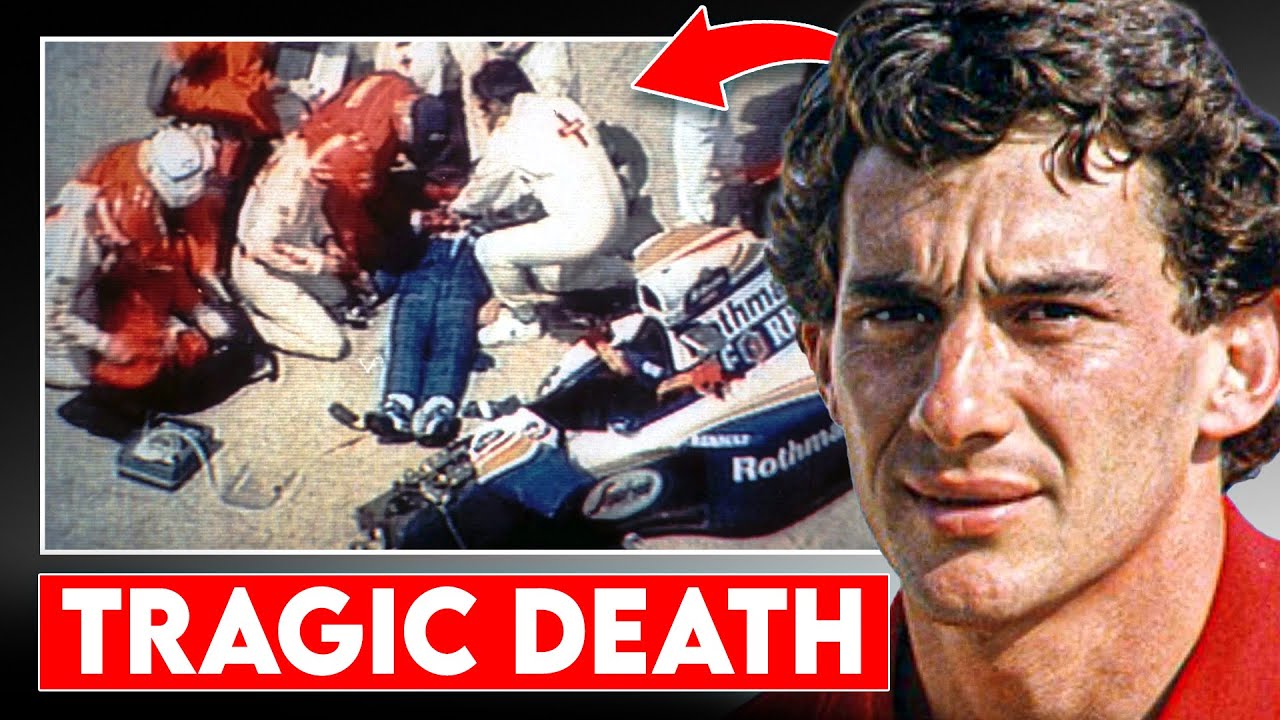
The race was immediately halted due to the severity of the crash. Within moments Senna was extracted from his car by Dr Sid Watkins and his medical team, including anesthetist Giovanni Gordini. They worked urgently, treating Senna beside the car as he struggled with a weak heartbeat and severe blood loss from a ruptured artery in his head.
By then he had lost about ninety percent of his blood volume, a critical situation.

Recognizing the gravity of Senna’s condition, Dr Watkins performed a tracheotomy at the scene and arranged for Senna to be airlifted to Maggiore Hospital in Bologna under Dr Gordini’s care. Later that evening, hospital officials sadly announced Senna’s passing. They noted that according to Italian law his time of death was officially declared at 14:17, the moment of impact, when his brain ceased functioning.
Dr Watkins recalled the moment he realized Senna’s injuries were unsurvivable, noting the fully dilated pupils that indicated his brain stem had stopped working. The injuries were devastating. The right front wheel and suspension had struck Senna’s helmet, causing fatal skull fractures, severe brain trauma and rupturing a major artery.
Even one of these injuries would likely have been fatal.
In a poignant discovery, a furled Austrian flag was found in Senna’s car, intended to honor Ratzenberger after the race, a gesture of respect amidst the tragedy. Photographs of Senna receiving medical aid on the track, taken by his friend Angelo Orsi, were never officially released out of respect for Senna’s memory.
Senna’s death sent shockwaves through Brazil and the world. The government declared three days of national mourning, and millions lined the streets of São Paulo as his coffin passed. Fellow drivers, team members and rivals wept openly at the funeral, and the sport he had transformed was forced to confront the safety failures that had claimed his life and Ratzenberger’s on the same terrible weekend.
Investigations into the crash would continue for years, producing theories about steering column failure, tire pressure loss and the possibility that Senna, carrying the Austrian flag and the weight of a sport in crisis, was pushing beyond the limits of a car that had become unpredictable. No single explanation ever satisfied everyone, and the mystery has never fully closed.
What remains beyond dispute is the scale of what was lost. Senna won three world championships, sixty-five pole positions and forty-one grands prix, but his legacy extends far beyond statistics. He gave millions of Brazilians hope, he demanded safety reforms that saved the lives of drivers who came after him, and he raced with a raw, almost spiritual intensity that no one who watched him has ever forgotten.
Imagine dying while doing what you loved most. That is what happened to Ayrton Senna, and the sadness of how he lived, always chasing, always pushing, always refusing to lift, is matched only by the sadness of how he died. His legacy will forever live on in the hearts of fans around the world.