A 2016 study from the University of Western Ontario presented a striking conclusion: humans are the “super predator,” feared by other predators more than those predators fear each other. Researchers played recordings of casual human conversation in the wild and found that mountain lions fled at more than twice the rate they fled from other predator sounds. Bobcats, deer, skunks, and possums all bolted faster and harder from human voices than from any other threat, with even apex predators displaying panic responses to the sound of people talking. The roots of this fear extend far deeper than recent history.
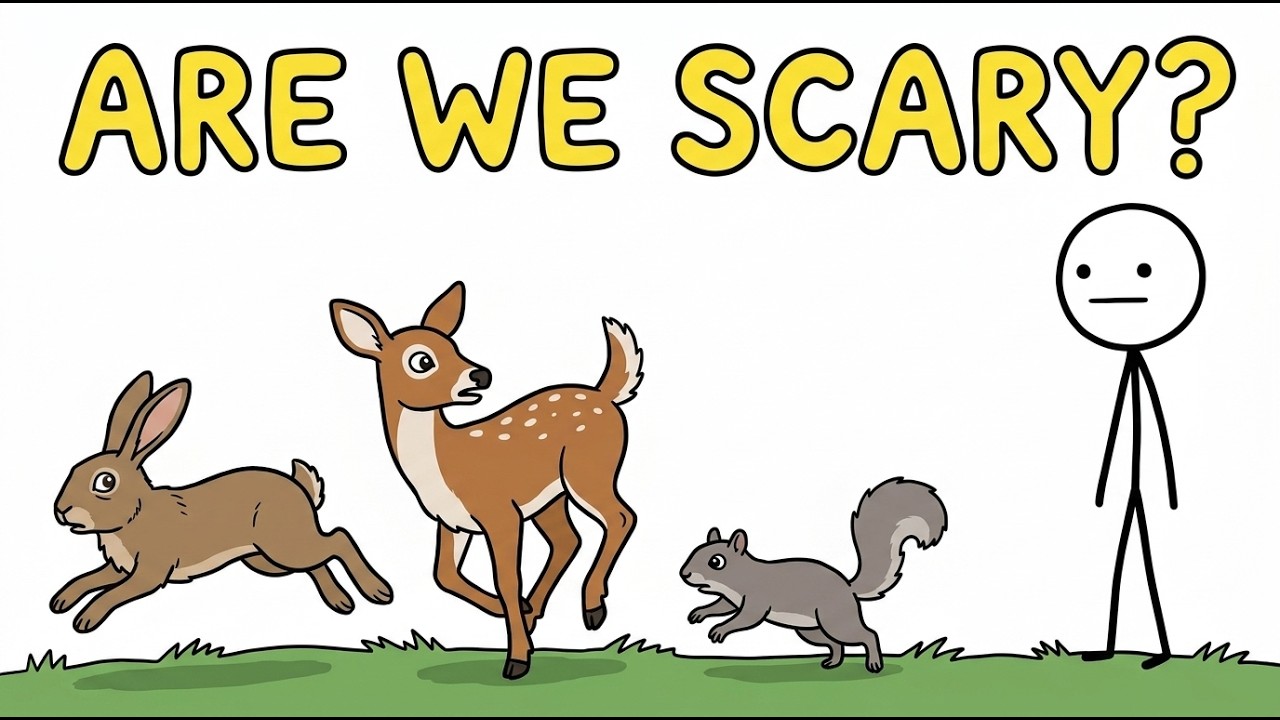
Scientists describe a “landscape of fear” in which prey animals shape their entire lives around the possibility of predators being nearby, calibrating their feeding patterns, sleeping spots, and movement around avoiding death. For millions of years, early humans were part of that calculation. Paleolithic humans were persistence hunters who lacked raw speed but could continue jogging for hours in the heat of the day until prey collapsed from exhaustion. Generational selection did the rest: animals that fled from human-shaped silhouettes survived and passed their wariness to offspring, while those that did not were eaten.
Over thousands of generations, that fear became a survival algorithm baked into the DNA of countless species. Unpredictability compounds the terror. Most predators follow recognizable patterns, with prey animals evolving calibrated responses to wolves that hunt at dawn, crocodiles that ambush near water, or hawks that strike open fields. Humans break the algorithm entirely, hunting at all hours, in groups or alone, using spears, bows, rifles, traps, and drones, on land, in water, and from helicopters.
We hunt species we eat and species we do not, dangerous animals and completely harmless ones. To an animal brain, there is no pattern to solve, and the only rational response is maximum avoidance. Animals that appear unafraid of people are not exceptions to this rule but evidence of a different process. Habituation occurs when animals are repeatedly exposed to humans without negative consequences, causing them to gradually reduce their fear response.
City pigeons and raccoons have lived alongside people for so long that the flight response has essentially been deselected. Crows have gone further, recognizing individual human faces, remembering those who have wronged them, harassing them for years, and teaching their young which people are dangerous. Natural experiments in remote locations provide the clearest evidence that fear of humans is installed through experience rather than being a factory setting. When Darwin arrived in the Galapagos Islands in the 1830s, he wrote in his journal about birds that did not fly away and iguanas that calmly returned to sit next to him after being pushed into the sea.
Penguins in parts of Antarctica walk directly up to researchers and inspect their equipment. Fish in marine reserves where fishing has been banned for decades actively swim toward divers, while fish in adjacent unprotected zones flee. When humans stop being a threat, the fear dissolves, sometimes within a few generations. The fear itself reshapes entire ecosystems.
When wolves were reintroduced to Yellowstone National Park in 1995, the deer population changed its behavior, avoiding open valleys and riverbanks. With the overgrazing stopped, vegetation returned, rivers changed course as bank erosion slowed, trees grew back, birds returned, and fish populations rebounded. Ecologists call this a landscape of fear, and it applies to human presence as well. A 2018 study published in Science found that mammals across six continents had become significantly more nocturnal in response to human activity alone, rewiring their daily schedules simply because people were around.
Human scent adds another layer of intimidation. Researchers have found that strips of cloth soaked in human sweat triggered reductions in animal activity comparable to strips soaked in mountain lion urine. Humans carry a cocktail of synthetic chemicals and natural odors that are entirely alien to natural ecosystems, and animals read that scent as a primary threat signal. When animals do attack humans, the explanation is almost always desperation rather than aggression.
The vast majority of dangerous encounters occur in three scenarios: an animal feels cornered with no escape route, a mother is protecting offspring, or an animal has been pushed into close proximity with humans by habitat destruction and is operating under extreme stress. Bears are naturally extremely avoidant of people and will leave given any reasonable opportunity, but as development shrinks their habitat and removes escape margins, stressed animals with no way out react defensively. Polar bears are a genuine exception, one of the few large predators that will actively hunt humans, but they evolved in an environment with no large predators to teach them fear of bipedal creatures. First-contact situations show what the world looks like before humans become an overwhelming presence.
Historical accounts from Pacific exploration describe sailors walking up to birds that had never seen humans and picking them up. The dodo, famously driven extinct largely because of its behavior, would walk toward hunters, not because it was stupid, but because it had never been taught to be afraid. Modern researchers find the same pattern in isolated insect species and deep-sea creatures brought up for the first time. The fear animals carry is statistically accurate.
Humans have caused the extinction of hundreds of species, transformed or destroyed more than half of all natural habitat on Earth, and altered the global climate. Animals that flee from us are making the right call. But that same fear has a hidden cost: because wildlife becomes invisible, fleeing and hiding rather than being seen, absence reads as peacefulness rather than flight. Conservation suffers as well, since deeply fearful animals are harder to study, harder to protect, and harder to help.
Habituation can work in the other direction when given the right conditions. Mountain gorilla tourism programs in Rwanda and Uganda have documented gorilla groups that went from fleeing rangers to tolerating human observers within just a few years of consistent, respectful, non-threatening contact. Rewilded areas show animals gradually recovering natural activity patterns, with daytime grazing and open-area use returning.
The landscape of fear can be dismantled, but it requires humans to be reliably, consistently, and provably not a threat.