Human children take longer to reach independence than any other species on Earth. A mayfly completes its entire life cycle in a single day, while a chimpanzee is ready to survive on its own by age eight or nine. Humans, by contrast, remain dependent for nearly two decades, with some researchers putting full brain development in the mid-twenties. This is not an accident of biology.
The unusually long human childhood appears to be a central feature of how our species evolved, not a flaw. The explanation begins with the brain itself, which is unusually large relative to body size and consumes about 20 percent of the body’s total energy. In newborns, that figure is closer to 60 percent. Many animals are born with brains that are largely finished.
A mouse brain is essentially complete at birth, and a baby gazelle arrives ready to run. That immediate readiness is a survival necessity, since prey animals face predators from day one. Humans took a very different path. Human babies are born with brains at roughly 25 percent of adult size.
The remaining construction happens after birth, and it continues for years. The prefrontal cortex, the region responsible for decision-making, impulse control, long-term planning, and risk assessment, is the last part to fully develop, typically not finishing until around age 25. The long developmental window allows the brain to be shaped by its environment. A brain that is mostly complete at birth is mostly locked in, running on instinct and designed for a specific set of conditions.
The unfinished human brain instead remains open, ready to absorb language, culture, social rules, tools, and skills from whatever environment it lands in. A child born into a fishing community learns to read tides and weather by observing adults over years. A child born in a modern city learns traffic signals, reading, and smartphones before age five. The same biological brain processes completely different information depending on its surroundings.
Play appears to be a primary mechanism for this learning. Human children play more and for longer than almost any other species. During play, the brain runs simulations. Children practicing social roles, building structures, or resolving conflicts over toys are developing negotiation skills, emotional regulation, and problem-solving abilities that will serve them as adults.
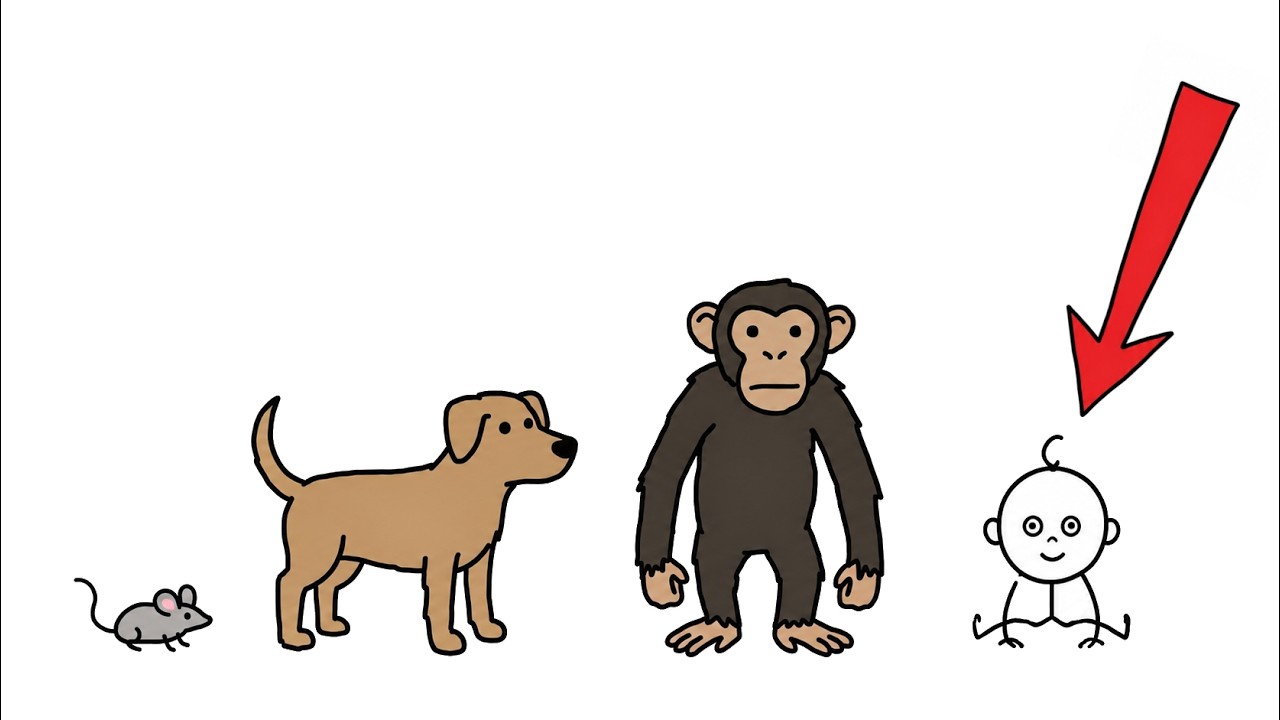
There is a pattern across species between childhood length and cognitive complexity. Mice mature in weeks, dogs in a year or two, chimpanzees in nearly a decade. Humans take close to two decades, plus additional years while the prefrontal cortex finishes maturing. The cost of this extended dependency is enormous.
Children must be fed, protected, taught, and kept alive by others for many years. From a purely evolutionary standpoint, this is an expensive investment with no immediate return. The payoff comes later. An adult who has spent 15 to 20 years learning, practicing, failing, and adapting is capable of solving new problems, inventing new tools, and cooperating with strangers using abstract systems like money, laws, and language.
Humans also pass accumulated knowledge across generations, meaning each generation builds on the last rather than starting from scratch. This process is called cumulative culture. It has produced every technological advance, scientific discovery, and civilization in human history. Complex knowledge must be built layer by layer inside a brain that is still under construction, which requires time.
Adolescence adds a second phase of brain reorganization. During the teenage years, the brain prunes old neural connections and strengthens new ones. Emotional systems mature faster than rational systems, and novelty-seeking spikes before impulse control catches up. Researchers describe this as a partial remodel that prepares young humans to separate from their family, explore identity, and eventually operate independently in a broader world.
The full developmental sequence looks like this: babies are born with unfinished brains, spend years absorbing language, culture, and social behavior through play and observation, go through a second reorganization during adolescence, and do not technically finish developing until the mid-twenties. The total construction time takes up roughly a quarter of a human life. It seems slow and inefficient by comparison with other species. But the result is a species adaptable enough to survive on every continent, one that invented agriculture, philosophy, music, medicine, nuclear physics, and the internet.
The longest childhood in the animal kingdom did not hold humans back. It is what made the species what it is.