Voyager 2’s Unimaginable Discovery at the Edge of the Solar System
In 1977, NASA launched two spacecraft that were expected to operate for only a few years. Instead, Voyager 1 and Voyager 2 have become humanity’s longest-running deep-space explorers, traveling farther than any human-made objects in history and transforming our understanding of the Solar System.
The mission was made possible by a once-in-176-year alignment of the giant planets. By carefully using the gravity of Jupiter, Saturn, Uranus, and Neptune as natural slingshots, the spacecraft could visit all four worlds while using remarkably little fuel. Missing this rare opportunity would have meant waiting until the twenty-second century for another similar alignment.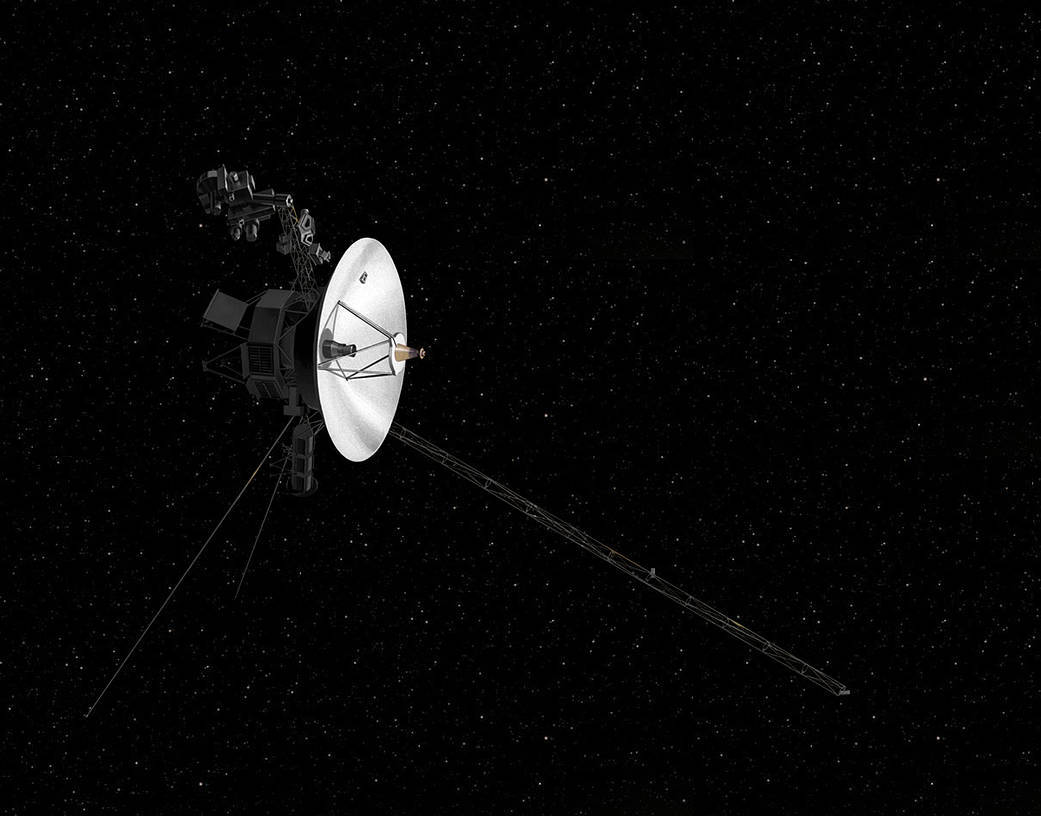
Each Voyager also carried one of humanity’s most symbolic artifacts: the Golden Record, a gold-plated copper disc containing music, natural sounds, greetings in dozens of languages, and images of life on Earth. Although designed as a message for any future discoverers, it also became a time capsule representing humanity itself.
Voyager’s scientific discoveries began almost immediately. At Jupiter, the spacecraft revealed that the Great Red Spot was an enormous storm larger than Earth, while its flyby of Io uncovered the first active volcanoes ever observed beyond our own planet. Nearby, Europa’s fractured icy surface hinted at a vast liquid ocean hidden beneath its frozen shell, forever changing the search for extraterrestrial life.
The journey continued to Saturn, where Voyager showed that the planet’s magnificent rings were not simple bands but thousands of intricate ringlets shaped by gravity and complex interactions. It also revealed Titan, a moon with a dense nitrogen atmosphere and a rich chemical environment that would later become one of the most important targets in planetary science.
Only Voyager 2 continued onward to the two ice giants. At Uranus, it discovered a planet rotating on its side with a highly unusual magnetic field that twists through space in unexpected ways. One of its moons, Miranda, displayed enormous cliffs, deep canyons, and fractured terrain, suggesting a violent geological history unlike anything previously observed.
In 1989, Voyager 2 became the first—and so far only—spacecraft to visit Neptune. Instead of the calm, frozen world many scientists expected, it found the fastest winds ever measured in the Solar System, reaching nearly 2,100 km/h (1,300 mph). It also observed the massive Great Dark Spot and discovered that Neptune’s moon Triton remained geologically active, erupting nitrogen geysers despite being one of the coldest known worlds.
These discoveries completely transformed scientists’ view of the outer Solar System. Rather than frozen, inactive worlds, the giant planets and their moons proved to be dynamic environments filled with storms, volcanic activity, underground oceans, shifting magnetic fields, and surprisingly complex geology.
After completing their planetary missions, both spacecraft continued toward the outer boundary of the Sun’s influence. Voyager 1 crossed the heliopause in 2012, becoming the first human-made object to enter interstellar space, while Voyager 2 followed in 2018, allowing scientists to directly compare measurements from two different regions of the heliosphere.
The “signals” Voyager continues to send today are not evidence of alien contact or mysterious messages. Instead, they are invaluable scientific measurements of plasma waves, magnetic fields, charged particles, and cosmic rays from a region no spacecraft had ever explored before. These observations have revealed that the boundary between the Solar System and interstellar space is far more dynamic and complex than scientists had predicted.
More than four decades after launch, the Voyager spacecraft remain extraordinary ambassadors for humanity. With only a handful of instruments still operating as their nuclear power slowly declines, they continue to transmit unique data from the edge of the Sun’s domain, extending our knowledge into a region where no human-made object had ever ventured before.