The word “assassin” traces its origins directly to a medieval Persian religious order that turned targeted killing into a highly organized craft. Founded in 1090 AD by Hasan-i Sabbah, a scholar of mathematics, astronomy, and theology, the Nizari Ismailis seized the mountain fortress of Alamut in modern-day Iran and launched a campaign of political murder that lasted nearly two centuries. Hasan-i Sabbah captured Alamut through infiltration rather than force. Supporters inside the garrison simply opened the gates.
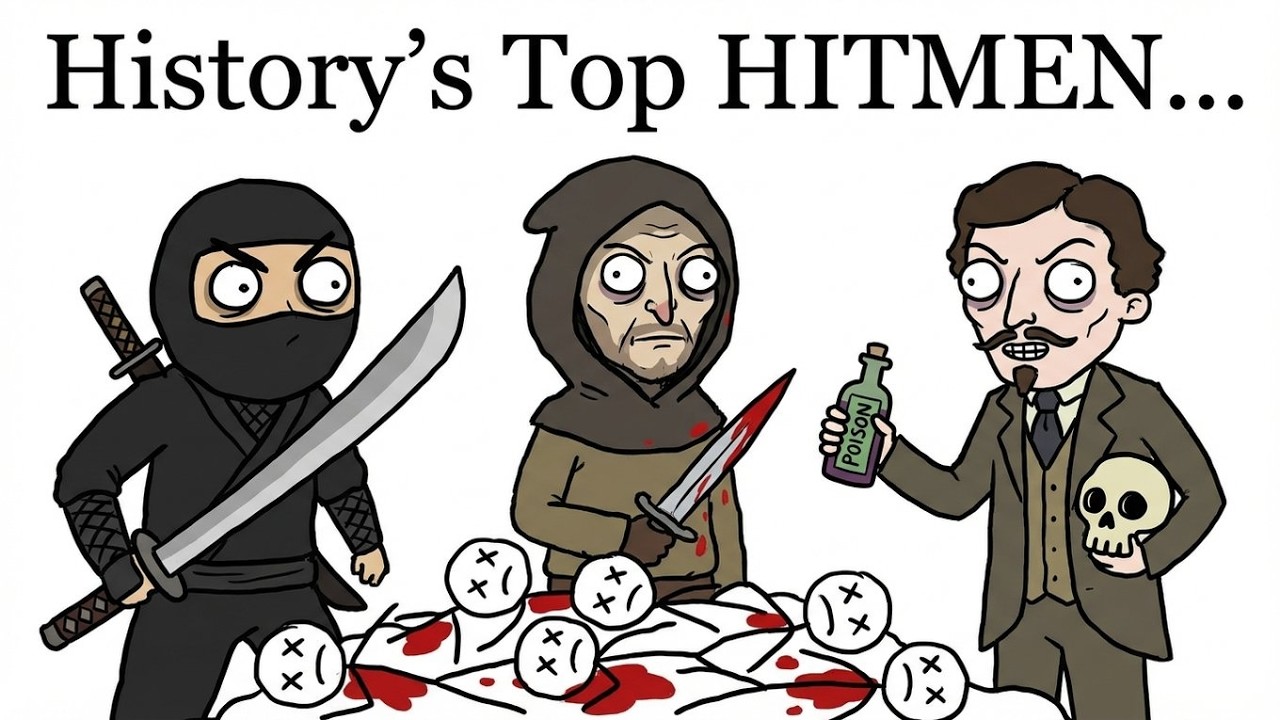
For the next 35 years, he reportedly never left his modest quarters except to climb to the rooftop twice, instead spending his time reading, writing, praying, and orchestrating assassinations across the medieval Middle East. His agents, known as fidai, or devotees, would spend years infiltrating enemy courts. They learned languages, adopted local customs, and built trust with their targets. A fidai might serve a vizier for five years as a trusted servant before receiving orders to strike.
Each target was carefully selected to destabilize rivals while minimizing civilian casualties. The order killed hundreds of high-profile figures, including the Seljuk vizier Nizam al-Mulk in 1092. When the Crusaders arrived in the Levant, the assassins added European targets to their list. The Mongols finally destroyed the order in 1256, systematically dismantling their fortress network.
Most historical records about them were written by their enemies. Marco Polo’s later account popularized the claim that Hasan-i Sabbah drugged his followers with hashish and promised them paradise, a story modern historians consider fantasy. The name “assassin” itself comes from medieval propaganda, not accurate history. Centuries earlier, in first-century Rome, a woman named Locusta turned poison making into an official career.
By 54 AD, she was already imprisoned on poisoning charges when Empress Agrippina the Younger hired her to kill her husband, Emperor Claudius. According to ancient sources, Locusta provided poison hidden in a dish of mushrooms, the emperor’s favorite food. When the first dose proved insufficient, Agrippina reportedly applied deadly nightshade to a feather used to induce vomiting. Claudius died, and Agrippina’s son Nero took the throne.
Nero hired Locusta again almost immediately. His target was Britannicus, Claudius’s biological son and a potential rival. Locusta’s first attempt was too slow, prompting Nero to personally flog her and threaten execution. Her second formula worked.
Britannicus died at a dinner party in 55 AD, right in front of the guests. Nero explained it away as an epileptic seizure, and the boy was cremated that same night. Nero rewarded Locusta with freedom, country estates, and a full pardon for all previous murders. He also commissioned her to train students in poison making.
When Nero committed suicide in 68 AD, the new emperor Galba had Locusta marched through Rome in chains and publicly executed. The ancient historians Tacitus, Suetonius, and Cassius Dio all documented her career. In first-century Judea, another group pioneered a very different method of assassination. The Sicarii, Jewish extremists operating during the Roman occupation, invented public assassination as political theater.
Their name comes from the Latin “sica,” meaning dagger. The Sicarii emerged around 54 AD from the broader Zealot movement. Rather than conventional guerrilla warfare, they targeted Roman collaborators and officials, stabbing them in crowded public events before disappearing into the panicked crowd. Their signature move was attending festivals and religious gatherings, using small curved daggers concealed under their cloaks.
After each killing, they joined the screaming crowd and pretended to be horrified bystanders. According to the historian Josephus, who remains the primary contemporary source, their victims included the high priest Jonathan, killed in Jerusalem’s Temple courtyard. They were also alleged to have killed 700 Jewish women and children at Ein Gedi, indicating they did not limit themselves to Roman targets. The Sicarii’s most famous moment came at Masada in 73 AD.
After the destruction of the Second Temple, a group took refuge in the fortress overlooking the Dead Sea. Roman forces, approximately 9,000 soldiers, laid siege and built a massive ramp to breach the walls. When they broke through, they found the compound burned and nearly all 960 defenders dead by suicide. Only two women and five children survived.
The word “sicario” still means assassin in Spanish, Italian, and Portuguese. India’s contribution to this history is the Thuggee cult, a network of organized killers operating from roughly the 13th century until British suppression in the 1830s. These travelers would join caravans, earn the trust of fellow travelers over days or weeks, then strangle them with a yellow ceremonial cloth called a rumal. The English word “thug” comes directly from them.
The Thuggees believed they served a divine purpose as children of the goddess Kali, created from her sweat to maintain cosmic balance. Each murder was a religious offering performed according to specific rituals and taboos. They would not kill women, children, or certain castes. Their method was simple.
A band would infiltrate a group of travelers, often posing as merchants or pilgrims, and travel with them for days or weeks. When the moment was right, typically at night in an isolated location, they would strike. Strangulation was preferred because it was quiet, left no blood evidence, and required no specialized weapons. The most infamous leader, Thug Behram, active between 1790 and 1840, has been credited in the Guinness Book of World Records with 931 victims.
However, records from the British officer who captured him indicate Behram claimed to have been present at 931 murders but personally strangled about 125 victims. William Sleeman, the British officer who made suppressing Thuggee his life’s work, used informants to map the network. By 1840, he had effectively dismantled the organization. Modern historians debate how much of the Thuggee threat was real and how much was colonial propaganda.
Scholar Martine van Woerkens argues in her book “The Strangled Traveler” that the Thuggee were partly an invention of British Oriental imagining, exaggerated to justify colonial expansion. Regardless of these debates, Behram was hanged in 1840. Japan’s ninja, or shinobi, were primarily spies and saboteurs rather than assassins, contrary to their popular image. They emerged during the Sengoku period, roughly the 15th and 16th centuries, when constant warfare created demand for unconventional military specialists.
The regions of Iga and Koga became famous training grounds because their mountainous terrain made them naturally resistant to feudal authority. Their primary job was intelligence gathering: infiltrating enemy castles, mapping fortifications, counting troops, and assessing supply lines. According to historian Yamada Yuji of the International Ninja Research Center at Mie University, the shinobi’s main task was obtaining crucial information through infiltration, not killing high-profile targets. Unlike samurai, who followed the honor code of Bushido requiring face-to-face combat, shinobi specialized in tactics samurai considered dishonorable: ambush, infiltration, poisoning, and deception.
This made them both invaluable and socially despised. Warlords needed their skills but could not publicly acknowledge using them. The famous Hattori Hanzo was actually a samurai who commanded ninja forces, rather than a ninja himself. The supernatural abilities attributed to ninjas were probably exaggerated stories spread either by ninjas for intimidation or by their victims to explain being outsmarted.
The unification of Japan under the Tokugawa shogunate in the early 1600s ended the constant warfare that created demand for their services. Many former shinobi families became security guards, doctors, merchants, or fireworks manufacturers. One of the most enduring legends in assassination history is the Vishkanya of ancient India. According to tradition, these were young women raised from childhood on carefully calibrated doses of poison until their very blood and bodily fluids became toxic.
Kings would deploy them as living weapons to seduce and kill enemy leaders. The concept appears in the Arthashastra, an ancient Indian treatise on statecraft written by Chanakya around 300 BC. According to the text, these poison maidens would disguise themselves as dancers or courtesans and kill through intimate contact. They could even eat poisoned food in front of their targets to prove it was safe.
The historical evidence for Vishkanyas is extremely thin, relying almost entirely on legend and literary sources. One story claims Alexander the Great died from embracing a Vishkanya, but this has no credible historical support. Alexander almost certainly died of fever, likely typhoid. The practice of building poison immunity through gradual exposure, known as mithridatism, is scientifically real.
King Mithridates VI of Pontus famously protected himself this way. When he later tried to commit suicide by poison, he found himself immune and had to be killed by a soldier. However, the idea of someone becoming so poisonous that their touch kills is biological fantasy. Historians generally view the Vishkanya as a combination of real palace intrigues involving female assassins and centuries of legendary exaggeration.
In the 20th century, assassination became industrialized. The Sicilian Mafia organized murder into a bureaucratic process. Giuseppe Greco, known as Pino the Shoe, was one of the deadliest contract killers during the Second Mafia War between 1981 and 1983, a conflict between rival Sicilian crime families that killed approximately 1,000 people in two years. Greco led a death squad that eliminated anywhere from 60 to 300 people, depending on estimates.
He was officially convicted of 58 murders, many committed with an AK-47. His methods for body disposal included dissolving corpses in vats of acid. He was murdered by his former associates in 1985. Brazilian hitman Julio Santana has been called the deadliest hitman in history, with claims of over 492 confirmed victims and possibly more than 500 total.
He operated for decades across rural Brazil, taking contracts from landowners, politicians, and criminals. Russian assassin Alexander Solonik, nicknamed “Superkiller,” eliminated numerous high-ranking rival mobsters before being killed by rivals in 1997. The American mob had Murder, Incorporated, an enforcement arm operating from the 1930s through the 1940s as a for-hire killing service. What separates modern hitmen from historical assassins is market economics.
Ancient assassins killed for ideology, religion, or imperial patronage. Modern professional killers operate in a marketplace where murder is simply a service with supply and demand, payment terms, and operational security. Throughout history, the methods changed and the motives evolved, but the basic transaction stayed the same. The Order of Assassins gave us vocabulary and tactics still studied by intelligence services.
Locusta proved chemistry could be weaponized. The Sicarii demonstrated that public violence creates political impact far beyond the immediate body count. The Thuggees showed how ideology can sustain organized violence across generations.
The deadliest assassins in history were not necessarily the ones with the highest body counts, but the ones who turned murder from chaos into craft.