Chapter Three: Thomas Hart’s Confession
The video was hidden inside a music box Evelyn had once kept beside her bed. Anna remembered winding it as a child while her grandmother brushed her hair, filling the room with a delicate melody that always sounded too sad to belong to a child’s toy. Mara had carried the box for twenty-two years without opening its false bottom, waiting for the moment when Anna would either be ready for the truth or broken enough that the truth could no longer wait.
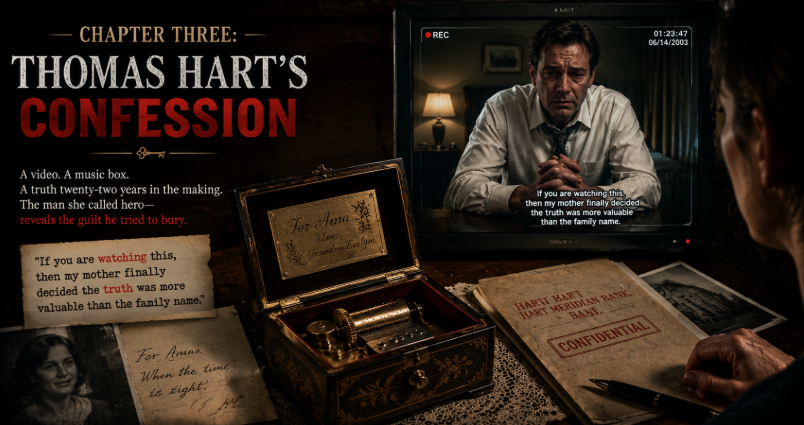
On the screen, Thomas Hart appeared younger than Anna remembered him, but not happier. He sat in what looked like a hotel room, tie loosened, eyes red, hands folded so tightly his knuckles had gone white. He did not look like a hero preparing to expose a crime. He looked like a guilty man who had discovered that regret did not undo participation.
“If you are watching this,” Thomas said, “then my mother finally decided the truth was more valuable than the family name.”
Anna’s hand tightened around the edge of the table.
Thomas looked directly into the camera. “I helped build the laundering structure Richard later used. At first, I told myself it was only a legal shelter for powerful clients who wanted discretion. Then I told myself the money had already been earned elsewhere, and Hart Meridian was merely moving it. Men like me always have prettier names for ugly things. We call greed strategy, fear loyalty, and silence maturity.”
Mara watched Anna carefully, but she did not reach for her. Perhaps she understood that comfort offered too soon would feel like another lie.
“When I realized what the structure had become, I tried to stop it,” Thomas continued. “Voss threatened Elise first. Then he threatened Anna. I went to my mother because I believed she still had the power to end it. Evelyn told me she would handle everything. I believed her because children believe their mothers, even after they become parents themselves.”
His voice broke.
“She did not end it. She contained it. And containment is just another word for letting poison stay in the room.”
Anna paused the video. The image froze on her father’s face, leaving him trapped between confession and plea.
“He helped them,” she said.
“Yes,” Mara replied quietly.
“You let me spend my whole life thinking he was innocent.”
“I let you spend your childhood loving your father before the world taught you how complicated love can become.”
Anna turned sharply. “That is not an answer.”
“No,” Mara said. “It is what I told myself when I was too afraid to give you the real one.”
The honesty hurt more than defense would have. Anna wanted to protect the father she remembered, but the man on the screen had made that impossible. Thomas Hart had not been innocent. He had been guilty enough to understand the machine, brave enough to turn against it, and late enough that people had already been ruined.
When Anna pressed play again, Thomas looked almost directly at her.
“If Anna ever sees this, I want her to know that trying to become better does not erase what you helped build. It only gives you one honest obligation: to stop pretending your guilt is private when other people paid the price for it.”
The video ended.
Anna sat in silence, not because there was nothing to say, but because there was too much. For years, her father had been the one clean place inside a dirty family. Now even that place had a locked room beneath it.
Mara finally spoke. “He tried to change.”
Anna wiped her face with the heel of her hand. “After helping them destroy people.”
“Yes,” Mara said. “Sometimes the person who tells the truth is not innocent. Sometimes they are just finished being guilty.”
Anna hated how much that sounded like justice, and hated even more that she understood it.