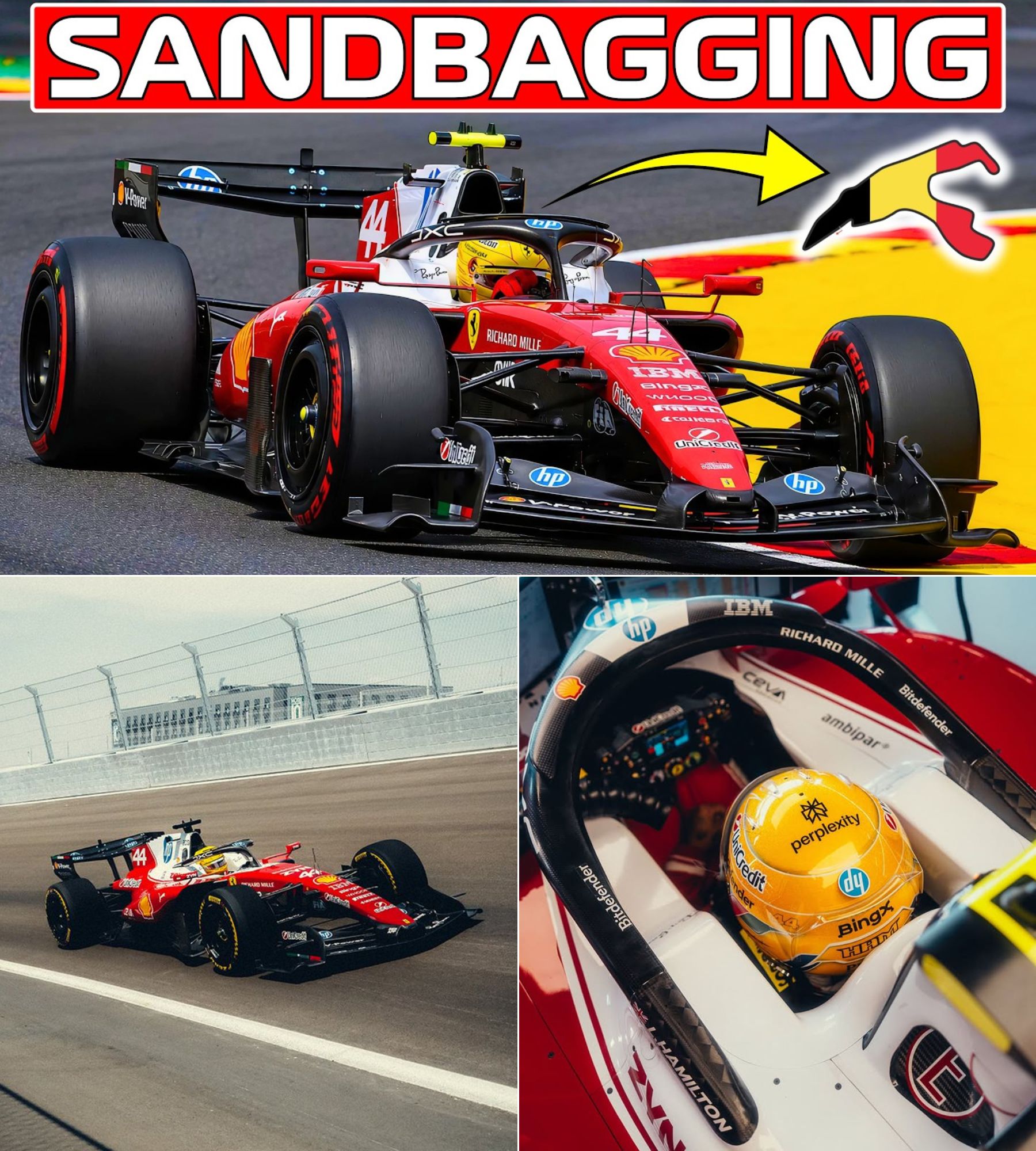
The question hanging over Spa-Francorchamps after Friday’s practice sessions is one that timing screens cannot answer: Is Ferrari deliberately hiding its true pace, or is the SF-26 simply struggling at a circuit that was supposed to be its weakest of the second half of the season? The team finished second and third in FP1 with an unchanged car, then dropped to 11th and fourth in FP2. Meanwhile, teenage sensation Kimmy Antonelli stormed to the top of the timesheets in FP2, a full 1.
126 seconds faster than the FP1 benchmark set by Max Verstappen.

Mercedes’ dramatic leap between sessions raises immediate suspicion. A 1. 126-second improvement cannot be explained by track evolution alone.
Antonelli is running a fresh power unit this weekend, and the team clearly managed its output conservatively in FP1 before unleashing full performance in FP2. That is textbook sandbagging. Ferrari, by contrast, went in the opposite direction – strong in FP1, quieter in FP2.
But the reasons for that drop are more complex than a simple decision to hide pace.
The first critical fact is what Ferrari is not running at Spa. Despite earlier reports that the Macarena Evo rear wing would arrive in Belgium, production delays prevented the component from being fitted. No new parts of any kind have been added to the cars.
The FTM exhaust device, which could be removed to gain seven horsepower at the cost of rear downforce, remains on both Ferraris. The team’s engineers have not yet finalized whether that trade-off works in their favor at this specific circuit.
That means Ferrari is racing the exact same specification that won at Silverstone two weekends ago. And with that package, Charles Leclerc and Lewis Hamilton finished second and third in FP1 at a track that was widely described as the team’s most challenging venue of the remaining season. Hamilton was just 0.
145 seconds behind Verstappen. Leclerc was 0. 207 seconds adrift.
Against a Red Bull that Verstappen himself admitted would be slower without the Macarena wing they removed, that baseline result is the most significant number of Friday.

The FP2 timing sheet tells a very different story. Leclerc finished 11th, Hamilton fourth. But the context is crucial.
Leclerc suffered a recurring problem in the third sector across both sessions. Telemetry data suggests he was on course to lead FP1 before the third sector cost him time on his best lap. The same issue appeared again in FP2.
This is not a driver mistake; it is a setup characteristic that Ferrari’s engineers will have worked through the evening to resolve before Saturday’s FP3.
Then there is the Gasly crash. The Alpine hit the wall at Fagnes with 15 minutes remaining, triggering a red flag that wiped out the final segment of the session. Most teams had not yet completed their planned qualifying simulations.
The fastest laps in FP2 were set roughly 40 minutes before the incident, meaning the session’s most valuable data collection window was lost. Hamilton’s fourth and Leclerc’s 11th do not represent the car’s qualifying potential.
So what does Friday’s data actually reveal about Ferrari’s real pace? The corner speed profile is the clearest confirmed advantage. The SF-26 was faster through Raidillon, Pouhon, Blanchimont and the Campus S section than any rival on Friday.
This is the same structural advantage that delivered Silverstone’s corner speed data, a consistent characteristic of the aerodynamic platform that Leclerc has said works everywhere.

The energy management approach at Pouhon specifically is producing lap time in the middle sector that the timing sheets do not fully capture. Ferrari deploys electrical energy on the approach to the corner to maximize entry speed, then uses the momentum to carry through the following section. The advantage is distributed across a long sequence of corners rather than concentrated in a single measurable point.
But the straight-line limitation remains very real. At the Bus Stop chicane exit, Verstappen’s Red Bull was pulling away from Hamilton in FP1, not due to driving differences but because Red Bull’s internal combustion engine produces more power at that critical moment. On the Kemmel Straight, the gap is partially addressed by the low-drag configuration Ferrari is running without the Macarena Evo.
Yet the fundamental limitation persists. Ferrari gives back time on the straights that it gains through the corners.
At Spa, where the Kemmel Straight is longer than at any comparable circuit, that give-back is more pronounced than it has been all season. The third sector issue Leclerc faced in both sessions compounds the problem. If it is not resolved before Q1, his qualifying lap will not reflect what the car is actually capable of, creating a strategic disadvantage for Sunday that the race pace data suggests is unnecessary.
Saturday’s qualifying will therefore determine whether Ferrari’s corner speed advantage translates into a front-row or second-row position when both cars produce clean laps in Q3. Antonelli’s FP2 benchmark of 1 minute 45. 944 is the Mercedes target.
Ferrari did not produce a clean representative qualifying simulation in FP2 due to the red flag. The gap between Antonelli’s best and Ferrari’s best clean lap in Q3 is the number that defines Sunday’s race strategy.
If rain arrives for qualifying, as the forecast suggests is possible, the calculation changes entirely. Wet conditions at Spa reduce the Kemmel Straight’s significance and amplify the high-speed corner advantages Ferrari holds. In the wet, the car that can commit most completely to Raidillon, Pouhon, and Blanchimont is the car that qualifies at the front.

Based on Friday’s corner data, that car is the Ferrari.
So is Ferrari sandbagging? The answer is nuanced. Mercedes was clearly sandbagging in FP1.
The 1. 126-second leap in FP2 confirms it. Ferrari was not sandbagging in FP1.
That was genuine pace from the Silverstone race-winning specification with no new parts. Ferrari’s FP2 result was shaped by Leclerc’s recurring third sector problem and Gasly’s crash – not by a deliberate strategy to hide speed.
The honest picture from Friday is that Ferrari is competitive at Spa with the same car that won at Silverstone, without the Macarena Evo or the FTM decision that were expected. The corner speed advantage is real. The straight-line limitation is real.
And the gap between those two realities is smaller than the FP2 timing sheet suggests, and smaller than anyone expected before the weekend began.
Whether that gap is small enough to put Ferrari on the front row is Saturday’s question. Whether it is small enough to win the race on Sunday is the question the championship has been building toward since Barcelona. Spa was supposed to be the circuit that answered it negatively.
Friday suggested it might not be that simple. The sandbagging question runs in both directions, and only qualifying will reveal which team truly holds the cards.