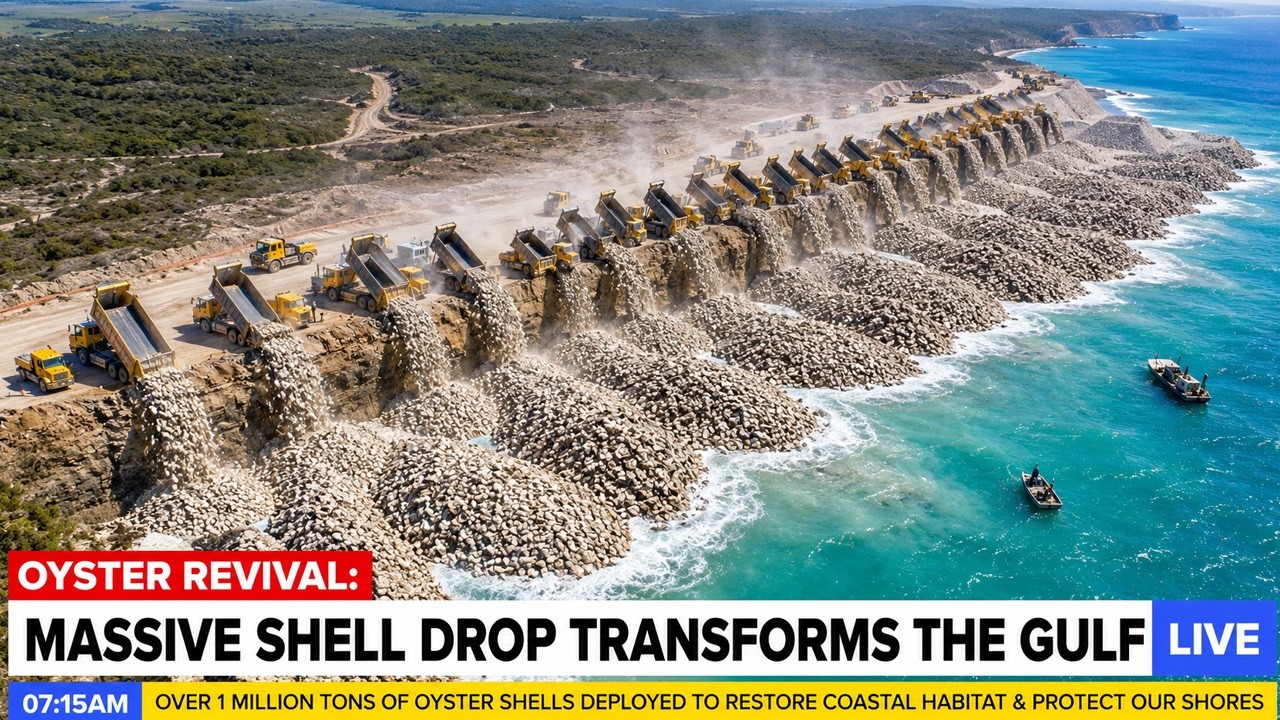
Florida’s bold gamble to dump half a million tons of oyster shells into the Gulf of Mexico has triggered a scientific revelation, rewriting our understanding of ecosystem revival. The controversial experiment, once derided as ocean dumping, unexpectedly sparked a rapid, self-sustaining marine renaissance, transforming devastated seafloors into thriving reefs and vibrant fisheries.
From 2007 through 2024, the Florida Fish and Wildlife Conservation Commission undertook one of the most contentious coastal restoration experiments in state history. Discarded oyster shells from the seafood industry were trucked and barged out to designated spots near Cedar Key, where more than 500,000 tons were methodically deposited on the Gulf’s seafloor.
The initiative ignited fierce opposition. Fishermen feared the shell deposits would destroy fragile habitats and cripple what little remained of their coastal fisheries. Conservation groups labeled it disguised ocean dumping. Public hearings overflowed with decades-long watermen, biologists, and industry stakeholders warning that this unproven method risked irreversible damage.
Despite the backlash, the commission pressed forward, hard-pressed by the logic that these shells were destined for landfills anyway. If they could serve as substrate to revive the decimated oyster reefs, the effort would justify the political cost. No one predicted the overwhelmingly rapid biological transformation that followed.
Initial shell dumping appeared uneventful to casual observers—gray mounds slowly sinking into sandy bottoms. For 18 months, researchers quietly collected data beneath the waves, monitoring water samples, sediment cores, and biodiversity markers. When results emerged, they shocked everyone. The ecosystem was not just recovering; it was accelerating at a pace unmatched anywhere in the scientific record.
The first colonizers were invisible to the naked eye—bacteria forming biofilms on shell surfaces, triggering localized alkaline microzones by slowly dissolving calcium carbonate. This new biochemical environment fostered rapid settlement of barnacles, juvenile oysters, and other calcifying organisms, effectively jumpstarting an entire food web.
Within weeks, microscopic algae and grazers appeared, followed by juvenile fish drawn by this emergent habitat. The seafloor, long a biological dead zone, was now a living, breathing reef foundation, creating shelter, food, and nursery grounds absent for decades. Florida’s once barren Gulf bottom was reborn—layer by invisible layer.
By the end of the first year, oyster larvae, or spat, found ample surface to attach to, breaking a cycle of reproductive failure caused by depleted substrates in the Gulf. Juveniles flourished in numbers far exceeding expectations, rapidly maturing into reproductive adults that sustained natural reef growth independent of human intervention.
Fishermen’s skepticism dissolved as restored reefs attracted thick schools of redfish and other species in record numbers. Catch-and-release charters noted the fish were not mere transplants but juveniles indigenous to the revitalized ecosystem, underscoring that real life was being created, not just relocated.
The ecological uplift extended beyond marine life. Reefs filtered billions of gallons of Gulf water daily, removing excess nutrients fueling harmful algal blooms and dead zones. Improved water clarity enabled seagrass beds to recolonize, restoring critical habitat for juvenile sea turtles, manatees, and wading birds, further boosting coastal biodiversity.
The reefs received a crucial test when Category 4 Hurricane Irma struck in 2017. Shorelines backed by the restored reefs suffered 30 to 40% less erosion compared to unprotected areas. The oyster structures absorbed powerful wave energy, preventing millions in property damage, demonstrating resilience unmatched by traditional seawalls or riprap.
Unlike static man-made barriers, the reefs grew stronger with every storm. Each new generation of oysters settled on the fragments of the last, building vertical and horizontal complexity. This natural engineering produced habitats rivaling pristine limestone reefs, effectively turning restoration into a self-perpetuating phenomenon.
The economic impact mirrored the ecological miracle. Local fishing businesses, charter operators, and waterfront restaurants reported notable revenue increases directly linked to reef sites. Coastal communities once bracing for economic decline witnessed a resurgence driven by a restored marine ecosystem and renewed tourism opportunities.
The program’s legacy rapidly expanded beyond Florida. Alabama, Mississippi, and Louisiana launched shell recycling initiatives inspired by Cedar Key’s success. Internationally, coastal engineers studying the results began applying the model to degraded reefs in Canada, Australia, and Europe, fueling a global shift toward nature-based restoration solutions.
This oyster shell experiment shattered entrenched scientific assumptions. The shells were not inert debris but active biological agents catalyzing rapid ecosystem regeneration. The discovery challenges conventional reef restoration timelines and redefines the role of substrate chemistry and microscopic life in habitat recovery.
Beyond immediate biodiversity gains, restored reefs sequester organic carbon, mitigating climate change impacts by trapping greenhouse gases absorbed into shell structures and sediments. This unexpected climate benefit adds urgency to scaling such interventions in coastal waters worldwide threatened by pollution and habitat loss.
As ongoing monitoring shows reefs continuing to expand their footprint, filter nutrients, and support growing species diversity, questions arise: Can this model sustain itself indefinitely? Will future environmental stresses test the resilience of these ecosystems? Or does this breakthrough mark the dawn of a new era in marine conservation?
Florida’s half a million tons of oyster shells laid the groundwork for an ecological revolution under the waves. What began amid controversy and skepticism now stands as a beacon of hope and a blueprint for restoring coastal ecosystems devastated by human activity. The Gulf’s living reefs are proof nature, given a chance, can heal faster and stronger than we ever imagined.