
Most people who train consistently for a year stop making progress not because they lack effort, but because they never change the demand they place on the body. Doing the same three sets of ten with the same weight, week after week, teaches the body that its current strength is already enough. Progressive overload is the principle that fixes this, and it does not require adding more days to your week.
What progressive overload actually means
Progressive overload is the gradual increase of stress placed on the body during training. Muscles, tendons and the nervous system adapt to the demand they meet. Once a demand becomes routine, adaptation stops. Increase it slightly, recover, and the body rebuilds slightly stronger than before.
The common misreading is that overload means adding weight to the bar every session. Weight is only one of several variables, and for most people it is the one that runs out first.

Six ways to add load without adding weight
- Reps: same weight, one or two more repetitions per set.
- Sets: three working sets become four, adding total volume.
- Tempo: slow the lowering phase to three or four seconds. The same weight becomes considerably harder.
- Range of motion: a deeper squat or a full stretch on a row increases demand at no extra load.
- Rest: cutting rest from three minutes to two raises density.
- Frequency: the same weekly volume spread across more sessions often produces better quality work.
Pick one variable per training block. Changing several at once makes it impossible to know what worked, and usually leads to a jump in fatigue that outpaces recovery.
Double progression: the simplest system that works
Double progression removes the guesswork. Choose a rep range rather than a fixed number, for example 8 to 12. Stay at the same weight until you can perform the top of the range for every working set with clean form. Only then increase the load, which drops you back toward the bottom of the range, and start again.
A worked example on a row: you start at three sets of 8. Over four weeks the sets become 9, 10, 11 and finally 12. Next session you add the smallest available increment and return to sets of 8 or 9. Progress is slow enough to be sustainable and fast enough to be measurable.
Why smaller jumps beat bigger ones
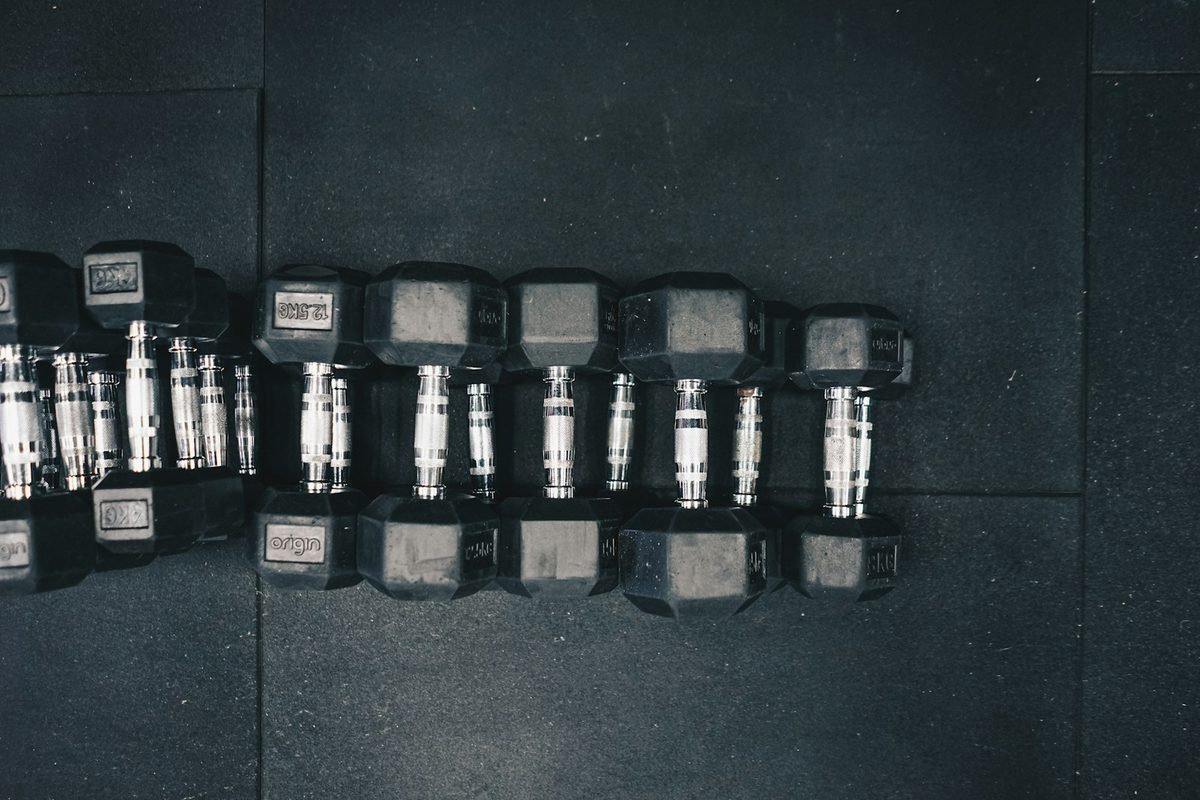
The urge to add ten kilos at a time is understandable and counterproductive. A jump too large forces a drop in reps, degrades technique, and burns recovery capacity that the next session needs. Microplates of 1 to 2.5 kilograms let you keep the rep quality and still move forward every fortnight.
Over a year, adding 1 kilogram to a lift every two weeks is 26 kilograms. Almost nobody adds 26 kilograms in a year by chasing big jumps, because big jumps produce stalls, frustration and resets. The lifter who looks patient in March is usually the one who looks strong in December.

Not every exercise should progress the same way
Big compound lifts — squats, presses, rows, deadlifts — tolerate load increases well and are where most measurable strength shows up. Smaller isolation work behaves differently. A lateral raise chased with heavier and heavier dumbbells usually turns into a swing, and the muscle you were trying to work stops doing the job.
A reasonable split: progress load on the main lifts, and progress reps, tempo or control on isolation work. That single distinction prevents most of the technique drift that quietly stalls a programme.
Track it or it is not a plan
Overload is a comparison, and a comparison needs a record. A notebook with exercise, weight, sets and reps is enough. Without it, you are relying on memory of a session you did five days ago while tired, which reliably overestimates what you actually lifted.
Note two extra things beside each session: how the last set felt, and whether form held. Those two notes explain nearly every stall you will encounter later.
When progress stops
Stalling is normal and usually has an ordinary cause. Work through the list before rewriting the programme:
- Sleep has dropped below what recovery needs.
- Food is not sufficient to support building tissue.
- Fatigue has accumulated across several hard weeks with no lighter week.
- The jump was too big and reps quietly collapsed.
- Form changed — a shorter range of motion can look like progress while actually being a reduction in demand.
If none of these apply, take a lighter week at roughly two thirds of your usual load, then return to the weight that stalled. Most stalls resolve themselves this way without any programme change at all.
Overload is not permanent escalation
Load cannot rise forever. Over a career, progress looks like a series of steps: a block of building, a lighter week, then a new block starting slightly higher than the last one began. Beginners can add load weekly, intermediates monthly, and advanced lifters may fight for a single kilogram across a season. All three are progress.
The point is not to be sore or exhausted. It is to give the body a reason to change, then give it the conditions to do so.
General information only, not medical or coaching advice. If you have an injury or a health condition, speak to a qualified professional before starting or changing a training programme.