Maureen O’Hara and John Wayne created such extraordinary chemistry on screen that generations of viewers wondered whether something deeper existed between them. Their arguments felt real, their affection appeared effortless, and their performances carried the familiarity of two people who seemed to understand each other completely.
But the truth was not a secret romance—or a hidden betrayal.
By O’Hara’s own account, Wayne was one of her closest and most trusted friends, a man whose loyalty remained important to her until his death.
Born Maureen FitzSimons in Dublin in 1920, O’Hara grew up dreaming of the stage before actor Charles Laughton helped bring her to international attention. She made her Hollywood breakthrough in films including The Hunchback of Notre Dame and How Green Was My Valley, establishing herself as a performer known for intelligence, physical courage, and a refusal to accept passive female roles.
Her fiery screen presence eventually made her the ideal partner for John Wayne.
The two appeared together in five films: Rio Grande, The Quiet Man, The Wings of Eagles, McLintock! and Big Jake. Their partnership was built on contrast. Wayne projected calm authority, while O’Hara challenged him with wit, strength, and emotional intensity. Rather than being overshadowed by one of Hollywood’s most imposing leading men, she met him as an equal.
That equality became the foundation of their friendship.
In her memoir, ’Tis Herself, O’Hara described Wayne as a close lifelong friend and emphasized that their bond was rooted in mutual respect. The book’s official description distinguishes that friendship from her much more troubled relationship with director John Ford, whose behavior she often found difficult and emotionally painful.
This matters because modern videos often reverse the story.
Some claim Wayne abandoned O’Hara when she faced damaging rumors, made cruel remarks about her, or became one of the great betrayals of her life. Those accusations are not supported by her memoir or by the most reliable accounts of their relationship.
O’Hara could be frank about people who mistreated her. She did not hesitate to discuss professional conflict, unwanted advances, unhappy relationships, or the harsh realities women faced in the studio era. Had she considered Wayne an enemy, there was little reason for her to conceal it in a memoir written partly to correct false stories about her life.
Instead, she remembered their friendship with affection.
Their best-known collaboration, The Quiet Man, became O’Hara’s favorite film. She was especially proud of playing Mary Kate Danaher, a woman whose fierce independence, dignity, and anger made her far more than a conventional romantic heroine. O’Hara later said she loved the character’s “hell and fire,” qualities that closely matched her own public identity.
The film also demonstrated why her partnership with Wayne worked.
Mary Kate refused to be intimidated by Sean Thornton, while Wayne’s character gradually learned that loving her meant respecting her pride and understanding the culture she refused to abandon. Their scenes were sometimes rough, humorous, and emotionally charged, but the actors trusted each other enough to make that conflict convincing.
Away from the cameras, O’Hara’s life contained genuine hardship.
Her marriage to producer and director Will Price became deeply unhappy. In ’Tis Herself, she described it as destructive and wrote candidly about the suffering it caused. The memoir’s publisher similarly characterizes this period as a deeply troubled chapter before she eventually found lasting happiness with aviation pioneer Charles F. Blair Jr.
That painful marriage should not be confused with her friendship with Wayne.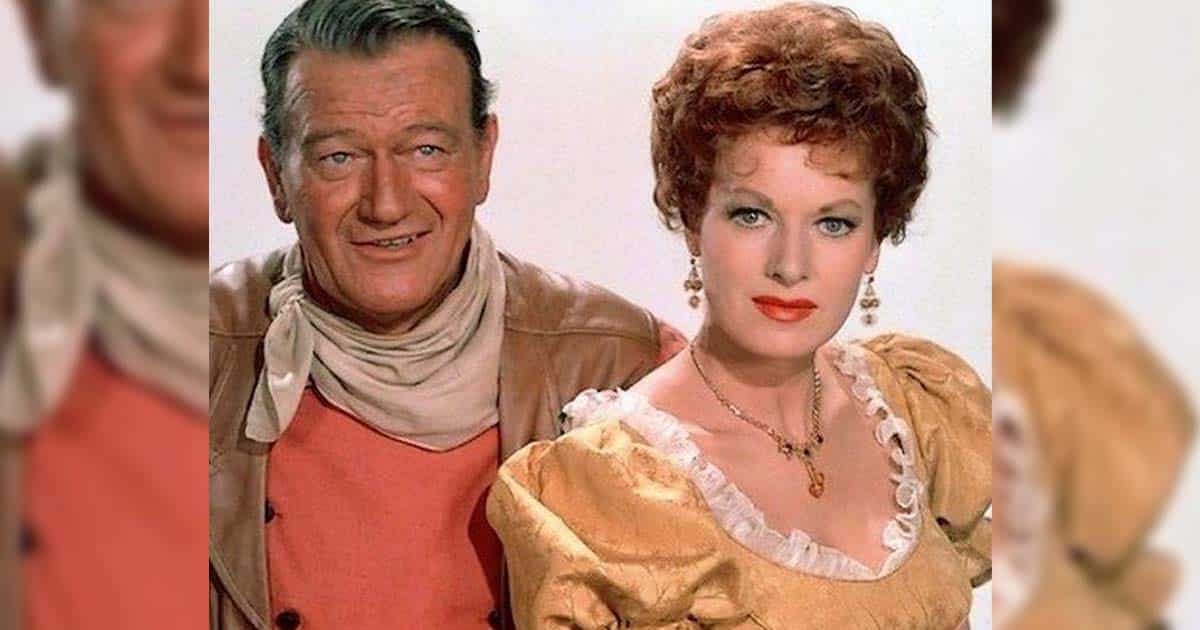
Nor should unverified stories involving Errol Flynn, Tyrone Power, Greer Garson, or James Stewart automatically be treated as established fact. O’Hara certainly encountered sexism and predatory behavior in Hollywood, but many dramatic quotations and private confrontations repeated in online videos cannot be traced to reliable interviews, contemporary records, or her autobiography.
Her most significant professional conflict was more closely associated with John Ford.
Ford directed O’Hara in five films and played an essential role in shaping her career, but she described him as mercurial, manipulative, and capable of humiliating the performers around him. Their creative bond produced remarkable films, yet their personal relationship became deeply complicated.
Wayne occupied a different place in her life.
Although they undoubtedly disagreed at times—as close friends often do—O’Hara consistently portrayed him as a loyal colleague who understood her strength. She famously defended his character after his death and objected when critics reduced him to political stereotypes or dismissed his acting ability.
The friendship lasted until Wayne died in 1979.
O’Hara continued honoring him through interviews, public appearances, and celebrations of their films. Their bond became part of the enduring mythology of classic Hollywood, but unlike many Hollywood legends, it was supported by the people who actually lived it.
O’Hara’s later years brought both loss and recognition.
After Charles Blair died in a plane crash in 1978, she managed aspects of his aviation business and became associated with one of the earliest scheduled airlines led by a woman. She later returned to acting in Only the Lonely opposite John Candy, whom she also remembered with great affection.
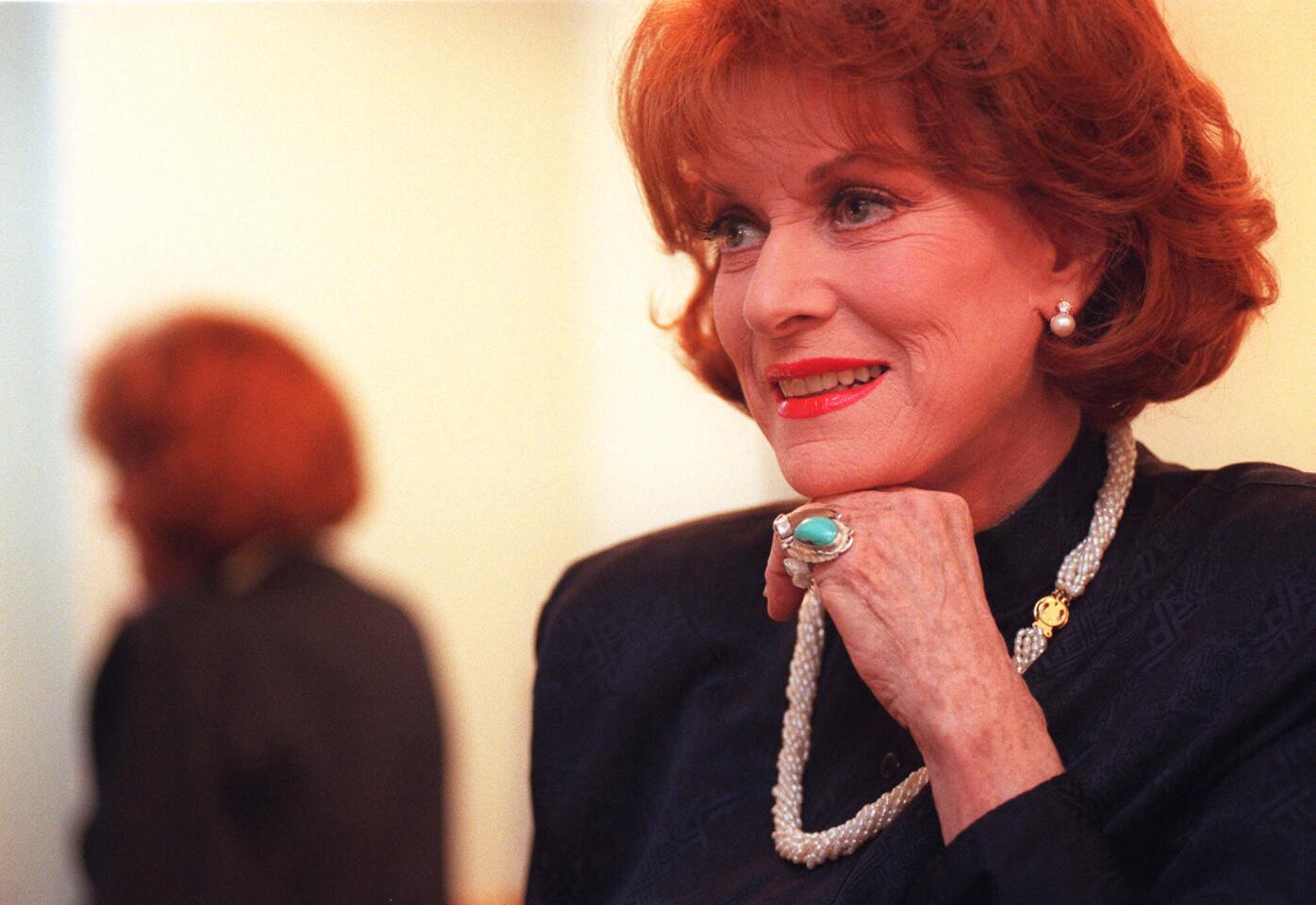
In 2014, she finally received an Honorary Academy Award recognizing a career that had never earned her a competitive Oscar nomination. She died peacefully on October 24, 2015, at the age of 95, surrounded by family while music from The Quiet Man played nearby.
That detail feels appropriate.
The film was not merely one of her greatest successes. It preserved the partnership that audiences loved most: Maureen O’Hara standing opposite John Wayne, refusing to retreat, and matching him with every look, argument, and gesture.
The real revelation is not that she secretly hated him.
It is that in an industry where trust was often fragile, their friendship survived fame, strong personalities, political differences, and the passing of time.
Hollywood produced countless fictional romances.
Maureen O’Hara and John Wayne created something rarer—a genuine friendship powerful enough to make audiences believe every emotion they performed.
💭 Do you think Maureen O’Hara and John Wayne formed the greatest screen partnership of Hollywood’s Golden Age, or was their chemistry strongest because their real relationship remained a friendship rather than a romance? Share your thoughts below. 🎥👇
#MaureenOHara #JohnWayne #TheQuietMan #ClassicHollywood #GoldenAgeHollywood #HollywoodHistory #MovieLegends #UntoldStories 🎬✨