
Before the Husband: The Dark Secret of Roman Brides – An Erased Ritual
Imagine you are invited to a Roman wedding. You step into the grand hall expecting romantic music, soft flower petals, and joyful laughter. Instead, a haunting silence hangs over the room. The groom steps toward the trembling bride—not with a gold ring, but with a sharp, blood-crusted weapon.
This is no horror movie script. It is one of the darkest, most carefully hidden rituals of ancient Rome, dragged out from the shadows of history.
To understand it, we must forget everything we know about modern weddings. For a Roman, marriage was never a celebration of love; it was a magical, dangerous pact with the gods of the Underworld and a ruthless transfer of property.
The Spear of the Fallen Gladiator: Hasta Caelibaris
At the center of aristocratic Roman weddings was a terrifying object: the Hasta Caelibaris (the “celibate spear”). This wasn’t just any ordinary weapon. It was specifically a spear that had been driven into the body of a gladiator and had ended his life in the dusty arena.
The groom took this deadly iron tip and ran it through the bride’s hair, parting her locks into six ritual braids.
Why introduce a symbol of death to mark the beginning of a new life?
While historians still debate the exact origin, the dark truth lies in ancient magic: Romans believed the primal strength and vitality of the slain warrior would transfer through the blood-stained blade into the bride, making her fertile and strong.
For the young bride, feeling that cold, bloody iron touch her scalp was an unmistakable message: You belong to me now, and I hold the power of life and death in this house.
A Fiery Veil and Crimson Shoes
Everything about the bride’s attire was designed to erase her old identity and mark her as a sacrificial vessel for her new family.
-
The Flammeum: Her veil was not white, but a deep, fiery yellow-orange, resembling a flickering flame. She wore it to look like a priestess about to perform a bloody animal sacrifice—though symbolically, she herself was the sacrificial lamb.
-
The Safran Shoes: Her feet were clad in vibrant saffron-yellow shoes that matched her veil. She was meant to glow like a burning beacon, unable to hide or fade into the shadows while hundreds of scrutinizing eyes tracked her every move.
The Theatrical Abduction
Before the couple could reach their new home, a strange ritual of violence took place—one that echoed the ancient legend of the Rape of the Sabine Women.
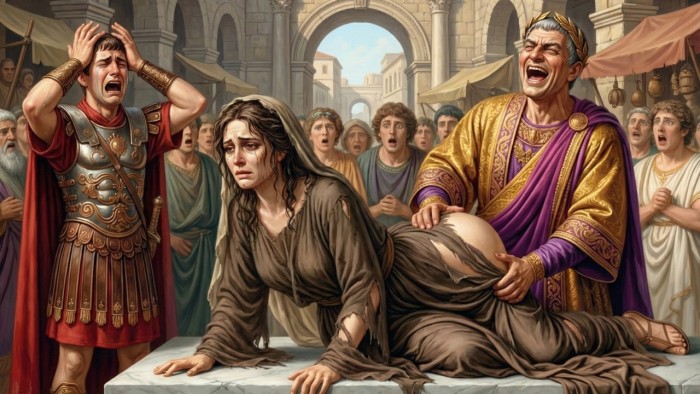
The bride was forced to cling desperately to her mother’s arms, weeping and screaming, while the groom and his companions tore her away with staged brutality. To an outsider, it looked like an assault; to Romans, it was a necessary theater of dominance. It declared to society that a Roman man takes what he wants by force.
Confarreatio: The Spell of Unbreakable Bonds
The darkest and most rigid form of marriage, reserved exclusively for the highest patricians, was the Confarreatio. This was no mere legal contract—it was an occult binding that made the couple prisoners of their own religion.
-
The Sacrifice: The bride and groom sat together on a wooden stool covered with the fleece of a sacrificed sheep.
-
The Sacred Cake: They shared a special spelt cake (panis farreus) while the High Priest of Jupiter (Pontifex Maximus) chanted ancient, unintelligible incantations.
-
The Binding Vow: As she crossed the threshold into her new home, the bride was forced to utter the famous vow:
“Ubi tu Gaius, ego Gaia”
(Where you are Gaius, I am Gaia.)
It sounds poetic to modern ears, but in reality, it was the total surrender of her identity. She shed her own name and history to become nothing more than the female shadow of her husband.
This ritual was overseen by the Pronuba—a stern matron who had only been married once. Acting as an unyielding guardian of tradition, she dragged the bride to the altar and forcibly placed her right hand into the groom’s, sealing the transfer of ownership.
The Horror of Diffarreatio: No Way Out
For a Roman woman trapped in an abusive marriage, escape was almost impossible. To dissolve a Confarreatio, the couple had to perform an inverse ritual called Diffarreatio.
This “anti-wedding” was soaked in dread and bad omens. Romans believed that severing a sacred bond invited the wrath of the heavens, meaning death symbolically hovered in the room during the ceremony. Many noblewomen preferred to live in pure hatred—or resort to poison and dark intrigues—rather than face the terror of the Diffarreatio.
The Bedchamber: Demons, Lard, and Hercules
Even the wedding night was a minefield of superstition.
-
Greasing the Doorposts: Before entering her new home, the bride smeared the doorposts with pig or wolf fat and wrapped them in wool. This was done to ward off evil spirits and demons that supposedly lurked at the threshold, waiting to curse the new household.
-
Carried Over the Threshold: The groom carried the bride across the doorway to ensure she wouldn’t trip—a stumble was considered a fatal omen of impending death.
-
The Knot of Hercules: Inside the bedchamber, the groom had to untie the complex Knot of Hercules securing the bride’s belt. The bride had to stand completely motionless like a statue. If the groom tore the knot out of anger or impatience, it was seen as a dark omen that the marriage would end in violent ruin.
Why Was This Dark History Erased?
When Christianity became the state religion of the Roman Empire, church authorities worked tirelessly to ban and erase these pagan, blood-soaked rituals. They replaced the gladiator’s spear and the ritual abduction with the image of a pious, peaceful union, burying Rome’s dark wedding secrets in dusty archives.
Yet, subtle echoes remain today. Carrying a bride over the threshold is a direct leftover from the ancient Roman fear of threshold demons.
The ancient Roman bride was not a partner in a romantic story; she was a guardian of the sacred hearth and a vessel for the next generation of legionnaires. Her wedding was a cold, militarized duty signed in the invisible ink of superstition—a stark reminder that beneath the marble majesty of Rome lay a world built on iron, blood, and unyielding discipline.