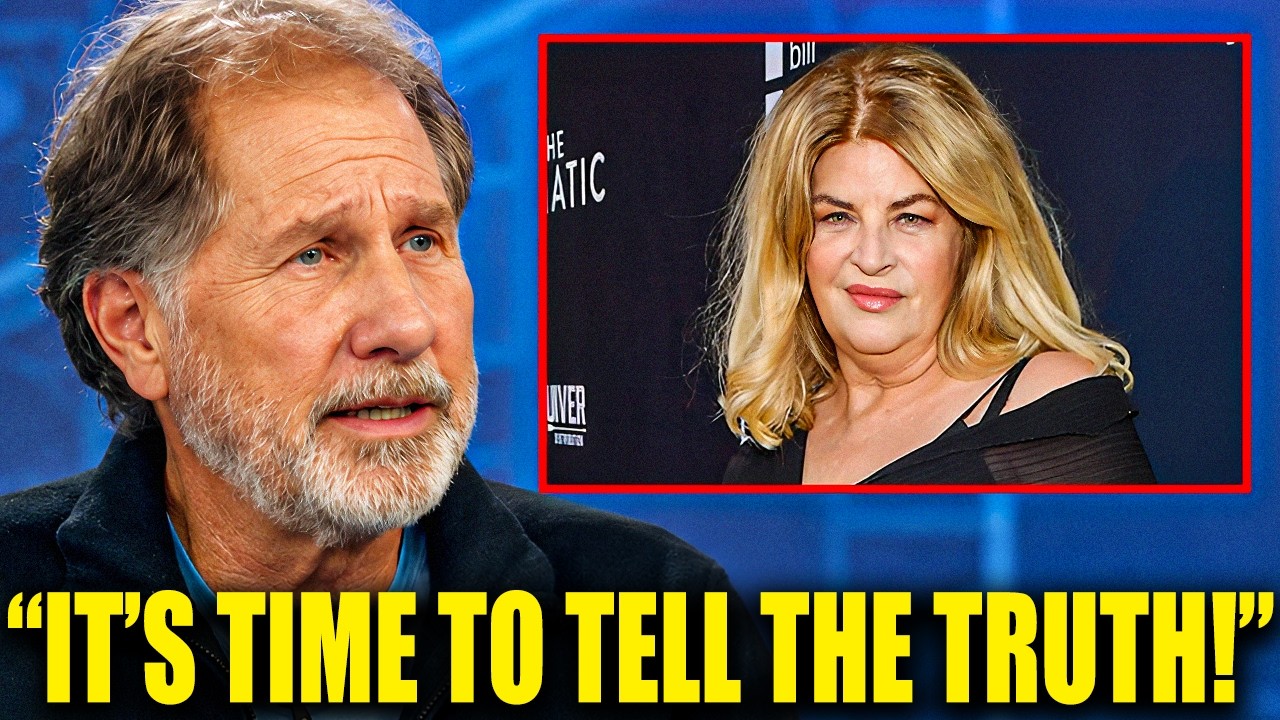
LOS ANGELES — Parker Stevenson has finally broken his silence after more than a decade of quiet, and the words he chose carry the weight of a lifetime shared with Kirstie Alley. At 74, the former teen heartthrob stepped back into the public eye to honor the woman who changed his life forever.

His tribute came through a single photograph posted to social media, showing Alley holding his shirt at the 1988 premiere of “Shoot to Kill.” Beside the image, he wrote words that stunned fans and reignited interest in a love story that many thought had ended long ago.
“Dear Kirsty, I am so grateful for our years together and for the two incredibly beautiful children and now grandchildren that we have,” he wrote. “You will be missed with love, Parker.”
Those words marked the first time Stevenson had publicly addressed Alley since her death on December 5th, 2022. She was 71 years old and had been battling cancer that her family said was only recently discovered before her passing.
True and Lily, the couple’s two adopted children, announced their mother’s death with a statement that called her “an incredible, fierce, and loving mother.” They said she was surrounded by close family and praised her joy for life, her children, grandchildren, animals, and creative work.
The news sent shockwaves through Hollywood. John Travolta called their bond one of the most special relationships of his life. Ted Danson remembered how easily she made him laugh.
Rhea Perlman spoke about Kirsty’s limitless joy and the elaborate treasure hunts she created for their children.
But it was Stevenson’s quiet tribute that pulled buried history back into the light. The couple’s story began in 1981, when Alley saw Stevenson across a Los Angeles bar and told her roommate she would give anything to be with him.
There was one obvious problem. Stevenson had arrived with someone else. Alley walked over anyway, and her confidence worked.
They danced that night, and by the time they left, they were drawn closely together.
Their differences appeared almost immediately. Alley loved rap music, vegetables, cigarettes, and Scientology. Stevenson preferred classical music, sugar, a smoke-free room, and his Episcopalian faith.
She was loud, quick, and impossible to miss. He was careful, calm, and happier outside the center of attention.
Stevenson later called them exact opposites. At first, that contrast created excitement. Each seemed to offer what the other lacked.
Their politics, habits, beliefs, and basic ways of living rarely matched, but the attraction was strong enough to overcome everything.
Before he met Alley, Stevenson had already tasted fame beyond anything he expected. Born June 4th, 1952, in Philadelphia, he was one of two sons born to Richard Stevenson Parker Sr. and Sarah Meade.
His mother was an actress who appeared on Broadway and in television commercials.
When Parker was only five, Sarah took him to a filming session. That visit led to two small television appearances, giving him an early look at the world that would later shape his life. His father did not welcome that direction and made it clear he did not see acting as a serious career.
Parker’s real interest was architecture. He liked structure, design, and the idea of creating something that could last. That plan followed him to Princeton University, where he studied architecture.
Acting remained more of a useful side job than a calling.
In 1972, acting moved to the front when he received his first notable screen role in “A Separate Peace.” He was credited as Parker Stevenson, the name audiences would soon know. Yet even then, he was not certain that Hollywood was where he belonged.
In 1977, he was cast as Frank Hardy in “The Hardy Boys/Nancy Drew Mysteries.” Shaun Cassidy played his younger brother Joe, while Pamela Sue Martin played Nancy Drew. Frank was the calmer and steadier brother, which suited Parker’s natural screen presence.
The show became a massive hit and turned both young actors into national heartthrobs overnight. Their faces appeared on posters, lunchboxes, and magazines. Parker later called the experience very surreal, recalling a visit to the King Tut exhibit where people stared at him instead of the famous treasures.
 The role gave him a lasting friendship with Shaun, whom Parker would later describe as a brother. But fame had arrived suddenly, and staying successful after that kind of role would prove much harder.
Alley’s road to Hollywood was far less predictable. She was born in Wichita, Kansas, on January 12th, 1951, to Robert Deal Alley and Lillian Alley. She graduated from Wichita Southeast High School in 1969, then attended Kansas State University before leaving after her second year.
She had already married her high school sweetheart, Robert “Bob” Alley, in 1971, but that marriage ended in 1977. After leaving Kansas, she moved to Los Angeles, where she wanted to study Scientology and work as an interior designer.
Before acting made her famous, television viewers saw her as a game show contestant. She appeared on “Match Game” in 1979 and won money in both of her games. Behind those light appearances was painful change.
In 1981, a drunk driver caused a crash that killed her mother and seriously injured her father.
By then, Alley had also faced cocaine addiction. She later said Scientology and its Narconon program helped her stop using the drug. Her faith became a major part of her identity and would remain important for the rest of her life.
While their relationship grew, both careers kept moving. Alley made her film debut in 1982 as Lieutenant Saavik in “Star Trek II: The Wrath of Khan.” Stevenson appeared in “Stroker Ace” in 1983, forming a friendship with Burt Reynolds that lasted for years.
On December 22nd, 1983, after about two years together, Parker and Kirsty married. Their wedding joined two people who had been pulled together by contrast, but marriage placed those differences inside the same home every day.
By 1985, Alley was gaining stronger roles. She appeared in the first “North and South” miniseries, a huge television story about two families divided by the American Civil War. Stevenson wanted a place in it, partly because he did not want another long separation from his wife.
He strongly pursued the role of Billy Hazard and got it, while Alley returned as Billy’s sister, Virginia Hazard. The plan did not work as expected. Stevenson filmed for about six months while Alley worked for only around two weeks.
Alley later admitted that she developed powerful feelings for Patrick Swayze while making “North and South.” She also spoke about intense feelings for John Travolta at another point in her life. She insisted that neither connection became physical and that she did not betray her marriage.
Alley’s career rose again in 1987 when she starred with Mark Harmon in “Summer School.” That same year, she joined “Cheers” as Rebecca Howe, replacing Shelley Long after five seasons. The role changed her status almost immediately.
She was no longer simply Parker Stevenson’s rising actress wife. She was becoming one of television’s biggest comedy stars. Stevenson was still working, including the short-lived 1988 series “Probe,” where he played Austin James.
In 1989, both reached major turning points. Stevenson joined the original cast of “Baywatch” as lifeguard Craig Pomeroy. The beach drama became a worldwide success, but Stevenson left after its first season, later admitting that leaving had been a mistake.
Alley, meanwhile, starred with John Travolta in “Look Who’s Talking.” The film earned more than $295 million worldwide and led to two sequels. Yet away from the cameras, she and Stevenson were trying to have a child.
In 1990, Alley became pregnant, and the “Cheers” staff planned to include the pregnancy in Rebecca Howe’s story. Then she suffered a miscarriage. Alley later described the shock of being told the baby was gone while Stevenson was not there.

“It’s just like all the life falls out of you,” she recalled. She said that after carrying a child for several months, she had already imagined the baby’s room, school, and whole future. Her “Cheers” castmates surrounded her with support, especially Rhea Perlman.
In 1991, Alley won an Emmy for “Cheers.” Her acceptance speech showed their opposite personalities in one unforgettable moment. She thanked “my husband Parker, the man who has given me the big one for the last 8 years.”
The crowd laughed and gasped while Parker sat in discomfort.
In October 1992, their long wait for parenthood ended when they adopted their son, William True Stevenson. The miscarriage had not been forgotten, but True brought new purpose into their home. Stevenson settled into fatherhood more naturally than he had settled into fame.
They adopted a daughter, Lily, a few years later. The family owned properties in several states, including a home on Islesboro Island in Maine that was once known as the Islesboro Inn. Their lifestyle included an annual Halloween party said to cost $25,000.
Behind that picture, however, the differences that once felt exciting were becoming harder to carry. Alley once said, “Every arrangement needed a boss.” And in their marriage, she said, Parker was the boss.
By the middle of the 1990s, that playful picture no longer matched reality.
Alley had become the bigger earner, while Stevenson wanted a clear place inside the family. He later admitted their differences “were terrible for married life” and called it a miracle they had remained together so long.
By late 1996, after nearly 13 years of marriage, they separated. Alley filed for divorce in Maine on March 26th, 1997. Stevenson filed his own case in California the following day.
Two states were now involved, and each offered different rules for property, money, and custody.
The legal fight exposed details they had once kept inside their marriage. Stevenson requested spousal support because Alley was earning far more than he was. He argued that he needed enough money to maintain the life they had shared, including $18,000 each month for rent on a beach home.
He also sought custody of True and Lily and requested $75,000 a month in child support until they reached adulthood. Although he had once been a highly wanted television actor, he said his earnings were only a fraction of Alley’s.
Maine eventually dismissed its action because it was the less suitable place for the case. In December 1997, the marriage legally ended in California. Reports said Stevenson ultimately accepted a single payment of $6 million and received part of their property, including the 21-bedroom mansion in Maine.
Both parents were given extended time with their children. Stevenson said that arrangement mattered because he and Alley were both crazy about them. Still, he described the settlement process as ugly.
He said they were no longer friends, although they spoke regularly about True and Lily.
Stevenson also carried a deeper regret. He believed divorce meant they had broken a promise made to God. If he married again, he said, he would choose someone who shared his dreams and goals.
After the divorce, Alley remained far more public than Stevenson. “Veronica’s Closet” ran from 1997 to 2000 and brought her more Emmy and Golden Globe attention. She later became a spokesperson for Pier 1 Imports, then for Jenny Craig.
Her changing weight became a public story that followed her work. She turned that struggle into television through “Fat Actress” in 2005 and “Kirstie Alley’s Big Life” in 2010. Her faith remained visible, and she gave the Church of Scientology $5 million in 2007.
Stevenson took a quieter route. He returned to “Baywatch” in 1997 and 1998, but photography gradually became his main creative focus. In a 2013 interview, he said he woke up to edit photographs, arrange shoots, and work on images.

In 2016, Parker and Kirsty became grandparents when True welcomed a son. Reports claimed Stevenson feared that Scientology had placed the baby under close control at its Los Angeles center. Alley remained fiercely loyal to the faith.
Stevenson continued building a different kind of life. From 2017 to 2020, he played academy director Lewis Osmond in “Greenhouse Academy.” He also found love again in an ordinary way after moving into the upper part of a beach duplex.
He met Lisa Shoen, who was temporarily living downstairs. Lisa asked to borrow a large stockpot. Two days later, she returned it filled with what Stevenson called the best chicken soup he had ever tasted.
They married at Demetria Vineyards in Los Olivos, California, on September 29th, 2018.
Alley kept working until the end. She finished second on “Celebrity Big Brother” in 2018, returned to “Match Game” as a celebrity panelist in 2019, and competed as Baby Mammoth on “The Masked Singer” in 2022. She still owned homes in Oregon and Florida.
Then came December 5th, 2022, when Alley died at age 71. In 2023, Stevenson spoke more openly about the loss. He called it a tragedy that Kirsty was not around longer, especially for True and Lily.
“We’re never really ready for our parents to be gone,” he said.
He believed the loss forced their children to grow up faster. True played guitar and drums and captained a charter fishing business in Florida. Lily and her husband made custom furniture.
Stevenson still went to the beach to jog and swim, though he surfed less often.
His fortune has been estimated at $10 million, while Alley reportedly left around $40 million. Stevenson hoped to travel with Lisa to Spain or England, where she could explore local food while he photographed their time there.
The question now hangs over everything: Was Stevenson’s tribute closure, or the closest he ever came to admitting Kirsty still had a hold on him? His quiet message suggested that even after 25 years apart and decades of silence, the bond they shared never fully disappeared.
Their children carried both of them forward. True and Lily grew up between two very different worlds, shaped by their mother’s fierce spirit and their father’s steady calm. The grandchildren Stevenson mentioned in his tribute represent the legacy that outlived the pain.
Friends say Stevenson has found peace in his photography, his marriage to Lisa, and his role as a father and grandfather. But the photograph he chose to share told its own story. It captured a moment when they were still together, still hopeful, still building something.
The image from 1988 shows Alley holding his shirt with a playful smile, while Stevenson beams beside her. It was a frozen moment from a time before the bitterness, before the legal battle, before the silence. It was the version of them that fans always wanted to believe in.
Stevenson’s public tribute was brief, but it spoke volumes. He did not mention the divorce, the custody fight, or the years of distance. He chose gratitude instead.
He chose the children they raised together and the grandchildren who came after.
For a man who spent decades avoiding the spotlight, those few words were a remarkable act of openness. They showed a side of Parker Stevenson that fans rarely saw during his “Hardy Boys” years or his “Baywatch” days.
The full story of what happened between them may never be completely known. Stevenson valued his privacy too much to reveal everything, and Alley took many of their secrets with her. But the tribute he offered after her death gave the world a glimpse of something real.
It was the closest he ever came to admitting that the woman he once called his exact opposite still held a piece of his heart. And for the fans who grew up watching them, that quiet admission was enough.