CHICAGO — The audience roared when Chris Farley crashed through another table, sweat pouring down his face, his chest heaving as he gasped for air. They thought it was the act. They had no way of knowing the man sprawled before them on the Saturday Night Live stage was fighting for something far more serious than a punchline.
On October 25, 1997, Farley returned to Studio 8H as a first-time host. It should have been a triumphant homecoming for the man who had defined the show’s wildest era. Instead, it became a horrifying preview of the tragedy that would claim his life less than two months later.
 That night, the comedy legend was visibly struggling. His voice was hoarse and unfamiliar. His face was flushed.
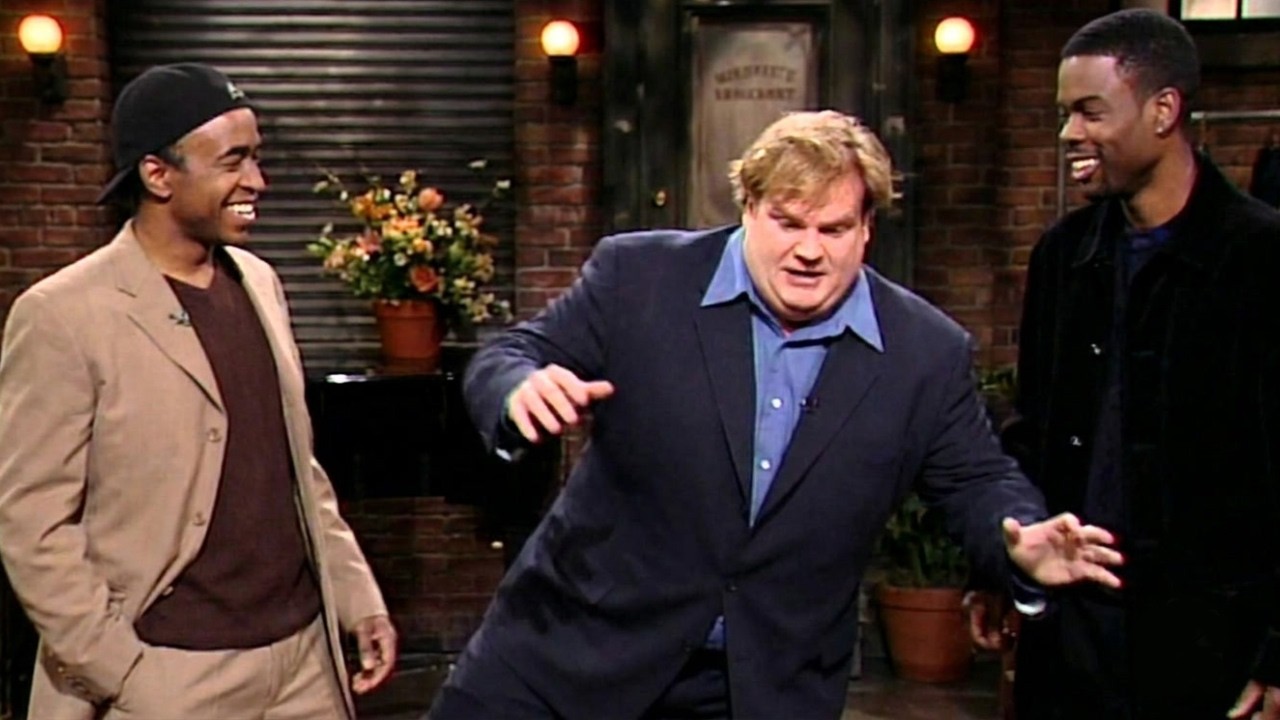
He appeared short of breath between sketches. Producers were so worried that show creator Lorne Michaels secretly brought Chris Rock in as a backup host, ready to step in if Farley physically could not continue.
The cold open turned that real-life fear into a joke. Tim Meadows assured Michaels that Farley was calm, focused, and sober. Chevy Chase appeared as a sponsor.
Farley pleaded for a chance, threw himself into a hard fall, and won permission to perform. The audience laughed because every sign of distress looked like another brilliant piece of physical comedy.
But the warning signs only multiplied as the night wore on. Farley revived his legendary character Matt Foley, the furious motivational speaker, spending much of the sketch riding a stationary bicycle after drinking an entire pot of coffee as part of the routine. At one point, he paused in what witnesses later described as genuine distress before forcing himself to continue.
Norm Macdonald, delivering the weekend update that evening, remembered the tension behind the scenes. He was upset that Farley had been asked to perform at all. During one segment, Macdonald reportedly asked the crowd to laugh harder simply because it gave Farley extra time to rest between appearances.
The sketches that night turned his deteriorating condition into the punchline. He played a Chicago superfan whose body repeatedly failed him. He played a giant baby.
He played a wrestler. He played a drunken Hank Williams Jr. Fake heart attacks, paramedics, and heavy falls were woven directly into the material.
The comedy was no longer just physical. It was medical.
Some laughter that evening sounded uneasy. The familiar act was still recognizable, but something was deeply wrong. Friends watching from the wings saw a man whose body could no longer keep up with the demands of his own legend.
The audience, conditioned to expect chaos from Farley, laughed at the struggle. It was the cruelest trick of his career.
 The October 1997 episode was not the first warning. Months earlier, during a taping of Nickelodeon’s All That alongside a young Kenan Thompson, Farley’s physical comedy had been noticeably limited. He breathed heavily.
He struggled to move. The producers edited around his limitations, but the signs were undeniable.
In July 1997, at a Planet Hollywood opening in Indianapolis, Farley appeared badly out of shape and sweating heavily. He poured milk over his own head like a race winner and behaved erratically in front of stunned onlookers. A concerned friend pulled him aside and urged him to slow down.
Farley reportedly smiled and replied, “I want to live fast and die young.”
The words were chilling. They were also a direct echo of the path carved by his hero, John Belushi, who died at 33 from a speedball overdose. Farley would die at the exact same age, from an almost identical combination of cocaine and morphine.
The parallel was so precise it seemed almost fated.
Farley’s rise had been meteoric. Born in Madison, Wisconsin, in 1964, he grew up in a large Irish-Catholic family where laughter filled the home but drinking was treated as normal. He was the class clown who pulled his pants down in school and took dares too far.
When nuns warned his mother that other children were laughing at him, not with him, his response was simple: who cares, as long as they’re laughing.
That hunger for laughter drove him through Marquette University, through Chicago’s Second City theater, and into the cast of Saturday Night Live in 1990. Alongside Adam Sandler, David Spade, Chris Rock, and Rob Schneider, he became part of the legendary “Bad Boys of SNL” era. His characters — Matt Foley, the Gap Girl, the Super Fan — made him a national sensation.
The famous Chippendales audition sketch with Patrick Swayze became one of the most iconic moments in SNL history. Farley removed his shirt, danced with startling commitment, and owned the stage. Audiences loved it.
 But the joke carried a painful price. Chris Rock later admitted he hated the sketch because its message was that Farley could not get the job because he was fat.
Farley internalized that message. He worried constantly about his weight, but he also feared that becoming thinner would destroy his career. Doctors warned him to lose weight.
His family begged him. But he had built his entire public identity around being loud, heavy, reckless, and fearless. Protecting that image meant ignoring what his body desperately needed.
Hollywood came calling with Tommy Boy, Black Sheep, and Beverly Hills Ninja. He commanded millions of dollars per picture. He dated models.
He had money, fame, and friends. But success never settled the storm inside him. In candid moments, he admitted that fame had not made him exempt from the basic rules of being human.
He struggled with relationships, telling interviewers he did not believe he had ever truly experienced romantic love outside his family. He battled severe depression and obsessive-compulsive disorder. In his final two years, he entered rehab or detox programs approximately 17 times.
Each attempt brought hope. Each relapse brought despair.
His brother Tom later said the family did not fully understand how loneliness, fear, and addiction could hide behind humor. Both brothers could stand in a crowded room and still feel completely alone. The performer who could command any audience could not find a way to be at peace with himself.
The final spiral began in December 1997. Farley checked into Hazelden for treatment but stayed only one night. He returned to Chicago on December 11, weighing close to 300 pounds.
For a few days, he seemed hopeful. He attended Mass, baked Christmas cookies, and bought an expensive decorated tree. He made promises about what 1998 would look like.
 On December 14, he began what friends described as a four-day binge. He moved through Chicago bars, drinking heavily and using drugs. At the club Karma, he partied until 2 a.
m. On December 15, he appeared at a Second City anniversary gathering, lively and drinking. On December 16, he missed a planned haircut appointment.
A woman using the name Autumn later said she spent the afternoon with him drinking screwdrivers, smoking marijuana, and searching for cocaine. She described him moving restlessly from room to room, unable to settle. “I don’t think he knew what he wanted,” she said.
At about 2 p. m. on December 18, 1997, John Farley entered his brother’s apartment on the 60th floor of Chicago’s John Hancock Center.
He found Chris dead in the front room, wearing only pajama bottoms. He was 33 years old. Police found no sign of foul play.
The autopsy revealed cocaine and morphine in his system — a speedball, the same combination that killed John Belushi. Advanced atherosclerosis, a serious buildup of disease in his arteries, was listed as a significant contributing factor. Years of abuse had badly damaged his heart and blood vessels.
A private funeral was held on December 23 at Our Lady Queen of Peace Catholic Church in Madison. More than 500 people attended, including the entire comedy fraternity that had loved him. David Spade did not attend, later explaining that the funeral would have been too emotionally overwhelming for him to bear.
Almost Heroes and Dirty Work reached theaters posthumously in 1998. His unfinished voice work for Shrek was scrapped, and Mike Myers rebuilt the role. In 1999, his brother created the Chris Farley Foundation to use humor in substance abuse prevention.
In 2005, Farley received a star on the Hollywood Walk of Fame.
The question that lingers, more than two decades later, is whether the laughter that night in October 1997 was a celebration or an accelerant. The audience laughed because they believed Chris was still performing. They could not distinguish the joke from the danger.
That is the tragedy of Chris Farley — a man who needed laughter to feel alive, and who died because everyone, including himself, mistook his dying for a brilliant act.