The man who wrote “It’s better to burn out than to fade away” has lived that lyric with terrifying precision. Neil Young, the iconic singer-songwriter who has shaped rock music for six decades, has a personal history far darker and more chaotic than his gentle hippie image suggests. From a childhood ravaged by polio to a brain aneurysm that nearly killed him, from friendships with Charles Manson to a bitter divorce that shattered a 36-year marriage, Young’s life has been a relentless collision with tragedy, controversy, and survival.
The story begins in a snowstorm. According to family lore, Neil Young was conceived while his parents were trapped in a tiny apartment in Toronto. Nine months later, on November 12, 1945, he arrived at Toronto General Hospital.
 His parents, Rassy and Scott, were opposites in every way. Rassy was fearless and volatile, raised in comfort. Scott was handsome and charming, from the wrong side of the tracks.
They fought over everything, including how to raise Neil and his older brother Bob. Family friend June Colwood said the parents were too wrapped up in their crumbling marriage to notice their children at all.
When Neil was five years old, his living nightmare got worse. He woke up feverish and groaning in pain. His parents raced him 145 kilometers from Omemee to Toronto.
Little Neil, wearing a surgical mask and clutching a toy train, rode silently in the back of the car. Doctors confirmed he had polio. In the pre-vaccine era, this was devastating news.
He was rushed into tests, spinal taps, and strict isolation. Six agonizing days passed while his family went home to quarantine and stew in their fears. Neil’s recovery was long and frightening, but he forced himself forward with small stumbling steps.
Music became his refuge. At 13, his parents gave him a cheap plastic ukulele for Christmas. After 19 tempestuous years together, they split.
As the family disintegrated, Neil’s obsession with music intensified. When Rassy and 14-year-old Neil moved to Winnipeg, music stopped being a pastime and became an obsession. By age 20, he was already touring Canada’s coffee houses as a solo act.
Then fate stepped in. In 1966, walking down a street in Toronto, Bruce Palmer invited him to join a rock and roll band called The Mynah Birds.
The Mynah Birds crackled with chemistry. During shows, Young would drop his guitar and start a raging harmonica solo, toss it in the air, and Rick James would catch it without missing a beat. Offstage, the two shared a Toronto apartment, surviving as broke musicians.
James kept them fed by swiping bakery deliveries before dawn. He also kept Young supplied with something far more dangerous: amphetamines. The band scored a record deal with Motown Records, but just as they started recording, authorities barged into the studio and busted Rick James for being AWOL from the US Navy.
The band splintered.
Young and bassist Bruce Palmer pawned their gear, bought a hearse, and barreled toward Los Angeles. That led to another chance encounter with Stephen Stills and the formation of folk rock powerhouse Buffalo Springfield. But just as the band was gaining momentum, Young started collapsing without warning.
At one gig, he bolted off stage mid-song. Stills chased him into the parking lot where Young lay across the hood of a Corvette, thrashing uncontrollably. A nurse thrust her fingers into his mouth to stop him swallowing his tongue.
 He was later diagnosed with epilepsy, a condition he kept private until a 1975 Rolling Stone interview.
Young’s brushes with danger were not over. Not only were he and Charles Manson birthday twins, they were also pals. Introduced by Beach Boys drummer Dennis Wilson in 1968, Young found Manson’s raw, unpredictable creativity fascinating.
At the time, Manson was just another musician. Within months, he would become the infamous Helter Skelter cult leader responsible for horrors that shocked the world. They hung out at Dennis Wilson’s Sunset Boulevard house, where Manson made up songs on the spot as Young played along.
Young gifted him a motorcycle and tried to get him a record deal, telling Warner Brothers, “This guy is unbelievable.”
In 1968, Young married his first wife, Susan Acevedo, 12 years his senior. Friends described her as tough, brilliant, strong-willed, and overpowering. Acevedo ran a tight ship at home and put Young on a healthy diet to help manage his epilepsy.
She also banned his mother from visiting. The marriage lasted just two years. After Buffalo Springfield split in 1968, Young didn’t pause.
He started Crazy Horse. In 1969, they recorded “Everybody Knows This Is Nowhere” in just two weeks. Young wrote “Cinnamon Girl,” “Cowgirl in the Sand,” and “Down by the River” while bedridden and burning up with a 102-degree fever.
His career took off with that album, “Déjà Vu” with Crosby, Stills & Nash, and his solo “After the Gold Rush.” Neil Young was never a people-pleaser. In 1970, after seeing shocking images from Kent State where the National Guard opened fire on student protesters, Young retreated to the woods with his guitar.
Just an hour later, he emerged with “Ohio,” one of music’s most enduring protest anthems. It was the first sign that activism would become part of Young’s DNA. But success put a strain on his marriage, and he didn’t stay single for long.
After watching the 1970 film “Diary of a Mad Housewife,” Young fell hard for Carrie Snodgress, the titular housewife. He got one of his roadies to drop off a note backstage that said, “Call Neil Young.” Snodgrass later said, “I didn’t know Neil Young from Neil Diamond.”
Their first date was unconventional. Snodgrass arrived at the Chateau Marmont to find Young stranded in bed with crippling back pain. The injury came from an accident while renovating his new ranch.
The very next day Young was in the hospital, but Snodgrass didn’t run. She showed up unfazed that Young was wearing an old-fashioned lace-up brace with metal bars digging into his hips.
 Unable to stand and shred his guitar, Young had no choice but to slow down. From that fragile state came “Harvest” in 1972. It became a chart-topping smash and remains his best-selling album.
But success unsettled him. He wrote that “Harvest” put him in the middle of the road. “Traveling there soon became a bore, so I headed for the ditch.”
It was a path he would choose over and over again. Unfortunately, while Young stood at the peak of superstardom, much of the strain at home fell to Snodgrass, and the cracks were already beginning to show.
Fresh off “Harvest,” Young planned a massive tour with the Stray Gators joined by Crazy Horse guitarist Danny Whitten. But at rehearsals, Whitten’s addiction made one thing clear: he could barely function. Young sent him home.
That same night, the coroner called from Los Angeles. Danny Whitten had overdosed. Neil later said, “I loved Danny.
I felt responsible.” The arena tour that followed was a blur of booze, substances, and bad decisions. Young was feeling raw and restless and far from faithful.
He’d already written “Motion Pictures,” a breakup song about ending it with Susan Acevedo before he even found out about her own affairs.
This dark period spawned what fans later called the Ditch Trilogy. In 1974, Young met Pegi, a waitress living in a tent with her dog. By 1978, they had two kids.
Ben, born with cerebral palsy, and Amber Jean, who has epilepsy like her father. Rather than retreating, they founded the Bridge School for children with verbal and physical disabilities and funded it with yearly star-studded benefit concerts. By the early 1980s, Young was flooring the gas and making U-turns in every direction.
He blindsided fans with “Trans,” a synth-heavy album packed with robotic vocals and electronic beats, partly inspired by efforts to communicate with his nonverbal son, Ben.
Then he veered into a stripped-down 25-minute rockabilly album. Geffen Records was livid and actually sued him for making music unrepresentative of himself. Young doubled down, shifting next into country, and making deeply controversial remarks about AIDS and praising Ronald Reagan.
For the man who once wrote “Ohio,” the shift was jarring. Neil Young had been flooding speakers with distortion, feedback, and raw emotion long before Seattle made grunge famous. Nirvana’s Kurt Cobain admired Young so much that he quoted one of his lyrics in his farewell note before ending his life: “It’s better to burn out than to fade away.”
 Tragically, Young had been trying to contact Cobain just a few days beforehand, and the loss hit him hard. A haunted Young poured his grief into music, blissfully unaware that his own brush with fate lay on the horizon. Neil Young had already survived polio, epilepsy, and a wrecked spine, but this one nearly took him out for good.
After feeling something like broken glass in his eye, doctors delivered the shocking news. He had a brain aneurysm that had been sitting there quietly for years. They needed to operate immediately.
Just two days after the procedure, doctors cleared him for a walk.
Half a block into the streets of New York, his body betrayed him. The artery that surgeons had used suddenly burst. Before collapsing, Young noticed one thing: his shoe was filling with blood.
Things were dicey, but he survived. The message landed. He knew he had to slow down, but his heart clearly didn’t get the memo.
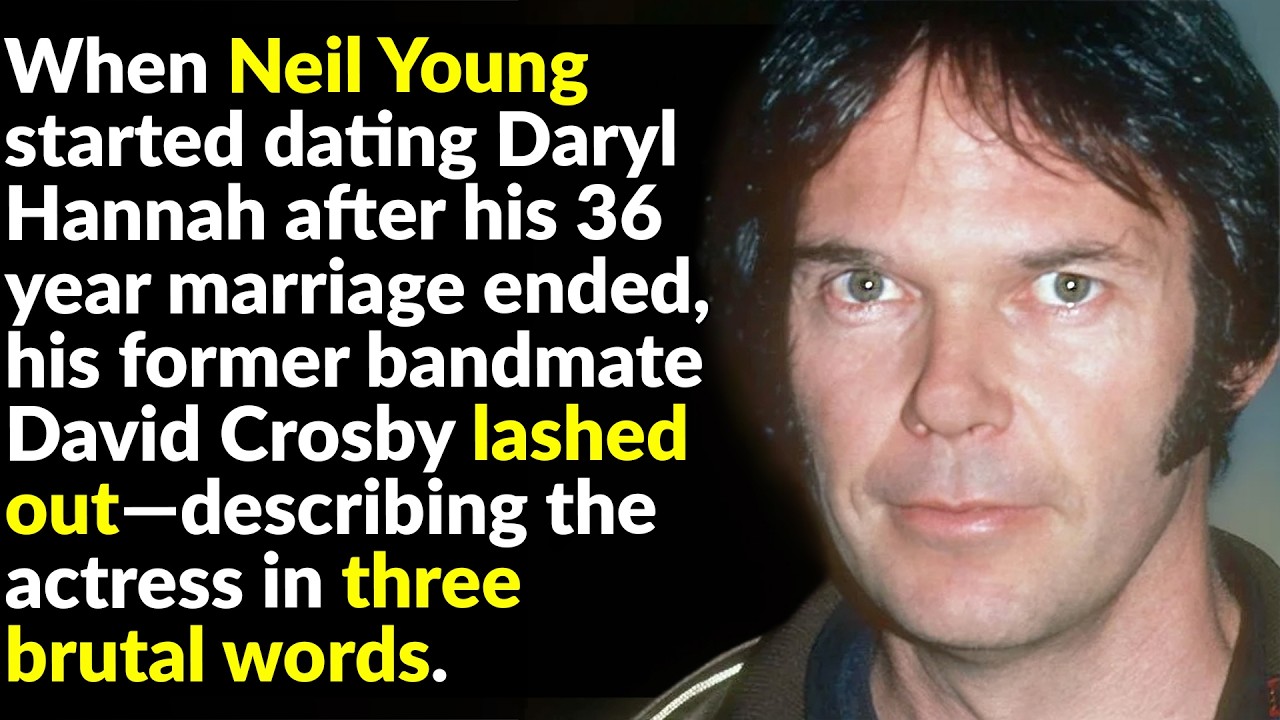
For decades, Neil and Pegi Young seemed unshakable. They weathered fame, illness, activism, and parenthood together, all while helping others by creating the Bridge School for kids with special needs. So when Young filed for divorce in 2014 after 36 years of marriage, it sent shockwaves through the music world.
Almost immediately, Young turned heads when he started dating actress and activist Daryl Hannah. Old friends weren’t impressed. David Crosby called her “a purely poisonous predator.”
But the couple bonded over activism and the environment. They quietly married in 2018, with Hannah bravely trading Malibu for a rustic cottage near Young’s childhood home in Omemee. Then in 2019, Pegi died after a battle with cancer.
Neil, as always, kept moving forward. It’s no surprise that the guy who wrote “Keep on Rocking in the Free World” was not afraid to take on big tech while in his 70s.
Young pulled his music from Spotify over pandemic misinformation and then from Amazon Music because of Jeff Bezos’s ties to the US government. While others chased streams, Young stuck to his principles, even though it cost him millions. Whether it’s protest songs that shook a generation, 35-minute feedback and noise odysseys, romantic yearnings that hit like a gut punch, or just nine minutes of Neil Young chanting “God mashed potatoes ain’t got no T-bone,” he never plays it safe.
As one wise fan put it, “It’s Neil. It’s a groove. Don’t overthink it.”
The man who burned everything to the ground just to see what the ashes look like is still standing, still rocking, and still refusing to fade away.