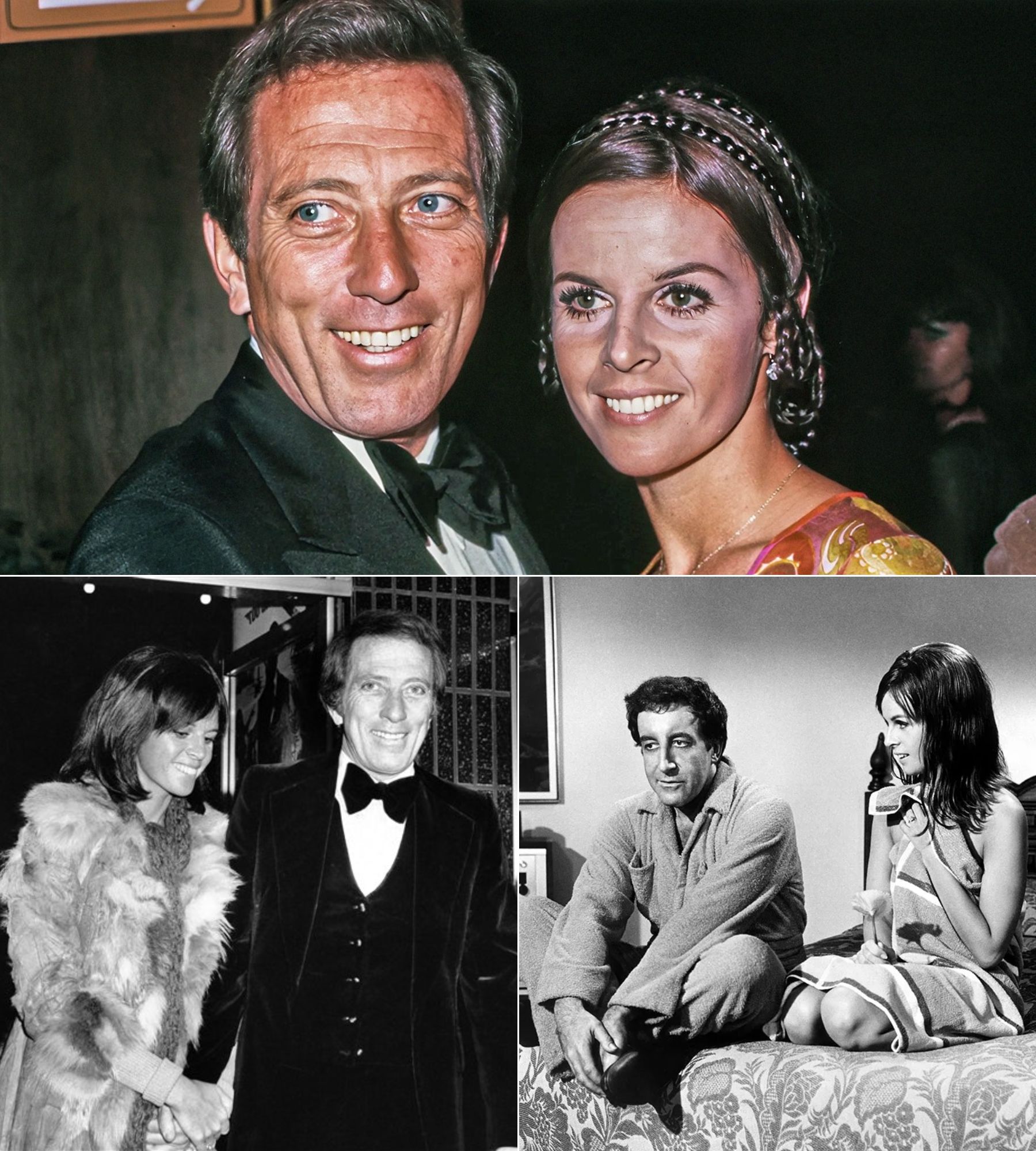
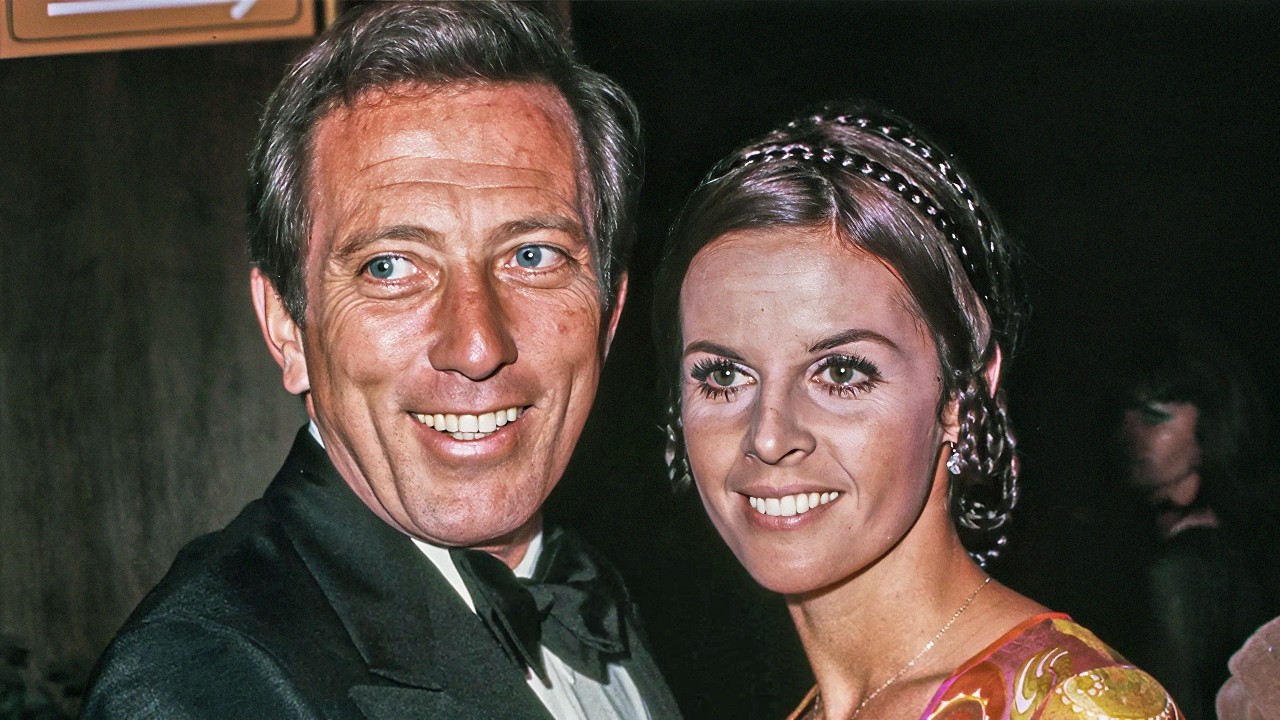
The public image of Claudine Longet and Andy Williams was one of Hollywood’s most glamorous unions, a fairy tale of fame, music, and celebrity friendships that captivated America. But behind the velvet curtains of their success, a series of painful and shocking turns would ultimately lead to a tragedy that has haunted the entertainment world for decades. The story of their lives, from a glittering rise to a devastating death, is a heartbreaking saga of ambition, love, and a single, catastrophic moment that changed everything.
Claudine Georgette Longet was born in Paris on January 29, 1942, long before her name became synonymous with one of the most controversial criminal cases of the 1970s. She was simply a young girl with a passion for performing, drawn to the world of entertainment from an early age. Dancing became her first gateway into show business, and as a teenager, she performed for tourists in Paris, learning how to captivate an audience.
 Those early performances seemed unremarkable at the time, but they opened a door that would completely alter her destiny.
Claudine eventually made her way into the American entertainment industry, not as an actress or singer, but as a dancer. That career path brought her to Las Vegas in the late 1950s and early 1960s, a city that was one of the biggest entertainment centers in the nation. Major hotels and casinos were constantly seeking performers, and international acts were a vital part of the scene.
Claudine became associated with the Folies Bergere at the Tropicana, a show that leveraged her French background. Her accent, appearance, and dancing helped her stand out in a world filled with celebrities and wealthy visitors.
Then she met the man who would change her life. According to the well-known account, Claudine was having trouble with her car when a man stopped to help her. That man was Andy Williams, an established singer from Iowa who had grown up performing with his brothers before launching his own successful career.
By the time he met Claudine, he had built a strong reputation as a recording artist. They came from vastly different backgrounds, but they were attracted to each other, and their relationship developed quickly. On December 15, 1961, Claudine and Andy married.
She was 19 years old. He was 33.
Marriage to Williams immediately placed Claudine closer to the center of American show business. It also coincided with a pivotal moment in Williams’ career. In 1962, he performed “Moon River” at the Academy Awards, a song closely associated with the film Breakfast at Tiffany’s.
His performance helped strengthen his standing as one of the country’s leading entertainers. Soon, another major opportunity arrived: his own television program, The Andy Williams Show. The show became a cornerstone of his career, introducing him to millions of American viewers.
For Claudine, being married to such a successful performer brought her into an extraordinary social and professional environment. She met major entertainers, appeared alongside her husband, and gradually became recognizable to television audiences herself. But there was more to their relationship than celebrity appearances.
Claudine and Andy were building a family, eventually having three children: Noelle, Christian, and Robert. For Claudine, this meant balancing motherhood with her growing interest in entertainment. She was no longer just the young dancer from France; she was a wife, mother, and increasingly visible public figure.
While Andy’s career continued to rise, Claudine began developing ambitions of her own. She wanted to act, sing, and prove she could build an identity beyond being Andy Williams’ wife. Her early acting opportunities came through television, with guest roles on shows like McHale’s Navy, 12 O’Clock High, The Name of the Game, and Hogan’s Heroes.
These were not major starring roles, but they allowed her to gain experience and become known for her own work. Claudine was also interested in music, and that opportunity arrived in an unexpected way.
In 1966, she appeared on the television series Run for Your Life, performing a song that caught the attention of Herb Alpert, the musician and record executive who helped build A&M Records. Alpert saw something in Claudine that went beyond her connection to Andy Williams, offering her a recording contract. This became an important turning point.
Claudine began releasing music that fit the softer pop sound of the period, incorporating French and bossa nova influences. Her style was quieter and more relaxed, and she developed a catalog of her own, including albums like Claudine, The Look of Love, Love is Blue, and Colors.
Her acting career received a major boost when she was cast in Blake Edwards’ 1968 comedy, The Party, starring Peter Sellers. Claudine played Michelle Monet, a French actress who becomes involved with Sellers’ character. The movie gave her considerably more exposure and placed her alongside one of the biggest comedy stars in Hollywood.
The Party did not turn her into a major star, but it gave her another important credit at a time when her career was expanding in several directions. She had television work, music releases, and a notable film role.
Away from her career, Claudine and Andy became close to some powerful people, including Robert F. Kennedy and his wife, Ethel. The two couples spent time together socially, and the relationship became personal.
That friendship became painful in June 1968. On June 5th, Claudine and Andy were at the Ambassador Hotel in Los Angeles when Robert Kennedy was shot after winning the California Democratic presidential primary. They rushed to Good Samaritan Hospital, where Kennedy was being treated, but he died from his injuries the following day.
The tragedy affected them deeply, and they later named their third son Robert in his honor.
Yet, while Claudine’s professional life was expanding and the couple appeared to have a successful family, their marriage was beginning to weaken. Andy’s career demanded much of his time, and his television and music commitments frequently kept him away from home. Williams later acknowledged that his career played a role in the breakdown of their marriage, admitting that he and Claudine had simply grown apart and regretting not taking better care of the relationship.
They separated in 1970 and eventually divorced in 1975. Despite the end of their marriage, they remained connected through their children.
 After her marriage to Andy Williams ended, Claudine Longet entered a very different part of her life. She became involved with a man from a completely different world: Vladimir “Spider” Sabich, a well-known American alpine skier who had competed for the United States at the 1968 Winter Olympics. Sabich had built a successful career in skiing and had become one of the most recognizable athletes in Aspen, Colorado.
He was young, athletic, and financially successful, and his lifestyle was closely connected to the ski culture that made Aspen famous.
Longet met Sabich in 1972 at a celebrity ski race at Bear Valley, California. The two quickly became interested in each other, and their relationship soon became serious. Longet eventually brought her three children into her new life with Sabich.
For Claudine, this was a major change. She had spent years living in the entertainment industry, but Aspen was very different. Her new home was centered around skiing, outdoor activities, and a much quieter social environment.
Sabich had a very different background, built around competition and independence.
At first, everything appeared to be going well. Longet had found a new partner, her children were living with them, and the couple were establishing a life together in Aspen. But as time passed, questions began to emerge about the condition of their relationship.
Longet maintained that they were in a good relationship, but the prosecution later presented a very different picture. Investigators became interested in Longet’s diary, which they believed contained information suggesting that the relationship had become troubled. There were also reports that Sabich was considering ending the relationship.
Then came March 21, 1976. That afternoon, Sabich was at the couple’s home in Aspen, preparing to take a shower. Longet entered the bathroom carrying a .
22 caliber pistol. What happened next would become one of the most disputed moments in the entire case. The gun fired, striking Sabich in the abdomen.
He was seriously wounded and lost a significant amount of blood. He was placed in an ambulance and taken toward the hospital, but his injuries were too severe. Sabich died from blood loss before he could reach the hospital.
He was only 31 years old.
Longet immediately became the focus of the investigation. There was no question that she had been present when the gun went off. The major question was whether she had intentionally shot Sabich or whether the shooting had truly been an accident.
Longet gave investigators an explanation that would remain at the center of the case. She said Sabich had been showing her how to use the pistol. According to her account, she was handling the gun while he was demonstrating how it worked when it accidentally discharged.
That explanation became the foundation of her defense.
Investigators and prosecutors were not convinced. One of the biggest problems involved Sabich’s position when he was shot. The physical evidence raised questions about whether his position matched Longet’s description.
Prosecutors argued that Sabich was several feet away from Longet and was bent over with his back toward her when the gun fired. That detail mattered. If Sabich had actually been demonstrating how to use the weapon, prosecutors questioned why he would have been positioned in that way.
They argued that the physical evidence did not fit neatly with Longet’s story.
There were also questions about why Longet had the pistol in the bathroom in the first place and exactly what happened during those final moments. The investigation centered on a series of unanswered questions: Why was Longet holding the pistol? Why was Sabich standing where he was when the gun went off?
Was he really teaching her how to use the weapon? Was their relationship already falling apart? And most importantly, what happened between the moment Longet entered the bathroom and the moment the gun fired?
Those questions would follow Claudine Longet for the rest of her life.
 One of the most surprising parts of the entire case was Andy Williams’ reaction to what happened. By the time Spider Sabich was killed, Williams and Claudine Longet were no longer married. They had separated years earlier, and their divorce was finalized in 1975.
Yet when Claudine was facing a serious criminal charge, Andy did not simply walk away. Williams traveled to Aspen and supported his former wife. He also helped arrange and pay for her legal defense.
Most importantly, he stood by her claim that the shooting had been an accident.
That decision was significant. Williams had spent years building a carefully managed public career. He was one of the biggest names on American television, and his friendly, clean-cut image was closely connected to his success.
Now, his former wife was at the center of a highly publicized shooting case. Supporting her meant becoming connected to the controversy himself, but Williams apparently believed that Claudine had not intentionally killed Sabich. Whatever had happened between them during their marriage, he was willing to help her when she faced the possibility of spending years in prison.
Meanwhile, prosecutors were preparing their case. Longet had initially faced a manslaughter charge, and prosecutors wanted to challenge her explanation that the gun had accidentally fired while Sabich was showing her how to use it. They had several pieces of evidence they believed could raise serious questions about her story.
Two of the most important were Longet’s diary and evidence from toxicology testing. Authorities had obtained blood and urine samples from Longet after the shooting, and the results were potentially damaging. Investigators had also obtained her diary, which they believed contained information about the condition of her relationship with Sabich.
But there was a major problem. The investigation had not been handled properly. The diary could no longer be used in the way prosecutors had hoped.
The toxicology results were also removed from the case. Evidence that might have helped prosecutors challenge Longet’s credibility or provide information about her state of mind was therefore no longer available to them in the same form. The problems did not end there.
Investigators also faced criticism over the way the pistol had been handled after the shooting. The firearm should have been treated as critical evidence from the beginning.
Instead, according to accounts of the case, one inexperienced officer wrapped it in a towel, placed it inside his glove compartment, and left it there for weeks. That was an extraordinary mistake in a case where the gun itself was at the center of everything. The weapon was potentially the most important physical piece of evidence in the investigation, yet its handling created questions about whether it had been properly preserved and whether investigators had followed the procedures expected in a serious criminal investigation.
As these problems accumulated, prosecutors found themselves in a difficult position.
They still had the death of Sabich. They still had the fact that Longet was holding the gun when it fired, and they still had serious questions about her explanation. But some of the evidence they had hoped would strengthen their case had been ruled inadmissible, while mistakes involving the firearm weakened the investigation further.
That left the physical evidence surrounding the shooting itself as one of the most important parts of the prosecution’s argument. The position of Sabich’s body became especially significant. According to the prosecution’s account, Sabich was several feet away from Longet when the gun fired.
He was also bent over and facing away from her. Prosecutors argued that this raised questions about Longet’s claim that Sabich had been demonstrating how to use the pistol. If he was actually showing her how to handle the weapon, prosecutors wanted the jury to consider why he would have been positioned that way.
But even this evidence had to be considered carefully. The shooting position created questions, but it did not automatically answer them. It was part of a larger dispute over what happened inside the bathroom, and the defense continued to maintain that the shooting was accidental.
The trial moved quickly. After only four days of testimony, the case went to the jury. What happened next surprised many people following the story.
The jury deliberated for roughly four hours, but the jurors did not convict Longet of the serious charge prosecutors had originally pursued. Instead, they found her guilty of the lesser offense of criminal negligence. Longet was ordered to pay a $250 fine and received a 30-day jail sentence that she was allowed to serve on weekends.
She was also placed on probation. For the Sabich family and others who believed the shooting had been intentional, the sentence was difficult to accept.
A 31-year-old man had died from a gunshot wound, yet the woman who had fired the gun was facing only a short weekend jail sentence and a small fine. The verdict also created an important distinction that is sometimes lost when the case is retold decades later. Longet was not found innocent.
 She was found guilty of a lesser offense. At the same time, the jury did not accept the prosecution’s most serious case against her. The evidence and the legal problems surrounding the investigation had left enough uncertainty for the jury to reach a much less serious verdict.
For prosecutor Frank Tucker, the outcome remained deeply frustrating. In the end, the trial did not answer every question about what happened in that Aspen bathroom. The jury reached a legal decision, but the circumstances surrounding Sabich’s death remained disputed.
Longet continued to maintain that the shooting was accidental, while those who believed Sabich had been intentionally killed remained convinced that the full truth had never emerged. And the controversy was far from over, because what happened after the verdict would create another storm around Claudine Longet.
One of the first developments involved the man who had represented her during the trial, attorney Ronald Austin. Soon after the case ended, Longet and Austin became romantically involved. Their relationship quickly attracted attention because Austin was still married at the time.
He eventually left his wife and family to be with Longet. For people already angry about the verdict, this was another reason to criticize her. The situation was especially sensitive because Austin had just been part of the legal team that helped her avoid a lengthy prison sentence.
To many observers, the timing was shocking.
The relationship nevertheless continued. Longet and Austin eventually married in 1985, and they remained together for decades. But the Sabich family was not prepared to simply accept the criminal verdict and move on.
In 1977, members of Sabich’s family filed a civil lawsuit against Longet. Their goal was different from that of the criminal prosecution. The criminal case had already resulted in a conviction for a lesser offense, but a civil case gave the family another opportunity to seek accountability over Sabich’s death.
The lawsuit eventually ended in an out-of-court settlement.
The exact terms were not made public, and reports have stated that the agreement included confidentiality provisions concerning what Longet could say about the shooting and settlement. That restriction became particularly important in the years that followed. Longet had already faced enormous public attention during the trial, and now there was another reason for her to avoid discussing what happened inside the Aspen home.
Instead of returning to the entertainment business, she largely disappeared from public life. But the public did not completely forget her.
In 1978, the Rolling Stones brought her name back into the spotlight in an unexpected way. Claudine appeared among the famous women pictured on the cover of the band’s album Some Girls. The cover included images of several well-known women, and Longet’s appearance connected her once again to popular culture.
The band also recorded a song called “Claudine,” and its lyrics referred directly to the shooting of Sabich. The song was controversial enough that the band’s lawyers advised against including it on the original album. It eventually became available in connection with a later reissue of Some Girls in 2008.
For Longet, the episode was another reminder that even though she had stopped talking publicly about the case, other people could still keep the story alive. Meanwhile, she and Austin continued their life together in Aspen. There was something unusual about that decision.
Aspen was not simply the place where Longet had lived with Sabich. It was also where he had died. After the trial and the civil lawsuit, she remained in the same community and eventually spent decades there with Austin.
Her presence did not erase the memory of Sabich’s death. Some people in Aspen continued to associate her with the case even many years after the shooting.
At the same time, Longet made little effort to return to the career that had once made her famous. Her acting and recording work gradually became part of her past. She stopped being a regular presence on television and rarely appeared in public.
The woman who had once performed beside major stars and released records through A&M Records was now living a much quieter life. Her marriage to Austin continued away from the entertainment industry, and the couple maintained a relatively private existence. That privacy lasted for decades.
Then, in 2023, Longet and Austin made another major move. They sold their Aspen property for nearly $60 million. By then, Longet was in her 80s, and her life in entertainment was many years behind her.
The sale marked the end of a long chapter in Aspen. Longet and Austin eventually relocated to their home in Hawaii, where they could live farther away from the attention that had followed her since the 1970s. For much of the public, Claudine Longet had become almost impossible to separate from the events of March 1976.
She had once been a dancer, actress, and recording artist who was married to Andy Williams. But after Sabich’s death, that career largely disappeared behind the legal case. She spent the rest of her life refusing to publicly revisit many of the details surrounding the shooting, while the settlement and the passage of time kept the full story difficult to establish.
Yet another painful chapter was still ahead. Andy Williams, the man who had once shared so much of her life, would eventually face his own final years. And Claudine’s story would continue long after his death.