Shelley Duvall, the iconic actress whose ethereal presence and quirky charm defined a generation of cinema, has died at the age of 75 due to complications from diabetes, leaving behind a complex legacy of brilliance, trauma, and a hauntingly public battle with mental health. The news broke in July 2024, sending shockwaves through Hollywood and the global fan community who had long wondered what happened to the star of “The Shining” and “Fairy Tale Theater.” Duvall’s passing was confirmed by family members, who requested privacy during this difficult time, but the outpouring of tributes from writers, directors, and fellow actors has already begun, underscoring the profound impact she had on the film industry.
Her death marks the end of a tumultuous journey that saw her rise to fame, endure psychological torment on set, vanish from the public eye, and then reappear in a deeply disturbing television interview that raised more questions than answers.
 Duvall’s story began in Fort Worth, Texas, where she was born on July 7, 1949, to parents who were real estate brokers and cattle auctioneers turned lawyers. She was an artistic child, bursting with energy that often left chaos in her wake, earning her the nickname “Manic Mouse” from her mother. Despite her entertaining personality, Duvall never considered a career in entertainment, initially pursuing science with dreams of becoming a researcher.
But a gruesome moment in biology class, where she was forced to observe a vivisection of a monkey, shattered her resolve. Her gentle heart and stomach could not take it, leading her to abandon science for nutrition and diet therapy at South Texas Junior College. She then worked as a cosmetics saleswoman and model, leading a quiet life until a chance encounter in 1970 changed everything.
That year, Duvall married artist Bernard Samson and threw a party to showcase his work. Three crew members from director Robert Altman’s film “Brewster McCloud” attended, not for the art, but for Duvall herself. Fascinated by her unique look, boundless energy, and hyper enthusiasm, they devised a plan to introduce her to Altman and producer Lou Adler under the guise of art patrons.
Duvall collected paintings and presented them to the group, but Altman and Adler cared little for the artwork. They were captivated by her, dropping the ruse to ask if she wanted to be in a movie. Despite her misgivings, she posed for a Polaroid and gave them her contact details, unaware of what she was in for.
For the next six or seven years, Duvall worked almost exclusively with Altman, becoming one of his favorite collaborators. Her quirks, effervescent personality, and unique looks endeared her to audiences, but her marriage to Samson collapsed as her fame grew, ending in divorce in 1974. To advance her career, Duvall took acting lessons at the famed Actor’s Studio in New York, but she found the approach too analytical and technical, preferring her freewheeling spirit.
Her instincts were right; she was a natural in front of the camera. Her breakout performance came in 1977’s “Three Women,” another Altman film where she was allowed to ad lib most of her lines and even write her character’s diary entries. Film critic Andrew Sarris of the Village Voice compared her to a young Katharine Hepburn, and she won the Best Actress award at the 1977 Cannes Film Festival.
 Shortly after “Three Women,” Duvall met singer-songwriter Paul Simon in New York, and they lived together, but it was no fairy tale romance. In a 1981 interview with Cosmopolitan, Duvall recalled her time with Simon with sadness, feeling lost, bored, and depressed despite being surrounded by sophisticated, glamorous people. She gave up several career opportunities for Simon, including a role from Altman that caused a rift in their friendship.
Realizing she could not continue living like this, she introduced Simon to her close friend Carrie Fisher, and the two hit it off. Duvall then gave a tearful goodbye to Simon at the airport and headed off to star in Stanley Kubrick’s “The Shining.”
Her performance as Wendy Torrance in 1980’s “The Shining” would become one of her most enduring roles, but it came at a terrible cost. Kubrick wanted the best possible performance from her and pushed her past her breaking point. He isolated her on set from co-stars, and Jack Nicholson claimed Kubrick picked on her more than anyone else, often losing his temper and berating her.
Duvall revealed that filming was grueling, six days a week, 12 to 16 hours a day, with only half an hour for lunch, for a year and one month. The role demanded she be in hysterics all the time, and she often ran out of tears, walking around with a bottle of water to stay hydrated. Kubrick did not allow anyone on set to come to her aid when he pushed her to her limits or beyond.
In the documentary “Arena: Making The Shining,” Kubrick’s daughter Vivian said the director wanted Duvall to feel utterly hopeless. The infamous baseball bat scene required 127 takes, the most for any scene in film history, to exhaust her completely. The stress took its toll; Duvall complained of nervous exhaustion and physical illness, and she was shedding her hair in clumps.
 After filming wrapped, she went to Kubrick with the hair that had fallen out because of how he treated her. Despite her suffering, she did not receive praise from critics or audiences; she was nominated for a Golden Raspberry for Worst Actress, though the co-founders later retracted the nomination after learning what she endured. Duvall still liked and respected Kubrick, and he was impressed by her performance in the final film.
After “The Shining,” Duvall teamed up with Altman again for the 1980 film “Popeye,” playing Olive Oyl, a role she was born to play. In grade school, classmates had teased her and called her Olive Oyl. Critics panned the film, but they heaped praise on Duvall, with Roger Ebert writing that she was like a precious piece of china with a tinkling personality.
Duvall learned to love Olive Oyl and embrace their similarities, feeling she had more depth than any character she had ever played. She then switched gears, spending more time behind the camera producing and narrating children’s and young adult shows. In 1989, she met her longtime boyfriend Dan Gilroy, and she imagined a life far from Hollywood.
A devastating earthquake in 1994 rocked her Los Angeles home, prompting Duvall to return to her home state of Texas. By 2002, she had all but stopped working in the film and TV industry, disappearing from the public eye. But when she finally reappeared, her fans barely recognized her.
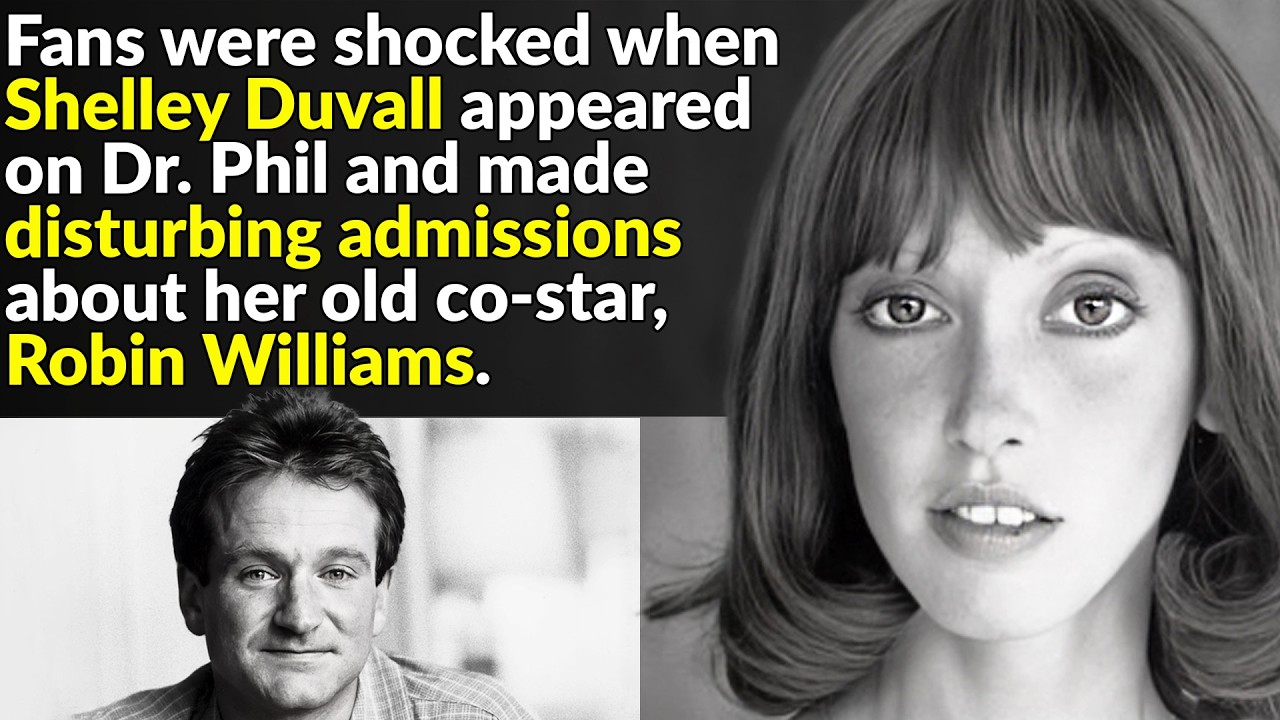
In 2016, Duvall agreed to appear on an episode of “Dr. Phil” about mental health, but she became the subject of the interview. During the show, a remarkably aged and unrecognizable Duvall made outlandish claims that had fans everywhere concerned.
 She claimed that her “Popeye” co-star Robin Williams, who had died two years earlier, was still alive and shape-shifting. She also stated that aliens had placed implants in her leg, that she was afraid of the Sheriff of Nottingham, and that hornets had attacked her spinal cord.
The shocking interview left audiences aghast, and the show received a flood of negative feedback. Duvall’s fans criticized the show for exploiting her at a vulnerable time. Vivian Kubrick, who had seen her suffering on the set of “The Shining,” rushed to her defense.
Something good did come out of the appearance; acclaimed director Lee Unkrich had been searching for Duvall for years to complete a book on the making of “The Shining.” Thanks to her reappearance, he tracked her down to a small town in Texas Hill Country. When he found her, Unkrich showed Duvall pictures from the set, and to his surprise, she was lucid and not at all how she had seemed on “Dr.
Phil.” She could converse for long coherent stretches and conjure up the slightest detail about her life and career, remaining proud of her accomplishments.
In October 2022, Duvall announced she was ending her 20-year retirement, making a comeback in the independent horror film “The Forest Hills.” She died in July 2024 due to complications from diabetes. The outpouring of tributes from writers, directors, and her fellow actors showed that despite her long absence, nobody had forgotten about Shelley Duvall.
Her work lives on, still being discovered by new generations and still being poured over by those who consider her performances to be the stuff of legend. The circumstances of her final years, marked by a disturbing public breakdown and a quiet resurgence, remain a poignant reminder of the fragility of fame and the human spirit. Her legacy is not just in the films she made, but in the conversations she sparked about mental health, exploitation, and the price of art.