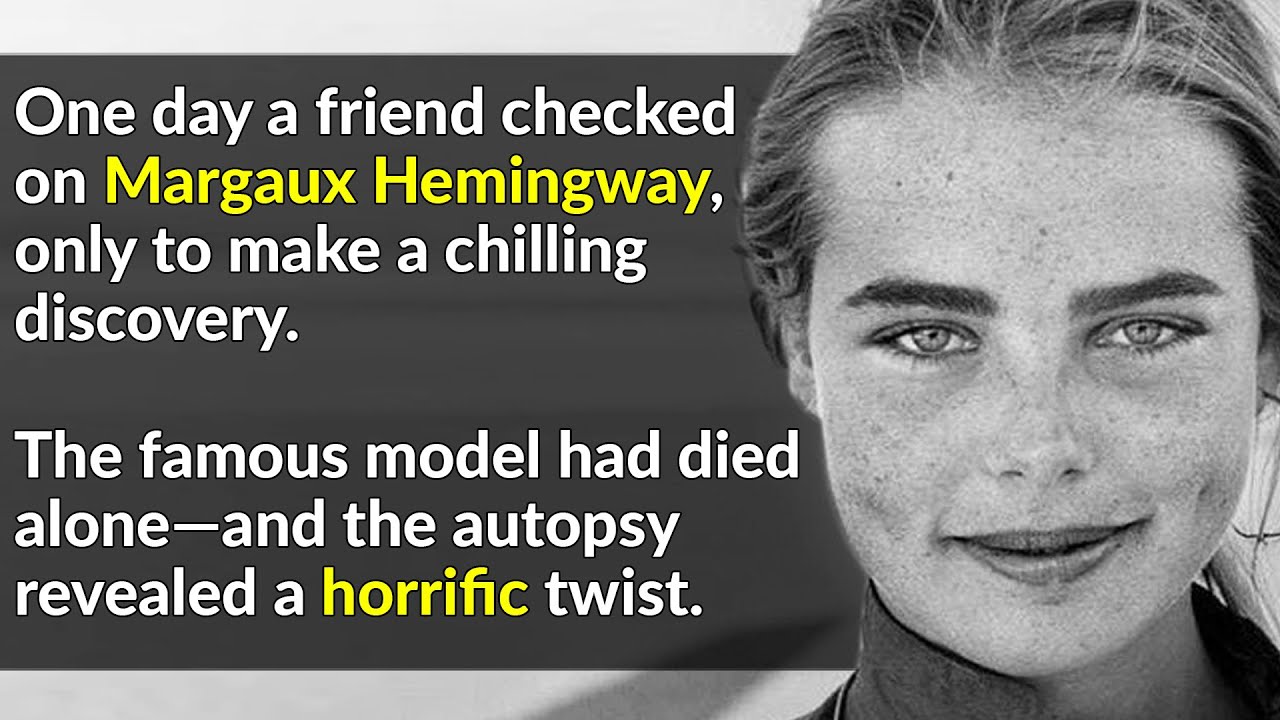
The body of Margaux Hemingway, the 41-year-old supermodel and actress who once commanded the covers of Vogue and redefined beauty in the 1970s, was discovered in her Santa Monica apartment on July 1, 1996, marking the latest and most devastating chapter in what has long been whispered as the Hemingway curse. Her friend, Judy Stabile, climbed a ladder to peer through a bedroom window after days of unanswered phone calls, finding Hemingway lying motionless on her bed, arms folded, still in her nightgown. The Los Angeles County coroner would later confirm that the granddaughter of literary giant Ernest Hemingway died from an overdose of phenobarbital, a barbiturate used to treat epilepsy, a condition she had battled for years.
The death was ruled a suicide, a tragic echo of the same fate that befell her grandfather in 1961, her half-sister Joan in 1984, and now, Margaux herself.
 The news sent shockwaves through the fashion and entertainment industries, where Hemingway had been a towering figure, both literally at six-foot-one and figuratively as one of the first supermodels to achieve global fame. But behind the glamour, there was a life marked by relentless personal demons, a family legacy of dysfunction, and a struggle for identity that began long before she ever stepped onto a runway. Margaux Louise Hemingway was born on February 16, 1954, in Portland, Oregon, to Jack Hemingway, the eldest son of Ernest Hemingway, and his wife, Byra Louise, known as Puck.
Growing up in the shadow of her grandfather’s literary genius was a burden that would shape her entire existence. The Hemingway name was a double-edged sword, a source of pride and a weight that crushed those who carried it.
The family was far from the picture-perfect image they projected. Margaux’s mother reportedly never fully loved her father, a rejection that was drowned in heavy partying and alcohol, leaving the children traumatized. By the late 1960s, the family had three daughters: Joan, Margaux, and Mariel, but the growing family only intensified the dysfunction.
The infamous Hemingway curse, a term used to describe the pattern of mental illness, addiction, and suicide that plagued the family, seemed to take root early. When Ernest Hemingway shot himself at the family farm in Ketchum, Idaho, in 1961, it sent shockwaves through the world, but the damage within the family was far deeper. Margaux was just seven years old, and the trauma would haunt her for the rest of her life.
Desperate to escape her hellish home life, Margaux turned to her looks as a ticket out. At just 14, she was already sneaking into local bars, using her striking appearance to gain entry, and drinking copious amounts of alcohol to numb her pain. According to her younger sister Mariel, Margaux was skipping school, partying at all hours, and engaging in attention-seeking behavior that was a cry for help.
By the time she was in her late teens, Margaux was dealing with a host of psychological issues, including depression, bulimia, and epilepsy. The partying was a temporary escape, but it never made her feel better. She was a young woman drowning in a sea of unresolved pain, and no amount of alcohol could save her.
In her late teens, Margaux decided to pursue a modeling career, moving to New York City, the epicenter of the fashion world. While her famous name certainly helped open doors, it was her ethereal beauty and charisma that made her an instant standout. By the early 1970s, she had ascended to international stardom, becoming one of the world’s most sought-after supermodels.
Her face graced the covers of prestigious magazines like Vogue and Elle, and she became the epitome of 1970s glamour. The fashion industry had found its new muse in Margaux, but the industry’s relentless pursuit of perfection took a toll on her self-esteem and mental health. She struggled with eating disorders, a painful secret that haunted her throughout her life, as she tried to conform to unrealistic beauty standards.
But the industry was not the only predator in her life. At 19, Margaux caught the eye of Errol Wetson, a wealthy middle-aged restaurant heir. Their chance meeting turned into a whirlwind romance, and after just four months, she moved into his Manhattan apartment.
Wetson quickly assumed the role of her manager, dictating what she could wear and critiquing every imperfection in her body, preying on her obvious insecurities to control her. The relationship was deeply disturbing, as Margaux later admitted. Her heavy drinking only worsened, and in a state of constant hazy hangovers, she decided to marry her controlling lover in 1975.
The marriage did not make anything better, and by 1978, the couple had divorced.
 While her personal life floundered, Hemingway’s career hit an all-time high. In 1976, she made her film debut in the controversial movie Lipstick, which delved into themes of sexual assault and violence. She played the lead role of Chris McCormack, and her performance, marked by its intensity and vulnerability, garnered both praise and criticism.
But the film also led to one of her depressive bouts, as critics largely tore apart her acting style and compared her unfavorably to her younger sister Mariel, who played her on-screen sibling. The sibling rivalry that had always simmered beneath the surface exploded into full-blown competition. Mariel’s star power took off, and Margaux’s response was self-destruction.
She descended deeper into substance abuse, and her relationship with Mariel took on adult dimensions of jealousy and resentment.
To distract herself, Margaux entered another relationship, marrying Venezuelan director Bernard Boren Fuche in 1979. They moved to Paris, living a glamorous life, but the escape was temporary. Margaux’s personal struggles were a reflection of the complexities and challenges faced by those who carry the Hemingway name.
She turned to not only alcohol but illegal substances as a coping mechanism. Throughout her life, she battled alcoholism and addiction, and her attempts to escape the pressures of her career and the burdens of her family history pushed her into a perilous cycle of substance abuse. These issues strained her relationships and took a significant toll on her physical and mental health.
In 1984, Margaux’s life was dealt a devastating blow when her half-sister Joan died by suicide. This tragic loss compounded Margaux’s own mental health struggles, deepening the emotional wounds she carried. It served as a stark reminder that even those who seemingly have it all can grapple with inner demons and profound sadness.
Despite her personal struggles, Margaux continued to pursue her acting career, appearing in films like Killer Fish and Double Obsession. While her acting career did not reach the same heights as her modeling success, it demonstrated her resilience and determination to overcome adversity.
In the 1980s, Hemingway tried to take another stab at Hollywood, working on the 1982 comedy They Call Me Bruce and the ensemble romantic comedy Over the Brooklyn Bridge. Although these projects did not get the attention she was hoping for, it seemed like things were back on the right path. But the curse was relentless.
Margaux got into a horrific crash while skiing in Austria, and her injuries debilitated her for nearly a year. Her recovery caused her to gain 75 pounds, pushing her weight to almost 200 pounds. For someone who had struggled with body image issues her entire life, this was enough to send her over the edge.
In later years, Margaux became an advocate for mental health awareness, using her platform to show the challenges she and her family had faced. But nothing much could survive in her head and heart at this point. Her second marriage crumbled in 1985, and she struck out into single life, trying to scrape by on her own.
 All this did was push her further into a downward spiral from which she would not escape. She became so mentally crippled that she was forced to admit something for the first time in her life: she needed professional help. In 1987, she checked into the famous Betty Ford Center, but it seemed like a temporary Band-Aid to a bigger problem.
While it helped with her addiction, it did not address the underlying issues of her mental illnesses.
When Margaux came out of the center, she looked and acted the part of a changed woman. She had her body back, or as society would call it, she was supposedly healthy. She was so sure that now that she had done all this work on herself, her second comeback would be a snap.
But deep down, she put too much unrealistic pressure on herself, and when this did not come to fruition, her depression came barreling back. The worst part was not having a support system. She never had a good relationship with her parents.
Her mother had been almost completely estranged from her since Margaux started booking regular acting gigs. It would take another tragedy to bring them back together. Hemingway’s mother was diagnosed with cancer, and in 1988, at almost the last moment possible, the mother and daughter finally reconciled.
But Puck passed shortly after, and Margaux was down one more loved one.
In the wake of her mother’s passing, Hemingway nabbed a part in the French film Love and C Minor, but it barely made any noise. No one in Hollywood was calling, so Margaux thought she would take matters into her own hands and get the attention she so craved, even in a negative light. In the spring of 1990, she posed nude for Hugh Hefner in Playboy.
Whispers spread fast that she was off her rocker, yet not one soul thought to seek her help. Her oddities were waved off with affection, but that was a fatal mistake. Margaux had just moved to a small apartment in Santa Monica, California, and the tight-knit community of friendly and caring neighbors could have been just the thing she needed to get her life back on track.
But the curse would not let her have peace.
Within days of Hemingway moving into her new place, her neighbors began noticing disturbing signs. One neighbor who talked to her just outside her apartment said she was troubled and looking very haggard. No one was quite sure how to take this, and only one of her old friends saw it for what it was.
 Margaux’s longtime friend Judy Stabile had witnessed a strange series of mood changes and tried to check in on her daily. But in the last week of June, Hemingway stopped returning her calls entirely, pushing Stabile to make a visit in person. Regretfully, it was a bit too late.
When Judy pulled up to Margaux’s apartment that fateful day, she could see the model’s car in the driveway, but no one was answering the door. She had a sinking feeling that something was terribly wrong. In desperation, she grabbed a nearby ladder and looked in through the bedroom window, where she could see her friend lying motionless on her bed, still in her nightgown, with her arms folded as if she could wake up at any moment.
Only she wouldn’t and couldn’t. Although she phoned emergency services right away, there was nothing they could do to bring back her dear friend. It became evidently clear that she had passed away through the night.
The autopsy results on Margaux’s body were initially inconclusive, but when the toxicology report came in, it showed that Hemingway had overdosed on phenobarbital. The Hemingway curse had caught up to her after all. After sinking into another depression, she had ended her own life.
At first, Margaux’s sister Mariel was in complete denial and refused to believe that her sister had taken her own life. When the news of her passing broke to her father and her stepmother Angela, they apparently received it with cold stoicism and did not say much. Whether they knew the curse was real or not, or maybe it was because of Margaux’s history that they knew it was sadly bound to happen, the news of Margaux Hemingway’s reported suicide made waves and was heavily reported on, breathing life into the curse once more.
The Hemingway curse, often cited as an example of a familial pattern of suffering and tragedy, has garnered significant attention over the years. While it is crucial to approach such claims with caution, there are undeniable patterns of mental health struggles within the Hemingway family. This raises questions about the role of genetics, environment, and the interplay between the two in shaping the destinies of family members.
Although her grandfather Ernest had the most infamous passing when she was just a child, an incredible number of Margaux’s relatives perished the same way as the years passed by. A total of seven, including Margaux herself, have died by suicide. Whether there really is a curse or it is something ingrained in their DNA, the pattern is undeniable.
Margaux Hemingway’s life was a poignant tale of beauty, fame, and tragedy. Her rise to international stardom in the world of fashion and modeling showcased her talent and charisma, yet her personal struggles with addiction, depression, and the weight of her family’s name cast a shadow over her remarkable journey. In remembering Margaux Hemingway, we are confronted with the fragile nature of human existence and the importance of empathy and understanding in the face of mental health challenges.
While the Hemingway curse remains a subject of debate, Margaux’s story emphasizes the need for open conversations about mental health and the significance of breaking the silence that often shrouds these issues. Margaux’s legacy is not defined solely by tragedy but by her resilience, determination, and advocacy in the face of adversity. Her life serves as a lesson that even in the face of the most daunting challenges, one can find the strength to make a lasting impact and raise awareness about issues that affect us all.