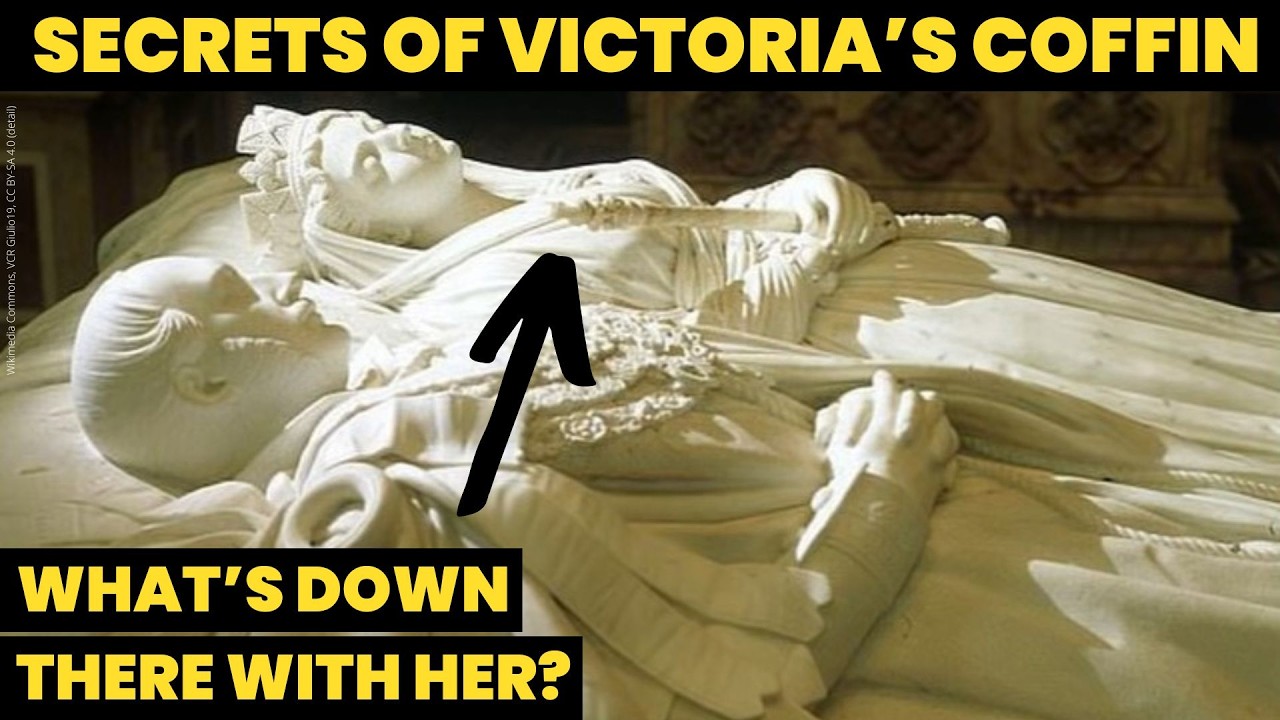
LONDON, England — The final secrets of Queen Victoria’s coffin have been revealed, exposing a cache of sentimental treasures, scandalous mementos, and a gruesome practical necessity that forced her inner circle to operate in stealth. The monarch, who died of a cerebral hemorrhage at Osborne House on the Isle of Wight at 6:30 p. m.
on January 22, 1901, at the age of 81, left behind a meticulously detailed list of items she demanded be buried with her. The instructions, drawn up on December 9, 1897, just over three years before her death, read like a inventory of a lifetime of devotion, grief, and control, and they have now come to light through a detailed eyewitness account from those who carried out her final wishes, keeping them secret from the wider royal family.
 The document, written in Victoria’s own hand, specifies a white silk or cashmere dress, a cap and white veil over her face, and a staggering array of rings, lockets, and photographs. She insisted on wearing her wedding ring, a diamond guard ring given by her beloved husband Prince Albert immediately after their marriage, and an engagement ring with an emerald in the head of a golden snake, gifted by Albert on October 15, 1839. She also demanded an oxidized silver ring with Albert’s enamel, a small green enameled ring that was his first gift to her on May 24, 1836, and a gold ring with three turquoises and two diamonds from her dearest sister.
The list continued with a ring of five Scotch pearls from her daughter Louise, a small gold ring with three pearls and small diamonds from her darling child Beatrice, and a plain gold wedding ring that had belonged to the mother of her valued servant John Brown, which she had worn constantly since his death.
The most scandalous items, however, relate directly to John Brown, the Scottish servant who became a constant companion after Albert’s death in 1861. Rumors of a secret marriage between Victoria and Brown have long circulated, and the Queen’s demands have done nothing to dampen that speculation. She ordered that a painted profile photograph of Brown in a leather case, along with some of his hair, be placed in her hand.
She also requested that a pocket handkerchief of her dearest husband and a pocket handkerchief of her faithful Brown, who she described as more devoted to her than anyone, be laid on her body. The inclusion of Brown’s mother’s wedding ring, which she had worn constantly since his death, elevated his status almost to that of Albert, a move that shocked even those closest to her.
The coffin itself required a macabre solution to a pressing problem. Victoria had left firm instructions that she was not to be embalmed, meaning her body would begin to decompose rapidly. To manage this, the coffin was packed with a layer of charcoal one and a half inches thick to soak up moisture and control odor.
The delay in getting her into a sealed coffin, which took until the morning of January 25, nearly two and a half days after her death, made this essential. Sir James Reid, her doctor, reported that there was no smell, likely due to the January cold and the flowers arranged around her corpse, but the charcoal was a grim necessity.
The eyewitness account comes from Lady Reid, wife of Sir James Reid and formerly a maid of honor to the Queen. In a letter to her sister-in-law, she described seeing Victoria lying in her bed on January 23, writing that her face was like a lovely marble statue, with no sign of illness or age, and that she still looked the queen, her wedding veil over her face and a few loose flowers on her bed. On January 24, Sir James Reid, along with two attendants, Mrs.
Tuck and a nurse, dressed the body in a satin dressing gown with a garter ribbon and star, cut locks of Victoria’s hair as mementos for family and friends, and arranged flowers around her.
The most dramatic moment came on the morning of January 25, when the coffin was finally prepared. Sir James Reid wrote in his private diary that he went to the Queen’s room at 9:30 a. m.
and arranged with Mrs. Tuck and Miss Stewart to put on the floor of the coffin, over the layer of charcoal, the various items: a dressing gown of Prince Albert, a cloak of his own embroidered by Princess Alice, a plaster cast of Albert’s hand, and numerous photographs. These were hidden by a quilted cushion made to fit the shape of the coffin, creating a secret compartment that disguised everything beneath the body.
This double-bottom design allowed the items to be placed without the royal family knowing, as Reid and the attendants worked in stealth.
Reid then described the physical act of moving the body. He got Woodford and his men to move the shell to the side of the Queen, on the same level as the bed. He sent them out into the adjoining dressing room, and the Princess of Wales, later Queen Alexandra, and the King remained alone in the room for a few minutes, with Alexandra laying flowers on the body.
Then Reid brought in the Emperor of Germany, the Duke of Connaught, Prince Arthur of Connaught, Mrs. Tuck, Mrs. Stewart, and Ticking, along with Woodford, Scott, and Spencer.
They lifted the Queen into the coffin, with Reid and Mrs. Tuck taking the head, Mrs. Stewart and Ticking the feet, and the King, Duke of Connaught, Emperor, and Prince Arthur handling the straps.
 After the royalties left, Reid, Mrs. Tuck, and Mrs. Stewart arranged the Queen’s dressing gown, veil, and lace, then packed the sides with bags of charcoal in muslin.
Finally, Reid placed in the Queen’s left hand the photograph of Brown and his hair in a case, according to her private instructions, wrapped in tissue paper and covered with Queen Alexandra’s flowers.
The fact that 10 people were required to lift Victoria, who was barely five feet tall, is remarkable, but it underscores the weight of the coffin and the ceremonial importance of the moment. Among those involved were King Edward VII, Kaiser Wilhelm II of Germany, Prince Arthur, and the Duke of Connaught, all of whom participated in depositing the Queen into her coffin. None of them noticed the objects surreptitiously placed in her hands, a testament to the skill and discretion of Reid and the attendants.
The coffin itself was a Russian doll of layers. The first Oak shell was placed inside another of lead, and then a final outer one of Oak, together weighing half a ton. It was transported back to the mainland, and a funeral service was held at St.
George’s Chapel at Windsor. Finally, on February 4, 1901, the Queen was laid to rest next to her beloved Albert in the mausoleum at Frogmore, within the security cordon of the Royal Estate. The combined coffins of Victoria and Albert remain a literal treasure trove, filled with gold, precious stones, and sentimental items that would be the stuff of dreams for any grave robber.
The list of items Victoria requested reveals her priorities with stark clarity. The clothing echoed a wedding dress, all white and including a veil, which she had popularized after her own nuptials in 1840. It also reflected her general requirement that her funeral be white, not black, with the pole on her coffin and even the horses pulling her remains to be that color.
Her biographer Christopher Hibbert attributes this to a conversation with Lord Tennyson, who had expressed a preference for white over black funerals. The many items belonging to, gifted by, or depicting Prince Albert are not surprising for anyone familiar with their story. Victoria had been devoted to her husband, who died prematurely in 1861, and she spent the rest of her life in mourning for him, still having Albert’s clothes and dish of shaving water laid out as though he were alive.
The number of items relating to him was over the top, and she sought to mirror the contents of his own coffin by ensuring they were buried with nearly matching rings.
The many things relating to her children and grandchildren were excessive but also show favoritism. Princess Beatrice was name-checked three times in the document, even granted the special favor of choosing which brooch her mother would wear in death. Princess Louise got one name check, and the other seven were not individually named, though Princess Alice was particularly remembered when it came to the cloak embroidered by her.
Victoria’s attitude to her own mother, the Duchess of Kent, had been fraught throughout much of her life due to the obsessive control the Duchess had exercised over her young daughter, but relations had improved by the time she died in March 1861. Victoria’s references to her dearest mother suggest she had found a way to remember her fondly. The order to place a piece of Balmoral Heather in the coffin demonstrates her great love for this Scottish castle, which remains a favorite summer holiday retreat for her descendants to this day.
The items relating to John Brown have sparked the most interest. The Scotsman had been a great favorite after Albert’s death, and the rumors of a secret marriage have persisted. The fact that she wanted his picture, hair, handkerchief, and his mother’s wedding ring in or on her hands, giving him a status almost as high as Albert’s, has done nothing to dampen the speculation.
The relationship was represented on screen in the film Mrs. Brown, starring Judi Dench and Billy Connolly, which cheekily explored the bond.
What did Victoria get out of demanding all this paraphernalia be buried with her? She was a lifelong Anglican and head of the Church of England, a woman who believed she would go to heaven and be with her lost family members and friends, eventually joined by those she left behind. She had even hoped in the immediate aftermath of Albert’s death that she would not long outlive him so they could be together again.
 Unlike the ancient Egyptians, who believed the mortal body would be important in the afterlife and went to great lengths to preserve it, Victoria did not seem to have any such belief. There was no embalming, and she will have decomposed very quickly. Many of these items were going to be destroyed by being buried with a decomposing corpse.
The best answer is a kind of cognitive dissonance, where she believed on one hand that her dead body would be of no use to her anymore, yet on the other drew comfort during her life from imagining her corpse, later skeleton, later dust, being surrounded by all these items. It does not really make sense, but there you go.
She may have viewed it as a last act of loyalty to all those she loved, so she could meet them in the afterlife and tell them she had not failed in her devotion even at the very end. Perhaps she also had at the back of her mind the performative aspect of monarchy. A high-ranking royal is always watched, and their every action dissected.
Even death was a kind of performance, and despite the private nature of her request, she may have anticipated that the list of items placed in her coffin would eventually become public and wanted to ensure she was buried in a suitably majestic manner. Last but not least, for a woman who was rarely told no after the age of 18 when she came to the throne, this obsessive planning for the contents of her own coffin may have given her a sense of control that she was by then much used to and not prepared to relinquish even in death.
Her demands were very much in character in another way too. The intense sentimentality she showed in having mementos of pretty much all her immediate relations plus some valued friends is very much in line with Victoria’s general attitude to death. She had always had a fascination with its rituals, even as they pertained to her dogs, which got lead coffins and posthumous statues.
She enjoyed visiting graves and tombs, even in an era when wearing mourning for deceased relatives and keeping locks of their hair, often placed into jewelry such as mourning rings, was very common. Victoria’s obsession with the afterlife, or rather with how the deceased were remembered by the living, was quite extreme. Even the way she wrote out the list is telling.
It was not necessary to explain when certain items had come into her possession or when certain people had died, but she did it anyway, and we can sense her reliving the memories associated with those objects as she wrote out their descriptions. She simply could not switch that strong sentimental streak off, nor could she ever loosen her grip on those who had died before her, especially Albert. To do so in her mind would have suggested that she did not love them.
Her requests for her coffin goods were slightly ridiculous given the size it would be. She was barely five feet tall, and her expectation that some of the contents be kept private, at least at the time of her burial, immediately caused headaches for those who had to try to enact them. In the week of her death, Sir James Reid spoke with Mrs.
Tuck, who read him the Queen’s instructions about what the queen had ordered her to put in the coffin, some of which none of the family were to see. As she could not carry out Her Majesty’s wishes without his help, she asked him to cooperate. The doctor agreed to do so and to be as discreet as possible, but he wrote what was done in his private diary, and when it eventually came into the public domain, it revealed how the stuffing of Victoria’s coffin with enough trinkets to open a fully stocked souvenir store had been accomplished without the royal family realizing, thereby keeping her final wishes secret from them.
The diary entry for January 25, 1901, also includes details of some extra items she had asked to be buried with. It says that at 9:30 a. m.
, he went to the Queen’s room and arranged with Mrs. Tuck and Miss Stewart to put on the floor of the Queen’s coffin, over the layer of charcoal one and a half inches thick, the various things: dressing gown of Prince Consort, cloak of his own embroidered by Princess Alice, the Prince Consort’s plaster hand, numerous photographs, etc. , which Her Majesty had left instructions with them to put in.
Over these was laid the quilted cushion made to fit the shape of the coffin, so that it looked as if nothing had been put in. This suggests that the coffin was comparatively deep and helps to explain how everything could be fitted in with enough room left over for the remains.
The reference to the cloak embroidered by Princess Alice is particularly moving. Alice had predeceased her mother and had actually died on the anniversary of Albert’s death in 1878. The plaster cast of Albert’s hand was something that Victoria had slept with on many nights since his death and which always brought her great comfort.
 It was also the inspiration for this whole revelation, as a reference to it being in her coffin sent researchers down the rabbit hole of investigating her coffin contents.
Reid explained what happened next, writing that he then got Woodford and his men to move the shell to the side of the queen and on the same level as the bed on which she was lying. He sent them out into the adjoining dressing room. The Princess of Wales, whom he sometimes calls the princess and sometimes the queen, and the King remained a few minutes alone in the room, and the queen, this is Alexandra, laid some flowers on the body.
Then he brought in the Emperor of Germany, the queen having gone out, the Duke of Connaught, Prince Arthur of Connaught, Mrs. Tuck, Mrs. Stewart, and Ticking, Woodford, Scott, and Spencer.
They lifted the queen into the coffin, Mrs. Tuck and he taking the head, Mrs. Stewart and Ticking the feet, the king and Duke of Connaught, the emperor and Prince Arthur the straps laid under the body on the left over the coffin, and Woodford, Scott, and Spencer on the bed on the right side of the body.
Then all the royalties went out, leaving Mrs. Tuck, Mrs. Stewart, and Ticking with him, and they arranged the Queen’s dressing gown, the veil, and the lace.
Then he packed the sides with bags of charcoal in muslin and put in the Queen’s left hand the photo of Brown and his hair in a case according to her private instructions, which he wrapped in tissue paper and covered with Queen Alexandra’s flowers.
The detail about who moved the body is fascinating. Nowadays, one would expect that the hired help would do this or the Queen’s personal servants at the very least. It seems remarkable that included in the group depositing her in her coffin were Edward VII, Kaiser Wilhelm II of Germany, Prince Arthur, and the Duke of Connaught.
It also seems a little much that 10 people were required to lift her. She was known to be overweight, but she was also only about five feet tall, and she lost some of her weight during her final illness. After all this was done, the various assembled members of the royal family came back in for a final look at Victoria, none of them apparently noticing the objects surreptitiously placed in her hands.
Reid managed to hide them so well and so fast, a feat that likely required immense nerve given that Edward VII and Kaiser Wilhelm II were just outside the room.
The servant Woodford plus two men who worked for him then came back in and sealed the coffin. This Oak shell, as they called it, was only the first coffin. It was then placed Russian doll style inside another of lead and a final outer one of Oak.
Together, it all weighed half a ton. It was transported back to the mainland, and a funeral service held at St. George’s Chapel at Windsor.
Finally, on February 4, 1901, the queen was laid to rest next to her beloved Albert in the mausoleum at Frogmore. It is fortunate indeed that the two are protected within the security cordon of the Royal Estate, for the contents of their combined coffins are a literal treasure trove and the stuff of dreams for any grave robbers who could live out the rest of their lives on the proceeds of selling all the gold and precious stones which still adorn Victoria and Albert’s skeletons to this day.
This trip into Victoria’s coffin and her psyche reveals a woman who was never prepared to let go, even in death. The items she chose to be buried with tell a story of love, loss, control, and a desperate need to remain connected to those she had lost. The scandalous inclusion of John Brown’s mementos, the sentimental devotion to Albert, the favoritism toward certain children, and the practical necessity of charcoal all combine to paint a portrait of a queen who ruled her empire with an iron fist but was ultimately ruled by her heart.
The secrets of her coffin, long hidden from the royal family, are now laid bare for the world to see, offering a final, intimate glimpse into the life and mind of one of history’s most iconic monarchs.