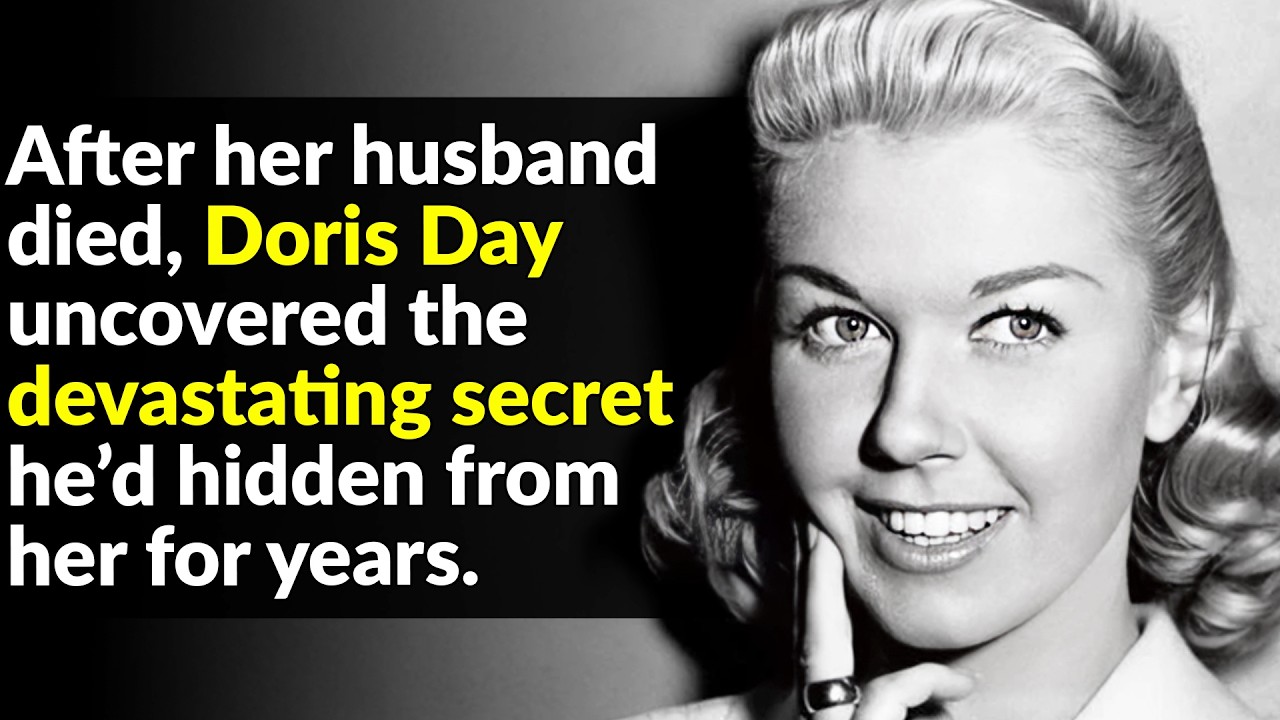
The wholesome image of America’s sweetheart Doris Day shattered in the wake of her husband’s death, revealing a betrayal so profound it left her destitute and questioning everything she thought she knew about her life. When Martin Melcher died suddenly on April 20, 1968, Day expected to inherit a fortune estimated at $23 million. Instead, she discovered a ruinous secret: Melcher and his business partner, Jerome Rosenthal, had squandered every penny, leaving her with a staggering $400,000 in debt.
The woman who had charmed the nation for decades was now facing financial ruin, forced to confront the devastating truth that the man she trusted most had been hiding a catastrophic deception.
 For Day, the discovery was not just a financial blow but a profound personal betrayal. Melcher had been her husband and manager since 1951, carefully curating her image as the all-American girl next door while secretly mismanaging her earnings. He had turned down lucrative roles, including the iconic part of Mrs.
Robinson in The Graduate, fearing they would tarnish her wholesome reputation. Yet behind the scenes, he was systematically dismantling her financial security. The betrayal cut deeper than money, as Day realized that Melcher had also signed her to star in a television series without her knowledge or consent, a commitment she felt trapped into honoring.
“It was awful,” Day later recalled of the moment she learned of the secret contract. “I was really, really not very well when Marty passed away, and the thought of going into TV was overpowering. But he’d signed me up for a series.”
With no way out and creditors closing in, Day had no choice but to carry on. The Doris Day Show premiered on September 24, 1968, just months after Melcher’s death, and ran for five seasons. The series, which featured a re-recorded version of her signature song “Que Sera, Sera,” became her lifeline, helping her climb out of debt and pay mounting legal bills.
Day’s ordeal did not end with the television show. Determined to reclaim what was rightfully hers, she sued Jerome Rosenthal for fraud and malpractice. The legal battle stretched on for years, but in 1974, a jury awarded her a jaw-dropping $22.
8 million judgment. The case dragged on until 1979, when Day ultimately settled with insurers for about $6 million. It was not the full amount, but it was a hard-earned victory that allowed her to begin rebuilding her life.
The fight, however, took an emotional toll, forcing her to relive the betrayal and confront the painful reality of her marriage.
 The financial devastation was only one chapter in a life marked by heartbreak and resilience. Day’s journey to stardom began with a tragic accident that shattered her dreams of a dance career. On October 13, 1937, while heading to her going away party in Hamilton, Ohio, the car she was in collided with a freight train around midnight.
The crash broke her right leg and left her bedridden for four months, with a cast that required over a year to fully heal. During her recovery, she lost her beloved dog, Tiny, to a car accident, sparking her lifelong passion for animal advocacy. But in her darkest moments, she discovered her true purpose: singing along to the radio, inspired by the voice of Ella Fitzgerald.
Her mother, Alma, recognized her daughter’s talent and arranged for singing lessons with Grace Rain at WLW radio. After just three lessons, Rain declared that Day had tremendous potential, giving her three weekly lessons for the price of one. Within a year, Day landed her first professional gigs, performing on WLW’s Carlin’s Carnival and later at Charlie Yee’s Shanghai Inn.
Her voice soon caught the attention of bandleader Barney Rapp, who had already auditioned about 200 singers for a female vocalist spot. Rapp was so impressed that he offered her the job, but he insisted on changing her surname from Kappelhoff to Day, inspired by her rendition of “Day After Day.”
Day’s rise to fame was meteoric, but her personal life was fraught with turmoil. In March 1941, at just 19, she married trombonist Al Jordan, a man she had initially thought of as a creep. The troubled musician suffered from schizophrenia and subjected her to physical abuse, even during her pregnancy.
She shielded her pregnant belly and their infant son, Terry, from potentially fatal beatings. After years of suffering, she divorced Jordan in February 1943. Tragically, he later took his own life, with official records citing his low spirits following the public spectacle of their divorce.
 Her second marriage, to saxophonist George William Weidler in March 1946, also ended in heartbreak. Behind his cool exterior lurked resentment toward her son, her stardom, and his own wandering impulses. By 1949, the marriage imploded amid reports of infidelity and jealousy.
Despite the painful endings, Day remained focused on her career, which soared to unprecedented heights. Her rendition of “Sentimental Journey” with Les Brown’s band hit the top of the Billboard charts in early 1945, becoming an anthem for servicemen on the front lines of World War II. She followed up with a flurry of hits, including “My Dreams Are Getting Better All the Time” and “You Won’t Be Satisfied Until You Break My Heart.”
Day’s transition to film was seamless. After wowing powerhouse songwriters Jule Styne and Sammy Cahn with her rendition of “Embraceable You,” she was offered a role in Romance on the High Seas. Director Michael Curtiz saw past her nervous confession that she had no acting experience, noting that her freckles made her look like the all-American girl.
The film not only marked her screen debut but also produced the hit “It’s Magic,” which soared to the second spot on the charts and earned an Academy Award nomination for Best Original Song. From 1948 to 1951, Day was unstoppable, racking up 15 songs on Billboard’s Hot 30 list.
Her third marriage, to film producer Martin Melcher on her 29th birthday in 1951, initially seemed like a fairy tale. Melcher embraced both her career and her son, formally adopting Terry, who later went by Terry Melcher. For the first time, Day’s personal and professional lives seemed in harmony.
But the harmony was an illusion, as Melcher’s secret mismanagement of her finances would later reveal. Despite the betrayal, Day’s career continued to flourish. She starred in Calamity Jane in 1953, a role she called her personal favorite, and her rendition of “Secret Love” won the Academy Award for Best Original Song.
 In 1955, Day shocked critics by stepping out of her sunny persona to play real-life torch singer Ruth Etting in Love Me or Leave Me. Sharing the screen with James Cagney, she delivered a raw, riveting performance that critics hailed as her best work. Cagney praised her ability to project simple, direct statements without cluttering them, comparing her work to Lorette Taylor’s legendary performance in The Glass Menagerie.
She then teamed up with Alfred Hitchcock for The Man Who Knew Too Much in 1956, which featured the iconic song “Que Sera, Sera,” which won the Oscar for Best Original Song and became her lifelong calling card.
Throughout her career, Day’s maternal instincts may have saved her son’s life. After hearing of Charles Manson’s dangerous antics, she urged Terry to move out of the infamous Cielo Drive home in early 1969. Seven months later, the house became the scene of the horrific Tate slayings.
Her warning spared him a grisly fate, but she received little thanks for her vigilance. Day’s compassion extended beyond her family, as she co-founded the Doris Day Animal League in 1978, later merging with the Humane Society to fight for spaying, neutering, and ending cruelty. She was awarded the Presidential Medal of Freedom by President George W.
Bush in 2004.
Day’s legacy is one of resilience in the face of unimaginable betrayal. She earned the Grammy Lifetime Achievement Award in 2008, the Cecil B. DeMille Award at the 1989 Golden Globes, and two stars on the Hollywood Walk of Fame.
More than 600 songs, nearly 40 movies, and countless hearts later, she had done it all. On May 13, 2019, she passed away at her Carmel Valley home after a short battle with pneumonia. At 97, the legendary all-American entertainer left the world with a simple farewell: “Que Sera, Sera.”
Her story, marked by heartbreak and triumph, serves as a powerful reminder that even the brightest stars can hide the darkest secrets.