The world woke on February 29th, 2012, to the stunning news that Davy Jones, the eternally youthful frontman of The Monkees, had died of a heart attack at his Florida ranch. He was just 66 years old, and days earlier, he had been performing on stage with the boundless energy that defined his career. Yet, the smile that launched a million teenage crushes concealed a life riddled with hidden marriages, draft evasion, and a bitter struggle for creative and financial control that followed him to the very end.
The public mourning was immediate and immense, but for those who looked closer, the narrative was far more complex than a simple tragedy. Jones’s death marked the end of an era, but it also forced a re-examination of the secrets and struggles that underpinned his pop perfection. The man who seemed untouched by time had, in fact, been battling the very systems that made him famous, and the revelations painted a portrait of a star who was often a pawn in a game he barely understood.
 Born David Thomas Jones on December 30th, 1945, in Openshaw, Manchester, his early life was marked by profound loss. His mother, who suffered from emphysema, died when he was just 14, a tragedy that sent the young actor, who had already appeared in Coronation Street, veering away from the spotlight. Seeking escape, he became obsessed with horses and dreamed of being a jockey, enrolling at the Newmarket stables and dropping out of school to pursue the track.
Fate, however, intervened in the form of his trainer, Basil Foster, who recommended Jones to a casting director. This connection led him back to the stage as the Artful Dodger in Oliver, a role that catapulted him from the stables to the West End and Broadway, earning him a Tony nomination. The horse racing dream was over, but the discipline and love for animals he cultivated there would remain a lifelong anchor, a stark contrast to the manufactured chaos of his later pop career.
The pivotal moment of his professional life came while watching The Beatles from the side of the stage during their explosive US debut on The Ed Sullivan Show. Witnessing the hysteria of thousands of screaming girls, Jones reportedly told himself, “I want a piece of that.” It was a desire that would be fulfilled, but the path to achieving it was paved with the very anonymity and lack of control that would later haunt him.
Screen Gems executive Ward Sylvester took notice of the charismatic young Brit, leading to roles in American television shows. But Jones knew acting alone wouldn’t generate Beatlemania-level frenzy. He needed a band.
After a modest solo single, he was cast in 1966 as a member of The Monkees, a made-for-television group that became a global phenomenon. Yet, the irony was that he nearly missed the part, having to audition like everyone else for a role that would define his life.
From the outset, the internal dynamics were fraught with tension. Songwriter Snuff Garrett’s decision to use Jones as the lead vocalist on early recordings sparked immediate resentment within the group. While Peter Tork argued Jones was a better drummer than frontman, the producers kept him at the center of the stage, fearing his smaller stature would hide him behind a kit.
This decision, made for purely visual reasons, set the stage for a career where his image was always prioritized over his musical instincts.
The original pilot for the show bombed, casting doubt on Jones’s ability to lead. It was only a reworked version, using his original screen test, that turned The Monkees into a television sensation. However, the financial rewards were shockingly meager.
 Jones and his bandmates were paid a pittance per episode, and they earned nothing from the massive merchandising empire their likenesses generated. This financial injustice would become a festering wound for Jones, leading to a later lawsuit that yielded a paltry settlement.
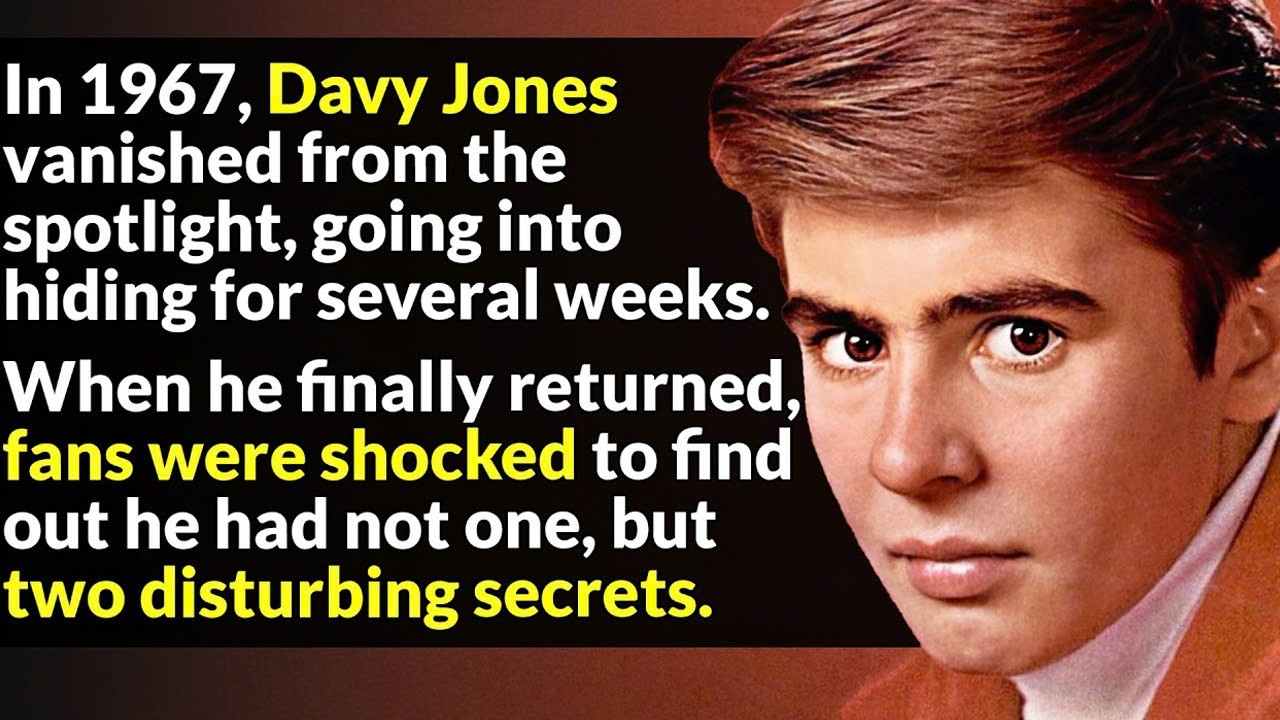
At the height of Monkeemania, at the end of the first season, Jones vanished from the public eye, sending fans into a panic. The truth was a desperate attempt to dodge the US draft. He reportedly fasted for nearly three weeks to fail his physical, a risky move that forced producers to rush production on the second season.
While this story is widely accepted, another version suggests he was also hiding the fact that he was the sole provider for a secret family.
In December 1967, at the peak of his heartthrob status, Jones secretly married his first wife, Dixie Linda Haynes. The marriage was concealed until the birth of their daughter Talia in 1968, a revelation that stunned fans who saw him as available. The backlash was significant, and Jones defended his decision, insisting that stars deserved a private life.
The pressure of maintaining this facade, however, took a heavy toll, and the marriage ended in 1975.
The cultural impact of his image was undeniable, influencing everything from David Bowie’s name change to the casting of Walter Koenig as Chekov on Star Trek, who was chosen to echo Jones’s look to lure younger viewers. But the peak of fame was unsustainable. After the TV series ended in 1968, the band’s foray into the surreal film “Head” created more friction than success.
Jones and his bandmates staged a walkout to protest their lack of creative control, permanently damaging their relationship with their creators.
 The official breakup came in 1970, leaving Jones and Micky Dolenz to record one final album, “Changes,” which Jones later claimed they were tricked into recording. His subsequent solo career with Bell Records was a disaster, stripping him of any creative freedom and resulting in bland releases. Despite a minor hit with “Rainy Jane,” he drifted, with music historian Glenn A.
Baker noting that Jones fell into a “directionless heap” when left to his own devices.
It was the stage that saved him. A 1977 London production of “The Point” with Dolenz reignited his passion, and the 1986 MTV marathon of The Monkees brought the band roaring back into the public consciousness. The reunion tours were lucrative and successful, but Jones was conflicted, reluctant to surrender his private life to the machine again.
He even declined to appear on the reunion single, signaling his deep ambivalence about the very thing that had made him a star.
Throughout his life, Jones sought refuge in his first love: horses. He held an amateur jockey’s license and won his first professional race in 1996. This passion provided a sense of authenticity and peace that the manufactured world of pop music could not.
His personal life remained turbulent, with a second marriage to Anita Pollinger ending during the 30th-anniversary tour, and a third marriage to Jessica Pacheco marked by a brief divorce filing just a year before his death.
On the morning of his death, Jones was at his ranch, doing what he loved most: caring for his 14 horses. He had ridden one of his favorites around the track and chatted with staff before complaining of chest pain. Initially given antacids, his condition deteriorated rapidly, and he was found unconscious in his car.
 Despite emergency efforts, he was pronounced dead at Martin Memorial South Hospital from a heart attack caused by arteriosclerosis.
The aftermath of his death was as complicated as his life. His final will, drafted before his last marriage, did not include his wife, and his eldest daughter petitioned to have it sealed to protect the estate. The surviving Monkees did not attend his private funeral to avoid media attention, instead paying tribute at separate memorials.
His ashes were eventually placed on his parents’ graves, a final return to his roots.
The tributes poured in from around the world, painting a picture of a man who was both a beloved icon and a deeply conflicted individual. Michael Nesmith stated, “For me, David was The Monkees,” while Micky Dolenz called him “the brother I never had.” Co-creator Bob Rafelson said Jones had “lived about seven lifetimes,” acknowledging the immense pressure and experience of his career.
The public outpouring of grief was a testament to his enduring appeal, with sales of Monkees music spiking dramatically. Yahoo Music noted that Monkees nostalgia spans generations, a rare feat for a band from the 1960s. Media theorist Paul Levinson summed up his legacy, calling The Monkees the first major example of a band created for television that leapt off the screen and reshaped the real world.
In the final analysis, Davy Jones was a man caught between two worlds: the authentic one he built with horses and family, and the manufactured one of pop stardom. He was a talented performer who was often denied the creative agency he craved, a heartthrob who hid his personal life to maintain an illusion, and a star who fought against the very industry that made him famous. His legacy is not just the music, but the cautionary tale of what it means to be a product of a system that values image over substance.
The secrets he kept, from the draft evasion to the hidden marriage, were not just salacious gossip; they were the coping mechanisms of a young man trying to navigate a world that demanded he be a perpetual teenager. The “disturbing secrets” that followed him to the end were less about scandal and more about the profound disconnect between the public persona and the private man. He was a singer who didn’t always control his songs, a leader who didn’t control his band, and an icon who didn’t control his own life.
As the years pass since that February morning, the complexity of Davy Jones’s story remains a vital part of his legacy. He was a pioneer of manufactured pop, a victim of its excesses, and a survivor who found his own peace in the quiet dignity of a horse stable. The smile that defined a generation was real, but it was also a shield, protecting a man who was, in many ways, as much a creation of the machine as the music he performed.
His death was not just the loss of a star, but the closing of a chapter on a unique and often painful era of pop culture history.