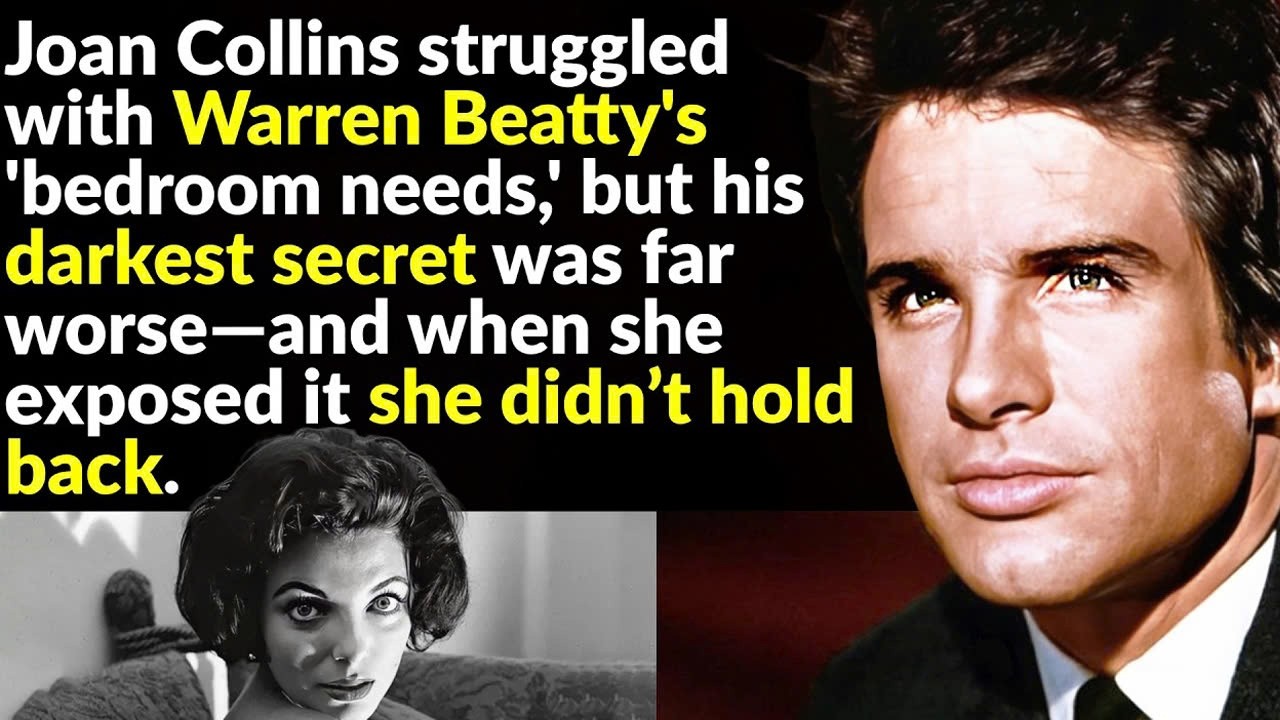
The legend of Warren Beatty, the insatiable Hollywood lothario who allegedly romanced 13,000 women, has long been a punchline in Tinseltown’s collective memory. But a deeper examination of his rise to stardom reveals a narrative far more unsettling than the playful rumors suggest, one defined by calculated manipulation, emotional devastation, and a pattern of behavior that left a trail of broken marriages and psychological wreckage in its wake.
When Joan Collins finally broke her silence decades after their explosive affair, her words were not those of a woman reminiscing about a glamorous romance. She was exposing a truth she had buried for years, a reality that had little to do with sex and everything to do with raw power and the ruthless machinery of a man determined to conquer both the screen and the people around him. The revelation forces a re-evaluation of the charming facade that protected Beatty for so long.
 The story begins far from the red carpets of Hollywood, in the modest household of two Virginia school teachers. Warren Beatty and his sister, Shirley MacLaine, grew up in an environment devoid of industry connections, where fame was a distant fantasy. It was Shirley who exhibited the natural flair for performance, while young Warren was quiet, introspective, and seemingly content to observe the world from the sidelines.
But Beatty was not content to live in his sister’s shadow. As he matured, the bookish child transformed into a standout high school football player, driven by a desperate need to escape the confines of his Virginia upbringing. While college football scholarships offered a respectable path out of town, he chose uncertainty, enrolling at Northwestern University with the vague hope that it might lead him toward acting, only to find himself feeling boxed in and profoundly disappointed.
Watching Shirley’s rapid ascent from Broadway to Hollywood sharpened his resolve but also intensified the pressure he felt to succeed. When he announced his intention to drop out of college, his parents were alarmed, yet they understood that resistance would only strengthen his determination. Shirley had already broken through the barriers he was still struggling against, and Beatty knew he was running dangerously late in a race he was determined to win.
Fueled by a potent mix of rivalry and stubbornness, he moved to New York and began studying under the legendary acting coach Stella Adler. He was just one of many ambitious young men hoping to follow in the footsteps of her famous students, but Beatty stood out quickly. On the surface, he appeared laser-focused on his craft, but privately, another side of his personality was forming, one that would come to define his public persona for decades.
Despite the playboy image that would later define him, Beatty described himself as a late bloomer, obsessed with sex from a young age but not losing his virginity until he was 20. Once that barrier was broken, he would spend years making up for lost time with a relentless appetite that shocked even his Hollywood peers. His early career moved quickly, turning small television roles into a supporting part on Broadway that earned him a Tony nomination.
At just 22, he was suddenly closing the gap with his famous sister, and Hollywood came calling with fierce competition among studios to sign him. But his first serious misstep came when he signed with MGM, was handed a dreadful script, and panicked. To escape the contract, Beatty had to borrow money just to buy his freedom, a painful lesson that was only the first of many waiting for him in an industry that would both worship and be wounded by him.
Warren Beatty was laser-focused on breaking into movies, willing to outmaneuver anything that threatened that goal, including the looming shadow of the Vietnam War. Long before the draft became unavoidable, he made a calculated move, joining the California Air National Guard in February 1960. A year later, he received a dishonorable discharge, which quietly made him ineligible for military service, ensuring no interruptions on his clear path toward Hollywood stardom.
At the same time, his personal life was heating up just as fast as his ambitions. After spotting Joan Collins at a string of Hollywood parties, Beatty finally asked her out. She was older, more established, and instantly drawn to him.
The chemistry was explosive, but it didn’t take long for Collins to realize she was outmatched. Beatty’s sexual appetite was relentless, even by Hollywood standards, leaving her exhausted and bewildered.
She confided in her friend Joanne Woodward, who offered blunt advice: if she wanted to keep a 22-year-old like Beatty, she’d better keep up. Collins tried, but the strain showed. Then came Beatty’s big break, his casting in his first film, Splendor in the Grass, opposite Natalie Wood.
On paper, they were an odd pairing. Beatty was still technically involved with Collins and already developing a reputation for wandering, while Wood was newly married to Robert Wagner.
He was untested in film while she had already made over 30 movies. Director Elia Kazan understood the stakes and pushed them mercilessly, demanding raw emotion and repeated intimate scenes. As Beatty and Wood were driven closer and closer on screen, their real-life partners watched from the sidelines with growing unease.
Tension mounted quickly, and Collins cracked first, fleeing to Italy, leaving Wood’s husband, Robert Wagner, to deal with the fallout.
Wagner didn’t exactly keep things under control. Soon, gossip columnists were buzzing about Beatty and Wood rehearsing far too intensely and far too privately. When the rumors reached Collins, she panicked, rushing back from Europe for just two days to confront Beatty.
What followed was classic Hollywood chaos, a fight followed by a dramatic reconciliation taken to an extreme. Beatty proposed, ring in hand, and Collins returned to Europe believing she had shut the door on the affair.
Whether she truly had remains an open question. The film was completed, careers were launched, and everyone moved on, but with Warren Beatty, stories like this rarely end cleanly. His next film paired him with screen icon Vivien Leigh, decades older than Natalie Wood, but the similarity wasn’t age, it was fragility.
When Beatty crossed paths with them, both women were struggling, exposed, and emotionally worn down, making them vulnerable targets.
Almost immediately, the familiar pattern resurfaced. The tabloids jumped at the idea of an affair between Beatty and Leigh, and the rumor mill went into overdrive. In reality, that noise worked as perfect cover.
Beatty was secretly involved with Susan Strasberg, but even she wasn’t the person occupying his thoughts. Natalie Wood, meanwhile, had hit a breaking point while filming West Side Story, with her anxiety about her career spiraling out of control.
Then the phone rang. It was Beatty. He hadn’t let her go.
 Soon, they were showing up together at Hollywood parties, this time with Wood’s husband, Robert Wagner, growing visibly impatient with their so-called friendship. Things finally exploded when Wagner hosted a wrap party for one of his films. Wood arrived late with Beatty, then vanished with him for a stretch of the evening, leading to an excruciating dinner that included Joan Collins.
By the next morning, Wood and Wagner’s publicists issued a bombshell announcement: the marriage was over. No explanation was offered, and none was needed. Almost in sync, Collins threw Beatty out of the apartment they shared.
He flew to England to see her, and they made one last attempt to salvage the relationship, but it failed. When another young actor caught Collins’ attention, she ended things for good, though the real reasons ran deeper than mere jealousy.
Beatty returned to Los Angeles and didn’t hesitate. He moved straight into Natalie Wood’s rented Bel Air mansion, all of this unfolding before Splendor in the Grass had even been released. What should have been a victory lap turned into a nightmare.
Beatty and Wood were sent on a relentless press tour, and every interview circled back to their relationship. Beatty loathed it, hating attention and bristling at personal questions, coming off as stiff and evasive.
The one bright spot was the film’s success. While Wood earned an Oscar nomination and he didn’t, Beatty did walk away with a Golden Globe for most promising newcomer. Two more films were released riding that momentum, but instead of a surge, his career began to stall.
Neither film landed the way he hoped, and Beatty froze, stopping his commitment to scripts altogether and rejecting role after role, even when they suited him perfectly.
One columnist claimed he had passed on 75 scripts and roughly $2 million in pay. Ironically, his attempt to regain control did the opposite. With no new work to discuss, the press abandoned his talent and zeroed in once again on his personal life, especially Natalie Wood.
Beatty didn’t help matters. The two had been living together for months, playing host to glamorous Hollywood gatherings, when one night, while out with friends, Beatty simply vanished.
Because Warren Beatty never explains himself, his story has always been pieced together by the people he left behind. No one knows where he went during the week he vanished, only that when he finally reappeared on Natalie Wood’s doorstep after days of silence, she’d had enough. That disappearance ended everything.
Wood moved on quickly, taking up with another man and closing the door on Beatty for good, a pattern that would repeat itself throughout his life.
Later that year, the Oscars delivered a cruel twist. Wood was nominated for Best Actress and arrived with her new partner, expecting a celebratory night. Instead, she found herself competing against Beatty’s sister, Shirley MacLaine, and young actress Leslie Caron.
When Caron entered the room, Wood froze. On Caron’s arm was Beatty. The shock rippled outward, as Caron was still married, but that hadn’t stopped Beatty before, and it didn’t stop him now.
The new affair coincided with Beatty finally accepting another film role, Lilith, which turned out to be a disaster. When the film failed, Beatty claimed he’d only taken the part because he needed the money, but few believed him. Those close to him knew he’d been invested in the project, and its failure hit him hard.
Meanwhile, Caron’s marriage collapsed, and her husband didn’t take the humiliation quietly, naming Beatty as a co-respondent in the divorce.
A judge ordered Beatty to cover the court costs, and for once, his behavior had real consequences. Beatty’s response was pure improvisation. He agreed to make another film with Caron, partly to keep working and partly to pay the bills.
But when the chaos finally settled, Caron began to see Beatty differently. One memory stayed with her, a night when he woke her up, anxious that she might not be thinking about him, a need for constant validation bordering on narcissism.
They stayed together for two years, with Beatty proposing more than once, but the emotional intensity wore her down, and they eventually split. Before they did, Caron introduced him to someone who would change everything, François Truffaut. Truffaut told Beatty he didn’t have a role for him, but he did have a script worth reading.
It was the story of two infamous outlaws, and Beatty was instantly hooked, finding a new purpose for his stalled career.
 At a moment when his career felt directionless, Caron urged him not just to star in a film about Bonnie and Clyde, but to produce it himself. The challenge snapped him awake. Beatty had always thrived when everything seemed stacked against him, and once again, the odds were terrible.
By the mid-1960s, he was ready to push Hollywood forward, but the studios weren’t ready to follow. He believed in a new kind of filmmaking that would later be called New Hollywood.
Determined, Beatty took his risky project straight to one of the ultimate gatekeepers of the old system, Jack Warner. What followed became legendary. Beatty agreed to a shoestring budget and went so far as to humiliate himself in front of Warner, nearly kneeling at his feet before the studio boss told him to stop.
That moment changed everything. At just 29, Beatty wasn’t only starring in the film, he became its producer and an uncredited screenwriter as well.
For the first time, he had real control, and it gave him the professional satisfaction he’d been chasing since his earliest days. It even brought an unusual sense of discipline. He and his co-star Faye Dunaway made a pact not to get romantically involved during production, and remarkably for Beatty, he stuck to it.
That restraint didn’t mean the casting process was free of complications, as he initially explored actresses he already had personal history with.
Natalie Wood was briefly considered, and another unexpected name was Cher. At the time, she was married to Sonny Bono, who strongly objected to her appearing in what he viewed as an overly graphic film. Beatty and Cher already knew each other from a brief earlier relationship, one that would later raise uncomfortable questions in hindsight.
Despite resistance from Warner himself, who disliked the project and tried to bury it, Bonnie and Clyde slowly caught fire.
Early reactions were mixed, even hostile, but momentum built. Audiences and critics eventually recognized it as something bold and different. The film became a defining success, and Beatty emerged as a creative force, not just a movie star.
With that victory behind him, Beatty relaxed and returned to old habits. He had always been drawn to acclaimed women, and now, as a successful producer, he aimed even higher, meeting Julie Christie.
The attraction was immediate and mutual. They were well-matched, independent, stubborn, and outspoken. Their relationship lasted longer than most of Beatty’s romances, partly because they quietly accepted an open arrangement, which reduced the tension that had doomed his previous relationships.
Still, even with new boundaries, Beatty couldn’t fully separate work from desire, and on the set of his next film, status offered little protection from his patterns.
After Bonnie and Clyde, Beatty landed a lucrative deal to star opposite Elizabeth Taylor in The Only Game in Town. But the atmosphere on set was tense. Taylor’s husband, Richard Burton, was a constant presence, hovering near the camera and firing off sharp remarks the moment a love scene ended.
Everyone endured it, but the timing couldn’t have been worse. Taylor’s star power was fading, and so was the kind of glossy studio film they’d just made.
Beatty regrouped in London with Julie Christie and their close-knit circle, trying to put the disappointment behind him. Then everything shattered. Two of their closest friends, director Roman Polanski and his wife Sharon Tate, were struck by unimaginable tragedy.
When Tate was murdered, Beatty rushed to Polanski’s side, helping him return to Los Angeles and surrounding him with friends so he wouldn’t face his grief alone, though he later cut ties when Polanski’s own legal nightmare unfolded.
Another quiet stretch followed, but this time it wasn’t paralysis, it was incubation. Beatty began shaping two projects that would eventually define his legacy, Shampoo and Reds. For Shampoo, he cast Julie Christie, and audiences adored their chemistry on screen, but off screen, it was fading.
Christie had always preferred committed relationships and a quieter life, while Beatty thrived on chaos and attention. Eventually, they broke up, but not cleanly.
On screen, he played a womanizing hairdresser juggling multiple girlfriends, among them characters played by Christie and Goldie Hawn, both women he’d dated in real life. The parallels were impossible to ignore. By the late 60s and 70s, Warren Beatty, Dennis Hopper, and Jack Nicholson were the new Hollywood elite and close friends, all three involved at different times with Michelle Phillips.
 Beatty came last, even living with her in the first house he ever bought.
But once the press closed in, he pulled away, even uninviting her from the London premiere of Shampoo. He promised marriage and children, but after the breakup, Phillips later said it took her two years of therapy to accept those promises meant nothing. Beatty rebounded fast.
In 1972, Carly Simon released You’re So Vain, and speculation exploded. Beatty was long suspected, and in 2015, Simon confirmed he inspired the second verse.
Next came Diane Keaton, fresh out of her relationship with Woody Allen. She later starred with Beatty in Reds, his most ambitious project. The film won three Oscars, including Beatty’s only directing win, though his perfectionism was infamous.
He demanded endless takes and lectured cast and crew on politics. Ironically, Spanish extras walked off the set until he agreed to raise their pay, a fitting metaphor for his contradictory nature.
After that came a final flurry of high-profile romances: Stephanie Seymour, Janice Dickinson, Mary Tyler Moore, Daryl Hannah, and a brief explosive affair with Madonna on Dick Tracy. It looked like one last run at bachelorhood until Beatty met Annette Bening during auditions for Bugsy. After watching her read, he told Barry Levinson, I’m going to marry her.
For once, he meant it, and despite doubts over his past, Bening took the risk.
In 1992, after decades of affairs and headline-making excess, Warren Beatty surprised nearly everyone by marrying Annette Bening. Even more surprising was what followed. Beatty stepped back from the spotlight, focused on family life, and became an attentive husband and father.
The couple had four children, and despite public scrutiny and private challenges, their marriage has endured, marking a stark contrast to his earlier years of chaos.
One of those challenges came when their eldest child, Stephen Ira Beatty, who was assigned female at birth, came out as transgender in 2006. Beatty has spoken publicly with pride and admiration, calling Stephen a revolutionary, a genius, and my hero. Words that marked a very different chapter from the man once defined by scandal, suggesting that fatherhood finally provided the anchor that fame and fortune never could.
Beatty briefly returned to the global spotlight in 2017 in one of the most infamous Oscar moments ever. Alongside his Bonnie and Clyde co-star Faye Dunaway, he presented Best Picture, only to be handed the wrong envelope. Dunaway announced La La Land instead of Moonlight, forcing a live on-air correction.
Beatty tried to explain the mix-up, but the damage was done, and a year later, the Academy invited them back for a symbolic redo.
Yet even late in life, Beatty’s past continued to resurface. Carrie Fisher later revealed that while working with Beatty on Shampoo, when she was just 17, he made an unwanted advance. She turned him down, placing her among the very few women who ever did.
An even darker story traces back to Bonnie and Clyde, when Beatty once approached Natalie Wood about starring in the film, and she broke down in tears.
According to accounts, she said she couldn’t bear the idea of working with him. Later that night, she attempted suicide and then withdrew from acting for three years. It was the last time they ever spoke before her death.
Adding to the tension, Beatty later became involved with Wood’s sister, Lana Wood, a relationship often labeled betrayal, though the circumstances were complicated, as she had fled an abusive situation with no money.
Beatty helped her escape, paid for her hotel stay, and made sure she and her baby were safe. A relationship followed, but the beginning was rooted in crisis rather than desire. Some of the most unsettling revelations go even further back.
In her memoir, Joan Collins disclosed that she had once been pregnant with Beatty’s child. Fearing scandal and the end of her career, she chose to have an abortion, a decision that haunted her for decades.
And then there is Marilyn Monroe. Beatty was 25 when he met her at a producer’s home shortly before her death. In a later interview, he recalled spending the evening together, talking, walking, and playing piano, describing it as intimate but not sexual.
Monroe died the next day, leaving Beatty with a memory that would forever be shrouded in the tragedy of her final hours and the mystery of what truly transpired.
By the time Beatty finally settled into family life, the scandals were already part of Hollywood legend. What remains is a life split cleanly in two, one half defined by excess and emotional fallout, the other by stability, loyalty, and long-delayed restraint. The question that lingers is not how many women he seduced, but how many lives he damaged in the relentless pursuit of his own legend, and whether the man who finally found peace was ever truly redeemed.